Which Bird Migrates the Farthest?
Which bird migrates the farthest? The Arctic Tern, at roughly 44,000 miles a year. The Bar-tailed Godwit holds the nonstop record. Meet the champions and how.
In this article
- Quick facts: migration record holders
- Why is “farthest” hard to define?
- Why is the Arctic Tern the migration champion?
- Which bird flies the longest distance without stopping?
- What about the Sooty Shearwater?
- Which songbird migrates the farthest?
- Which bird migrates the farthest for its size?
- Which bird spends the most time flying?
- What other birds make extreme journeys?
- How do scientists track migration records?
- Myths and facts about the longest migrations
- Why do these long-distance migrants matter to backyard birders?
- The bottom line
- Sources
- Frequently asked questions
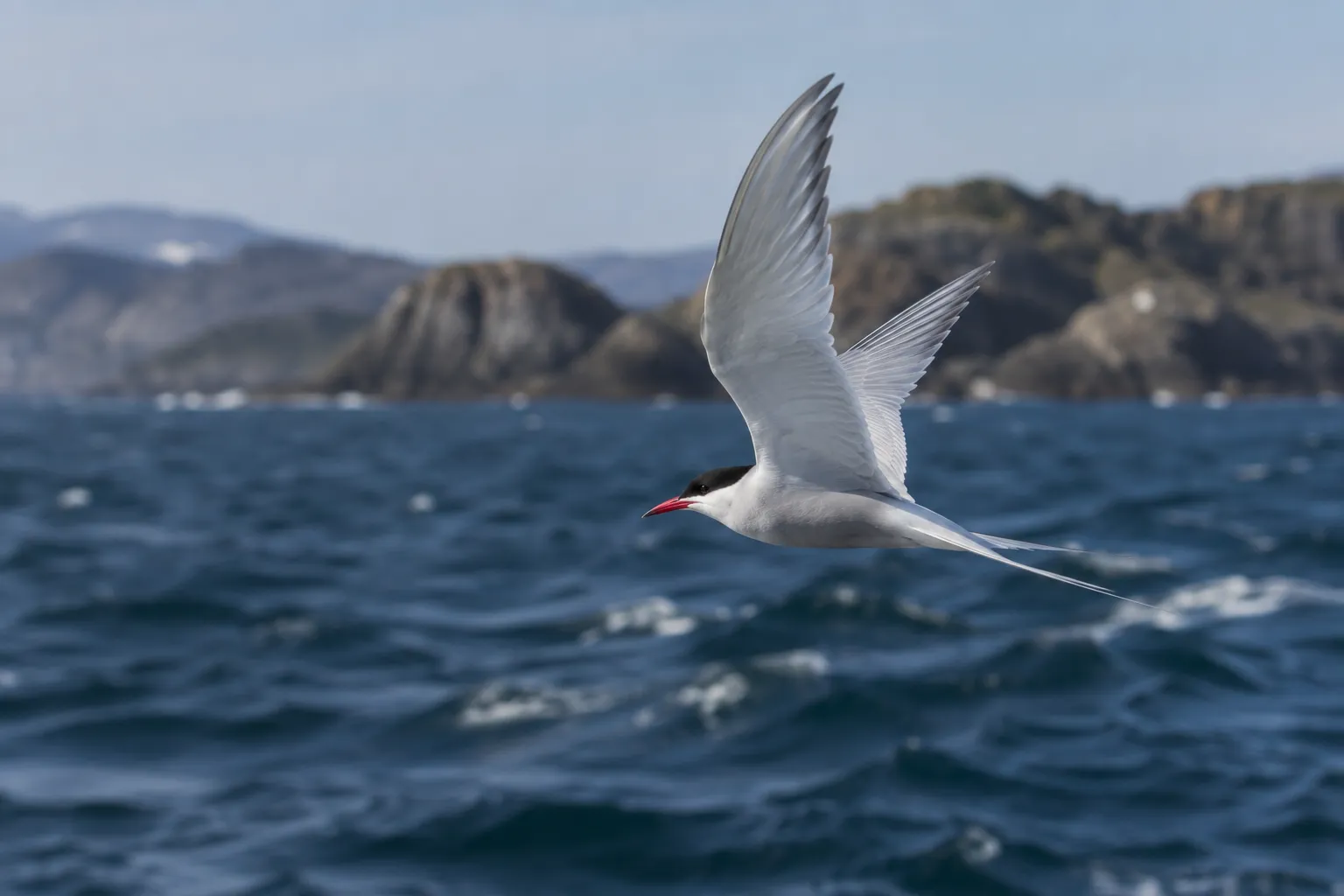
Which bird migrates the farthest? The Arctic Tern, farther than any other known bird. Tracking studies have found that Arctic Terns travel roughly 44,000 miles (about 71,000 km) a year on average, flying from breeding grounds in the Arctic to the edge of Antarctica and back, and some populations cover even more. But “farthest” depends on how you measure it: the Bar-tailed Godwit holds the record for the longest nonstop flight, and some tiny songbirds and hummingbirds make the longest journeys relative to their size.
This guide looks at each record, how scientists measured it, and how these birds pull off journeys that seemed impossible a few decades ago. For the broader picture of typical distances, see our guide to how far birds migrate.
Quick facts: migration record holders
- Longest annual migration: Arctic Tern, about 44,000 miles on average in one major study, up to about 56,000 miles in another.
- Longest nonstop flight: Bar-tailed Godwit, about 8,400 miles from Alaska to Tasmania in roughly 11 days.
- Long-distance seabird contender: Sooty Shearwater, about 40,000 miles a year in a figure-eight loop around the Pacific.
- Long-distance songbird: Northern Wheatear, roughly 9,000 miles each way between Alaska and East Africa.
- Longest relative to size: Rufous Hummingbird is often cited.
- Longest time airborne: Common Swift, with some individuals flying for about 10 months without landing.
Why is “farthest” hard to define?
There are at least four reasonable ways to rank migration, and each produces a different winner.
| Measure | Record holder | Approximate figure |
|---|---|---|
| Total distance in a year | Arctic Tern | 44,000 to 56,000 miles |
| Single nonstop flight | Bar-tailed Godwit | About 8,400 miles |
| Distance relative to body size | Rufous Hummingbird (often cited) | Several thousand miles for a bird about 3 to 3.5 inches long |
| Continuous time in the air | Common Swift | About 10 months |
| Songbird distance | Northern Wheatear | About 9,000 miles each way |
Records also depend on which birds have been tracked. Tracking devices have only become small enough for many species in the past two decades, and every new study has the potential to change the rankings.
Why is the Arctic Tern the migration champion?
Where does the Arctic Tern migrate?
The Arctic Tern breeds across the Arctic and sub-Arctic of North America, Europe and Asia, including Alaska, Canada, Greenland, Iceland, Scandinavia, the British Isles and northern Russia. After nesting, it heads south to spend the northern winter in the Southern Ocean around Antarctica, then returns north the following spring.
That round trip makes it the only bird known to regularly see two polar summers each year, and it probably experiences more daylight annually than any other animal.
How far does the Arctic Tern really fly?
For a long time, estimates were based on the straight-line distance between breeding and wintering areas, which suggested about 25,000 miles a year. When researchers could finally attach tiny geolocators to terns, the real figure turned out to be much higher.
A landmark study published in the Proceedings of the National Academy of Sciences in 2010 tracked Arctic Terns from Greenland and Iceland. The birds averaged roughly 44,000 miles (about 71,000 km) over a year, with some individuals flying more. Rather than flying straight, they followed long S-shaped routes down the Atlantic, taking advantage of global wind patterns. Many also paused for weeks at a productive feeding area in the North Atlantic before continuing south.
A later study of Arctic Terns breeding in the Netherlands found annual journeys of around 56,000 miles (about 90,000 km). These birds took a different route, traveling down the coast of Africa, crossing the Indian Ocean and passing near Australia before reaching Antarctic waters.
How far does an Arctic Tern fly in its lifetime?
Arctic Terns can live a long time. Banding records show wild birds surviving more than 30 years. If a tern migrates tens of thousands of miles every year for decades, its lifetime total could exceed a million miles. The authors of the 2010 study estimated that a 30-year-old tern could travel roughly 1.5 million miles (about 2.4 million km), equivalent to about three round trips to the Moon. That figure is an estimate built on average yearly distances, not a measured lifetime track, but it gives a sense of scale.
How can a small seabird fly so far?
Several traits make it possible:
- It feeds as it goes. Arctic Terns catch small fish and crustaceans at the sea surface, so they can refuel along the route rather than fasting.
- It uses the wind. The S-shaped routes follow prevailing winds, which reduce energy costs.
- It is built for efficient flight. Long, narrow wings and a light body, around 3 to 4 ounces, make sustained flight cheaper.
- It rests on the water or on floating objects. Unlike godwits, terns can stop at sea without landing on land.
Which bird flies the longest distance without stopping?
The Bar-tailed Godwit
The Bar-tailed Godwit is a large, long-billed shorebird that breeds in Arctic tundra from Scandinavia to Alaska. Birds of the subspecies that breeds in western Alaska make an astonishing autumn flight: they depart the Alaska coast and fly directly across the Pacific Ocean to New Zealand and eastern Australia.
Godwits cannot swim or rest on water, and there is nowhere to land in most of that expanse. They must stay aloft the entire way.
- In 2007, a satellite-tagged female known as E7 was tracked flying about 7,200 miles nonstop from Alaska to New Zealand, then considered a record.
- In later years, tagged godwits flew even farther.
- In 2022, a juvenile godwit tagged in Alaska was tracked flying about 8,400 miles (roughly 13,500 km) to Tasmania in around 11 days, the longest nonstop flight recorded for any bird at the time.
How does a godwit fly for 11 days without eating?
Research on Bar-tailed Godwits has revealed a series of remarkable adaptations.
- Massive fat stores. Before departure, godwits feed intensely on Alaskan mudflats and may nearly double their body mass, with fat making up a large share of their weight.
- Shrinking internal organs. Studies found that their digestive organs, such as the gizzard and intestines, shrink before departure, reducing weight they do not need during a flight without food.
- Enlarged flight muscles and heart. At the same time, the organs needed for flying grow larger.
- Riding weather systems. Godwits tend to depart with strong tailwinds associated with storm systems, which can give them a big boost at the start of the journey.
- Continuous flight. They are thought to rest parts of the brain in flight, although how they manage sleep on such long flights is not yet well understood.
On arrival, they are thin and exhausted, and their digestive organs regrow as they begin feeding again.

What about the Sooty Shearwater?
The Sooty Shearwater is a dark, gull-sized seabird that nests in burrows on islands around New Zealand, southern South America and the Falklands. In a 2006 study, researchers tracked shearwaters from New Zealand and found that they followed a vast figure-eight route across the Pacific, traveling north to feeding areas off Japan, Alaska or California during the southern winter, then returning. The average distance was roughly 40,000 miles (about 64,000 km) in a year.
Like terns, shearwaters can feed and rest at sea, which is why seabirds dominate the list of longest annual migrations.
Which songbird migrates the farthest?
The Northern Wheatear
The Northern Wheatear is a small ground-dwelling bird related to Old World flycatchers, with a gray back, black mask and a distinctive white rump and black tail pattern. It breeds across a huge area of the Northern Hemisphere, from Alaska and northern Canada through Greenland, Europe and Asia. Remarkably, nearly all populations winter in sub-Saharan Africa.
That means wheatears breeding in Alaska do not fly to South America like most American songbirds. Instead, they cross Asia and the Arabian region to reach East Africa. A tracking study published in 2012 showed Alaskan birds covering roughly 9,000 miles (about 14,500 km) each way. Birds breeding in eastern Canada and Greenland take a different route across the North Atlantic to Europe and then West Africa, including long ocean crossings.
For a bird that weighs less than an ounce, that makes it one of the longest-distance migrants of any songbird. Its routes are thought to reflect the species’ history: it probably spread into the Americas from the Old World, and its migration still points back toward ancestral wintering grounds in Africa.
The Blackpoll Warbler
The Blackpoll Warbler is another small-bird champion. It breeds in boreal forests from Alaska to Newfoundland and winters in northern South America. In fall, many make a nonstop flight over the western Atlantic Ocean, from the northeastern United States and Atlantic Canada to the Caribbean and South America. A 2015 study using geolocators confirmed ocean flights of roughly 1,400 to 1,700 miles lasting two to three days. Before departure, these birds fatten up substantially, and the total annual migration for western breeders can exceed 10,000 miles.
Which bird migrates the farthest for its size?
Distance alone favors large, efficient flyers. Adjusting for body size changes the picture.
The Rufous Hummingbird is a small hummingbird, about 3 to 3.5 inches long, that breeds in western North America as far north as southern Alaska and winters mainly in Mexico. Its one-way trip can be several thousand miles, and its route often forms a loop: north along the Pacific coast in spring and south through the Rocky Mountains in late summer, following flowers that bloom at different times. When calculated in body lengths, the Rufous Hummingbird’s journey is often described as one of the longest migrations of any bird.
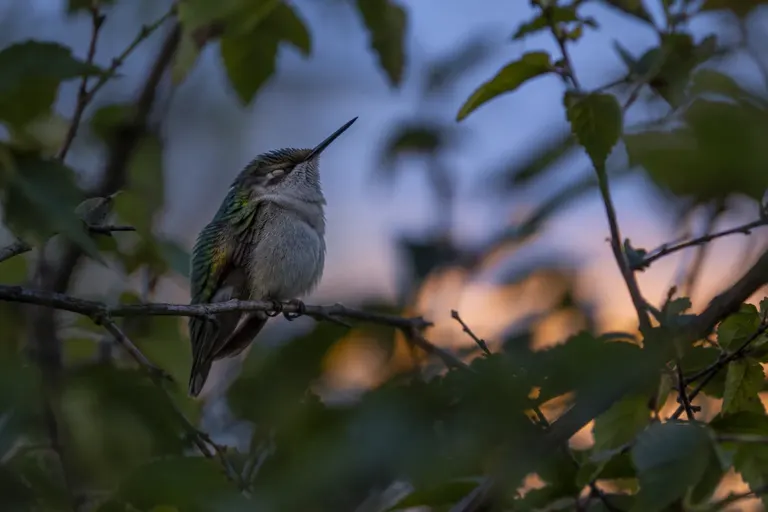
The Ruby-throated Hummingbird of the East is another impressive small migrant, with many individuals thought to cross the Gulf of Mexico nonstop, a flight of roughly 500 miles.

Which bird spends the most time flying?
The Common Swift breeds across Europe and Asia and winters in sub-Saharan Africa. It feeds entirely on flying insects and rarely lands except to nest. A 2016 study using data loggers found that some swifts remained airborne for about 10 months continuously after leaving the breeding grounds. Young swifts that do not breed may stay in the air even longer before they first nest. The swift’s migration distance is not a record, but its total time and distance aloft are extraordinary.
Albatrosses deserve mention too. Grey-headed Albatrosses tracked from South Georgia have been found to circle the Southern Ocean between breeding attempts, and some individuals completed a lap of the globe in weeks. These are wide-ranging foraging movements rather than classic north-south migration, which is why albatrosses are usually listed separately.
What other birds make extreme journeys?
Several other species regularly appear in discussions of record migrations, even if they do not top a category.
- Short-tailed Shearwater. This close relative of the Sooty Shearwater breeds in southeastern Australia, including Tasmania, and spends the southern winter in the North Pacific, making a huge loop around the ocean each year.
- Amur Falcon. This small falcon breeds in northeastern Asia and winters in southern Africa. Tracking has shown that many cross the Arabian Sea and western Indian Ocean in long flights on the way to Africa, one of the longest over-water crossings made by any raptor.
- Swainson’s Hawk. Breeding on the grasslands of western North America, it travels to Argentina for the northern winter, soaring overland in large flocks through Central America.
- Great Snipe. This wader, which breeds in Scandinavia and eastern Europe and winters in Africa, has been tracked flying several thousand miles nonstop over land at high average speeds, a striking contrast with godwits, which cross oceans. Our guide to the fastest bird covers the different ways speed is measured.
- Red Knot. The subspecies that winters in southern South America flies to the Canadian Arctic to breed, with a critical stopover in Delaware Bay, where it feeds on horseshoe crab eggs. The round trip can reach roughly 18,000 miles.
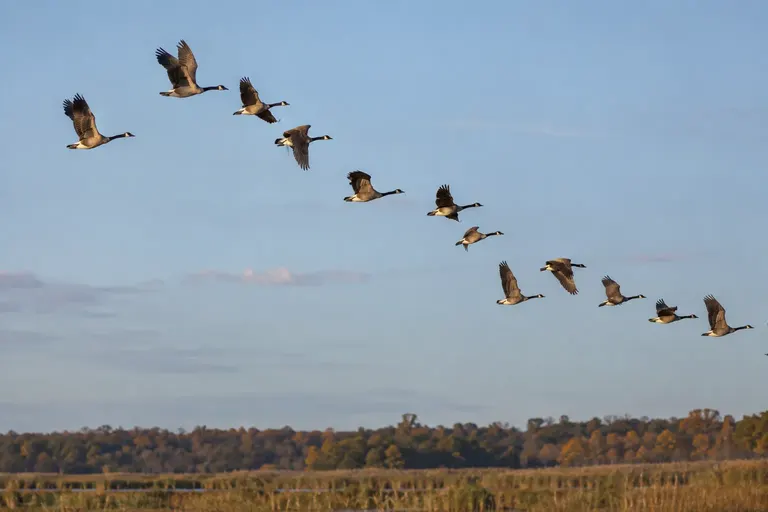
Many of these birds travel in flocks, which may help with navigation and, for some species, with energy savings, as explained in our guide to why birds fly in a V.
How do scientists track migration records?
Records like these were impossible to confirm until recently. Researchers now rely on several tools:
- Geolocators, tiny light loggers that record day length and sunrise and sunset times, allowing positions to be estimated. They weigh a fraction of an ounce but must be recovered from the bird.
- Satellite tags, which transmit locations and are used on larger birds such as godwits.
- GPS loggers, which record precise positions and are getting smaller every year.
- Automated radio tracking networks, such as Motus, which detect tiny radio tags on small birds as they pass receiver stations.
- Banding, which remains essential for measuring lifespan and connecting breeding and wintering sites.
The navigation that makes these journeys possible, including the use of the sun, stars and the magnetic field, is covered in our guides to how birds know where to migrate and whether birds use the Earth’s magnetic field.
Myths and facts about the longest migrations
Myth: The Arctic Tern flies 25,000 miles a year. Fact: That was an older straight-line estimate. Tracking shows average journeys closer to 44,000 miles, with some populations flying more.
Myth: Big birds always migrate farthest. Fact: Some of the most extreme journeys belong to small birds, including wheatears, warblers and hummingbirds.
Myth: Birds on long flights glide the whole way. Fact: Godwits and many shorebirds flap continuously for days. Soaring birds glide, but they avoid long ocean crossings.
Myth: These records are final. Fact: Records keep being broken as tracking devices get smaller and more birds are tracked.
Why do these long-distance migrants matter to backyard birders?
Most of these champions never visit a feeder, but they are connected to your yard in several ways.
- Shared stopovers. Many long-distance songbirds, such as Blackpoll Warblers and other warblers, pass through backyards and parks during migration. Native trees, shrubs and insect-rich gardens help them refuel.
- Conservation lessons. Long-distance migrants depend on habitat in several countries. Losing a single key stopover, like the Yellow Sea mudflats used by godwits, can affect a whole population. Our guide to why bird populations are declining explains the wider threats.
- Night-time safety. Many migrants fly at night and can be disoriented by bright lights. Turning off unneeded outdoor lights during migration seasons helps.
- Citizen science. Reporting birds to eBird helps researchers understand when and where migrants move. Our eBird guide shows how to start.
- Wonder. The same small hummingbird that visits your feeder may be preparing to cross an ocean. That is worth pausing for.
The bottom line
The Arctic Tern migrates the farthest of any known bird, traveling roughly 44,000 miles or more each year between the Arctic and Antarctic. The Bar-tailed Godwit holds the record for the longest nonstop flight, crossing the Pacific in more than a week without landing. Seabirds such as the Sooty Shearwater rank close behind, and small birds like the Northern Wheatear, Blackpoll Warbler and Rufous Hummingbird make journeys that are just as impressive for their size.
Sources



Frequently asked questions
What bird has the longest migration in the world?
The Arctic Tern has the longest known annual migration. Birds tracked from Greenland and Iceland averaged about 44,000 miles (71,000 km) round trip in a year, and birds from the Netherlands were recorded traveling around 56,000 miles (90,000 km). They breed in the Arctic and spend the northern winter in the Southern Ocean near Antarctica.
What bird flies the longest without stopping?
The Bar-tailed Godwit holds the record for the longest known nonstop flight by a bird. In 2022, a young satellite-tagged godwit flew about 8,400 miles (13,500 km) from Alaska to Tasmania in roughly 11 days without landing. Godwits cannot rest on water, so they must fly the whole distance continuously, burning fat stored before departure.
What songbird migrates the farthest?
The Northern Wheatear is among the longest-distance songbird migrants. Birds breeding in Alaska winter in East Africa, and tracking has shown individuals traveling roughly 9,000 miles each way, for a round trip near 18,000 miles. That is remarkable for a bird weighing less than an ounce.
How long do Arctic Terns live?
Arctic Terns are long-lived for their size. Banding records show wild birds surviving more than 30 years. Combined with their annual migration, that means a long-lived tern may fly well over a million miles in its lifetime, a distance comparable to several round trips to the Moon.
Which small bird has the longest migration for its size?
The Rufous Hummingbird is often cited. It breeds as far north as southern Alaska and winters mainly in Mexico, a one-way trip of several thousand miles. Measured in body lengths, that journey is among the longest of any bird. The Blackpoll Warbler, which crosses the Atlantic nonstop, is another contender.
Why do Arctic Terns migrate so far?
Arctic Terns follow the summer. By breeding in the Arctic and spending the northern winter near Antarctica, they live in near-constant daylight and exploit rich polar feeding areas at both ends of the globe. They can feed at sea along the way, which makes such long travel possible, and they use winds to reduce the energy cost.