Do Birds Have Teeth?
Do birds have teeth? No living bird does. Their ancestors did, but modern birds use a keratin beak and a muscular gizzard instead. Here is how that works.
In this article
- Quick answer: what birds use instead of teeth
- What exactly is a tooth, and why don’t beaks count?
- Did birds ever have teeth?
- Why did birds lose their teeth?
- Can chickens grow teeth?
- How do birds eat without teeth?
- Which birds have tooth-like structures?
- What is an egg tooth?
- How do baby birds eat without teeth?
- Myths vs facts about birds and teeth
- What does this mean for backyard birders?
- Quick facts
- Sources
- Frequently asked questions
No, birds do not have teeth. No living bird has true teeth made of enamel and dentine set in the jaw. Instead, birds use a lightweight beak covered in keratin to grab, crack and tear food, and a muscular gizzard in the stomach to grind it. Their ancestors did have teeth, though, and several ancient bird groups kept them until the dinosaurs died out about 66 million years ago.
So the answer is simple, but the story behind it is one of the more interesting in bird evolution. It involves fossil birds with toothy grins, genes that still carry the broken remains of tooth-building instructions, chickens that can be coaxed into growing tooth-like buds, and some ingenious workarounds living birds use to do the jobs teeth do.
Quick answer: what birds use instead of teeth
- Beak (bill). Bone covered with a hard, continuously growing keratin sheath. Shape varies with diet.
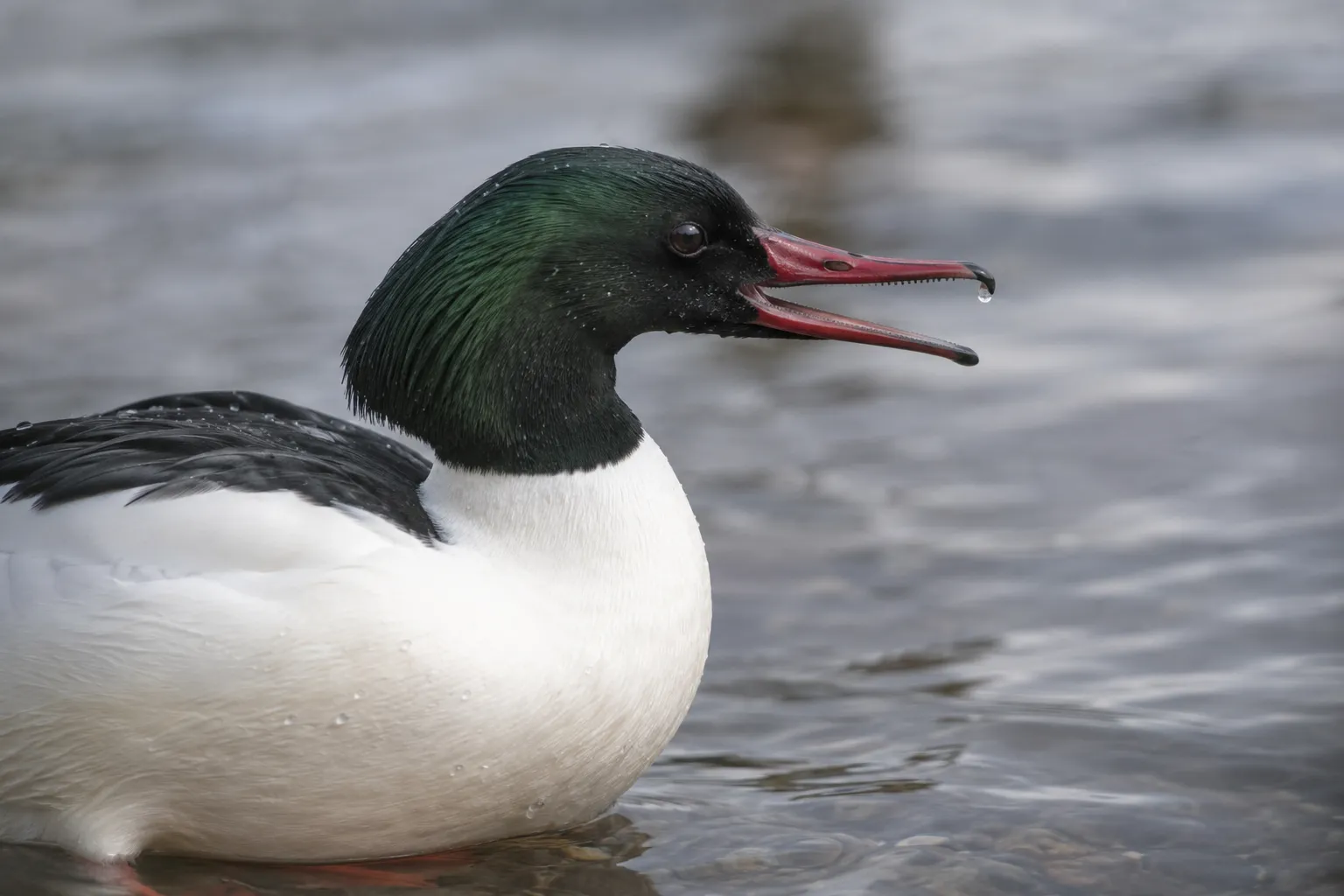
- Serrated bill edges. Some ducks, geese and mergansers have tooth-like ridges for gripping slippery food.
- Tomial tooth. Falcons and shrikes have a notch on the upper bill that works like a killing tooth.
- Crop. A stretchy pouch in the throat of many species that stores food before digestion.
- Gizzard. A muscular stomach that grinds food, often with swallowed grit.
- Egg tooth. A temporary keratin point that chicks use to break out of the egg.
What exactly is a tooth, and why don’t beaks count?
A true tooth, in the biological sense, is a structure made of layers of hard tissue, mainly enamel and dentine, anchored in the jawbone. Teeth grow from specialized tissue in the embryo through a series of well-understood developmental steps.
A bird’s beak is different. It has a bony core formed by the upper and lower jaws, and it is covered by a sheath of keratin called the rhamphotheca. Keratin is the same family of protein found in fingernails, hair, hooves and feathers. The sheath grows continuously and wears down with use, a bit like a fingernail. That is why captive birds sometimes need their beaks trimmed if they cannot wear them down naturally.
So even when a beak has sharp edges, hooks or serrations, those are extensions of the keratin sheath or the underlying bone, not teeth. Biologists call these structures tooth-like, or “pseudoteeth,” to keep the distinction clear.
Did birds ever have teeth?
Yes. Birds evolved from theropod dinosaurs, the group that includes Tyrannosaurus and Velociraptor, and those dinosaurs had teeth. Early birds kept them.
Archaeopteryx and other early birds
Archaeopteryx, which lived about 150 million years ago in what is now Germany, is one of the oldest known bird-like animals. It had feathered wings, but also small, sharp teeth in its jaws, a long bony tail and clawed fingers. Many other early birds from the Cretaceous period had teeth too.
One large and diverse group, the enantiornithines or “opposite birds,” was the most common kind of bird for much of the Cretaceous. Many had teeth. They lived on almost every continent and vanished at the end of the Cretaceous about 66 million years ago.
Hesperornis and Ichthyornis: toothed seabirds
Two famous toothed birds come from marine rocks in North America, deposited in shallow seas that once covered the middle of the continent.
- Hesperornis was a large, flightless diving bird, up to roughly 5 feet long, with strong legs for swimming and small, pointed teeth for gripping fish.
- Ichthyornis was a flying seabird about the size of a pigeon or small gull. It had teeth in its jaws, and fossil studies suggest it also had a small beak at the tip of the jaws, a combination that shows the beak and teeth overlapping during bird evolution.
These fossils caused a stir when they were described in the 1870s, because they showed that “bird” and “teeth” were not mutually exclusive.
When did modern birds lose their teeth?
Genetic evidence offers a surprisingly precise estimate. Living birds still carry the genes that build enamel and dentine in other animals, but in birds those genes are broken by mutations and no longer work. A 2014 study in Science compared these genes across dozens of bird species. Because the same disabling mutations appear in all modern birds, the researchers concluded that the common ancestor of today’s birds had already lost its teeth, and they estimated the loss happened roughly 116 million years ago.
That does not mean all birds lost teeth at once. Several other lineages, including the enantiornithines and the Hesperornis group, kept teeth for tens of millions of years more. It is just that none of those toothed lineages survived the mass extinction at the end of the Cretaceous. The survivors, the ancestors of every bird alive today, were toothless.
Tooth loss also happened independently in several dinosaur and early bird lineages, which suggests it was an evolutionary change that came about more than once.
Why did birds lose their teeth?
Nobody knows for certain, and scientists have proposed several hypotheses. They are not mutually exclusive.
Was it to save weight for flight?
This is the classic explanation. A lighter head helps balance a flying animal. However, many researchers now think teeth themselves are not heavy enough for weight saving alone to be the full answer, and some flightless birds and flying birds alike are toothless. It may have played some role, but it is unlikely to be the whole story.
Was it about diet?
Another idea links tooth loss to a shift in diet toward seeds, fruit and plant material, where a beak for cracking and a gizzard for grinding could do the job better. The fossil record shows that in some groups, beaks expanded as teeth shrank, often from the tip of the jaw backward, which is consistent with a diet-driven change.
Was it to hatch faster?
A more recent hypothesis, published in 2018, suggested that growing teeth takes time in the embryo, and that losing them could shorten incubation. A shorter time in the egg would mean less exposure to predators and other dangers during a vulnerable stage. It is an intriguing idea, and it fits with the observation that bird embryos develop quickly, but it remains a hypothesis rather than an established fact.
Our explainer on how long it takes bird eggs to hatch shows how fast that development can be in small songbirds.
Can chickens grow teeth?
The old saying “as rare as hen’s teeth” is almost right, but not completely. In the early 2000s, researchers studying a naturally occurring mutant chicken called talpid2 found that its embryos developed small, cone-shaped tooth-like structures in the jaw, somewhat similar to the teeth of crocodilians, a group closely related to birds. The embryos did not survive to hatch.
Earlier experiments had also shown that tissue from bird embryos could take part in forming tooth-like structures when combined with tissue from mice. Together, these findings suggest birds still carry some of the developmental machinery for making teeth, even though the genes for enamel are broken. Evolution switched teeth off, but did not wipe every trace of them from the genome.
How do birds eat without teeth?
Birds have split the work that teeth do in mammals between several body parts.
The beak does the gripping and cracking
Beak shape matches diet closely:
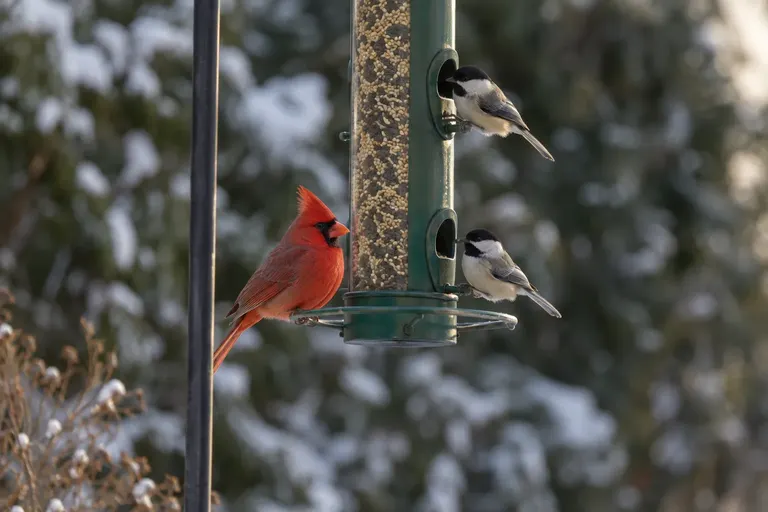
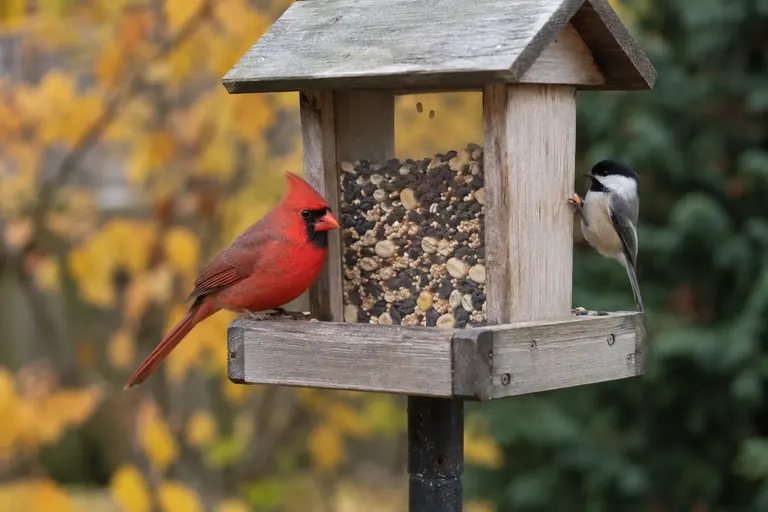
- Seed crackers. Finches, grosbeaks and cardinals have thick, conical bills and strong jaw muscles. They hold a seed in grooves on the bill and crush or slice the husk, then roll the kernel out with the tongue. Watch a Northern Cardinal at a feeder handling black oil sunflower seed and you will see the husk drop away while the kernel is swallowed.
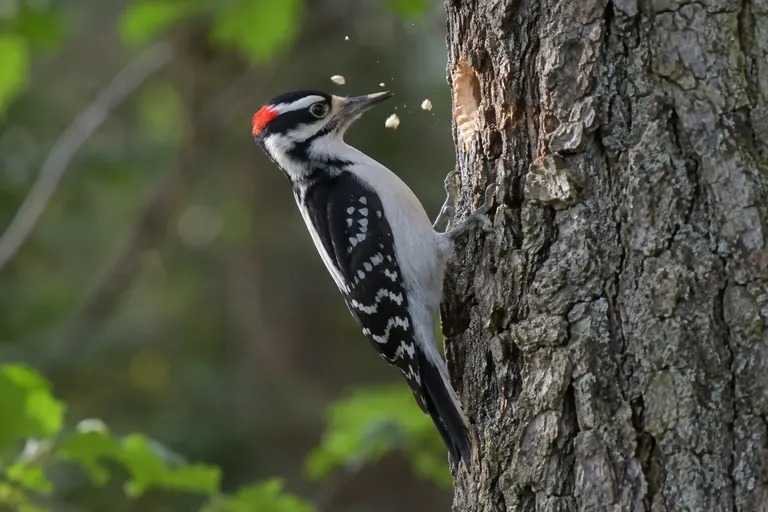
- Hammer and chisel. Woodpeckers use a strong, pointed bill to chip wood and reach insects. Our article on why woodpeckers peck wood explains the full toolkit.
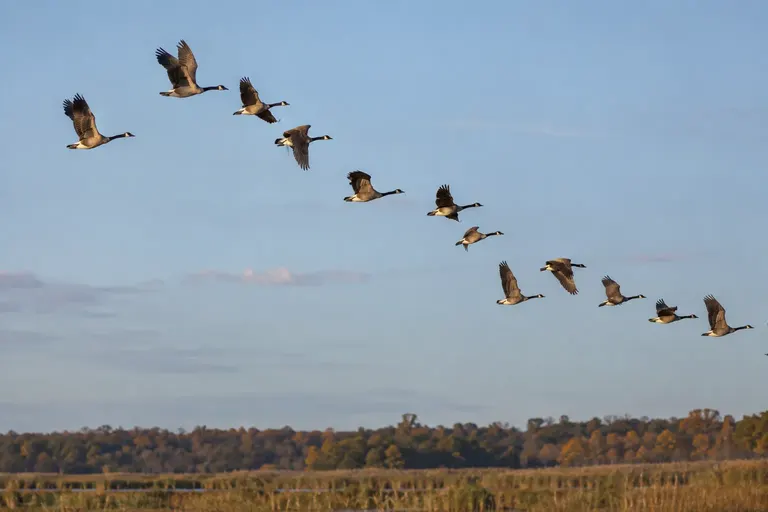
- Hooks for tearing. Hawks, eagles, owls and falcons use a sharply hooked upper bill to tear meat into swallowable pieces.
- Probes and tweezers. Hummingbirds, shorebirds and warblers use slender bills to reach nectar, worms or insects.
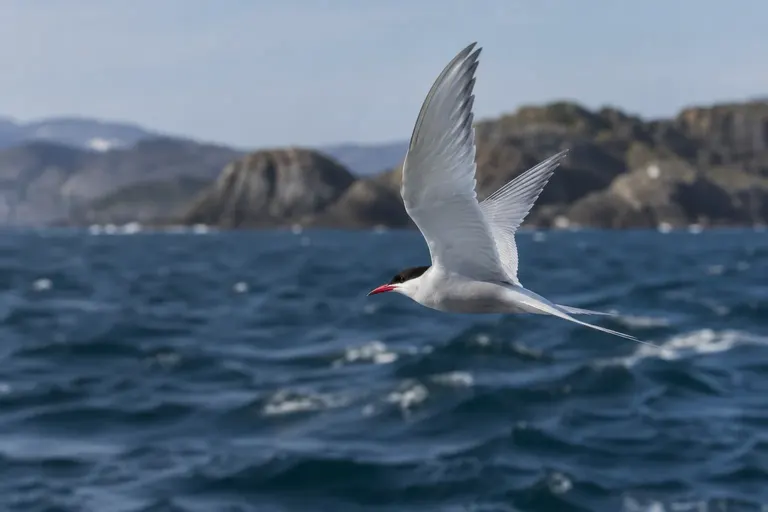
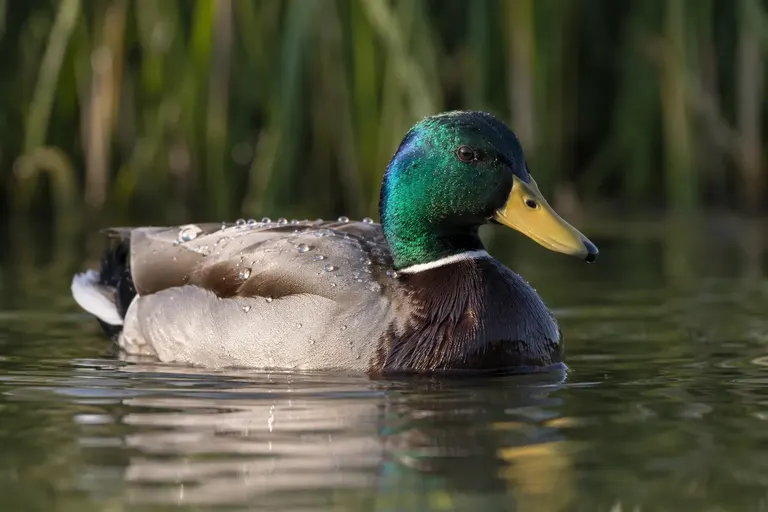
- Filters. Flamingos and many ducks strain small food from water or mud using comb-like plates along the bill edges.
The crop stores food
Many birds, including pigeons, doves, gamebirds and many finches, have a crop, a stretchy pouch partway down the esophagus. Food can be stored there and eaten quickly, which reduces time spent exposed to predators at a feeding site. Pigeons and doves also produce “crop milk” there to feed their young.
The gizzard does the grinding
The real replacement for molars is the gizzard, the muscular second chamber of a bird’s stomach. First, the glandular stomach (proventriculus) adds digestive juices. Then food passes into the gizzard, which has thick muscular walls and a tough inner lining. It contracts rhythmically, grinding food against itself.
Many seed-eating birds swallow small stones or grit, which stay in the gizzard and work like millstones. Chickens, turkeys, pigeons and many finches do this. In birds that eat soft food, such as nectar-feeding hummingbirds or fish-eating birds, the gizzard is less muscular.
Owls and some other birds swallow prey whole or in large pieces. The gizzard holds back indigestible bones, fur and feathers, which are compacted and later coughed up as a pellet.
Why do birds toss seed out of feeders?
Without teeth, a bird must handle each seed with its bill. Some species sort through seed mix and flick out what they do not want, while others drop husks. That is one reason feeders can get messy. Our explainer on why birds throw seed out of the feeder goes into it.
Which birds have tooth-like structures?
Several living birds have bills or tongues with structures that work somewhat like teeth, even though they are not.
| Bird | Structure | What it does |
|---|---|---|
| Mergansers (Common, Red-breasted, Hooded) | Serrated keratin edges along the bill | Grip slippery fish |
| Geese | Tooth-like ridges on bill edges | Clip and strip grass and plants |
| Falcons | Tomial tooth, a notch on the upper bill | Help break the neck of prey |
| Shrikes | Tomial tooth on the hooked upper bill | Kill insects and small vertebrates |
| Penguins | Backward-pointing spines on the tongue and palate | Keep fish and krill moving toward the throat |
| Some tropical hummingbirds | Fine serrations or hooked bill tips, mainly in males | Used in fights with rivals, according to recent research |
Pelagornithids: the bony-toothed birds
The most tooth-like beaks in bird history belonged to an extinct group called pelagornithids, or bony-toothed birds. These enormous seabirds had spiky bony projections along their jaws. Some species had very large wingspans, with one of the largest estimated at more than 20 feet, which may make them among the largest flying birds known. Their “teeth” were outgrowths of the jawbone, not true teeth, and probably helped them grip squid and fish at the ocean surface.
What is an egg tooth?
Almost every bird hatches with an egg tooth, a small, hard point on the tip of the upper bill (in some species, on both bill halves). It is made of keratin and calcium deposits, not enamel, so it is not a true tooth despite the name.
When it is time to hatch, the chick pushes the egg tooth against the inside of the shell and chips a small hole, a step called pipping. It then rotates and continues chipping until it can push the cap off. The egg tooth usually falls off or is worn away within days to a few weeks. If you see a newly hatched nestling in a nest box with a pale white dot on the tip of its bill, that is the egg tooth.
How do baby birds eat without teeth?
Nestlings face the same problem as adults, with even weaker bills, so parents do much of the processing for them.
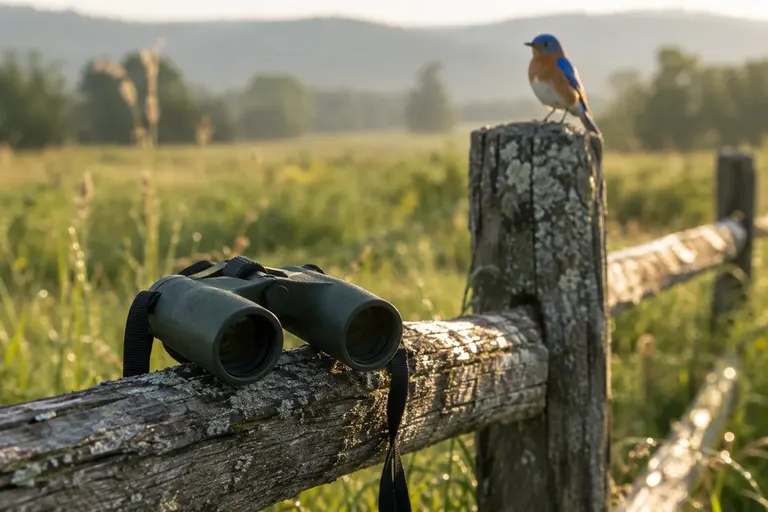
- Songbirds such as bluebirds, wrens and chickadees mostly feed their young soft-bodied insects and caterpillars, which are easy to swallow whole. Parents often crush or break up larger prey, removing hard legs or wings first.
- Pigeons and doves feed their young crop milk, a protein- and fat-rich secretion from the lining of the crop, produced by both parents.
- Many seabirds and raptors tear prey into small pieces or bring back partly digested food and regurgitate it for the chicks.
- Seed-eating finches such as American Goldfinches feed their young a regurgitated mash of seeds that has already been softened.
As chicks grow, the gizzard strengthens and they gradually take on tougher food. Our explainer on what baby birds eat covers the menu species by species.
Myths vs facts about birds and teeth
Myth: Some birds, such as geese, have real teeth. Fact: geese have tough, tooth-like serrations on the edges of the bill, but these are keratin, not teeth.
Myth: Birds cannot eat hard food. Fact: many birds crack extremely hard seeds and nuts. The Hawfinch of Europe and Asia can split cherry and olive stones with its bill.
Myth: Birds swallow grit because they are hungry. Fact: grit is a tool for grinding food in the gizzard, and many seed-eaters seek it out.
Myth: All ancient birds had teeth. Fact: tooth loss happened in several lineages at different times, and some Cretaceous birds were already toothless.
Myth: Baby birds have teeth. Fact: the egg tooth is a temporary keratin point, not a tooth.
What does this mean for backyard birders?
Knowing that birds have no teeth helps explain several practical feeding tips.
- Seed size matters. Small birds such as chickadees and finches can handle small seeds or pieces more easily. Hulled sunflower chips suit a wide range of species.
- Offer grit in winter. When the ground is frozen or snow-covered, seed-eating birds may have trouble finding grit. Crushed eggshells, which also supply calcium, can be offered in small amounts on a tray. Bake them first to reduce the risk of bacteria.
- Avoid large, hard chunks that birds cannot break. Whole nuts in the shell suit jays and woodpeckers but not small songbirds. Chop or crush large pieces.
- Some foods do not suit birds at all. Our guide on what not to feed birds lists foods to skip, and our myth-buster on whether birds can eat rice covers another common question.
Common mistakes
- Assuming birds need bread “softened” for them because they have no teeth. Bread offers little nutrition; see our guide on whether bread is bad for birds.
- Offering hard, oversized food to small birds that cannot crack or swallow it.
- Worrying that birds swallowing small stones are sick. It is normal behavior.
Quick facts
- No living bird has true teeth made of enamel and dentine.
- Beaks are bone covered with a keratin sheath that grows continuously.
- Archaeopteryx, about 150 million years old, had teeth.
- Genetic studies estimate the ancestor of all modern birds lost its teeth roughly 116 million years ago.
- Toothed bird lineages survived until about 66 million years ago, then died out.
- A mutant chicken embryo known as talpid2 can grow tooth-like buds.
- The gizzard, often aided by swallowed grit, does the grinding teeth do in mammals.
- Hatchlings use a temporary egg tooth to break out of the shell.
Sources
Frequently asked questions
Do any birds have teeth?
No living bird has true teeth. Teeth are made of dentine and enamel and sit in sockets in the jaw, and modern birds lost them long ago. Some birds have tooth-like structures instead: serrated bill edges in mergansers and geese, a notch called a tomial tooth in falcons, and spiny projections on the tongue in penguins. None of these are real teeth.
How do birds chew food without teeth?
They do not chew in the way mammals do. Birds use the beak to grab, crack, tear or husk food, then swallow it in pieces or whole. Many store food in a crop, and the gizzard, a thick muscular part of the stomach, grinds it, often with the help of small stones or grit the bird has swallowed.
When did birds lose their teeth?
Birds' dinosaur ancestors had teeth, and several early bird groups kept them. Genetic research on tooth-related genes in living birds suggests the common ancestor of all modern birds had lost its teeth by roughly 116 million years ago. Other toothed bird lineages survived until the end of the Cretaceous about 66 million years ago, then died out.
What is an egg tooth?
An egg tooth is a small, hard point on the tip of a hatching chick's bill. It is made of keratin, not enamel, so it is not a real tooth. The chick uses it to chip through the eggshell, and it falls off or wears away within days to weeks after hatching. Many reptiles have a similar structure.
Can birds bite hard without teeth?
Yes. Beaks can deliver strong bites. Large parrots crack very hard nuts, and finches such as the Hawfinch of Europe and Asia can split cherry and olive stones. Birds of prey tear flesh with a hooked beak, and falcons use a notch in the bill to break a prey animal's neck.