Do Birds Use the Earth's Magnetic Field?
Do birds use the Earth's magnetic field? Yes. Migrating birds carry a built-in magnetic compass, probably in their eyes, and may also read the field like a map.

In this article
- Quick answer: how birds use the magnetic field
- How do we know birds can sense the magnetic field?
- What does a bird’s magnetic compass actually sense?
- Where is the magnetic sensor in a bird?
- Do birds use the magnetic field as a map?
- How does the magnetic sense fit with other navigation cues?
- Can human technology disrupt a bird’s magnetic compass?
- Do other animals use the magnetic field?
- Myths vs facts about bird navigation and magnetism
- What does this mean for backyard birders?
- Examples from around the world
- Quick facts
- Sources
- Frequently asked questions
Yes. Birds use the Earth’s magnetic field as a compass, and many migrants probably use it as part of a map as well. The ability has been shown experimentally in dozens of species, starting with European Robins in the 1960s, and the best current evidence points to a light-sensitive protein in the eye, cryptochrome 4, as the sensor. How a bird turns that signal into a sense of “north” and “home” is one of the most active questions in biology.
Below is what scientists know with confidence, what is still debated, and what it means for the birds that pass over your yard on autumn nights.
Quick answer: how birds use the magnetic field
- As a compass. Birds can tell direction from the magnetic field even when they cannot see the sun or stars.
- As a map, probably. The strength and angle of the field change across the planet, and experiments suggest some migrants read those changes to judge where they are.
- Through the eyes, most likely. The compass in songbirds needs light and appears to work through a chemical reaction in retinal proteins called cryptochromes.
- Alongside other cues. Birds also use the sun, the stars, polarized light at dusk, landmarks and possibly smell. The magnetic sense is one tool in a kit, not the whole kit.
How do we know birds can sense the magnetic field?
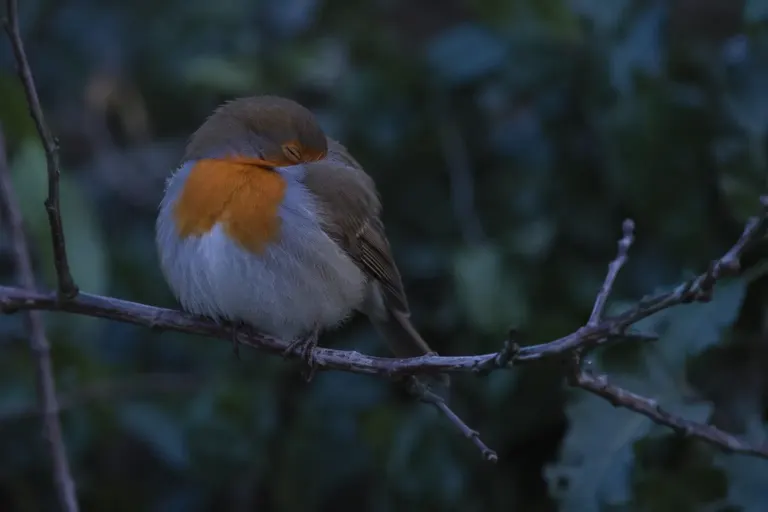
The first convincing evidence came from Germany. In the mid-1960s, Wolfgang Wiltschko and colleagues placed European Robins in circular orientation cages during their migration season. Caged migrants become restless at night, a behavior known by the German word Zugunruhe, and they hop in the direction they would fly. When the researchers used electric coils to shift the direction of the magnetic field around the cage, the robins shifted their hopping direction to match.
A popular tool for this kind of work is the Emlen funnel, developed by Stephen Emlen and John Emlen. It is a cone lined with paper; a bird stands on an ink pad at the bottom and leaves footprints where it hops up the sides. Count the smudges and you have a map of where the bird wanted to go.
Homing pigeons gave a second line of evidence. In the early 1970s, William Keeton at Cornell attached small magnets to pigeons and released them far from their lofts. On sunny days the birds with magnets homed as well as controls. Under overcast skies, many were disoriented. That result suggested pigeons rely on the sun when they can see it and fall back on the magnetic field when they cannot.
Since then, a magnetic compass has been demonstrated in a few dozen species across very different groups, from night-migrating warblers and flycatchers to domestic chickens. Because it appears in birds that are only distantly related, most researchers think it is widespread.
What does a bird’s magnetic compass actually sense?
This is where birds differ from the compass in your glove box. A hiking compass points to magnetic north because its needle responds to the polarity of the field. A bird’s compass works differently.

What is an inclination compass?
The Earth’s magnetic field lines do not run flat along the ground. Near the equator they are roughly horizontal. Toward the poles they tilt down more and more steeply until they point almost straight into the ground. The Wiltschkos showed in 1972 that robins read this angle of tilt, called inclination, rather than polarity.
In practice, that means a bird does not know “north” and “south” in the magnetic sense. It knows “poleward,” the direction where field lines dip toward the ground, and “equatorward,” the direction where they rise. When researchers reversed only the vertical part of the field, robins turned around. When they reversed the polarity but kept the angle, the birds did not care.
An inclination compass has an interesting blind spot. At the magnetic equator the field lines are horizontal, so poleward and equatorward look the same. Birds that cross the equator on migration, such as many European songbirds heading to southern Africa, must switch their preferred heading once they pass it. How exactly they manage that is still studied, but experiments suggest that experiencing horizontal field lines can trigger the switch.
Does the magnetic compass need light?
In songbirds, yes. Robins orient normally under dim blue or green light and become disoriented under red or yellow light. This light dependence was one of the first strong hints that the sensor is chemical and lives in the eye, not in a lump of iron somewhere in the head.
Where is the magnetic sensor in a bird?
For decades there were two main candidate mechanisms. Evidence has since tilted strongly toward one of them for the compass.
The eye: cryptochromes and the radical pair idea
In 1978 the physicist Klaus Schulten proposed that birds might sense magnetism through a “radical pair” reaction. When light hits certain molecules, it can knock an electron from one part of the molecule to another, leaving two unpaired electrons. Those electrons spin, and the Earth’s weak magnetic field can nudge the balance between their spin states. That balance, in turn, changes which chemical products form. If such molecules sit in an orderly array in the retina, the result would vary with the bird’s head direction relative to the field.
In 2000, Thorsten Ritz and colleagues suggested that proteins called cryptochromes were the right kind of molecule. Cryptochromes absorb blue light and are found in bird retinas.
The strongest evidence so far came in 2021, when a team led by Henrik Mouritsen and Peter Hore published a study in Nature on cryptochrome 4, or Cry4, from European Robins. They produced the protein in the lab and showed that its light-triggered reactions were sensitive to magnetic fields. Robin Cry4 appeared more magnetically sensitive than the versions from chickens and pigeons, which are not night migrants. That fits the idea that evolution tuned the protein in birds that navigate at night.
This does not yet close the case. Measuring magnetic effects on a purified protein in a lab is not the same as proving that the same reaction drives behavior in a living bird. But Cry4 is now the leading candidate.

Cluster N: a brain region for night navigation
Another clue comes from the brain. In night-migrating songbirds, a region of the forebrain called Cluster N becomes highly active when birds perform magnetic orientation at night. Cluster N receives input from the visual system. In a 2009 study in Nature, Manuela Zapka and colleagues found that robins with Cluster N damaged could no longer use their magnetic compass, although they could still use star and sun cues. That fits neatly with an eye-based sensor.
The beak: what happened to the iron hypothesis?
The other idea was that birds carry tiny crystals of magnetite, a magnetic iron oxide, connected to nerves. For years, clusters of iron-rich cells in the upper beak of pigeons were proposed as magnetoreceptors. In 2012, a team led by David Keays showed in Nature that those cells were mostly macrophages, immune cells that store iron, rather than sensory neurons.
The iron idea is not fully dead. Some studies suggest that a branch of the trigeminal nerve, which serves the beak and face, carries magnetic information that may help with the map sense rather than the compass. The evidence is mixed and the sensor, if it exists, has not been found. For now the fair summary is: the compass is very likely in the eye; a separate magnetic map sense may exist, and its hardware is unknown.
Do birds use the magnetic field as a map?
A compass tells you which way you are facing. A map tells you where you are. Birds that are blown off course or moved by researchers can often correct and head for the right goal, which requires some sense of position.
The magnetic field could help. Its total intensity is weaker near the equator and stronger near the poles. Inclination changes with latitude. Declination, the angle between magnetic north and true geographic north, varies across the globe in a way that can help with longitude. In principle, a bird that knows the pattern of these values could work out its position.
Several experiments support this. In a 2017 study in Current Biology, Nikita Chernetsov and colleagues exposed Eurasian Reed Warblers in Russia to a changed declination while leaving everything else the same. The birds reoriented as if they had been physically moved about 1,000 km, roughly 600 miles, to the west, and adjusted their heading to compensate. Other studies on sea turtles and salmon show similar magnetic map abilities, which suggests the strategy is ancient and shared across animals.
Map use is harder to test than compass use, so expect this area of research to keep changing. It is reasonable to say that many migrants appear to use magnetic information for position, especially adults that have migrated before.
How does the magnetic sense fit with other navigation cues?
No bird relies on magnetism alone. Migrants juggle several systems and cross-check them.
| Cue | What it tells the bird | Who uses it | Key limitation |
|---|---|---|---|
| Magnetic field | Compass direction; possibly position | Night and day migrants, pigeons | Needs light (songbirds); disturbed by some electronic noise |
| Sun | Direction, corrected for time of day | Day migrants, pigeons | Needs clear sky and an internal clock |
| Stars | Direction from the center of sky rotation | Night migrants such as Indigo Buntings | Needs clear skies; learned when young |
| Polarized light at dusk | A reference used to calibrate other compasses | Many songbirds | Only at sunrise and sunset |
| Landmarks | Coastlines, rivers, mountain ranges | Many species, especially experienced adults | Must be learned |
| Smell | Possibly a map near home | Homing pigeons, seabirds such as shearwaters | Still debated for many species |
Stephen Emlen’s work in the 1960s showed that young Indigo Buntings learn the star compass by watching the night sky rotate around the celestial pole. Later work by Rachel Muheim and others suggested that songbirds use the band of polarized light at sunset and sunrise to calibrate their magnetic compass. The details differ between species, and some studies disagree, but the big picture is consistent: birds combine cues and adjust one with another.
For a deeper look at how young birds manage their first journey, see our guide to how birds know where to migrate.

Can human technology disrupt a bird’s magnetic compass?
This is a fair worry, and one of the most interesting results in the field.
In 2014, Svenja Engels and colleagues at the University of Oldenburg in Germany published a study in Nature after noticing that their caged robins could not orient on campus. When they lined the wooden huts with grounded aluminum screens, which blocked broadband electromagnetic noise in roughly the 2 kHz to 5 MHz range, the robins oriented normally. When the screens were ungrounded or noise was added back, the birds lost their bearings again. The noise levels were far below any human safety limit.
The disruptive signal was weak, broadband radio-frequency noise, the kind produced by ordinary electronics in a city, not the magnetic fields of power lines or the signals from a single phone mast. It is also important to be clear about scope: this was a lab setup with caged birds. How much urban electronic noise affects wild migrants flying high over cities, where they also have star and sun cues, is not known.
Solar activity may matter too. Some radar studies of North American migration have reported fewer birds flying, or more birds drifting off course, during strong geomagnetic storms, especially under cloud cover. These are correlations, and researchers are still working out how important the effect is.
Do other animals use the magnetic field?
Birds are far from alone. Magnetic senses have been found or strongly suggested in:
- Sea turtles, which appear to imprint on the magnetic signature of their home beach.
- Salmon, which may use magnetic cues to find their way back to their home river mouth.
- Some mammals, including mole rats and possibly some bats.
- Insects, including some migrating butterflies and moths.
Humans have no confirmed magnetic sense. A few experiments have reported subtle brain responses to changing magnetic fields, but nothing that gives us a usable compass.
Myths vs facts about bird navigation and magnetism
Myth: birds have a tiny compass needle in their heads. Fact: the songbird compass responds to the angle of field lines, not their polarity, and it depends on light. That is very unlike a needle.
Myth: scientists have found the exact magnetic sensor. Fact: cryptochrome 4 in the eye is the leading candidate for the compass, backed by strong lab evidence, but the full chain from molecule to behavior in a living bird is still being worked out.
Myth: birds see magnetic lines painted across the sky. Fact: this is a reasonable hypothesis because the sensor seems to be visual, but no one knows what the bird experiences. Illustrations of “magnetic vision” are artist’s guesses.
Myth: power lines and cell towers ruin bird migration. Fact: there is no good evidence for that. Weak broadband radio noise disrupted caged robins in one well-known study. Collisions with lit buildings and glass are far better documented threats. Read more in why birds fly into windows.
Myth: young birds learn the route from their parents. Fact: in many songbirds, first-time migrants fly alone at night and follow an inherited direction and distance program. Geese, cranes and swans are different; they migrate in family groups and learn routes.

What does this mean for backyard birders?
Most songbirds you see at your feeders in spring and fall migrate at night. Warblers, thrushes, vireos, sparrows, orioles and buntings take off after dusk and fly for hours, often at altitudes of several thousand feet. Every one of them is reading some combination of stars, magnetism and learned cues as it passes overhead.
A few practical takeaways:
- Lights out matters more than wifi. Bright artificial light at night pulls migrants off course and into cities, where they hit glass. Turning off unneeded outdoor lights during peak migration, roughly April to May and September to October in much of North America and Europe, is one of the simplest things you can do.
- Make your windows visible. Tired migrants land in yards at dawn to feed. External screens, dot patterns and cords help. See our guide on how to stop birds hitting windows.
- Offer a rest stop. Native shrubs, fruiting plants, leaf litter and a clean bird bath help migrants refuel. Our guide to designing a small bird-friendly garden covers the basics.
- Listen at night. On calm autumn nights you can often hear the thin flight calls of migrants overhead. Many birders enjoy recording them; our piece on why birds chirp at night explains what you are hearing.
- Log what arrives. Reporting sightings through eBird helps scientists track migration timing. Here is how to use eBird.
Examples from around the world
- European Robin. The model species for magnetic compass research. Northern and eastern populations migrate at night toward southern Europe and North Africa, while many British robins stay put.
- Garden Warbler and Pied Flycatcher. Long-distance night migrants from Europe to sub-Saharan Africa, used in experiments on inherited headings and the equator switch.
- Bar-tailed Godwit. Makes nonstop flights of more than 11,000 km, around 7,000 miles, from Alaska to New Zealand, with no landmarks over open ocean. Researchers suspect a combination of celestial and magnetic cues. See which bird migrates the farthest.
- Homing pigeon. Uses the sun compass on clear days and the magnetic field when cloudy, and may use smell for a map near home.
- Indigo Bunting. Showed that young birds learn a star compass, a reminder that magnetism is only one strand.
- Shearwaters and petrels. Ocean wanderers where smell seems to play a large role in finding home islands, along with magnetic cues.
Quick facts
- The Earth’s magnetic field is weak, roughly 25 to 65 microtesla at the surface, depending on location. A fridge magnet is hundreds of times stronger.
- The first experimental proof of a bird magnetic compass came from caged European Robins in Germany in the 1960s.
- The songbird compass reads the tilt of field lines, not north or south polarity.
- It needs light and works under blue and green light in lab studies.
- Cryptochrome 4 in the retina is the leading candidate molecule.
- A forebrain area called Cluster N is needed for magnetic orientation at night in migratory songbirds.
- Weak broadband radio-frequency noise disrupted robins’ compass in a 2014 lab study.
- The iron-rich “magnetic” cells once reported in pigeon beaks turned out to be immune cells.
Sources
- Magnetic sensitivity of cryptochrome 4 from a migratory songbird (Xu et al., Nature, 2021)
- Anthropogenic electromagnetic noise disrupts magnetic compass orientation in a migratory bird (Engels et al., Nature, 2014)
- Cornell Lab of Ornithology: All About Birds
- RSPB: Robin species profile
- Audubon: Bird Migration Explorer



Frequently asked questions
How do birds sense the Earth's magnetic field?
The leading explanation is a light-dependent chemical reaction in the eye. Proteins called cryptochromes, especially cryptochrome 4 in the retina, form pairs of radicals when struck by blue light, and the outcome of that reaction appears to depend on how the molecule is aligned with the magnetic field. Birds may effectively see the field as a pattern overlaid on their vision, although that last idea is still a hypothesis.
Can birds see magnetic fields?
Possibly, in a sense. Because the magnetic compass of songbirds depends on light and involves the eyes and a visual brain region called Cluster N, many researchers suspect the field shows up as a faint visual pattern. Nobody can confirm what a bird actually experiences, so treat vivid descriptions of birds seeing magnetic lines as informed speculation rather than established fact.
Do all birds use the magnetic field to navigate?
A magnetic compass has been demonstrated experimentally in a few dozen species, from European Robins and Garden Warblers to homing pigeons and chickens. Because it turns up in such different groups, scientists think it is widespread among birds. Most species have never been tested, so it is fair to say it is likely common but not proven for every bird.
Do phone towers and power lines confuse migrating birds?
The evidence does not point at phone towers or power lines as compass disruptors. What has been shown is that weak broadband radio-frequency noise, of the kind produced by electronic equipment in cities, can stop European Robins from orienting with their magnetic compass in lab huts. How much this affects wild birds in open country is still unknown. Lights and glass are much better documented hazards.
What happens to birds when magnets are attached to them?
In classic experiments in the early 1970s, homing pigeons carrying small magnets flew home normally on sunny days but were often disoriented under overcast skies. That suggested pigeons use the sun compass when they can and fall back on the magnetic field when the sun is hidden. Later experiments with magnetic coils have produced similar results in other species.