Why Do Male Birds Have Brighter Colors Than Females?
Why do male birds have brighter colors? Mostly sexual selection: females choose colorful mates and males compete, while dull females stay hidden on the nest.
In this article
- Quick facts: why male birds are more colorful
- What is sexual selection?
- Why are female birds so drab?
- Where do bird colors come from?
- What does bright plumage cost a male bird?
- How do scientists study bird color?
- Are there birds where females are brighter than males?
- Do male birds stay bright all year round?
- Why do male and female look the same in some species?
- Does mating system affect how colorful males are?
- Myths and facts about colorful male birds
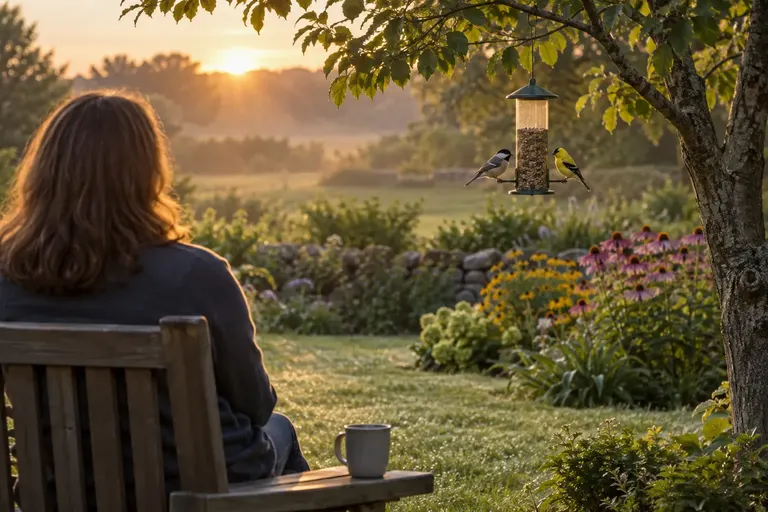
- What this means for backyard birders
- The bottom line
- Sources
- Frequently asked questions
Why do male birds have brighter colors than females? Mostly because of sexual selection, an idea Charles Darwin laid out in 1871. In many species, females choose mates, and they tend to pick males with the most vivid colors, while males also use bright patches to intimidate rivals. At the same time, females that sit on exposed nests benefit from dull, camouflaging plumage, so natural selection keeps them drab.
Charles Darwin laid out this idea in 1871 in The Descent of Man, and Selection in Relation to Sex, and more than 150 years of research have refined it rather than overturned it. The details are more interesting than the headline, though. Some females are brighter than males, some males are bright only for a few months, and some species that look identical to us look very different to the birds themselves.
Quick facts: why male birds are more colorful
- Main cause: sexual selection, through female choice and male competition.
- Why females are drab: camouflage while incubating and caring for young.
- Colors can be honest signals: red and yellow carotenoid colors depend on diet and health.
- Not universal: in phalaropes and a few other birds, females are brighter.
- Often seasonal: many males molt into dull plumage outside the breeding season.
- We miss part of the picture: birds see ultraviolet, so some “identical” sexes differ in ultraviolet.
What is sexual selection?
Natural selection favors traits that help an animal survive. Sexual selection favors traits that help it reproduce, even if they make survival harder. A long tail or glowing red plumage may attract predators, but if it also attracts more mates, it can still spread through a population.
Sexual selection works in two main ways.
Female choice
In most birds, females invest more in each breeding attempt than males. They produce large, nutrient-rich eggs and in many species do most or all of the incubation. That makes each female a limited resource and makes females choosier. Males, in turn, compete for their attention.
Over many generations, female preferences can push male traits to extremes. The birds of paradise of New Guinea are the classic example: males of many species have elaborate plumes and colors and perform intricate displays, while females are relatively plain and raise the young alone. The Indian Peafowl is another. Research on peacocks has linked the train and its eyespots to mating success, although results have varied between studies and populations.
Male competition
Bright colors also work as signals between males. A colored patch can advertise fighting ability or status and settle disputes without an actual fight.
The Red-winged Blackbird of North America is a good example. Territorial males flash their red and yellow shoulder patches, called epaulets, during displays. In a classic experiment in the 1970s, males whose epaulets were blackened out had more trouble holding their territories, which suggests the patches matter in male-male interactions.
Why are female birds so drab?
The other half of the answer is about females. In many songbirds, the female builds the nest, incubates the eggs and broods the chicks, spending long hours sitting still in one spot. A bright red bird on an open cup nest would be easy for a hawk, jay, squirrel or snake to find.
The 19th-century naturalist Alfred Russel Wallace, who co-discovered natural selection with Darwin, emphasized exactly this point: he argued that drab females were the result of selection for concealment, not just the absence of selection for color.
Modern studies suggest both men were partly right. A large comparative analysis published in Nature in 2015, covering thousands of songbird species, found that male and female colors tend to evolve together, and that strong sexual selection is linked to a bigger color difference between the sexes. It also suggested that in many lineages the difference arose because females became duller, not only because males became brighter. That finding helps explain why the pattern varies so much from family to family.
Where do bird colors come from?
To understand why some males can be brighter than others, it helps to know how feathers get their color. There are two broad sources.
| Color source | Colors it produces | How birds get it | Examples |
|---|---|---|---|
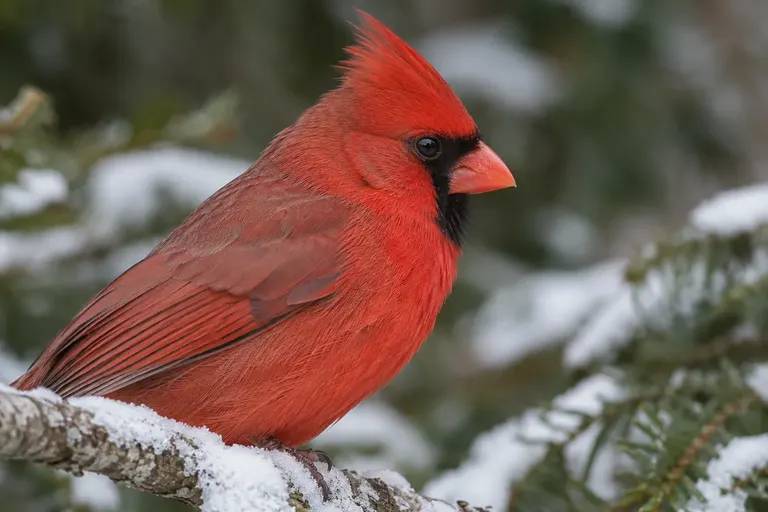
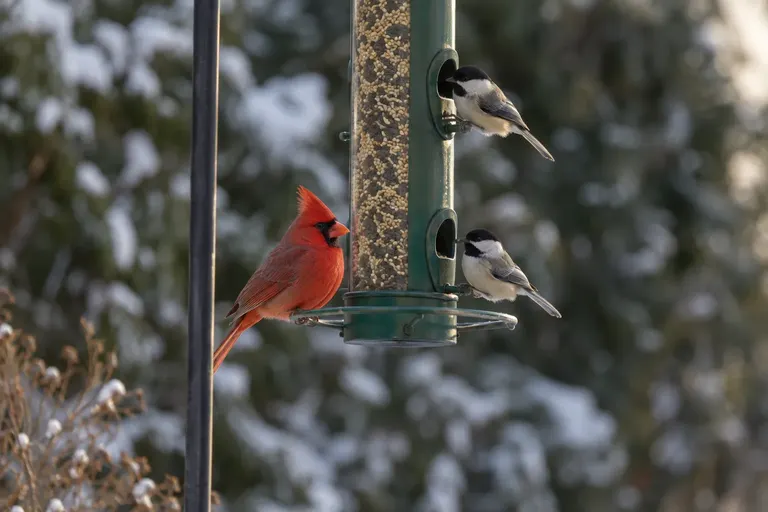
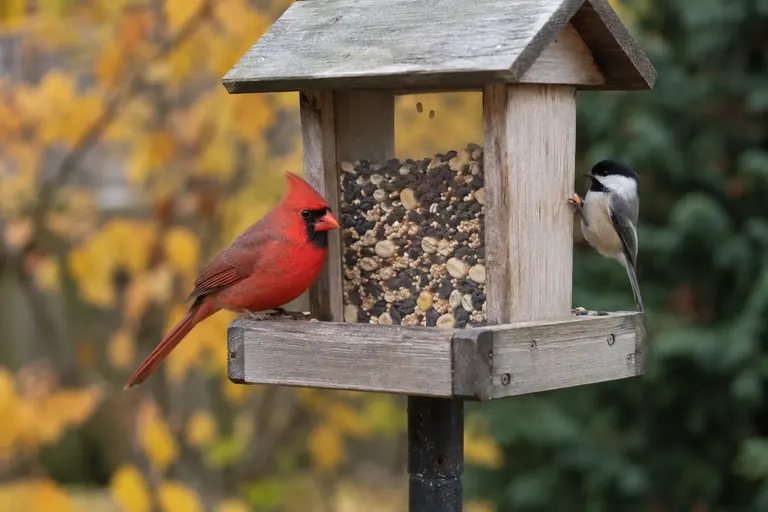
| Melanins | Black, gray, brown, rufous, buff | Made by the bird’s own cells | Crows, sparrows, the black mask of a cardinal |
| Carotenoids | Red, orange, yellow | Must come from food | Northern Cardinal, House Finch, American Goldfinch, Baltimore Oriole |
| Structural color | Blue, violet, iridescent green and purple | Microscopic feather structures scatter light | Blue Jay, Indigo Bunting, hummingbird throats, Mallard head |
| Other pigments | Special reds, yellows and greens in certain groups | Made by the bird | Parrots (psittacofulvins), turacos |
Why carotenoid colors are “honest” signals
Birds cannot make carotenoids. They must find them in fruits, seeds, flowers and insects, then absorb, transport and deposit them into growing feathers. A male that is healthy, parasite free and good at finding food can build a redder or yellower plumage than a weaker rival.
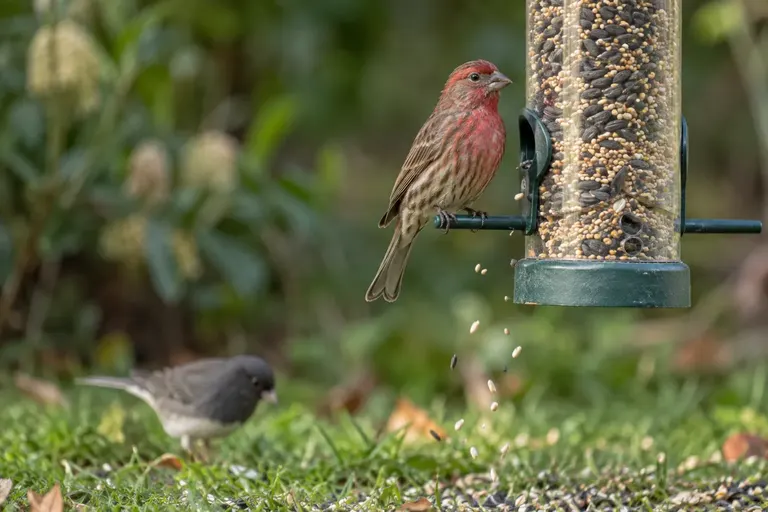
The House Finch is the best-studied example. Male House Finches range from pale yellow through orange to deep red. Research led by Geoffrey Hill found that this variation reflects the carotenoids males eat while molting, and that females tend to prefer redder males. For a female, the red is a readable advertisement of a male’s foraging skill and condition.
The same principle applies to the Northern Cardinal and the orange of the Baltimore Oriole. Because color depends on the diet during molt, it gives an up-to-date snapshot of a male’s condition. Our guide to why birds molt explains how that yearly feather replacement works.
A striking backyard example: some Cedar Waxwings in eastern North America have orange rather than yellow tail tips. Researchers traced this to a red pigment in the berries of certain non-native honeysuckles eaten while the tail feathers were growing. It shows how directly food can change a bird’s color.
Structural colors can also signal quality
Blues and iridescent colors are made by the fine structure of the feather rather than by pigment. Producing a well-ordered structure may also depend on a bird’s condition, and several studies have linked the brightness of blue plumage to male quality in species such as bluebirds. Our explainer on why blue feathers are not actually blue covers the physics.
What does bright plumage cost a male bird?
If bright colors were free, every bird would have them. The fact that they are not universal tells us they come with real costs, and those costs are part of what makes them meaningful to females.
Predation risk
A conspicuous bird is easier to find. Studies using painted models and field observations have generally found that brightly colored birds are more likely to be noticed by predators, although the size of the effect varies with habitat and predator type. Many brightly colored males reduce the risk by displaying from particular perches, singing from cover or staying close to dense vegetation.

Nutritional and physiological costs
Carotenoids are not only pigments. In the body they are also linked to immune function and antioxidant activity. That has led to the “trade-off” hypothesis: a male that diverts carotenoids into feathers may have less available for other uses, so only males in good condition can afford the brightest color. The idea is well supported in some species and debated in others, but it offers one explanation for why color is such a reliable signal.
Social costs
A bright male can attract aggression from rivals as well as attention from females. In species where color signals status, a male whose plumage promises more than he can deliver may face costly challenges. Some researchers think this social policing helps keep signals honest.
How do scientists study bird color?
Much of what we know comes from a few kinds of work.
- Spectrophotometry. Researchers measure the light reflected from feathers across the full range birds can see, including ultraviolet, rather than relying on human judgment.
- Visual modeling. Measurements are fed into models of bird eyes to estimate how different two colors look to a bird rather than to a person.
- Experiments. Scientists sometimes alter plumage, for example by darkening a color patch, or offer females a choice between males, then track mating success.
- Diet studies. Changing the carotenoids in captive birds’ food during molt shows how much color depends on diet.
- Comparative studies. Comparing hundreds or thousands of species reveals broad links between color, mating systems, parental care and habitat.
Are there birds where females are brighter than males?
Yes, and they help prove the rule. When the usual roles reverse, the colors reverse too.
Phalaropes. Three species of these small shorebirds, the Red Phalarope, Red-necked Phalarope and Wilson’s Phalarope, breed in the Arctic and in North American wetlands. Females have the brighter breeding plumage, court the males and may compete with other females. After laying, the female often leaves and the duller male incubates the eggs and cares for the chicks. Here, the sex that sits on the nest is the camouflaged one.
Painted-snipes and some buttonquails. In these groups, found in parts of Africa, Asia and Australia, females are also typically more boldly marked, and males do much of the parental care.
Eclectus Parrot. This species from New Guinea and northern Australia is a special case: both sexes are brilliant. Males are mostly bright green, and females are red with purple or blue. Research in Australia linked the female’s bold color to intense competition among females for scarce nest hollows, where females spend long periods and advertise their ownership, while the male’s green helps him blend in as he forages in the canopy.
Do male birds stay bright all year round?
Many do not. In a number of species, males are bright only during the breeding season and molt into a duller plumage afterward.
- American Goldfinch: males are brilliant yellow with a black cap in spring and summer, and olive brown in winter. See our American Goldfinch guide.
- Scarlet Tanager: males change from scarlet and black to yellowish green with black wings in fall.
- Indigo Bunting: males become patchy and brownish in fall and winter.
- Many ducks: male ducks go into a dull “eclipse” plumage in summer, while they are flightless during molt.
Why bother switching? Bright plumage has costs, including greater visibility to predators and, in some cases, the energy needed to grow it. When there are no mates to impress or territories to defend, the benefits drop, so a more cryptic winter look can be the better strategy.
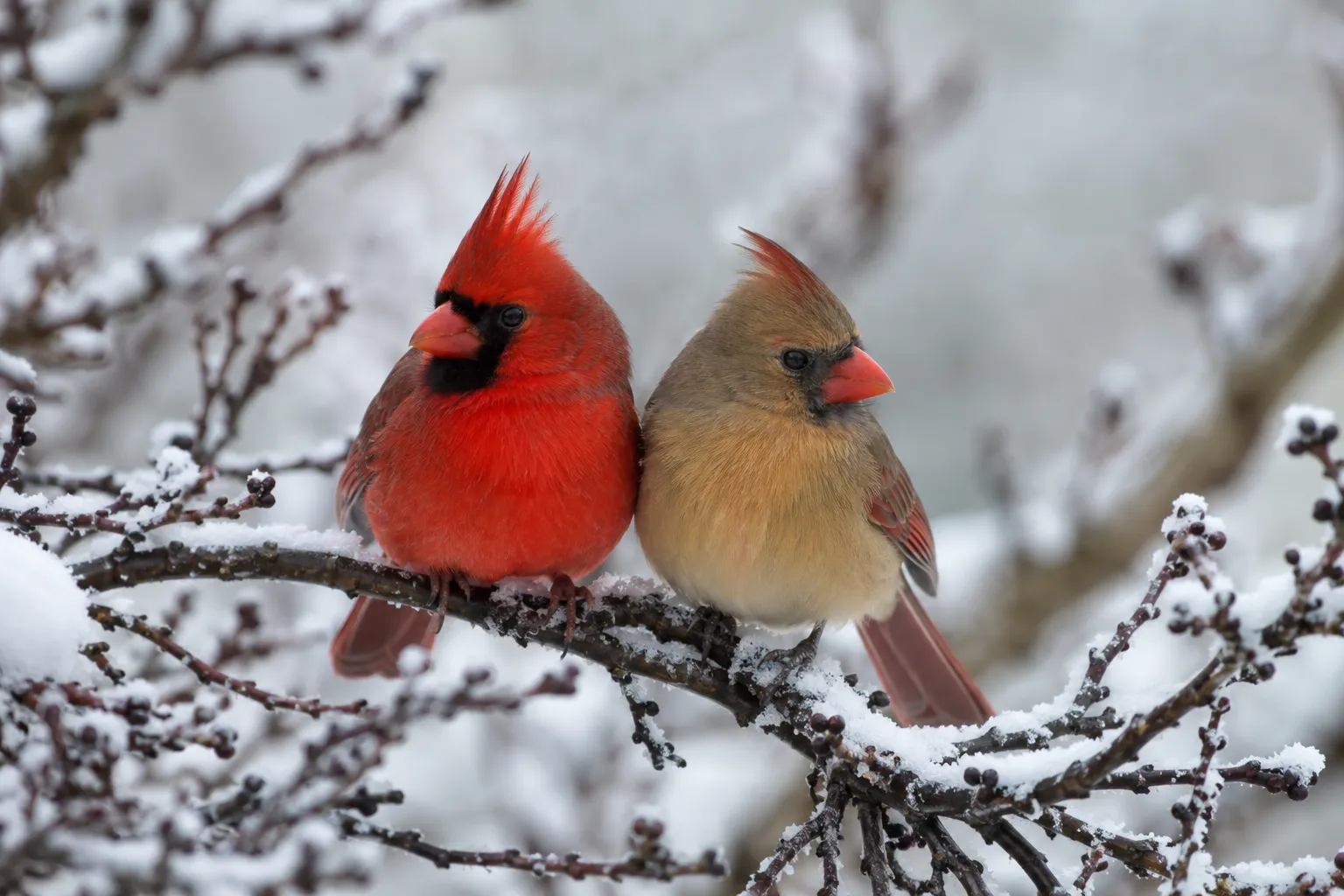
Other species, like the Northern Cardinal, keep their color year-round. Cardinals often stay paired and on or near their territories through winter, which may reduce the advantage of switching.
Why do young males look like females?
In some species, first-year males look like females or show only hints of adult color. This is called delayed plumage maturation. The American Redstart, Orchard Oriole and Purple Martin are familiar North American examples.
Researchers have proposed several reasons:
- Avoiding aggression: older males may attack young males less if they look like females.
- Saving energy: young males may be unlikely to win a territory in their first year, so investing in costly adult colors could be wasted.
- Camouflage: duller birds may be less exposed to predators during their riskiest year.
The best explanation likely differs among species, and it remains an active research question.
Why do male and female look the same in some species?
In many birds, such as the Blue Jay, Northern Mockingbird, American Crow and most gulls, the sexes look alike to us. Several factors seem to be involved.
- Both parents share the work. Where males and females share incubation and feeding, both face similar predator risk.
- Both sexes compete. In many tropical species with year-round territories, both partners defend the territory, and both may be colorful.
- Mutual choice. In some species, males also choose females, which can favor ornaments in both sexes.
Some “identical” sexes are not identical to birds
Humans see three primary colors. Most birds have four types of color-sensitive cone cells, including one sensitive to ultraviolet light, as explained in our guide on whether birds can see ultraviolet light.
That means we can miss differences that birds see clearly. The Blue Tit of Europe is the famous case: the sexes look nearly alike to us, but studies in the late 1990s showed that males have crowns that reflect more ultraviolet light than females, and that females appear to use this ultraviolet signal when choosing mates. Similar hidden ultraviolet differences have been reported in other species. It is a useful reminder that “monomorphic” often means “monomorphic to human eyes.”
Does mating system affect how colorful males are?
Broadly, yes. The more unequal mating success is among males, the stronger sexual selection tends to be, and the more ornamented males often become.
- Lekking species. In birds where males gather to display and females visit only to mate, such as many birds of paradise, manakins and grouse, a few males may father most of the young. These species tend to show extreme ornaments.
- Social monogamy with extra-pair mating. Many songbirds pair for a season, but DNA studies show that a meaningful share of chicks in many species are fathered by males other than the social partner. Several studies have found that species with more extra-pair mating tend to show stronger color differences between the sexes. Our guide on whether birds mate for life explains this in more detail.
- Shared, long-term partnerships. In species where pairs stay together for years and share care equally, such as many geese, swans and seabirds, the sexes often look alike.
Myths and facts about colorful male birds
Myth: Males are brighter simply because they are “the showy sex.” Fact: Color differences come from specific selective pressures, and in some species females are the showy sex.
Myth: Brighter males are always healthier. Fact: Color often reflects condition, but it also depends on age, genetics, diet and local food. A yellow House Finch is not necessarily a sick bird.
Myth: A brown bird next to a bright one is always the female. Fact: It might be a young male, a male in winter plumage, or a different species.
Myth: Birds see each other the way we see them. Fact: Birds see ultraviolet, so their view of plumage differs from ours.
What this means for backyard birders
Knowing why males are brighter makes identification easier and watching more rewarding.
- Learn the females. Many identification challenges involve the drab sex. Spend time with female cardinals, goldfinches and buntings so you can recognize them without the males.
- Expect seasonal changes. A dull goldfinch in January is the same species you saw in June.
- Watch for displays. In spring, look for males fluffing feathers, spreading tails or flashing wing patches. You are watching sexual selection at work.
- Notice color variation. Red, orange and yellow House Finches at the same feeder reflect differences in diet during their last molt.
- Use the right clues. Shape, behavior and song often identify a bird faster than color, as covered in our guide on how to identify birds.
The bottom line
Male birds tend to be brighter because females in many species choose colorful mates and males use color to compete, while females that incubate and guard nests benefit from camouflage. The pattern is shaped by diet, mating system, parental care and even by the colors birds can see and we cannot. Where roles reverse, as in phalaropes, the colors reverse too, which is some of the strongest evidence that the explanation is right.
Sources
Frequently asked questions
Why are female birds usually duller than males?
Two forces work together. Sexual selection favors bright colors in males because females prefer them and rivals respect them. Natural selection favors camouflage in females because in many species the female incubates the eggs and a drab bird on an open nest is harder for predators to spot. In some lineages, research suggests females actually became duller over time rather than males becoming brighter.
Are there birds where the female is more colorful?
Yes. In phalaropes, small sandpipers that breed in the Arctic, females are brighter than males, compete for mates and leave the males to incubate and raise the chicks. In the Eclectus Parrot of New Guinea and northern Australia, both sexes are bright: males are green and females red and purple, a difference tied to how females compete for scarce nest holes.
Do male birds stay bright all year?
Not always. Many males molt into duller plumage after the breeding season. Male American Goldfinches turn olive brown in winter, male Scarlet Tanagers become yellowish green, and male Indigo Buntings look patchy brown. Other species, like the Northern Cardinal, keep their bright color year round.
Why do some male birds look like females in their first year?
This is called delayed plumage maturation. First-year males of species such as the American Redstart and Orchard Oriole look much like females. Scientists have proposed several explanations, including avoiding aggression from older males and saving energy while young males are less likely to win a territory. The explanation may differ among species.
Can birds see colors in each other that we cannot?
Yes. Most birds see ultraviolet light, which humans cannot. Some species that look identical to us, such as the Blue Tit of Europe, differ in ultraviolet reflectance: males have crowns that reflect more ultraviolet than females. To another bird, males and females of such species may look clearly different.
Does diet affect how bright a male bird is?
For red, orange and yellow feathers, often yes. These colors usually come from carotenoid pigments that birds cannot make and must eat. A male House Finch that finds carotenoid-rich food while growing new feathers tends to be redder, and studies have found that female House Finches tend to prefer redder males.