How Do Birds Perch Without Falling When Asleep?
How do birds perch without falling when asleep? Tendons that tighten as the bird crouches, a ratchet-like grip, fine balance control and half-awake brains.
In this article
- Quick answer: why sleeping birds do not fall
- How does a bird’s foot grip a branch without effort?
- What is the tendon locking mechanism?
- How do birds keep their balance while they sleep?
- Do birds sleep with half their brain awake?
- Do all birds sleep perched on branches?
- Where do birds actually sleep at night?
- Don’t birds’ feet freeze while they sleep?
- Myths vs facts about sleeping birds
- How long do birds sleep each night?
- What does this mean for backyard birders?
- Common questions from observant watchers
- Quick facts
- Sources
- Frequently asked questions
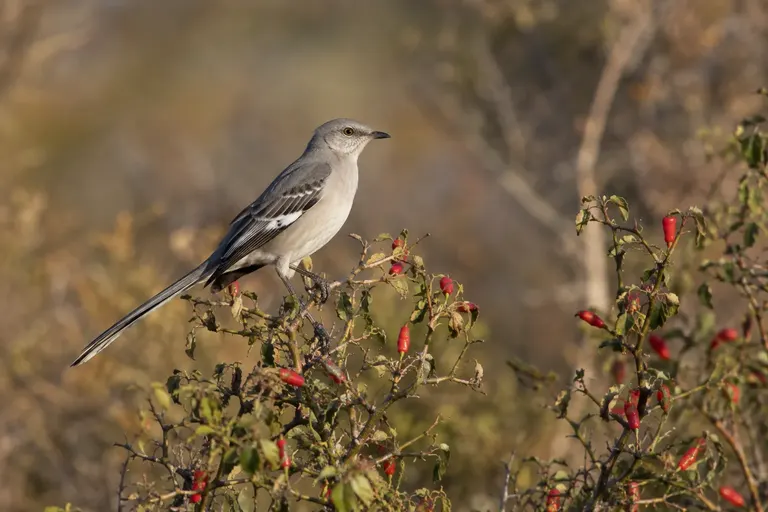
How do birds perch without falling when asleep? They stay put because their legs are built to hold on with very little effort. The tendons that close the toes pass behind the ankle, so when a bird settles into a crouch its own weight pulls the toes tight around the branch. Many perching birds add a ratchet-like tendon lock, and they combine all of this with excellent balance and a brain that can stay partly on guard while it rests.
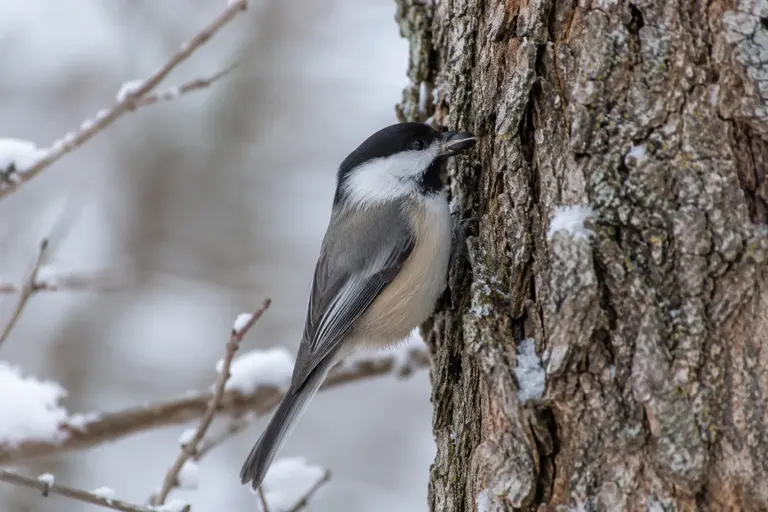
It is one of the neatest pieces of engineering in the bird world, and it explains why a chickadee can doze through a windy January night on a twig no thicker than a pencil. The full answer involves anatomy, physics and some surprising discoveries about how birds sleep.
Quick answer: why sleeping birds do not fall
- Crouch-to-grip tendons: bending the leg tightens the toe tendons, so sitting down closes the foot.
- Tendon lock: in many songbirds, tiny ridges on the tendons catch in folds of their sheath, helping hold the grip without constant muscle work.
- Low center of gravity: a sleeping bird crouches with its belly close to the perch, which makes it more stable.
- Balance sensors: the inner ear and a special balance organ in the lower spine help trigger fast, automatic corrections.
- Half-alert sleep: many birds can rest one half of the brain while the other stays more watchful.
- Short sleep bouts: birds tend to sleep in brief stretches and wake often, so slips get caught quickly.
How does a bird’s foot grip a branch without effort?
Look at a bird’s leg and the part that looks like a backward knee is actually its ankle. Birds walk on their toes. The long bare section above the foot, the tarsometatarsus, is made of fused bones that correspond roughly to the bones of your foot. The real knee is hidden up against the body, under the feathers.
The muscles that curl the toes sit high on the leg, near the body, where their weight does not make flying harder. Long flexor tendons run from those muscles down the back of the leg, around the back of the ankle joint and along the underside of each toe. This routing is the key.
When a bird bends its leg to crouch, the ankle joint folds. Because the tendons wrap around the back of that joint, folding it increases the distance they have to travel. The tendons are effectively stretched, and they pull on the toes, curling them closed. The more the bird sinks down, the harder the toes are drawn around the perch.
You can see a similar effect in your own hand. Bend your wrist forward and your fingers tend to curl slightly, because the finger tendons are pulled across the bent joint. In a bird, the arrangement is much more pronounced and very efficient.
Why is the passive grip so useful?
Holding a muscle contracted all night costs energy, and small birds have little energy to spare after dark. A songbird can lose a significant share of its body weight overnight in winter just keeping warm. A grip that comes mostly from body weight and tendon geometry, rather than from constant muscle work, frees that energy for staying alive until morning.
What is the tendon locking mechanism?
In many perching birds, especially songbirds, there is a second feature working with the tendon routing. Along the underside of the toes, the flexor tendons carry rows of small, rigid bumps or ridges. The tendon sheath that surrounds them has matching pleats or folds.
When the toes are flexed and the bird’s weight presses down, the ridges on the tendon can engage the folds in the sheath, a bit like the teeth of a zip tie or a cable tie catching. Once engaged, the tendon resists sliding back, which helps keep the toes closed with little muscle effort. Anatomists call this the tendon locking mechanism.
This lock has been described in detail in many songbirds and in a range of other birds. It tends to be well developed in birds that spend a lot of time perched and holding on, and weaker or absent in groups such as many shorebirds and waterfowl, which rarely perch on thin branches.
Does the lock really stop sleeping birds from falling?
The popular version of the story says birds are simply “locked” onto branches and could not fall even if they tried. The real picture is more nuanced. Experimental work on European Starlings suggests the passive grip and tendon lock are not strong enough on their own to hold a limp bird on a perch. Anesthetized birds, whose balance reflexes were switched off, did not reliably stay perched, which points to balance and posture as essential partners.
So the best current reading is that the tendons make gripping cheap and secure, while the bird’s balance system does the fine work of staying upright. The two together are what keep a sleeping bird in place.
How do birds keep their balance while they sleep?
Staying on a perch is as much about balance as grip. A crouched bird is naturally stable: its belly drops close to the branch and its center of gravity sits low and directly over its feet. Fluffing the feathers adds insulation without shifting that balance much.
Birds also have unusually good balance hardware. Like us, they have a vestibular system in the inner ear that senses tilt and movement. They also appear to have a second balance sensor in the lower spine, in the region called the lumbosacral area, where fluid-filled channels and specialized tissue may detect body rotation. Researchers think this helps birds keep steady while walking and perching, quite separately from the head, which birds often move independently.
These sensors feed into fast reflex loops. If a gust rocks the branch, the leg and tail muscles make tiny adjustments without the bird needing to wake fully. You can sometimes see this on a windy evening: a roosting bird sways with the branch, its body shifting slightly while its head stays tucked and still.
Does the tail help?
For many birds, yes. The tail acts as a counterweight and a stabilizer, and some birds press it against the perch or trunk for support. Woodpeckers are the extreme example. Their stiff tail feathers brace against the bark like the third leg of a tripod, which lets them sleep clinging vertically inside roost holes. For more on how these birds use their bodies, see our guide to why woodpeckers peck wood.
Do birds sleep with half their brain awake?
Many do, and it is one of the most striking findings in sleep research. Birds show two main kinds of sleep, broadly similar to ours: slow-wave sleep and rapid eye movement (REM) sleep. What is unusual is that birds can have slow-wave sleep in one half of the brain while the other half is more awake. This is called unihemispheric slow-wave sleep.
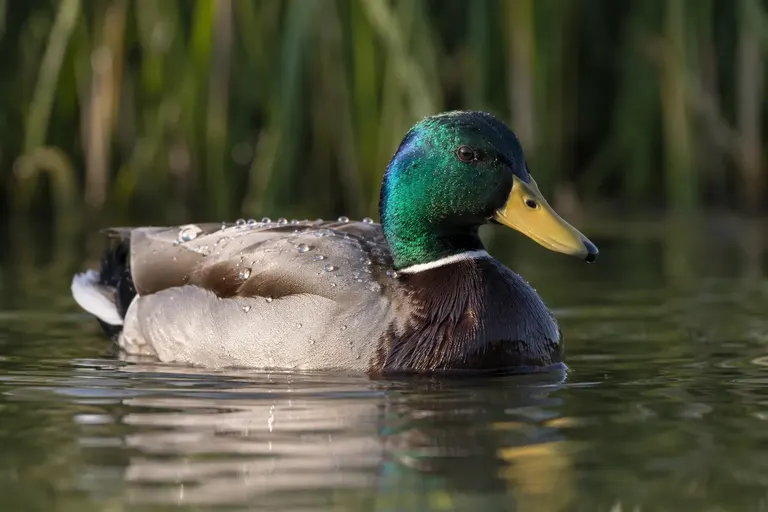
The eye connected to the more awake half often stays open. In a well-known study of Mallards sleeping in a row, the ducks at the exposed ends kept their outward-facing eye open far more often than the ducks in the protected middle. They were resting while keeping watch toward the side where danger was most likely to come from.
Later research on Great Frigatebirds, seabirds that stay aloft over the ocean for weeks, found they can sleep in flight in short bursts, sometimes with one hemisphere and sometimes with both. They slept far less in the air than on land, often only minutes a day, which shows how flexible bird sleep can be.
What happens during REM sleep on a perch?
REM sleep is the phase when muscle tone typically drops. In birds, REM bouts are generally very short, often only seconds long, which limits the risk of slumping off a perch. During REM, some birds’ heads may droop slowly, then the bird rights itself. Short bouts, a stable crouch and a passive grip mean that even the most relaxed phase of sleep does not leave them hanging by a thread.
Do all birds sleep perched on branches?
No. Perching in a crouch is typical of songbirds and many other tree-dwelling birds, but sleeping positions vary widely across the world’s birds.
| Sleeping style | Examples | How they stay put |
|---|---|---|
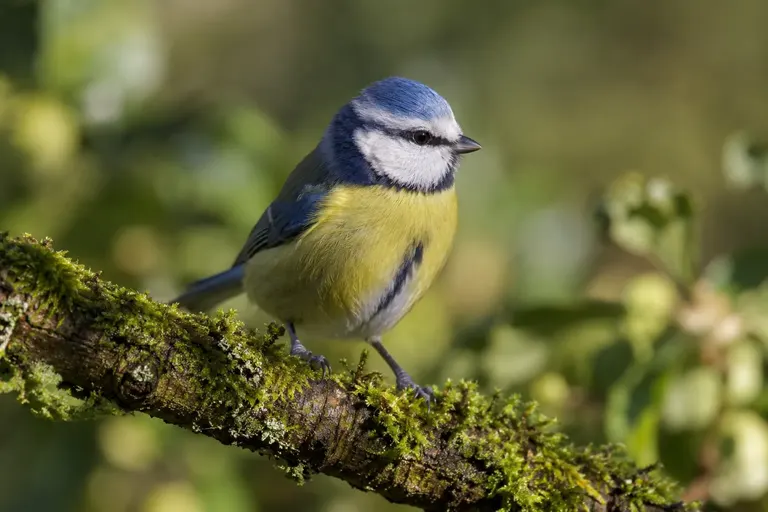
| Crouched on a branch | Northern Cardinal, European Robin, sparrows, Great Tit | Tendon grip, tendon lock, balance |
| Clinging vertically | Woodpeckers, nuthatches, treecreepers | Strong claws plus tail brace or grip |
| Standing on one leg | Herons, flamingos, gulls, many shorebirds | Leg posture that needs little muscle effort, balance |
| Floating on water | Ducks, geese, swans, grebes | Buoyancy, some paddle to hold position |
| Hanging upside down | Hanging parrots of South and Southeast Asia | Grip on a twig, body hanging beneath |
| Clinging to walls or cavities | Chimney Swifts, Common Swifts roosting off the wing | Sharp claws on rough surfaces |
| In the air | Common Swifts, frigatebirds | Short sleep bouts while gliding |
| Communal huddles | Long-tailed Tits, Eastern Bluebirds in boxes | Shared body heat, sheltered spot |
Flamingos and many wading birds are worth a closer look. Studies on flamingos suggest that standing on one leg may need less active muscle effort than standing on two, because of how the leg joints line up under the body. It also reduces heat loss through bare legs. Our article on why birds stand on one leg explains this in more depth.
Where do birds actually sleep at night?
Most birds do not sleep in nests. Nests are for eggs and chicks, and adults generally leave them once the young fledge. At night most small birds pick a roost: a sheltered branch deep in a hedge, a dense conifer, a tangle of vines, a tree cavity or a nest box. For the full picture, read our guide to whether birds sleep in nests.
Good roost sites have a few things in common:
- Shelter from wind and rain. Dense evergreen foliage cuts wind chill.
- Protection from predators. Thorny shrubs and thick cover make it hard for owls, cats and martens to reach sleeping birds.
- A suitable perch size. Small birds prefer thin twigs they can wrap their toes around fully.
- Consistency. Many birds return to the same roost for weeks.
Some species roost together. Winter flocks of starlings and corvids can gather in the tens of thousands, while wrens and treecreepers in Europe sometimes pack into a single cavity on very cold nights to share warmth. Birds in cold climates also use fluffed feathers, reduced blood flow to the feet and in some cases controlled drops in body temperature to get through the night, as covered in our piece on how birds stay warm in winter.
Don’t birds’ feet freeze while they sleep?
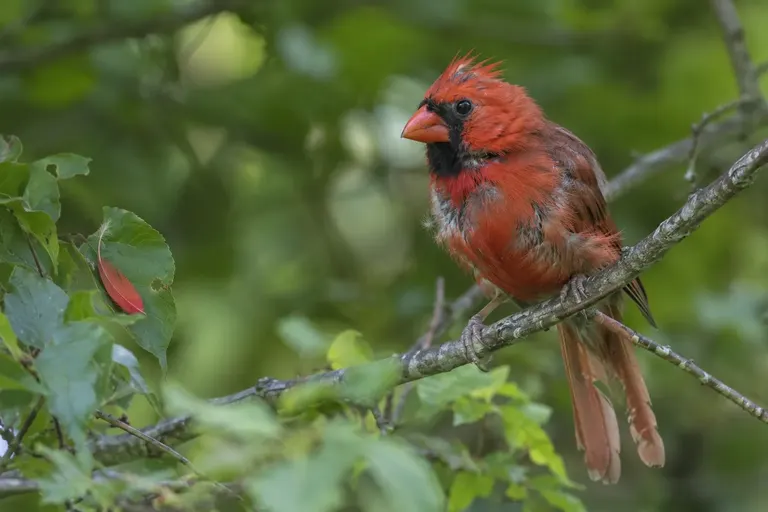
Rarely, even in hard winters. A sleeping bird on a branch in freezing weather typically sinks down so its belly feathers cover most of its feet. The feet themselves contain little muscle and are made mostly of tendon, bone and tough skin, which need less warmth. A counter-current heat exchange system in the legs, where warm arteries run alongside cold veins, keeps heat in the body and lets the feet run cool without being damaged.
This is another place where the passive tendon grip pays off. Because the toe muscles sit high up in the warm body rather than in the feet, the grip keeps working even when the feet themselves are very cold.
Myths vs facts about sleeping birds
Myth: Birds are locked onto perches and cannot fall. Fact: The tendon system makes gripping cheap and firm, but balance is essential. Research suggests a limp bird without working reflexes will not reliably stay on a perch.
Myth: Birds sleep in their nests every night. Fact: Most adult birds roost away from the nest. Only incubating or brooding parents, and some cavity-roosting species, regularly sleep in or near a nest.
Myth: A bird with its head tucked under its wing is sleeping deeply. Fact: Birds usually tuck the head into the back feathers, not under the wing. They may be deeply asleep, lightly dozing or in half-brain sleep with one eye open.
Myth: Birds that sleep on one leg are cold or injured. Fact: One-legged resting is a normal posture for many birds and helps conserve heat and possibly energy.
Myth: Only ducks can sleep with one eye open. Fact: Unihemispheric sleep has been recorded across many bird groups, from songbirds to seabirds, as well as in some marine mammals.
How long do birds sleep each night?
It depends on species, season and latitude. Many songbirds sleep roughly from dusk to dawn, which means long nights in winter and short ones in summer. Near the poles in summer, birds may get only a few hours of darkness and sleep in shorter, scattered bouts.
Unlike humans, birds do not usually sleep in one long block. Their sleep is broken into many short bouts, with frequent brief awakenings to check surroundings. REM episodes are especially short. This pattern helps explain how a sleeping bird can react quickly to a slip or a threat.
During the breeding season some birds sleep less, and during migration many songbirds that normally sleep at night fly after dark instead. Research on migratory songbirds suggests they compensate with short naps during the day, including micro-sleeps lasting seconds.
What does this mean for backyard birders?
Knowing how birds sleep can help you give them better nights in your yard.
Plant or keep dense evergreen cover
Birds need safe, sheltered roosts close to where they feed. Dense conifers such as spruce, fir, juniper and holly, or thick native hedges like hawthorn in Europe, give wind protection and cover from predators. A brush pile in a quiet corner can also offer shelter for sparrows, wrens and juncos on cold nights.
Offer thin perches near feeders
Small birds grip best on branches they can wrap their toes around. Natural twigs of varying thickness near your feeders give birds places to pause and rest between visits. Placement matters too, as covered in our guide to where to put a bird feeder.
Leave nest boxes up in winter
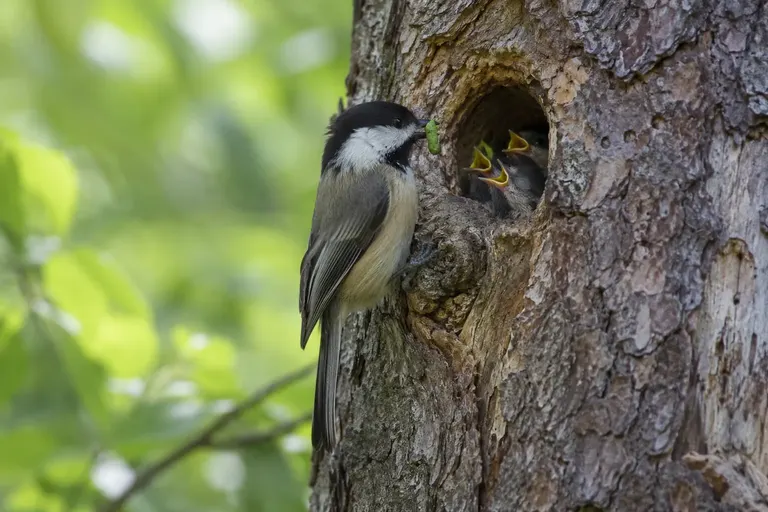
Many cavity-nesting birds, including chickadees, tits, bluebirds and wrens, roost in nest boxes during cold weather. Cleaning out old nesting material after the breeding season and leaving boxes up gives them a snug place to sleep.
Keep predators and lights in mind
Outdoor cats are one of the main threats to roosting and ground-feeding birds. Keeping cats indoors, as discussed in cats and birds: keeping your yard safe, protects birds at night as well as by day. Bright outdoor lighting left on all night can also disturb roosting birds, so motion-activated or shielded lights are kinder.
Do not panic if a bird seems asleep at a feeder
A small bird fluffed up and dozing on a perch during the day may simply be resting. However, a bird that sits fluffed, sluggish and unresponsive for long periods, especially at a feeder, can be sick. Our guide to sick birds at the feeder explains the warning signs.
Common questions from observant watchers
Why does a sleeping bird look so round?
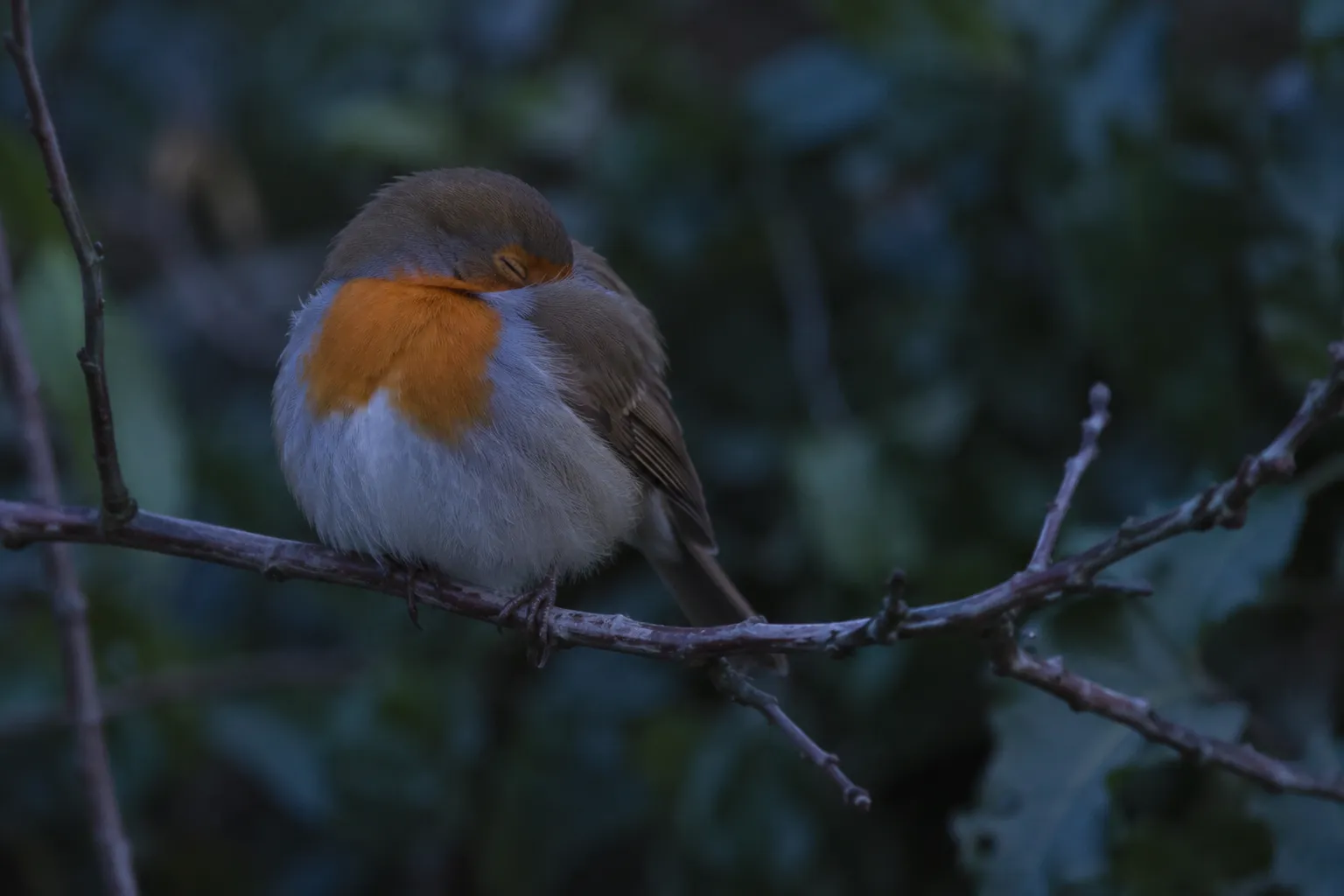
When a bird sleeps it fluffs its feathers to trap an insulating layer of air, drops its body onto its feet and turns its head back, often pushing the bill into the feathers of its back. The result looks like a round ball of feathers with no visible legs or head. The pose saves heat and also keeps the body low and stable on the perch.
Why do some birds bob or sway while asleep?
Bobbing and swaying are usually the balance system at work, correcting for small movements of the branch. It is a sign the reflexes are doing their job, not that the bird is about to fall.
Can baby birds perch while they sleep?
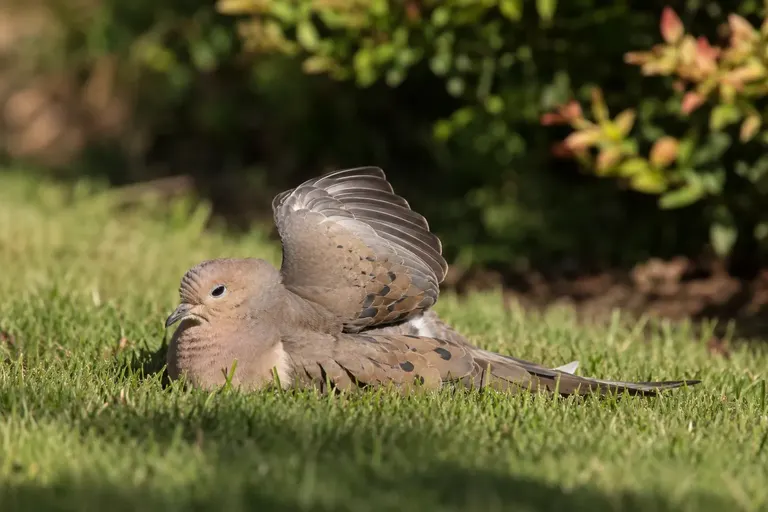
Fledglings can perch, but their grip and balance are less refined than an adult’s. Young songbirds often sit close together on a branch after leaving the nest and sometimes wobble. Parents choose sheltered spots and keep feeding them while they gain strength and coordination.
Quick facts
- The joint that looks like a bird’s backward knee is actually its ankle.
- Toe tendons run behind the ankle, so crouching pulls the toes closed.
- Many songbirds have a tendon locking mechanism with ridges that catch in the tendon sheath.
- Experiments suggest balance reflexes are essential; the grip alone is not enough.
- Birds may sense balance with both the inner ear and a special organ in the lower spine.
- Many birds can sleep with one half of the brain while the other half stays more alert.
- Great Frigatebirds have been recorded sleeping in flight in short bursts.
- REM sleep in birds typically lasts only seconds per bout.
- Most adult birds sleep in roosts, not nests.
Sources
Frequently asked questions
Why don't birds fall off branches when they sleep?
Several systems work together. The tendons that curl a bird's toes run behind the ankle, so when a bird crouches its toes are pulled closed around the perch. Many perching birds also have a ridged tendon and sheath that can catch like a ratchet. On top of that, birds balance with constant small corrections, and many keep part of the brain alert during sleep.
Do birds lock their feet when they sleep?
Partly. Songbirds and many other perching birds have a tendon locking mechanism: tiny ridges on the toe tendons can engage folds in the surrounding sheath, helping hold the toes closed with little muscle effort. Research suggests this helps but is not the whole story. Balance and posture matter at least as much, and the lock is released easily when the bird stands up.
Can birds sleep with one eye open?
Yes. Many birds can sleep with one half of the brain while the other half stays more awake, keeping the eye connected to the alert half open. Studies of Mallards showed that ducks at the exposed end of a row kept the outward-facing eye open more often, watching for predators while the rest of the body slept.
Do birds sleep standing up?
Many do. Songbirds usually sleep crouched on a perch, while herons, gulls, flamingos and shorebirds often sleep standing on the ground or in shallow water, frequently on one leg. Others sleep lying down, floating on water, clinging to walls like swifts, or hanging upside down, as some parrots called hanging parrots do.
What happens if a bird falls asleep and slips?
Occasionally birds do lose their footing, especially young or sick birds. In healthy adults, the balance system and fast reflexes normally catch a slip before it becomes a fall. Because bird sleep comes in short bouts and is often shallow on one side of the brain, a sleeping bird can wake and correct its grip in a fraction of a second.