Why Do Birds Sunbathe? What Those Odd Poses Mean
Why do birds sunbathe? To warm up cheaply, help feathers dry and settle, and likely to flush out feather lice and mites. What the odd sunning postures mean.
In this article
- Quick answer: why birds sunbathe
- What does sunbathing look like?
- Do birds sunbathe to get warm?
- Do birds sunbathe to kill parasites?
- Do birds sunbathe to dry their feathers?
- Does sunbathing help feathers?
- Do birds get vitamin D from sunbathing?
- Which birds sunbathe?
- When do birds sunbathe most?
- Why do birds sunbathe in hot weather?
- Can birds get sunburned?
- Is a bird lying on the ground with wings spread OK?
- Myths vs facts about bird sunbathing
- What does this mean for backyard birders?
- Common mistakes when you see a sunbathing bird
- Quick facts
- Sources
- Frequently asked questions
Why do birds sunbathe? Mainly to warm up, care for their feathers and control feather parasites. Basking gives a bird free heat, which saves energy on cool mornings. Spreading the wings and raising the feathers also helps wet plumage dry, may help feathers settle into shape, and is thought to make feather lice move around so the bird can remove them by preening. Some birds, oddly, sunbathe most on hot days, which points to the parasite explanation.
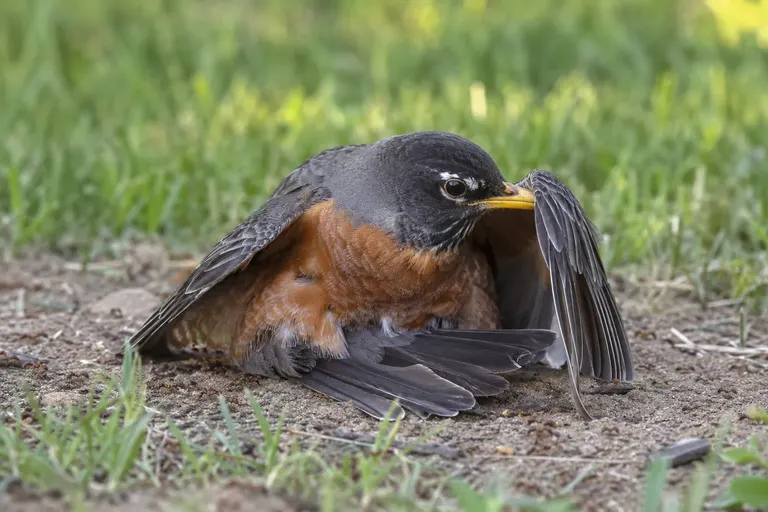
The postures can look alarming, with birds sprawled on the ground, wings spread and bills open, but sunbathing is a normal and widespread behavior. This guide explains the science, the main postures, which birds do it around the world, and what to do if you find a bird that looks stunned on your lawn.
Quick answer: why birds sunbathe
| Reason | How it helps | Best evidence |
|---|---|---|
| Warming up | Absorbs solar heat and saves energy | Strong for roadrunners, vultures, many songbirds |
| Drying feathers | Speeds drying after rain or bathing | Strong for cormorants and anhingas |
| Feather parasite control | Heat makes lice move, and preening removes them | Supported by several studies |
| Feather maintenance | May help reshape feathers and spread preen oil | Plausible, less tested |
| Vitamin D | UV may convert compounds in preen oil | Uncertain in wild birds |
| Relaxation or comfort | Birds may look almost trance-like | Observational only |
What does sunbathing look like?
Sunbathing, also called sunning, comes in several recognizable postures. The same bird may shift between them in one session.
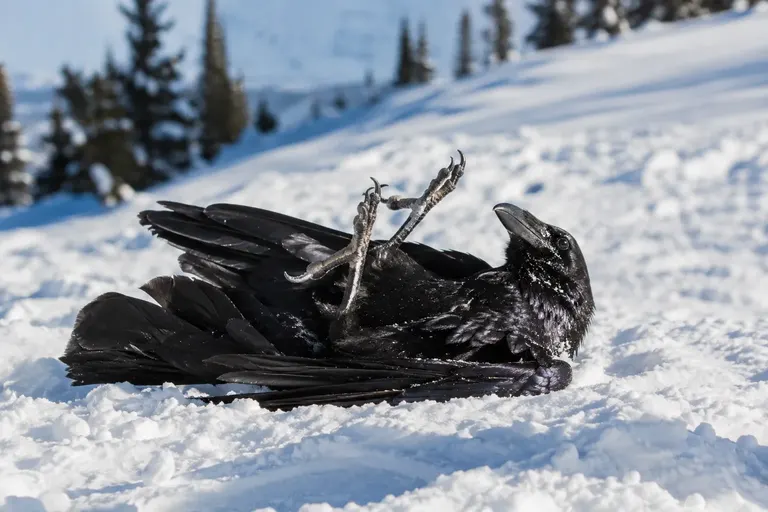
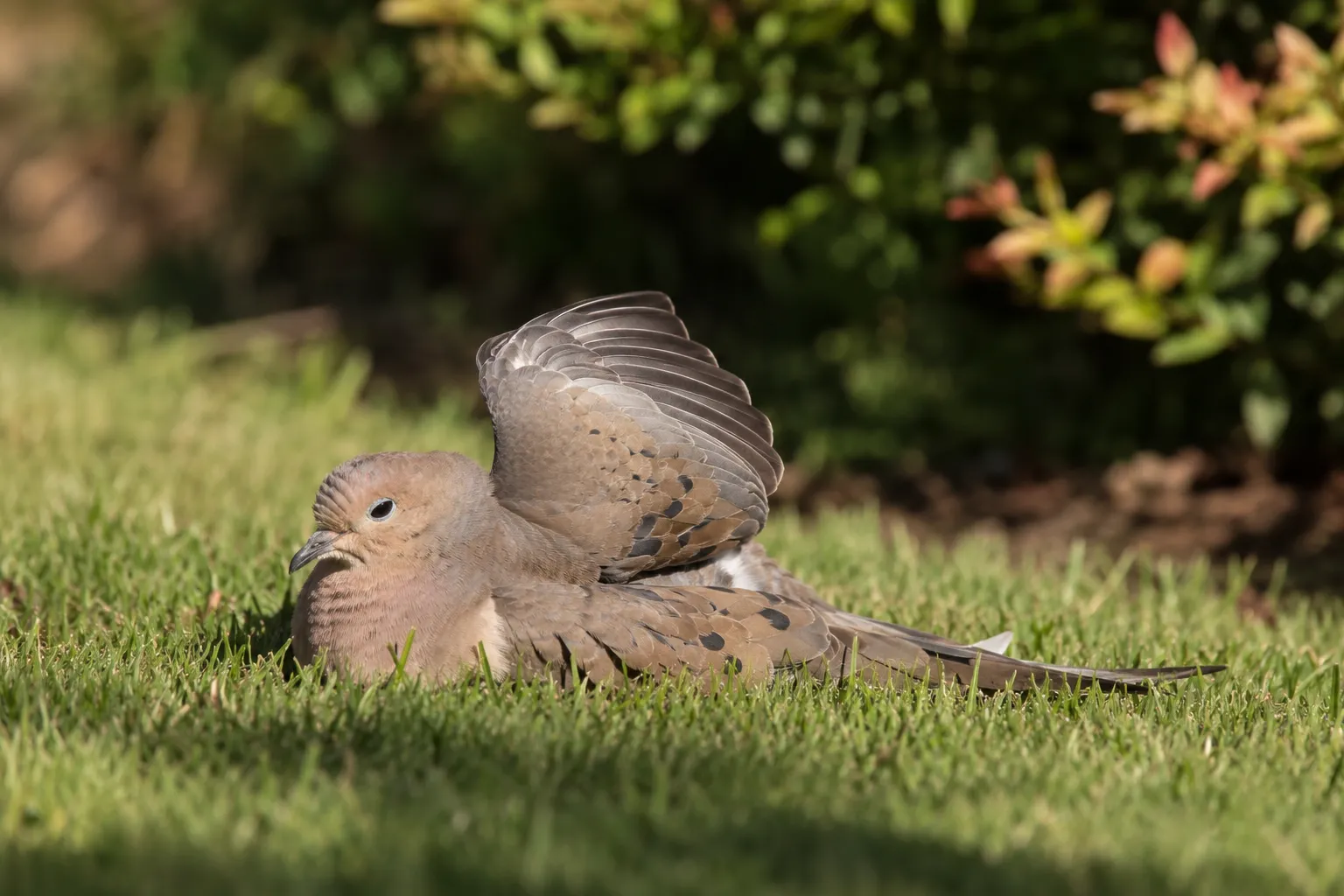
- Lateral posture. The bird leans or lies on one side, raises the wing facing the sun and fans it, often tilting the head so one eye points upward. Doves, robins, blackbirds and sparrows often do this.
- Spread-eagle posture. The bird lies flat on its belly with both wings spread and tail fanned, feathers raised. It can look as if it has fallen from the sky.
- Upright wing-spread. The bird perches upright and holds its wings open, like a vulture or cormorant drying its wings.
- Back to the sun. On cold mornings, many birds simply perch with their back to the sun and feathers slightly raised, soaking up heat without dramatic spreading.
Many sunbathing birds keep the bill open and may pant, and some seem dazed, with half-closed eyes and little reaction to nearby movement. Some observers describe this as a trance-like state. The bird usually snaps out of it quickly if a threat approaches.
Do birds sunbathe to get warm?
Yes, and this is the most intuitive reason. Staying warm is expensive for birds, especially small ones with a high body temperature and little room for fuel. Sunshine is free heat. By exposing dark feathers or skin to the sun, a bird can raise its temperature with less shivering and less burning of fat.
The roadrunner’s solar panel
The Greater Roadrunner of the southwestern United States and Mexico is the classic example. On cold mornings, it turns its back to the sun and raises the feathers on its back, exposing patches of dark skin. Dark skin absorbs sunlight efficiently, so the bird warms up quickly after a cold desert night.
Vultures and the morning spread
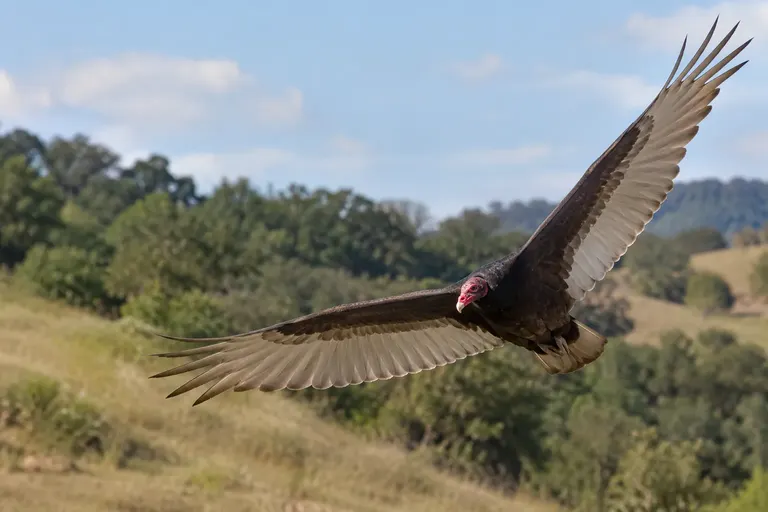
Turkey Vultures and Black Vultures often perch on dead trees, towers or rooftops with wings spread wide, especially on cool or damp mornings. Turkey Vultures are known to let their body temperature drop at night, so morning sunning helps them warm up before they launch into the rising thermals they use for soaring. The spread-wing posture may also dry the feathers and possibly help sanitize them after feeding on carcasses, though that last idea is less well tested.
Small birds in winter
Chickadees, tits, finches and sparrows often perch in sunny, sheltered spots on cold mornings. The saving may be small each time, but over a winter day it adds up. Our guide to how birds stay warm in winter explains why every bit of energy counts.
Do birds sunbathe to kill parasites?
This is one of the leading explanations, and it helps explain a puzzle: many birds sunbathe on hot summer days when they clearly do not need extra warmth.
Feather lice live on the plumage, chewing feathers and skin debris. They are sensitive to heat. The idea is that when a bird raises its feathers and exposes them to intense sun, the rising temperature drives lice to move, often away from the hot surface toward cooler areas of the plumage. Mobile lice may be easier for the bird to find and remove when it preens afterward. In high enough heat, some lice may be harmed directly.
Several studies have supported parts of this idea, including experiments showing that feather lice are affected by the temperatures reached on sun-exposed feathers. But sunbathing alone does not eliminate parasites; birds also rely on preening, bathing and, in some cases, dust bathing and anting. See why birds take dust baths and what is anting in birds.
Do birds sunbathe to dry their feathers?
For some waterbirds, drying is a major reason. Cormorants and the Anhinga are the famous examples. Unlike ducks, their outer feathers are partly wettable, which is thought to reduce buoyancy and help them dive and chase fish underwater. The trade-off is that they get soaked, so after fishing they perch with wings spread to dry.
The Anhinga, a bird of warm wetlands in the southeastern United States and Central and South America, also has a relatively low metabolic rate for its size, so sunning is thought to play an important role in warming as well as drying. You will often see Anhingas and cormorants holding their wings out on a snag in the midday sun.
Other birds sun themselves after bathing or rain. Drying feathers quickly restores their insulating and flight performance.
Does sunbathing help feathers?
Possibly in several ways, although these ideas are harder to test.
- Reshaping feathers. Heat may help feathers relax and settle back into shape, especially feathers that have been bent or ruffled.
- Spreading preen oil. Warmth might make preen oil flow more easily over the feathers during the preening that often follows a sunning session.
- Molt comfort. Some observers report more sunbathing during molt, when new feathers are growing and the skin may be itchy. This is plausible but not well quantified. Most songbirds replace their feathers once a year after breeding, and the growing feathers emerge from waxy sheaths that birds pick away while preening, so any behavior that helps loosen that debris or soothe the skin could be useful at this time of year.
There is a cost too. Ultraviolet light can degrade feathers over time, and pale feathers seem more vulnerable than dark ones. That trade-off may help explain why birds do not sunbathe constantly.
Do birds get vitamin D from sunbathing?
This idea is often repeated, so it deserves a careful answer. Birds need vitamin D for calcium metabolism, which matters for bones and eggshells. In many animals, ultraviolet B light on the skin helps produce vitamin D. For birds, a long-standing hypothesis holds that preen oil contains precursor compounds that UV light converts into vitamin D on the feathers, and that birds then ingest it while preening.
Research on domestic poultry and captive birds shows that UV light does influence vitamin D status in birds. What remains uncertain is how much vitamin D wild birds actually get through sunbathing compared with their diet and ordinary daylight exposure. It is fair to say vitamin D might be a benefit, but it is not proven to be a main reason birds sunbathe.
Which birds sunbathe?
Sunbathing has been recorded in a very wide range of birds. Some of the most commonly observed include:
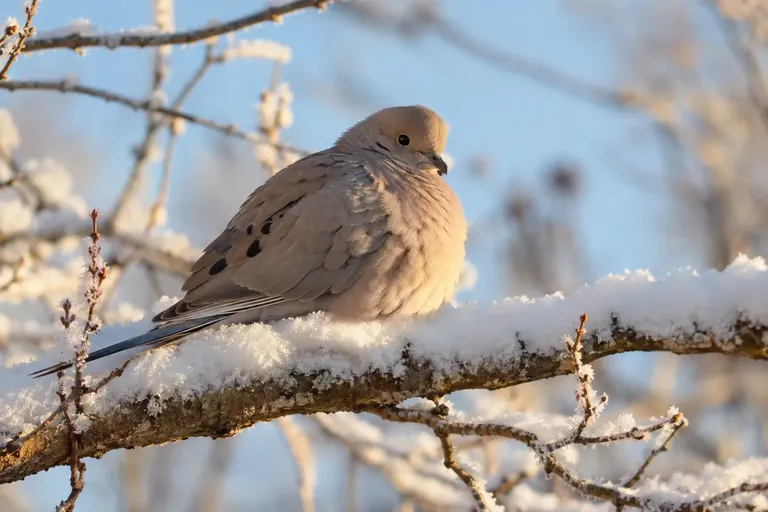
- Doves and pigeons. Mourning Doves, Rock Pigeons, Eurasian Collared Doves and many others lean over with one wing raised. Our Mourning Dove guide describes these common backyard birds.
- Thrushes. American Robins in North America, and Eurasian Blackbirds and Song Thrushes in Europe, often sprawl on lawns in sun.
- Sparrows and finches. House Sparrows sunbathe frequently, often right after dust bathing.
- Jays and crows. Blue Jays and many other corvids sunbathe in striking spread-wing postures, and some also ant.
- Hoopoes. Found from Europe and Turkey across Africa and Asia, Hoopoes are known for sunning with wings and tail spread flat on the ground.
- Waterbirds. Cormorants, anhingas and darters hold wings out to dry and warm.
- Raptors and vultures. Vultures, many hawks and some falcons sun themselves, especially in the morning.
- Roadrunners. They expose dark skin patches to the sun.
In Brazil and other tropical regions, observers regularly report sunbathing in species such as thrushes, doves and tanagers, showing that it is not just a cold-climate behavior. Common tropical garden birds such as the Rufous-bellied Thrush and the Ruddy Ground Dove are among the species people in Brazil often notice sprawled in the sun, and in Turkey and around the Mediterranean, Laughing Doves and House Sparrows are frequent sunbathers on rooftops and walls.
When do birds sunbathe most?
Observers and researchers have noticed several patterns, and they line up with the different purposes of sunning.
- Cool, sunny mornings. Warming-up sunbathing is most obvious early in the day, after a cold night, when birds perch with backs to the sun or spread their wings on exposed perches. Vultures, roadrunners and many songbirds follow this pattern.
- Hot, bright afternoons. Some of the most dramatic spread-eagle sunbathing happens in strong summer sun, when birds clearly do not need warmth. This is the pattern that best fits the parasite and feather-care explanations.
- After rain or bathing. Birds often sun right after a bath or a shower, which fits the drying explanation.
- Sudden sunshine. Many observers report that birds start sunbathing when the sun comes out after a long overcast spell, as if taking advantage of a brief opportunity.
- Late summer. Sunbathing is often reported more during the late-summer molt, when many birds are growing new feathers.
Sessions are usually short, often a few seconds to a few minutes, and a bird may repeat them several times in an afternoon. Longer sessions tend to end with panting and a move into shade.
Why do birds sunbathe in hot weather?
At first glance, lying in the blazing sun on a hot day seems like the last thing a bird should do. Birds cannot sweat, and overheating is a real danger. Yet sunbathing in heat is widely documented, which is one of the strongest clues that sunning is about more than temperature.
The parasite hypothesis fits best. Feather surfaces in direct summer sun can become much hotter than the air, hot enough to stress lice living in the plumage. A short burst of heat may be enough to get lice moving, and the bird can then preen them out. Birds seem to manage the trade-off by keeping sessions brief, gaping and panting to shed heat, and retreating to shade as soon as they have finished.
Can birds get sunburned?
There is little evidence that sunburn is a meaningful problem for most wild birds. Feathers block most sunlight from reaching the skin, and exposed skin on the legs, face and bill is usually protected by scales, pigment or thickened tissue. Sunbathing birds expose skin only briefly. Feathers themselves can fade and weaken with long ultraviolet exposure, which is one of the reasons plumage wears out and must be replaced during molt. Birds are also able to see ultraviolet light, which is used in signaling; see can birds see ultraviolet light.
Is a bird lying on the ground with wings spread OK?
In most cases, yes. It is common for people to find a bird lying flat on a lawn, patio or rooftop, wings out, feathers ruffled and bill open, and assume it is injured or dying. Here is how to tell.
Signs it is simply sunbathing
- It is in a sunny spot, often in a sheltered corner or near cover.
- It rights itself quickly and flies or hops away when you approach.
- It looks alert once disturbed, with normal posture and movement.
- It preens or shakes after the session.
Signs it may need help
- It cannot stand, hop or fly when you approach closely.
- It stays in the same spot for a long time, including after the sun moves.
- It has obvious injuries, blood, a drooping wing or a head tilt.
- It is near a window, which might suggest a collision rather than sunning.
If you are concerned, watch from a distance first. If the bird still cannot move, see what to do with an injured bird and contact a licensed wildlife rehabilitator.
Myths vs facts about bird sunbathing
Myth: A bird sprawled on the ground must be hurt. Most are sunning and will fly off normally.
Myth: Birds sunbathe only when cold. Many sunbathe in hot weather, which supports the parasite and feather-care explanations.
Myth: Sunbathing is a well-proven vitamin D source. That remains a hypothesis for wild birds.
Fact: Some birds use sunning as solar heating. Roadrunners and vultures are strong examples.
Fact: Cormorants spread their wings largely to dry. Their wettable feathers help them dive but leave them soaked.
What does this mean for backyard birders?
- Leave some sunny open ground. A patch of lawn, bare soil or a flat rock in the sun, near but not right against cover, gives birds a safe place to sun and dust bathe.
- Keep cats indoors. Sunbathing and dust-bathing birds are distracted and vulnerable. See cats and birds.
- Avoid lawn chemicals. Birds that lie on grass and soil can pick up residues on their feathers.
- Offer water. Birds often bathe, then sun. A clean birdbath gives them the first step.
- Enjoy the show. Sunbathing is a rewarding behavior to watch and photograph from a distance. Our guide to reading bird behavior covers other postures.
Common mistakes when you see a sunbathing bird
- Rushing over to “rescue” it. This interrupts a normal behavior and stresses the bird.
- Picking it up to check. Wild birds should not be handled unless clearly injured, and in many countries handling protected species needs a permit.
- Offering food or water directly. A healthy sunning bird does not need it.
- Assuming a gaping bird is choking. Panting is how birds cool down.
Quick facts
- Sunbathing is also called sunning.
- Common postures include one wing raised, both wings spread flat, or upright wing-spreading.
- Roadrunners expose dark skin to absorb heat on cold mornings.
- Turkey Vultures spread wings in the morning to warm up and dry off.
- Cormorants and anhingas have partly wettable feathers and sun to dry.
- Heat can drive feather lice to move, making them easier to remove.
- The vitamin D role in wild birds is uncertain.
- Birds may pant with bills open while sunbathing; it is a cooling response.
Sources
Frequently asked questions
Why do birds spread their wings in the sun?
Spreading the wings and raising the feathers exposes the skin and the undersides of the feathers to direct sunlight. This warms the bird with little metabolic cost, helps wet feathers dry, may help reshape feathers, and is thought to drive feather lice to move so they can be removed by preening. The exact mix of reasons varies by species and weather.
Is a bird lying on the ground with wings spread hurt?
Usually not. Sunbathing birds often lie flat with wings and tail spread, feathers raised and bill open, and may look dazed or even dead. If the bird rights itself and flies off when you approach, it was simply sunning. A bird that cannot stand, fly or move away may need help from a wildlife rehabilitator.
Why do birds sunbathe with their mouths open?
Sunbathing birds often gape or pant because they are absorbing a lot of heat. Birds cannot sweat, so they cool themselves by panting or fluttering the throat, which evaporates water from the mouth and airways. An open bill during sunbathing is normal and usually means the bird is getting warm while holding the sunning posture.
Do birds sunbathe to get vitamin D?
Possibly, but this is not well established. One long-standing idea is that sunlight converts compounds in preen oil into vitamin D, which birds then swallow while preening. Birds certainly need vitamin D, and ultraviolet light helps many species make it, but how much sunbathing contributes in wild birds is uncertain.
Why do vultures spread their wings in the morning?
Turkey Vultures and Black Vultures often perch with wings spread wide after cold nights or rain. This posture is thought to warm the body, dry the feathers and possibly bake off bacteria picked up while feeding on carcasses. Vultures let their body temperature drop at night, so morning sunning helps them warm up before they take off to soar.