Why Do Birds Fly Into Windows?
Why do birds fly into windows? Glass reflects sky and trees or looks like open space, and birds have no instinct for it. Here is the science and what helps.
In this article
- Quick answer: the four reasons birds hit glass
- Why can’t birds see glass?
- Why do reflections fool birds so well?
- Why do birds hit windows they can see through?
- How much of a problem is it?
- Why do birds hit windows more in spring and autumn?
- Why does a bird keep attacking my window?
- What happens to a bird after it hits a window?
- Myths vs facts about birds and windows
- What does this mean for backyard birders?
- Quick facts
- Sources
- Frequently asked questions
Birds fly into windows because, to a bird, glass does not look like a barrier. A window either reflects sky and trees, so it looks like more open habitat, or it is transparent, so the bird sees a clear path to plants, sky or another window beyond. Birds evolved in a world with no glass, so nothing warns them a hard surface is there. In the United States, building collisions kill an estimated 365 million to 988 million birds a year.
That single fact explains most collisions. The rest of the story is about where birds look while they fly, why some windows are far more dangerous than others, why the problem peaks in spring and autumn, and why a cardinal pecking at your glass is doing something completely different from a warbler that hits it at full speed. If you want the practical fixes in detail, our guide on how to stop birds hitting windows covers them step by step. This article explains the why.
Quick answer: the four reasons birds hit glass
- Reflection. Glass mirrors trees, shrubs and sky. A bird flying toward the reflection sees a place to land or fly through.
- Transparency. Clear glass shows what is behind it: houseplants, a garden on the other side of a glassed corner, or open sky through two aligned windows.
- Light at night. Artificial light draws in and confuses birds migrating in the dark, which then end up among buildings.
- Territorial attacks. In breeding season, some birds fight their own reflection. That is repeated pecking and fluttering, not a single high-speed crash.
Why can’t birds see glass?
Nothing in nature behaves like a window. Water reflects, but it lies flat and birds rarely need to fly through it. Open gaps between trees are real gaps. Glass is the only common object that is both solid and either invisible or a convincing picture of somewhere else. Birds have had a few centuries of exposure to large panes of glass, which is no time at all in evolutionary terms, and there is no evidence that any species has developed a reliable way to detect it.
Human eyes are not much better at it, in fact. People walk into clean glass doors often enough that businesses put stickers on them. We simply move slowly and have learned, culturally, where glass tends to be. A bird crossing a garden at 20 to 30 miles an hour has neither advantage.
Is it a problem with how birds see?
Partly, yes. Bird eyes are superb in many ways, including sharp detail at a distance in raptors, fast motion processing and, in many species, vision that extends into ultraviolet light. But the layout of the visual field matters here. Most small songbirds have eyes set on the sides of the head. That gives them an enormous field of view for spotting predators, but only a narrow zone straight ahead where both eyes overlap.
Sensory ecologist Graham Martin, who has studied bird visual fields for decades, has argued that many birds in flight are not necessarily looking straight ahead. Their sharpest vision often sits in the side view, where they scan for predators, food and other birds. On that view, a bird does not stare at the path in front of it the way a human driver watches the road. It assumes the open-looking space ahead is open, because in nature it almost always is. That idea is well supported by research on visual fields, although exactly how much it contributes to each collision is hard to measure.
Can birds see ultraviolet patterns on glass?
Many songbirds can see ultraviolet light, which humans cannot. That has led glass manufacturers to develop panes with UV-reflective patterns that are meant to be visible to birds but nearly invisible to people. Results from testing have been mixed: some UV products perform reasonably well, while patterns people can see, such as dots, lines or frit, have a stronger and more consistent record in flight-tunnel trials. Our explainer on whether birds can see ultraviolet light covers the vision side of this in more depth.
Why do reflections fool birds so well?
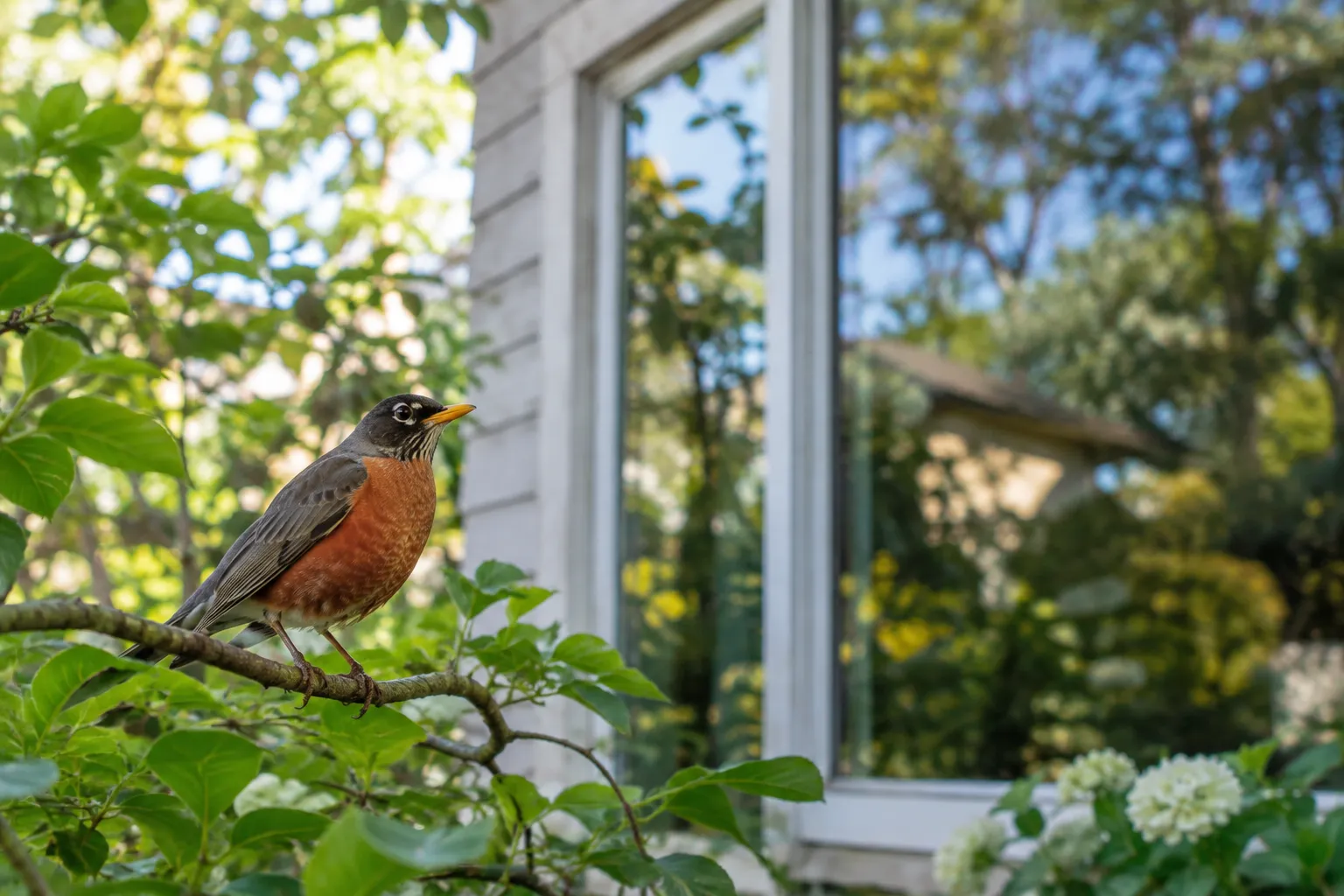
A reflection in a window is not a flat image of a tree. From a bird’s point of view, it shifts with the angle of approach in much the same way a real scene would, so it gives the impression of depth. When a bird flies toward a reflected shrub, it is doing exactly what it would do with a real shrub: heading for cover.
When are windows most reflective?
Windows become strongest mirrors when it is brighter outside than inside. That usually means daytime, and especially mornings and afternoons when sun falls on the garden but not directly on the glass. A window that looks see-through from a lit room at night can be a near-perfect mirror at 9 a.m. from the yard.
This is also why the problem can seem random to homeowners. The same window might be harmless most of the day and dangerous for a couple of hours when the light shifts. Big picture windows, sliding glass doors, glass balcony railings and conservatories are the classic trouble spots because they present a large, uninterrupted reflective surface near the ground, right where songbirds feed and move.
Why are windows near trees and feeders riskier?
Birds spend most of their time near vegetation and food. A window that reflects a hedge sits in the flight path between one part of that habitat and the next. A feeder draws birds into the area at close range, and a sudden scare, such as a hawk or a door slamming, sends the whole flock scattering in every direction at once. Some of those escape routes point straight into the glass.
Why do birds hit windows they can see through?
Transparency is the second big cause. If a bird can see through a window to something it wants, it has no reason to stop.
What is the “passage effect”?
Researchers sometimes use this term for situations where a bird sees what looks like a clear corridor through a building. Common examples at home:
- Two windows on opposite walls of a room that line up, so the bird sees sky through the house.
- A glassed-in corner, porch or sunroom where two panes meet and the garden is visible on the far side.
- Glass walkways, bus shelters or railings where there is nothing behind the glass at all.
To a bird, those all read as a gap in the obstacle, and gaps are safe to fly through. Houseplants placed just inside a window can have a similar effect, because a bird sees green leaves and heads for them.
How much of a problem is it?
It is one of the largest direct human-caused sources of bird deaths. A widely cited analysis by Scott Loss and colleagues, published in The Condor in 2014, estimated that building collisions kill somewhere between about 365 million and 988 million birds a year in the United States. The Cornell Lab of Ornithology summarizes the figure as up to about 1 billion. An earlier study estimated deaths in Canada in the tens of millions per year, and researchers in Europe have reported large numbers too, although national estimates vary widely in their methods.
Are skyscrapers the main culprit?
No, and this surprises many people. Tall glass towers kill many birds each, and they get most of the media attention. But there are relatively few of them. The 2014 study attributed well under 1 percent of the estimated deaths to high-rise buildings. The overwhelming majority happened at low-rise buildings and houses, simply because there are tens of millions of them. The Cornell Lab states it plainly: far more birds are killed by low-rise buildings and homes, because there are so many of them.
That makes home windows a real conservation issue, and it means individual homeowners can make a measurable difference. Collisions are one of several pressures discussed in our article on why bird populations are declining.
Which birds hit windows most often?
Almost any flying bird can hit glass, but some groups show up again and again in collision data:
- Migratory songbirds. Warblers, thrushes, sparrows and kinglets that migrate at night are heavily represented, especially in autumn.
- Woodland species moving through towns. Birds such as Ovenbirds, Brown Creepers and Wood Thrushes, which normally live under forest canopy, turn up often in urban collision counts in North America.
- Hummingbirds. Ruby-throated Hummingbirds fly fast and dart between flowers and feeders, and they are among the species noted as frequent collision victims.
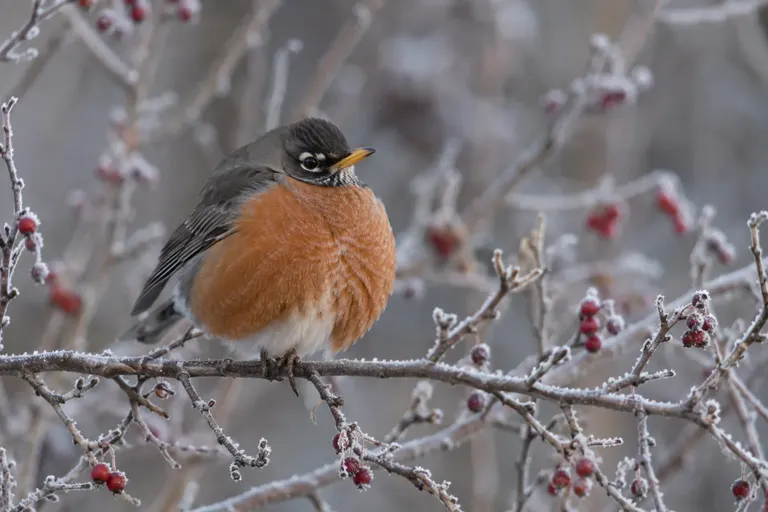
- Common garden birds. In yards, the everyday feeder crowd, from American Robins and Dark-eyed Juncos in North America to Eurasian Blackbirds, European Robins and tits in Europe, account for a large share of home collisions because they are present in the highest numbers.
Studies from different regions produce different lists, and local habitat matters a great deal, so treat any single ranking as a snapshot rather than a rule.
Why do birds hit windows more in spring and autumn?
Two seasonal patterns overlap.
Migration and light at night
Most North American and European songbirds migrate at night. Artificial light can pull them off course. On cloudy or foggy nights, when stars are hidden and birds fly lower, lit buildings and skyglow seem to be especially disorienting. Birds may circle lit structures until exhausted, or land in the middle of a city.
The effect has been measured. A study published in PNAS in 2017 found that the powerful vertical light beams of the annual Tribute in Light memorial in New York City concentrated large numbers of migrating birds overhead, and that the birds dispersed within minutes when the lights were briefly switched off. Research at a large convention center in Chicago also linked lit windows to more collisions, and found that darker facades had far fewer dead birds. That work is the basis for “Lights Out” programs in many cities, which ask building owners to turn off or dim unnecessary lights during migration seasons.
For a house, the lesson is simpler: at night during migration, draw curtains, switch off lights you do not need and point outdoor lights downward. Our guide on how birds know where to migrate explains why night migrants rely so heavily on stars and other cues that light pollution can disrupt.
Young birds and busy yards
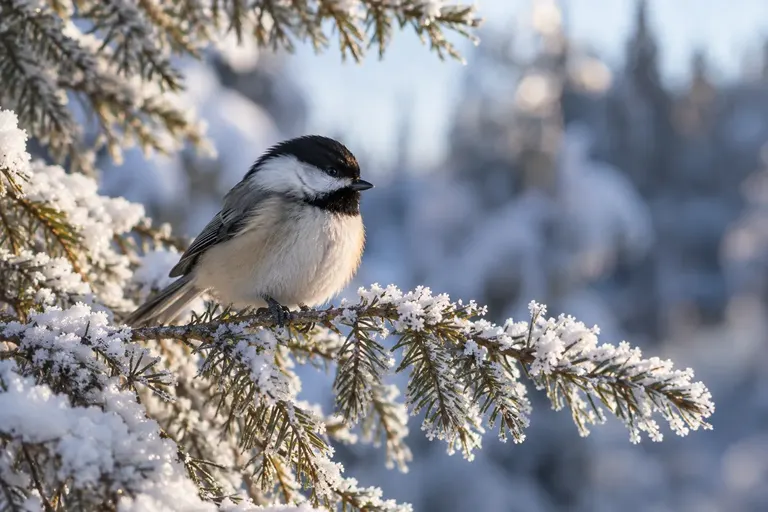
Late summer and autumn also put huge numbers of young birds on the move. Fledglings and first-year birds are inexperienced. They are exploring unfamiliar territory, often flying in loose flocks, and they have not learned the local landscape. Meanwhile, feeders and fruiting shrubs concentrate birds around houses. More birds, less experience and more glass add up to more strikes.
Why does a bird keep attacking my window?
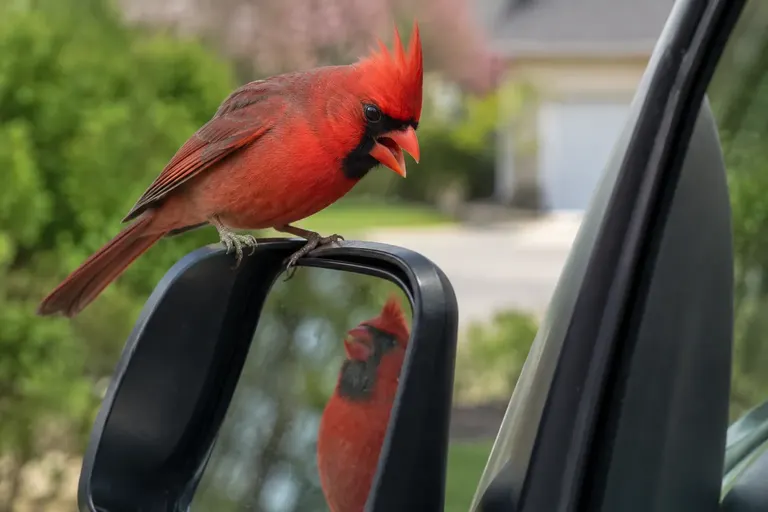
This is a separate behavior, and it is almost never fatal. In spring and early summer, a male (and sometimes a female) of a territorial species sees its reflection and treats it as an intruder. It pecks, flutters, flies at the glass and returns again and again, sometimes for hours a day over several weeks.
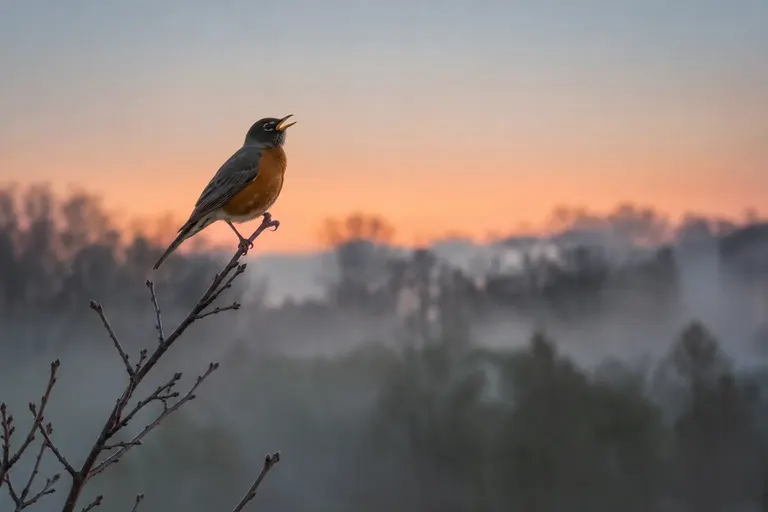
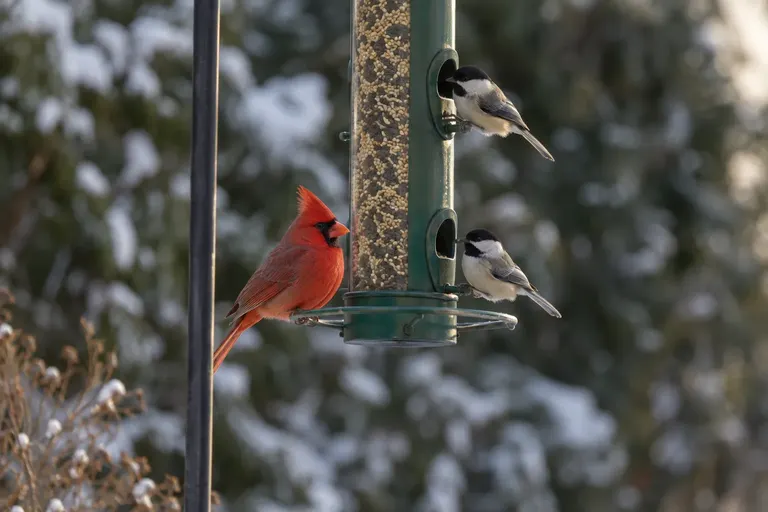
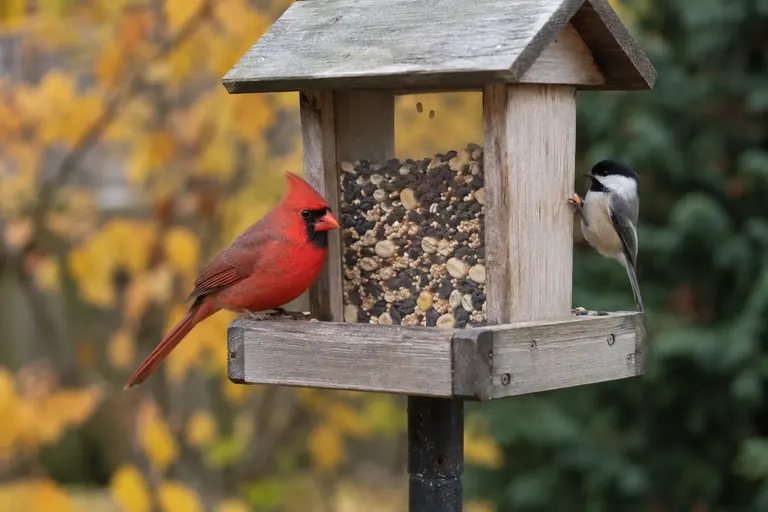
Species well known for this in North America include Northern Cardinals, American Robins, Eastern Bluebirds, Northern Mockingbirds and Chipping Sparrows. In Europe, Chaffinches, Pied Wagtails and European Robins are frequent culprits. The behavior is driven by breeding-season hormones and territorial defense. The rival never retreats, because it is the bird itself, so the fight never ends on its own until the season’s drive fades.
The same thing happens with car mirrors, chrome bumpers and shiny hubcaps. Our explainer on why birds peck at car mirrors goes into the hormone biology. The fix is the same as for collisions: break up or cover the reflection on the outside of the glass until the bird loses interest.
How to tell an attack from a collision
| Clue | Territorial attack | Collision |
|---|---|---|
| Sound | Repeated tapping or fluttering | A single thud |
| Timing | Spring and early summer, often at dawn | Any season, peaks in migration |
| Behavior | Bird returns again and again | Bird flies off, sits stunned, or dies |
| Marks | Smudges and droppings low on the glass | Feather or body “ghost” print |
| Risk | Rarely fatal, but tiring for the bird | Often fatal, sometimes later |
What happens to a bird after it hits a window?
A bird that hits a window at speed can suffer head trauma, including bleeding in and around the brain, as well as damage to the beak, eyes and internal organs. The Cornell Lab notes that many birds which appear to recover and fly away die later from internal bleeding or bruising, especially on the brain. A stunned bird sitting on the ground is also extremely vulnerable to cats and other predators.
The recommended response is straightforward. Gently place the bird in a small cardboard box or an unwaxed paper bag with ventilation, keep it somewhere dark, quiet and warm, away from pets and children, and do not try to give food or water. Contact a licensed wildlife rehabilitator for advice. Our guide on what to do with an injured bird walks through that process.
What is the “ghost print” on my window?
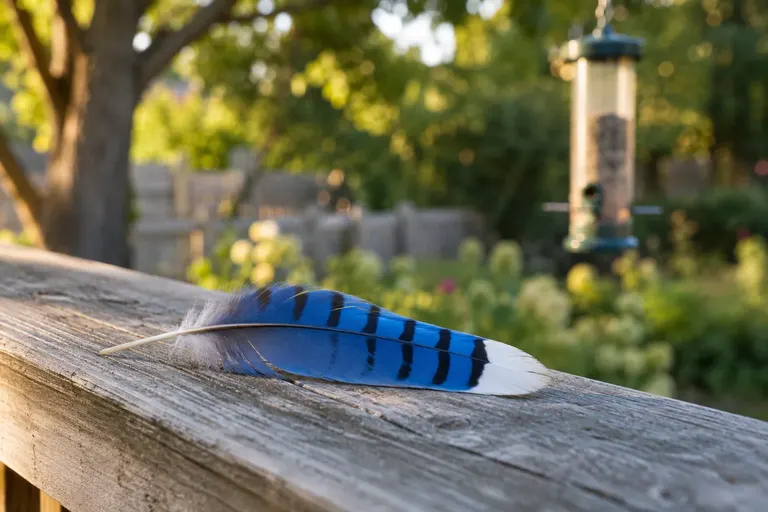
Sometimes a collision leaves a detailed dusty outline of the bird on the glass, wings spread and even feather patterns visible. That image comes from powder down and feather dust. Many birds, and pigeons and doves in particular, produce a fine powder from specialized feathers that helps waterproof and condition the plumage. When the bird hits the glass, the powder transfers in the shape of its body. The print does not tell you whether the bird survived.
Myths vs facts about birds and windows
Myth: One hawk silhouette sticker scares birds away. Fact: birds do not treat silhouettes as predators, and a single decal only protects the small area it covers. Markings need to cover the whole outside surface in a tight pattern. The Cornell Lab recommends spacing them about 2 inches apart.
Myth: Birds that fly off after a hit are fine. Fact: many die later from injuries that are not visible at the time.
Myth: Only big buildings kill birds. Fact: homes and low-rise buildings account for nearly all collision deaths in the United States because they are so numerous.
Myth: Birds hit windows because they are sick or old. Fact: healthy, strong birds hit glass regularly. Collisions are a problem of perception, not fitness.
Myth: Interior blinds solve the problem. Fact: blinds can help a little on transparent windows, but they do nothing about reflections on the outside surface. Treatments need to go on the exterior of the glass.
What does this mean for backyard birders?
If you feed birds, you are drawing them toward your house, so it is worth thinking about your glass. The main ideas follow directly from the science:
- Find your problem windows. Look for feather prints or listen for thuds. Walk around the yard in the morning and note which windows mirror trees and sky.
- Break up the reflection on the outside. Dots, tape strips, paracord curtains, exterior screens or netting all make the glass read as a surface. Details and spacing are in our window collision guide.
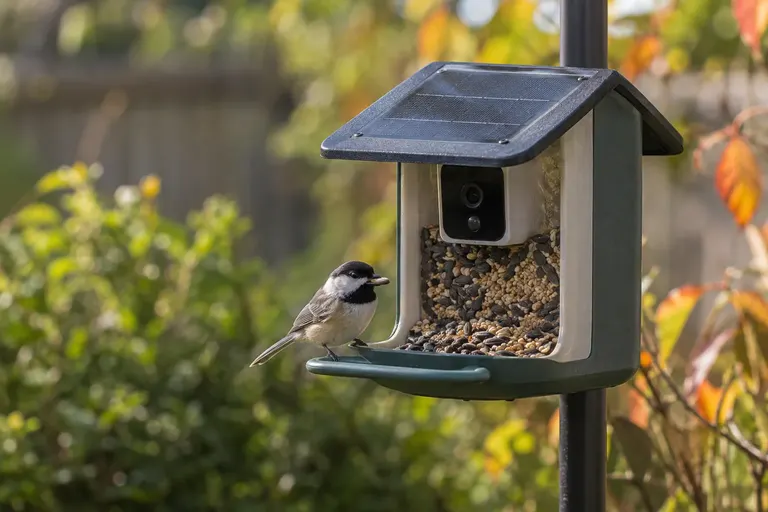
- Rethink feeder placement. The Cornell Lab now considers older fixed “safe distance” rules obsolete and recommends making any window near a feeder bird-friendly instead. A feeder mounted directly on treated glass, such as the models in our roundup of window bird feeders, means birds cannot build up speed before they reach it. See also our guide on where to put a bird feeder.
- Turn off lights at night in spring and autumn. Close curtains in lit rooms and switch off unneeded outdoor lights.
- Move houseplants away from windows where birds can see them from outside.
Common mistakes
- Putting decals on the inside of double-glazed windows, where the outer pane still reflects.
- Using one or two stickers and assuming the job is done.
- Placing a feeder a few yards from a large picture window with no treatment on the glass.
- Treating only the window where you found a bird, when the adjacent glassed corner is the real trap.
Quick facts
- Birds do not recognize glass as a solid object. They react to what it shows: a reflection or the view through it.
- In the United States, building collisions kill an estimated 365 million to 988 million birds a year, based on a 2014 study.
- Homes and low-rise buildings account for nearly all of those deaths; high-rises contribute well under 1 percent.
- Windows are most reflective when it is brighter outside than inside.
- Night-migrating songbirds are drawn toward artificial light, which pulls them into areas full of glass.
- Territorial window attacks are a spring behavior driven by hormones and are rarely fatal.
- Stunned birds may die later from brain injuries, so contact a wildlife rehabilitator.
- Exterior markings spaced about 2 inches apart across the whole pane make glass visible to birds.
Sources
- Why Birds Hit Windows, and How You Can Help Prevent It - Cornell Lab of Ornithology, All About Birds
- Loss, S. R., et al. (2014). Bird-building collisions in the United States: Estimates of annual mortality and species vulnerability. The Condor
- Van Doren, B. M., et al. (2017). High-intensity urban light installation dramatically alters nocturnal bird migration. PNAS
- Glass Collisions - American Bird Conservancy
Frequently asked questions
Why do birds fly into windows?
Birds fly into windows because glass is effectively invisible to them. A window either reflects sky and vegetation, so it looks like more habitat, or it is transparent, so the bird sees an open path to plants or sky beyond. Birds evolved in a world with no glass, so they have no instinct to treat a clear or mirrored surface as a solid barrier.
Why does a bird keep attacking my window?
That is usually a different behavior from a collision. In spring, territorial birds such as Northern Cardinals, American Robins and bluebirds see their own reflection, read it as a rival and attack it again and again. It is driven by breeding hormones and usually fades as the season moves on. Covering the outside of the glass to kill the reflection stops it.
Do birds survive hitting a window?
Some do, but many do not. The Cornell Lab notes that birds which fly off after a strike often die later from internal bleeding or bruising, especially on the brain. A bird that looks stunned should be placed in a dark, ventilated box somewhere quiet and warm, and a licensed wildlife rehabilitator should be contacted rather than trying to feed or treat it at home.
How many birds die from hitting windows each year?
A widely cited 2014 study in The Condor estimated that between about 365 million and 988 million birds die from building collisions in the United States each year. The Cornell Lab summarizes this as up to about 1 billion. Houses and low-rise buildings account for nearly all of those deaths, because there are so many of them.
Why do more birds hit windows during migration?
Many songbirds migrate at night, and artificial light can attract and disorient them, pulling them into lit areas. At dawn they land in unfamiliar places full of glass and search for food and cover, which puts them close to windows. Young, inexperienced birds on their first migration are also on the move in autumn, which adds to the risk.