Why Don't Birds Get Shocked on Power Lines?
Why don't birds get shocked on power lines? A bird on one wire is at one voltage, so no current flows through it. Touching two wires or a wire and pole kills.
In this article
- Quick facts: birds and power lines
- How does electricity actually flow?
- When do birds get electrocuted?
- Which birds are most at risk of electrocution?
- How many birds die on power lines?
- How do utilities make power lines safer for birds?
- Why do birds build nests on power poles?
- What should you do if you find an injured bird under a power line?
- How big a threat are power lines compared with other hazards?
- Why do squirrels cause more power outages than birds?
- Myths vs facts about birds on power lines
- Why is it dangerous for people?
- What does this mean for backyard birders?
- Do birds prefer to sit on power lines?
- Common mistakes and misunderstandings
- The bottom line
- Sources
- Frequently asked questions
Birds don’t get shocked on power lines because a bird sitting on a single wire has both feet at the same voltage, so no current is pushed through its body. Current stays in the wire, a far better conductor. Birds do get electrocuted, though, when their body touches two wires at once or a wire and a grounded part of the pole. That danger falls mostly on large birds such as eagles, hawks, owls and storks; a Bald Eagle’s wingspan is often around 6 to 7 feet.
Here is the physics in plain English, why size matters, and what utilities do to keep birds safe.
Quick facts: birds and power lines
- One wire is safe. A small bird on a single wire is not part of a circuit.
- Two contacts are deadly. Touching two energized wires, or one wire and a grounded part, lets current flow through the body.
- Wingspan matters. Large birds like eagles and storks can bridge gaps that small songbirds cannot.
- Poles are the hot spots. Most electrocutions happen at poles, where wires, hardware and grounds sit close together.
- Collisions are a separate problem. Birds also die from flying into lines, which is a different risk from electrocution.
- Fixes exist. Spacing, covers and perch guards can make poles much safer for birds.
How does electricity actually flow?
Electric current flows when there is a difference in electrical potential, or voltage, between two points, and a conducting path between them. Think of voltage as pressure in a water pipe. Water flows from high pressure to low pressure. If both ends of a hose are at the same pressure, nothing flows.
A power line carries alternating current at a high voltage relative to the ground. The wire itself is energized, but every point along a short stretch of it is at nearly the same voltage.
What happens when a bird lands on one wire?
When a bird perches on one wire, both feet touch that same wire, just a few inches apart. The voltage at the left foot and the right foot is essentially identical. With virtually no voltage difference across the bird, there is no meaningful push for current to flow through its body.
Even if there were a small difference, current follows the path of least resistance. The copper or aluminum conductor has far lower resistance than a bird’s body, so the current keeps traveling along the wire. The bird is, electrically, a side path that the current has little reason to take.
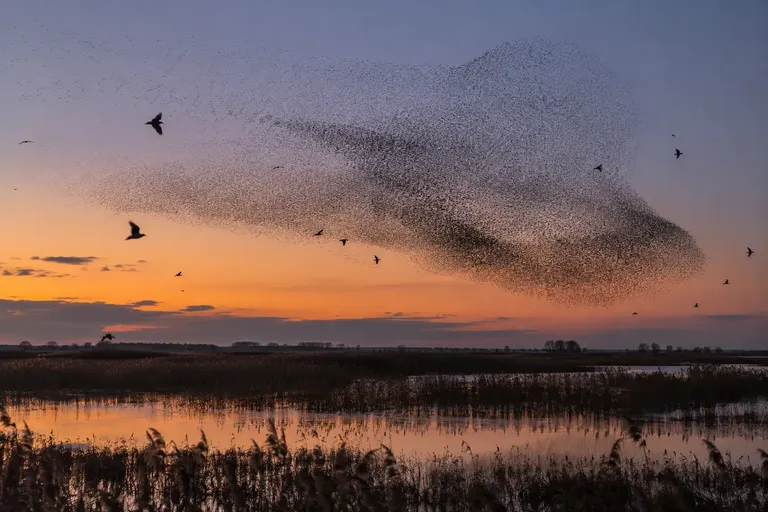
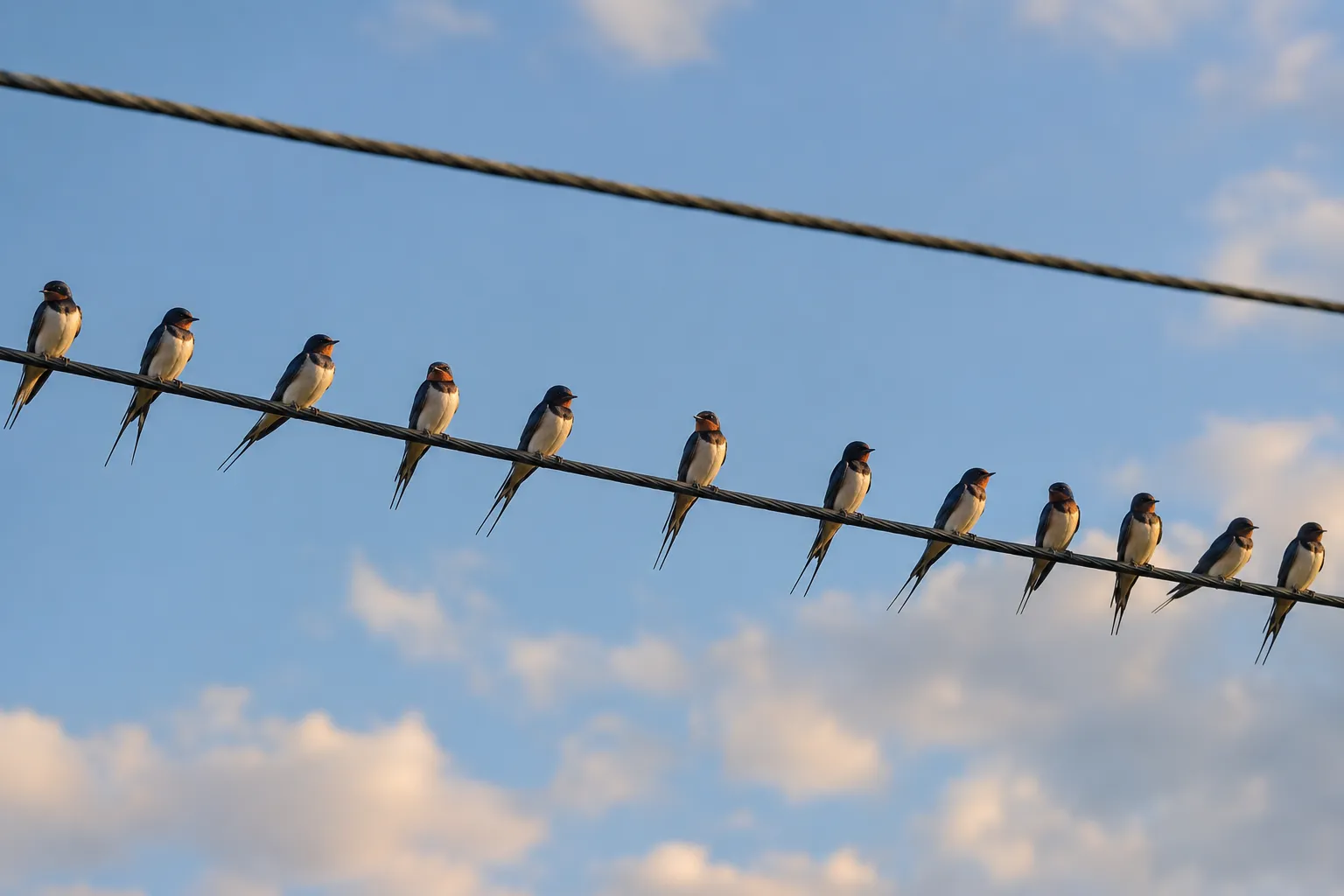
This is why you can see dozens of starlings, swallows or pigeons lined up on a wire without harm, and why squirrels can run along a single line.
Is there any charge at all?
When a bird first lands on a high-voltage wire, its body may briefly take on the wire’s voltage. Some engineers describe a tiny transient current as this happens. For a small bird this effect is minimal, and birds show no sign of being bothered by it. We could not find strong evidence that birds feel anything meaningful from it, so treat claims either way with caution.
When do birds get electrocuted?
A bird is electrocuted when its body completes a circuit between two points at different voltages. On power lines, that happens in two main ways.
Phase to phase: touching two wires
Many distribution lines carry more than one energized conductor, often called phases, and each is at a different voltage at any given moment. A bird that touches two phases at once, say with a wingtip on one and a foot on another, becomes a bridge. Current flows through its body and the result is usually fatal.
Phase to ground: touching a wire and a grounded part
Poles often have metal hardware, ground wires, transformers and other equipment connected to the earth. If a bird perched on a grounded crossarm or bracket touches an energized wire with a wing, head or tail, current flows through the bird to ground.
Wet feathers make this worse, because water improves conductivity. Some electrocutions happen when a large bird lands or takes off in rain and spreads its wings.
Which birds are most at risk of electrocution?
Size is the main factor. Small songbirds rarely span the distance between conductors or between a conductor and a grounded part. Large birds can.
| Bird group | Why at risk |
|---|---|
| Eagles | Very large wingspans; often perch on poles in open country to hunt |
| Hawks and buzzards | Use poles as hunting perches in open landscapes |
| Owls | Hunt from poles at night; Great Horned Owls are frequent victims in North America |
| Storks | Large wingspans and a habit of nesting on poles, well known in Europe for White Storks |
| Vultures | Large, gather in groups, roost on structures |
| Ravens and crows | Build nests on poles and often perch in groups |
| Parrots and parakeets | Monk Parakeets build bulky stick nests on utility structures in some US cities |
A Bald Eagle’s wingspan is often around 6 to 7 feet, and Golden Eagles are similar. That is easily enough to reach between conductors or hardware on many older pole designs.
Why do raptors use power poles?
In open grasslands, deserts and farmland, trees can be scarce. Poles offer high perches with a wide view for spotting prey, as well as nest sites. That makes poles attractive to exactly the birds most vulnerable to electrocution. It is one reason why electrocution is a well documented cause of death for eagles and hawks in the western United States, and for species such as the Spanish Imperial Eagle and Bonelli’s Eagle in parts of Europe.
How many birds die on power lines?
Estimates are uncertain, but the numbers are large. A 2014 study by Scott Loss, Tom Will and Peter Marra in PLOS ONE estimated that between about 12 and 64 million birds die each year from collisions with power lines in the United States, and between about 0.9 and 11.6 million die from electrocution. The wide ranges reflect how hard it is to count bird deaths across a huge network.
To put that in context, collisions with building glass and predation by outdoor cats are estimated to kill far more birds each year. But for certain species, especially eagles and other large raptors, electrocution can be a significant cause of death.
Collisions vs electrocution
These are different problems:
- Electrocution happens mostly at poles, affects mainly large birds, and occurs when a bird bridges conductors or a conductor and ground.
- Collisions happen along the spans between poles, when birds fly into wires they do not see in time. Heavy birds with limited maneuverability, such as cranes, swans, bustards and some waterfowl, are often at higher risk. Utilities sometimes add markers or diverters to make lines more visible.
How do utilities make power lines safer for birds?
Electrocution risk depends heavily on pole design, and it can be reduced a great deal. In the United States, the Avian Power Line Interaction Committee (APLIC), a collaboration of utilities, wildlife agencies and conservation organizations, publishes guidance on avian-safe design. Similar efforts exist in Europe, South Africa and elsewhere.
Common measures include:
- Adequate spacing. Designing poles so that conductors, and conductors and grounded parts, are far enough apart that a large bird cannot touch both. APLIC guidance uses separations based on the wingspans of large birds such as eagles.
- Insulating covers. Plastic or rubber covers on conductors, jumper wires, transformer bushings and other exposed parts.
- Perch management. Perch discouragers on dangerous crossarms, and safe alternative perches placed higher above the energized parts.
- Nest platforms. Platforms that give ospreys, storks and other birds a safe place to nest away from live equipment.
- Line markers. Spiral or flapping diverters that help birds see lines and avoid collisions.
In the United States, killing protected birds, including through electrocution, can violate federal wildlife laws, such as the Migratory Bird Treaty Act and the Bald and Golden Eagle Protection Act. That gives utilities strong incentives to develop avian protection plans and retrofit problem poles.
Why do birds build nests on power poles?
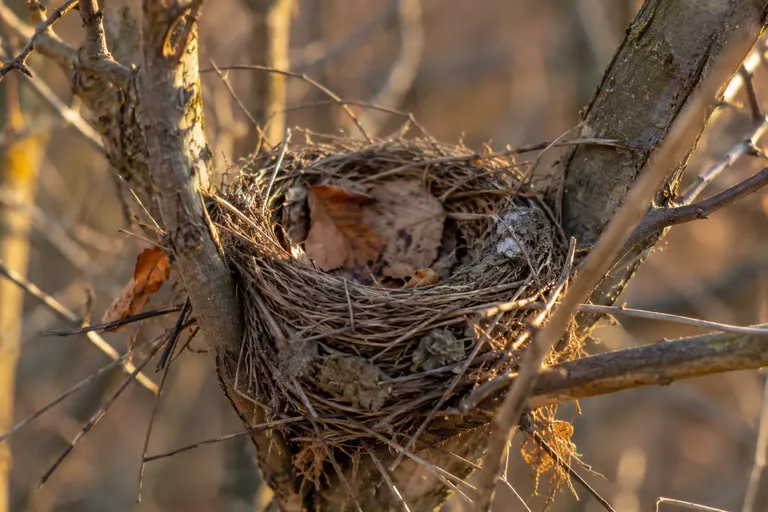
Poles and transmission towers are tall, stable and often the only tall structures in open country, which makes them appealing nest sites. Ospreys are the best known example in North America: they readily build bulky stick nests on top of poles near lakes, rivers and coasts. In Europe, White Storks have nested on buildings and poles for centuries, and in parts of Spain and Portugal it is common to see stork nests on utility structures. Ravens, some hawks and, in several US cities, introduced Monk Parakeets also use them.
Nests on energized equipment bring two problems. Sticks, wet nest material and droppings can create a path for current, risking both the birds and a power outage, and the nest can catch fire. Utilities often respond by installing a nest platform on a separate, safe pole nearby or raising a platform above the energized parts, then carefully moving the nest outside the breeding season where laws allow. Ospreys in particular take readily to these platforms, and they have played a part in the species’ recovery in many areas.
What should you do if you find an injured bird under a power line?
First, keep your distance from the pole and wires. If there is any chance a line is down or damaged, call the utility or emergency services and stay away.
If the bird is clear of the pole and there is no electrical hazard:
- Do not touch large raptors. Eagles, hawks and owls have powerful talons and can seriously injure people.
- Call a licensed wildlife rehabilitator or your state wildlife agency. They can advise on safe capture and transport.
- Note the pole location. A pole number or GPS pin helps the utility find and assess it.
- Report dead eagles. In the United States, the US Fish and Wildlife Service and state agencies want to know about dead eagles, and you should not collect or keep any part of one.
Our general guide to what to do with an injured bird covers smaller birds and the basics of safe containment.
How big a threat are power lines compared with other hazards?
Power lines are one of many human-made hazards birds face. In the United States, researchers estimate that collisions with building glass kill hundreds of millions of birds a year, and outdoor cats kill even more. Power line collisions and electrocutions, while serious, are generally estimated to be lower. For some large, long-lived species with few young, such as eagles, the loss of breeding adults through electrocution can matter a great deal locally.
If you want to help birds most in your own yard, the biggest wins are usually preventing window strikes and keeping cats indoors. See how to stop birds hitting windows and the broader picture in why are bird populations declining?
Why do squirrels cause more power outages than birds?
Squirrels are notorious for causing outages. Like birds, they are safe on a single line. The trouble comes when they climb onto equipment, such as transformers, and bridge an energized part and a grounded one. This can kill the squirrel and trip protective devices, cutting power to a neighborhood. Birds can do the same, especially large birds and nesting birds that bring sticks and wet material into equipment.
Myths vs facts about birds on power lines
| Myth | Fact |
|---|---|
| Birds have special insulation that protects them | Birds are not special; they are safe on one wire because there is no voltage difference across their body |
| Birds’ feet are nonconductive | Bird bodies do conduct; they are just not part of a circuit when on a single wire |
| All power lines are equally dangerous | Risk depends on pole design, wire spacing and bird size |
| Birds never get electrocuted | Large birds are regularly electrocuted when they bridge conductors or ground |
| If a bird can do it, a person can too | People are almost always grounded in some way; never approach power lines |
Why is it dangerous for people?
The physics that keeps a perched bird safe does not protect people. A person touching a power line is almost always also touching something else, whether the ground, a ladder, a tree or a vehicle, that provides a path to a different voltage. High-voltage lines can also arc across air gaps without direct contact.
Always stay well clear of overhead lines. Never try to rescue a bird, kite or pet from a power line or pole. Call your utility company or emergency services, and treat any downed line as live.
What does this mean for backyard birders?
Most backyard birds face little risk from the wires that run through your neighborhood, since songbirds are too small to bridge conductors. A few practical points:
- Report dead large birds under poles. If you find a dead hawk, owl or eagle beneath a pole, contact your utility and state wildlife agency. It can help them identify a pole that needs retrofitting.
- Report nests on equipment. Utilities can relocate or build safe nest platforms, particularly for ospreys.
- Enjoy the view. Power lines are some of the best places to spot hawks, kestrels, bluebirds, swallows and doves. For tips on getting a better look, see our guide on how to find a bird in your binoculars fast.
- Keep learning behaviors. Why birds line up on wires can connect to other questions, like why birds flock together and how birds perch without falling when asleep.
Do birds prefer to sit on power lines?
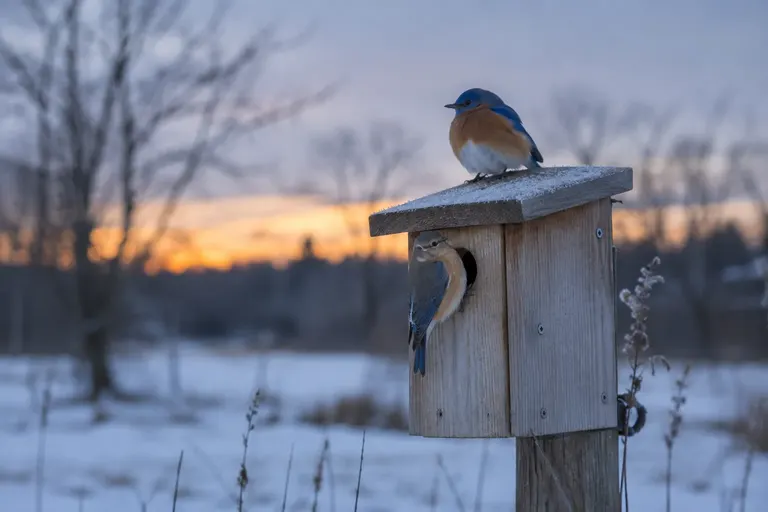
Many birds do. Wires offer a clear view of predators and food, easy take-offs, and space to sit in groups. Swallows gather on lines in late summer before migration, and doves, starlings and blackbirds often line up along them. Kestrels, kingbirds and bluebirds use them as hunting perches, dropping down to catch insects or small animals and returning.
You might also notice that birds on a wire often space themselves out at fairly regular intervals. Each bird keeps a small personal zone, sometimes just enough room to avoid being pecked by a neighbor. Watching this spacing and how it changes as birds arrive and leave is a simple behavioral study you can do from your porch. For more on reading what birds are doing, see bird behavior: reading what birds are doing.
Common mistakes and misunderstandings
- Assuming birds are “insulated.” They are not; they are safe only because they are not completing a circuit.
- Thinking only high-voltage transmission towers are dangerous. Many electrocutions happen on local distribution poles, where wires are closer together.
- Approaching a pole to help a stuck or injured bird. Leave it to the utility and trained rescuers.
- Assuming lines are dead after a storm. Downed or sagging lines can still be energized.
The bottom line
A bird on a single wire is safe because both feet are at the same voltage, so no current passes through it. The risk comes when a bird’s body connects two points at different voltages, either two wires or a wire and a grounded part. That is why large birds like eagles, hawks, owls and storks are most at risk, especially at poles. Thoughtful pole design, covers and perch management can greatly reduce those deaths, and reporting dead raptors under poles helps utilities find and fix problem spots.
Sources
Frequently asked questions
Why don't birds get electrocuted on power lines?
Electric current flows only when there is a difference in voltage between two points. A bird perched on a single wire has both feet at the same voltage, so almost no current passes through its body. The current keeps flowing along the metal wire, which conducts far better than the bird. The danger comes when a bird touches two wires, or a wire and a grounded part, at the same time.
Can birds get electrocuted on power lines?
Yes. Birds are electrocuted when their body bridges two energized wires or an energized wire and a grounded part of a pole, such as a metal crossarm or ground wire. Large birds with long wingspans, including eagles, hawks, owls, storks and vultures, are most at risk. Electrocution is a significant cause of death for some raptors in the United States, Europe and elsewhere.
Would a person get shocked touching a power line like a bird?
Do not test it. A person touching a line is usually also in contact with the ground, a ladder, a tree or a vehicle, creating a path for current. High-voltage lines can also arc across small gaps. Always stay well clear of overhead lines, and treat downed lines as live. Contact your utility or emergency services.
How do utilities protect birds from electrocution?
Utilities use avian-safe designs that space wires far enough apart for large birds, insulating covers on wires and equipment, perch discouragers, and alternate perching platforms. In the United States, the Avian Power Line Interaction Committee publishes widely used guidelines. Many utilities retrofit dangerous poles after bird deaths are found.
Do birds feel electricity on power lines?
Probably very little, if anything, in most cases. With no significant current flowing through the body, there is little to feel. Some sources suggest a bird may experience a tiny transient charge when it first lands on a high-voltage line, but the effect is small, and birds routinely perch on lines without apparent distress.