Can Birds Predict the Weather?
Can birds predict the weather? Short term, yes: they sense falling air pressure and maybe infrasound, then feed or flee before storms. Seasonal lore is a myth.
In this article
- Quick facts: birds and weather
- How could birds sense the weather?
- What does the research show?
- Why do birds swarm feeders before a storm?
- What do birds do during storms?
- What is a bird fallout, and how does weather cause it?
- How does day-to-day weather change what you see at feeders?
- Can birds sense earthquakes?
- Do birds sense temperature changes before cold snaps?
- Which weather folklore about birds is true?
- Can birds predict long-term weather or seasons?
- What does this mean for backyard birders?
- Common mistakes people make
- The bottom line
- Sources
- Frequently asked questions
Birds can’t read a weather map, but they can sense changes that signal bad weather is coming, and they often act on them. Research shows birds respond to falling barometric pressure by feeding more, some appear to detect infrasound, sound below about 20 hertz, from distant storms and move out of the way, and migrating birds time departures to favorable winds. What birds cannot do, as far as science can tell, is predict the weather weeks or months ahead, so folklore about harsh winters is not supported.
Here is what the evidence says, how birds might sense weather, and what you can see from your own window.
Quick facts: birds and weather
- Air pressure: birds appear to sense falling barometric pressure, a classic sign of an approaching storm.
- Feeding before storms: captive sparrows ate more when researchers lowered air pressure.
- Tornado escape: tagged Golden-winged Warblers left their breeding area before a major 2014 tornado outbreak.
- Infrasound: some birds can hear very low-frequency sound, which storms produce and which travels long distances.
- Migration: birds time migration to favorable winds and weather, often right after fronts pass.
- Long-range forecasts: no good evidence that birds can predict seasonal weather.
How could birds sense the weather?
Birds have several senses that could pick up the signals of a coming change.
Barometric pressure
Falling air pressure is one of the best short-term signs of a storm. Birds routinely experience pressure changes as they fly up and down, so it makes sense that they are sensitive to them. Pigeons, for example, have been shown in lab experiments to detect small changes in air pressure.
Where exactly birds sense this is not fully settled. One candidate is the paratympanic organ, a small sensory structure in the middle ear of birds that some researchers have proposed works as a barometer or altimeter. That idea is plausible but not yet proven, so treat it as a leading hypothesis rather than an established fact. For more on bird hearing anatomy, see do birds have ears?
Infrasound
Infrasound is sound below about 20 hertz, too low for humans to hear. Severe storms, tornadoes, ocean waves and earthquakes generate infrasound, and it can travel hundreds of miles. Experiments on homing pigeons in the 1970s suggested they can detect infrasound, and some researchers have proposed that pigeons might use it in navigation. Whether wild birds use infrasound to detect approaching storms is suggested by some field evidence, discussed below, but has not been directly demonstrated.
Other cues
Birds may also respond to changes in wind direction and speed, temperature, humidity and light, all of which shift as weather systems approach. Many of these cues are easy for birds to detect and change quickly before a storm.
What does the research show?
Sparrows eat more when pressure drops
A 2013 study by Creagh Breuner and colleagues, published in the Journal of Experimental Biology, tested White-crowned Sparrows in captivity. When the researchers lowered the air pressure in the birds’ chamber, simulating an approaching storm, the sparrows increased how much they ate. This supports the idea that birds use pressure drops as a cue to stock up on energy before bad weather.
Warblers fled a tornado outbreak
One of the most striking examples comes from a study led by Henry Streby, published in Current Biology in 2015. The team had fitted Golden-winged Warblers breeding in the Cumberland Mountains of Tennessee with tiny geolocators to track their migration. In late April 2014, a severe storm system produced a large tornado outbreak across the central and southern United States.
The data showed that the warblers left their breeding territories roughly a day or two before the storm arrived, when it was still hundreds of miles away. They flew south, some reaching the Gulf Coast or beyond, then returned to their territories after the storm passed, a round trip that the researchers estimated at well over 900 miles in a matter of days. There was no obvious local change in weather when they left.
The researchers suggested the birds may have detected infrasound from the storm system. That remains a hypothesis, but the study shows that small songbirds can make large, rapid movements to avoid dangerous weather.
Migrants read the winds
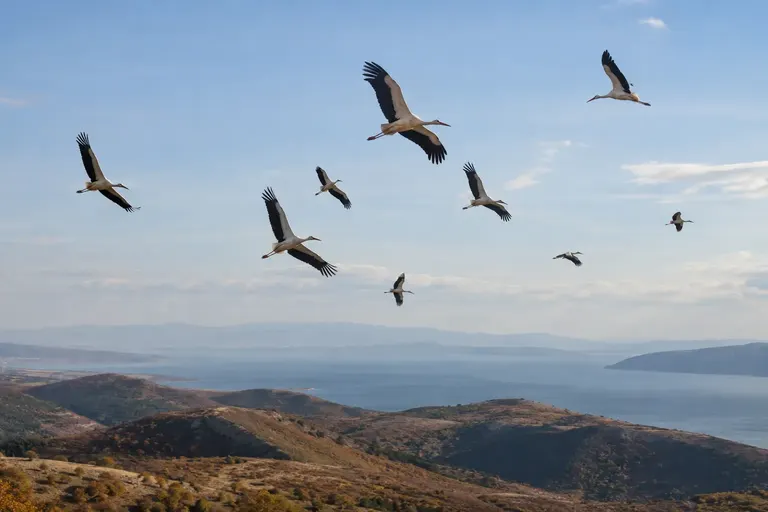
Weather radar and tracking studies show that migrating birds are highly selective about when they fly. In North America, big fall migration nights often follow the passage of a cold front, when northerly winds give southbound birds a tailwind. In spring, warm southerly flows bring waves of migrants north. The BirdCast project uses weather forecasts to predict migration intensity, which works precisely because birds’ decisions track the weather so closely.
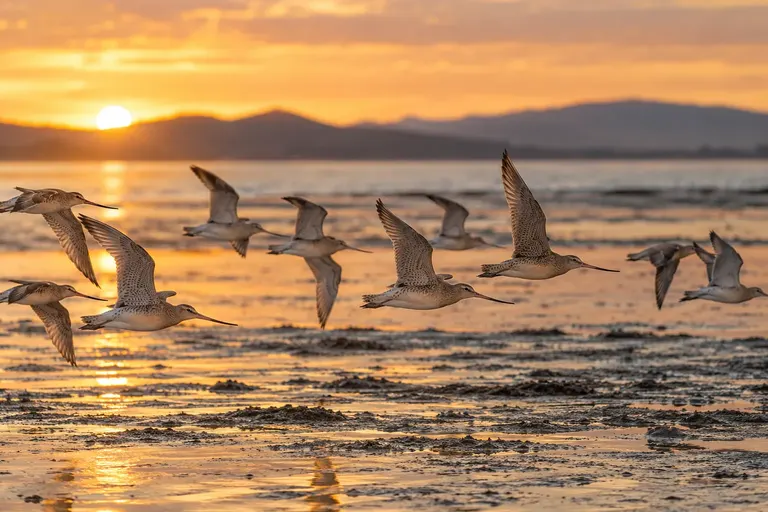
Long-distance migrants appear especially skilled. Bar-tailed Godwits, which fly nonstop from Alaska to New Zealand, are thought to time their departures to take advantage of favorable wind patterns associated with passing weather systems. Details of how they judge conditions are still being studied. For more on navigation, see how do birds know where to migrate?
Why do birds swarm feeders before a storm?
Many backyard birders notice feeders getting busy before snow or heavy rain. There are good reasons.
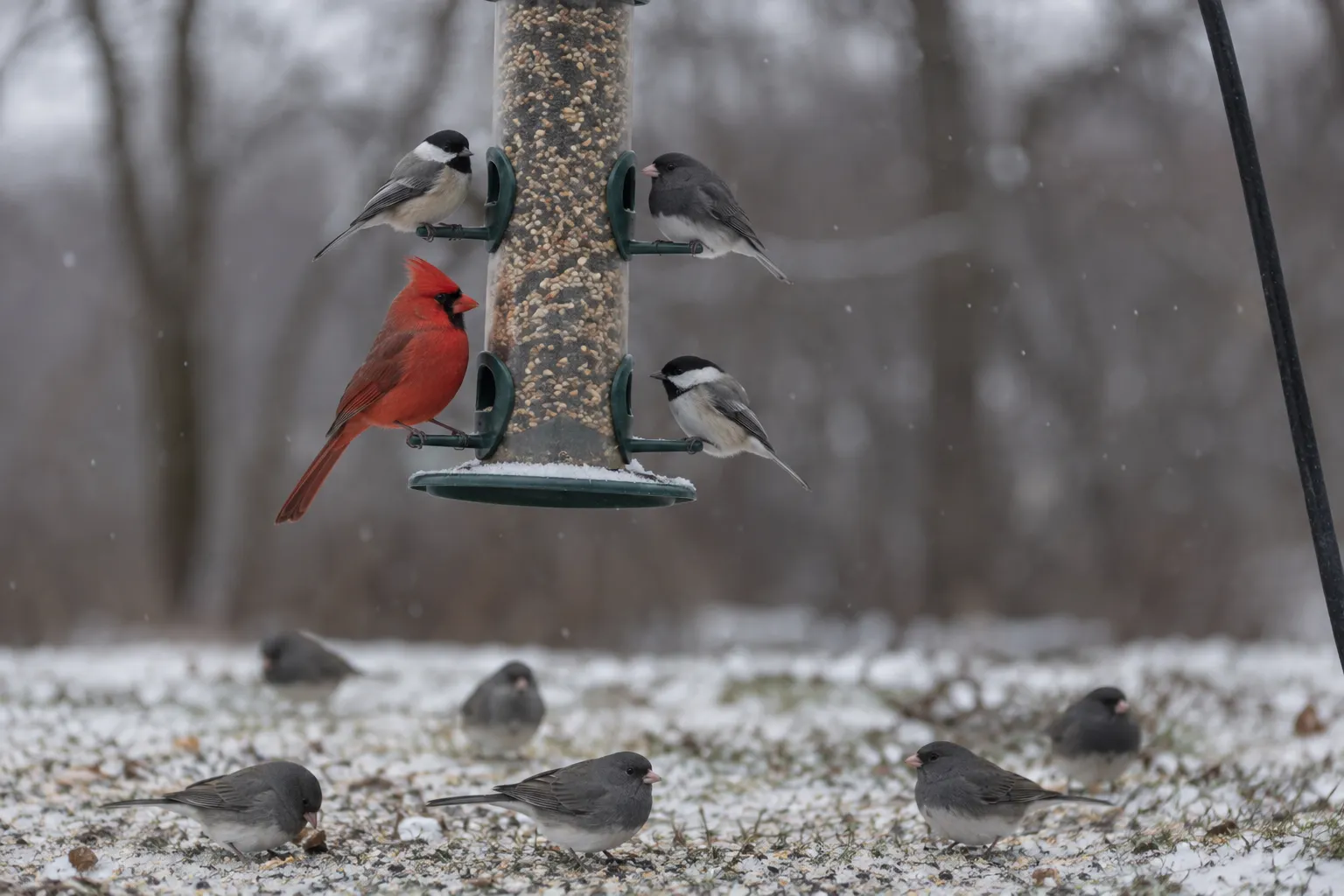
Small birds like chickadees, titmice and juncos have very little room for error in winter. They build up fat during the day and burn much of it overnight just to keep warm. If a storm is about to bury food under snow or make foraging difficult for a day or more, eating as much as possible beforehand could be the difference between surviving and not. The Breuner study suggests that falling air pressure may help trigger this behavior.
You may notice:
- More birds at once, including species that usually come in ones or twos.
- Longer feeding bouts and less time spent perched between visits.
- More caching by chickadees, nuthatches and jays, which store food to retrieve later. See why do birds hoard food?
After the storm, feeding activity often surges again as birds refuel.
What do birds do during storms?
During storms, most small birds seek shelter. They move into dense evergreens, thick shrubs, brush piles and cavities, where they are out of the wind and rain. Many fluff their feathers for insulation and reduce activity to save energy. Birds grip perches with a locking tendon arrangement in their feet, which helps them hold on in strong winds. For more, see how do birds stay warm in winter? and why do birds puff up?
Hurricanes and big storms
Hurricanes and typhoons are a special case. Some birds appear to move out of the way, while others are caught up in the storm. Seabirds and other birds are sometimes trapped inside the calm eye of a hurricane and carried long distances. This is why birders often go looking for “storm birds,” such as tropical seabirds, far inland or far north after a hurricane passes. Tracking studies of shorebirds such as Whimbrels have documented birds flying through or around tropical storms, sometimes successfully, sometimes not.
What is a bird fallout, and how does weather cause it?
A fallout is one of the most dramatic ways weather shapes bird behavior, and it shows the limits of birds’ ability to anticipate conditions. It happens when large numbers of migrating birds are forced down in one place by bad weather.
The classic example is on the northern Gulf Coast of the United States in spring. Millions of songbirds leave Mexico’s Yucatán Peninsula in the evening and fly north across the Gulf of Mexico overnight, a trip of roughly 500 miles or more. If they meet a cold front with strong north winds and rain over the water, they burn through their fat reserves fighting headwinds. Exhausted birds then drop into the first trees they reach on the coast. Sites like High Island in Texas are famous for spring days when warblers, tanagers, orioles and buntings crowd every bush.
Fallouts also happen in Europe, for example on the east coast of Britain in autumn, when easterly winds and rain push Scandinavian migrants over the North Sea and down onto the coast. Birders watch the weather charts closely for these events.
Fallouts show that birds’ weather sense is good but not perfect. Birds usually pick good departure conditions, but weather over long water crossings can change after they are committed.
How does day-to-day weather change what you see at feeders?
Even without storms, weather shapes feeder activity from hour to hour:
- Cold mornings: activity often peaks early as birds refuel after a long night. The colder the night, the more urgent that first meal.
- Wind: strong winds can reduce activity at exposed feeders, and birds favor feeders near sheltering shrubs.
- Light rain: many birds keep feeding, though small birds may seek cover in heavy downpours.
- Heat: in summer, activity often drops in the hottest part of the day and rises in the morning and evening. Water becomes a bigger draw than food.
- Snow cover: ground-feeding birds such as juncos, sparrows, doves and cardinals may crowd feeders when natural food is buried.
- Fog and low cloud during migration: migrants may be grounded or disoriented, which can bring unusual species into yards.
Keeping notes on these patterns is a simple way to see birds responding to weather in real time. A notebook, or a checklist app like eBird, can help you spot trends over a season.
Can birds sense earthquakes?
This question comes up often, and the honest answer is that the evidence is limited. There are many anecdotal reports of birds and other animals behaving unusually before earthquakes, and some scientists have explored whether animals might detect early ground vibrations, changes in air ions, or infrasound. Some tracking studies on farm animals and wildlife have looked for patterns, but results so far are not strong enough to show that birds can reliably sense earthquakes in advance. Treat claims that birds predict earthquakes with caution.
What is well established is that birds, like many animals, react quickly once shaking begins, often taking flight or giving alarm calls.
Do birds sense temperature changes before cold snaps?
Birds certainly respond to temperature, but whether they anticipate cold snaps is less clear. Falling temperatures often come with pressure changes and shifting winds as a cold front approaches, so birds may be responding to the same pressure and wind cues discussed above. Once cold arrives, birds adjust quickly: they fluff feathers, spend more time feeding, and in some species, such as chickadees, lower their body temperature overnight to save energy, a state called regulated hypothermia or torpor. Hummingbirds go further, entering deep nightly torpor when needed.
Which weather folklore about birds is true?
| Saying | What the evidence suggests |
|---|---|
| Birds feed heavily before a storm | Largely supported: falling pressure can trigger extra feeding |
| Swallows fly low before rain | Partly true: they follow insects, which are often lower in humid, unsettled air |
| Birds go quiet before a storm | Plausible: many birds reduce activity and seek cover as conditions worsen, but this is not well quantified |
| Seagulls fly inland before storms | Plausible: gulls may seek sheltered areas in rough weather, but they also move inland for food |
| Birds face into the wind on wires | True, but it is about keeping feathers smooth and making takeoff easier, not forecasting |
| Early migration means a harsh winter | Not supported: migration timing follows daylight, food and near-term weather |
| Big flocks at feeders in fall predict a hard winter | Not supported: flock size reflects food supply, breeding success and local conditions |
Why swallows fly low before rain
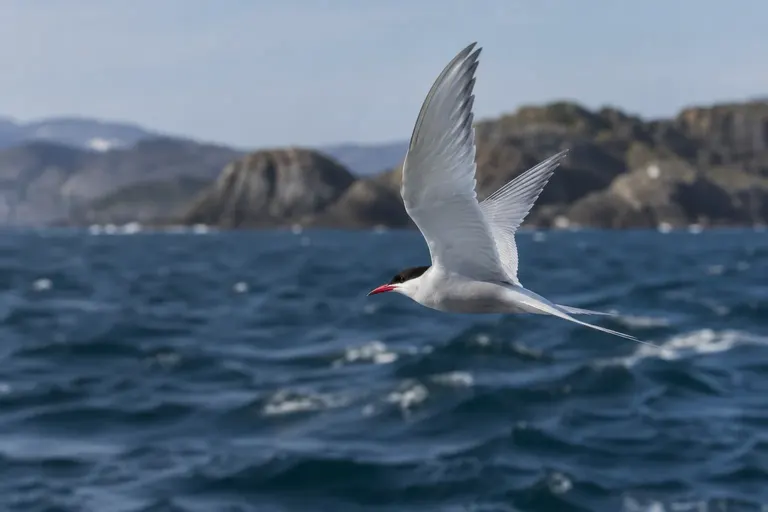
The old rhyme about swallows and rain has a reasonable explanation. Swallows and swifts catch insects in flight, so they fly where the insects are. In fair weather, warm rising air carries small insects higher. In cooler, humid, unsettled conditions, insects often stay lower, and so do the birds that eat them. It is a loose indicator, not a forecast, because insect behavior depends on many factors.
Can birds predict long-term weather or seasons?
Probably not. There is no good evidence that birds can forecast the severity of a coming winter or summer. Their seasonal behaviors, like migration, molting and breeding, are mainly driven by day length, internal annual rhythms and current conditions such as temperature and food.
When birds do something unusual, such as an “irruption” of northern finches or Red-breasted Nuthatches into the south, it usually reflects poor seed crops in the north, not a forecast of harsh weather. Irruptions are a response to food shortages that have already happened.
Climate change highlights this limit. Many birds, especially long-distance migrants, time spring migration largely by day length and internal clocks, cues that do not change as the climate warms. In some regions, spring now arrives earlier, and insects emerge sooner, but migrants that rely on fixed cues may not shift their arrival as quickly. Researchers in Europe and North America have documented cases of this mismatch, such as Pied Flycatchers in the Netherlands arriving after the caterpillar peak their chicks depend on. If birds could forecast seasons, such mismatches would be less common.
What does this mean for backyard birders?
You can use bird behavior as a fun, informal weather signal, and you can help birds get through storms:
- Keep feeders full before storms. High-energy foods like black oil sunflower seed, suet and peanuts help birds build fat reserves. See what to feed birds in winter.
- Clear snow from feeders and a patch of ground after a storm so ground-feeding birds like juncos and sparrows can reach food.
- Provide shelter. Dense evergreens, shrubs and brush piles give birds places to wait out bad weather. See how to build a brush pile for birds.
- Offer water, especially when natural sources freeze.
- Watch and log. Note when feeder activity spikes and compare it with the weather. It is a simple way to observe the patterns scientists study. Our guide to winter bird feeding covers the basics.
Common mistakes people make
- Treating bird behavior as a reliable forecast. Birds respond to real cues, but their behavior is affected by many factors. Check the actual forecast.
- Letting feeders run empty during storms. That is when birds most need a reliable food source.
- Believing seasonal folklore. Early migrants or big fall flocks do not predict a harsh winter.
- Assuming storms only harm birds. Storms can be deadly, but many birds are well adapted to ride them out, especially with good shelter nearby.
The bottom line
Birds can sense short-term weather changes and act on them. They appear to detect falling air pressure and may hear distant storms through infrasound, and they respond by feeding more, sheltering, or even fleeing hundreds of miles, as Golden-winged Warblers did before the 2014 tornado outbreak. Migrants time their flights to favorable winds with impressive precision. But there is no good evidence that birds can forecast the weather weeks or months ahead. For backyard birders, the takeaway is practical: when your feeders suddenly get busy on a gray day, a storm may be on its way, so keep the food and shelter ready.
Sources
- Breuner et al. (2013), Environment, behavior and physiology: do birds use barometric pressure to predict storms?, Journal of Experimental Biology
- Streby et al. (2015), Tornadic storm avoidance behavior in breeding songbirds, Current Biology
- BirdCast: migration forecasts and live migration maps
- Cornell Lab of Ornithology, All About Birds: Golden-winged Warbler
Frequently asked questions
Can birds sense a storm coming?
There is good evidence that they can, at least in the short term. Birds appear to detect falling barometric pressure, and some may hear infrasound, very low-frequency sound produced by severe storms. Studies have shown captive sparrows eating more when air pressure drops, and tagged warblers leaving their breeding grounds a day or more before a major tornado outbreak.
Why do birds eat so much before a snowstorm?
Birds need enough fat reserves to survive long, cold nights, and a storm can make food hard to reach for hours or days. Feeding heavily beforehand is a sensible strategy. Research suggests falling air pressure may trigger extra feeding, so the crowded feeders you see before storms likely reflect birds responding to real cues rather than coincidence.
Do birds fly low before rain?
Swallows and swifts sometimes do feed lower before rain, and the old saying has some basis. They follow the flying insects they eat, and insects are often found lower in cool, humid, unsettled conditions. It is a loose pattern rather than a reliable forecast, since insect height is affected by many factors.
Can birds predict a harsh winter?
There is no good evidence that birds can forecast conditions weeks or months ahead. Early migration, heavy feeding in fall or big flocks do not reliably predict a severe winter. Birds respond to current and near-term conditions such as daylight, temperature, food supply and approaching weather systems, not to long-range seasonal forecasts.
What do birds do during a hurricane?
Responses vary. Some birds move ahead of the storm, many hunker down in dense cover and grip perches tightly, and seabirds may be swept far inland. Birds are sometimes carried inside the eye of a hurricane. After major storms, birders often find unusual seabirds and other displaced species far from their normal range.