Why Do Birds Sing in the Fall? Winter Turf and Practice
Why do birds sing in the fall? To claim winter feeding turf, to keep year-round pairs together and to practice. Here is who sings in October and November.
In this article
- Quick facts: fall birdsong
- Why do most birds stop singing in late summer?
- Why do some birds start singing again in the fall?
- Which birds sing in the fall in North America?
- What is the European Robin’s autumn song?
- Do hormones make birds sing in the fall?
- Why is fall birdsong quieter and less structured?
- How do young birds practice singing in the fall?
- Which birds can you hear singing in October and November?
- Does fall song mean birds think it is spring?
- What does fall song mean for your yard?
- Common mistakes when listening to fall song
- The bottom line
- Sources
- Frequently asked questions
Birds sing in the fall mainly to claim winter feeding territories and to keep year-round territories, not to attract a mate. According to the Cornell Lab of Ornithology, Carolina Wren pairs get “no vacation from singing or defending territory,” and White-throated Sparrows keep singing their roughly 4-second whistled song on their winter range. A small autumn stir in hormones, driven by shortening days, and young birds practicing their first songs add to the fall chorus.
Below: who is singing in your yard this fall, what the song means, and why it sounds rougher than in May.
Quick facts: fall birdsong
- Main reason: defending a winter or year-round territory, especially a good feeding spot.
- Top US fall singers: Carolina Wren, Northern Mockingbird and White-throated Sparrow.
- Occasional fall singers: Northern Cardinal, and American Robins giving quiet subsong in flocks.
- Famous example: the European Robin, where males and females each sing to hold separate winter territories.
- Hormones: testosterone is low in fall, but not zero, and in some species a small autumn revival of singing follows the return of shorter days.
- Young birds: first-year birds practice soft, variable “subsong” in late summer and fall.
- Sound: fall song is often quieter, shorter and less structured than spring song.
Why do most birds stop singing in late summer?
Most North American songbirds go quiet in July and August because the breeding season is over and they are replacing their feathers. Song in spring does two jobs, attracting a mate and defending a nesting territory. Once the young have fledged, neither job pays off, and singing costs time and energy that a molting bird would rather spend on feeding and growing new feathers.
Hormones follow the same curve. Long spring days push up reproductive hormones, including testosterone in males, and those hormones help drive singing. By midsummer, many temperate songbirds become “photorefractory”: their reproductive system switches off even though days are still long. Testosterone falls, and so does song. If you want the spring side of this story in detail, see our guide to why birds sing in the morning.
That is why the first fall songs catch people off guard after weeks of near silence.
Why do some birds start singing again in the fall?
Some birds sing again in fall because they now have something new to defend: a patch of ground that will feed them through the winter. For a resident or short-distance migrant, a territory with reliable berries, seeds or insects can decide whether it survives until spring. Song is the cheapest way to say “this spot is taken” without fighting every newcomer.
Three groups of birds do most of the fall singing:
- Birds that defend year-round territories. Carolina Wrens are the clearest US example. Pairs stay together and keep their territory through the winter, so the male keeps singing.
- Birds that set up separate winter feeding territories. Northern Mockingbirds and European Robins switch from a breeding territory to a winter one, and song marks the new boundaries.
- Migrants on the move or on their winter grounds. White-throated Sparrows sing on migration and after arriving in southern and eastern states for the winter.
On top of those, young birds practicing their first songs make a lot of the odd, rambling sounds you hear from shrubs in September and October.
Which birds sing in the fall in North America?
White-throated Sparrow: the sound of October
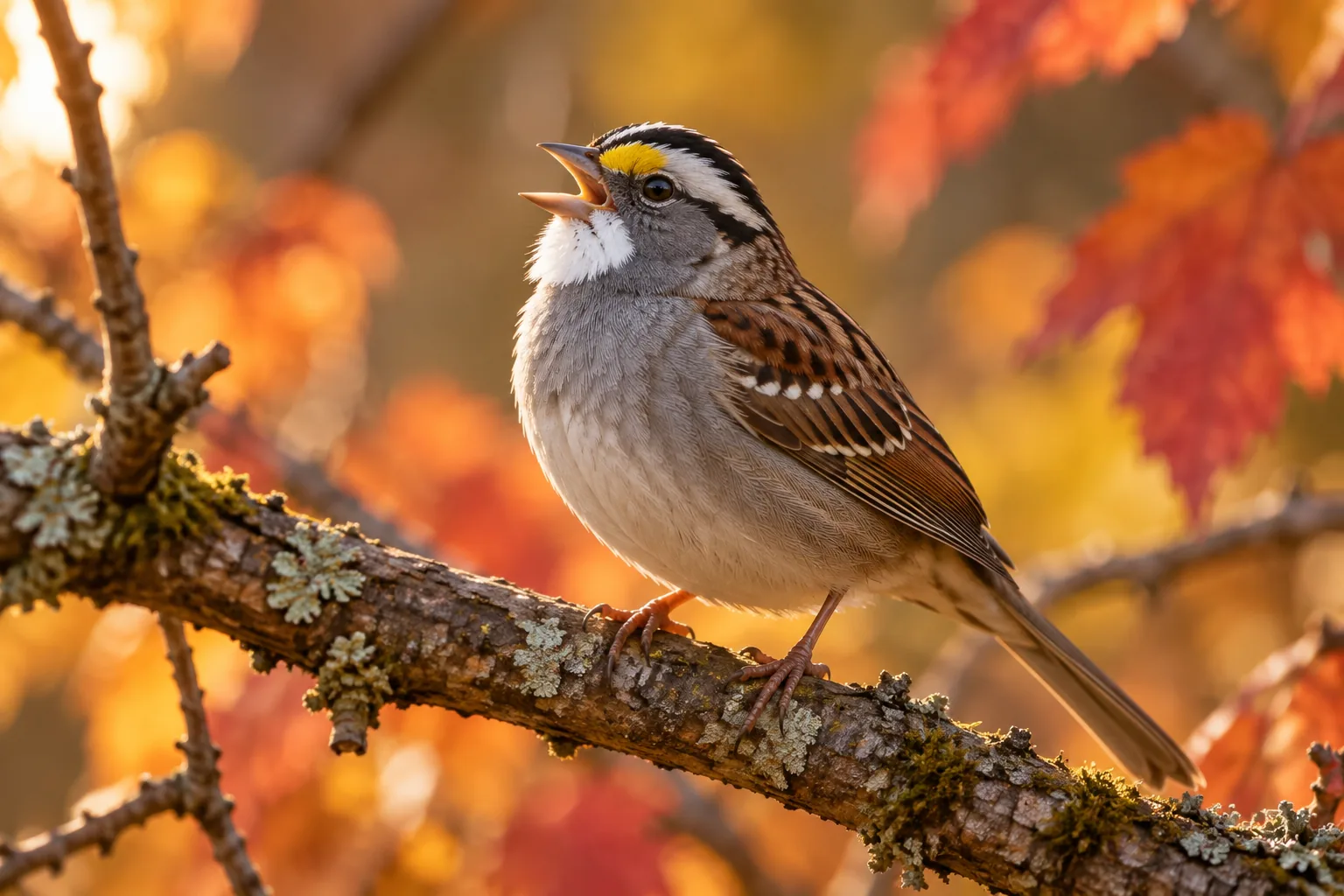
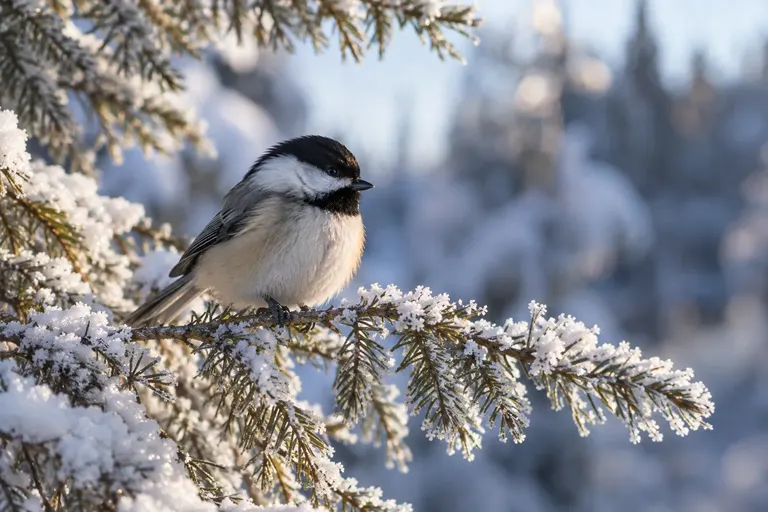
For many people in the eastern half of the US, the most noticeable fall song is the thin, whistled “Oh-sweet-Canada-Canada” or “Old-Sam-Peabody-Peabody” of the White-throated Sparrow. Cornell Lab’s All About Birds notes that these sparrows sing often in the breeding season “and on their winter range as well.” Each song lasts about 4 seconds. Males of both color forms sing, and so do white-striped females, while tan-striped females sing only rarely.
White-throated Sparrows breed mostly in Canada and the northern US, then move south in fall, mostly east of the Rockies. Cornell puts the continental population at more than 160 million birds. When a flock reaches your yard in October, the whistles you hear from the brush are often birds sorting out who forages where.
Fall and winter song may even matter for how this sparrow’s song changes over time. A 20-year study published in 2020 in Current Biology tracked a new version of the song, ending in a doublet instead of the classic triplet, as it spread from British Columbia across more than 3,000 km (over 1,800 miles) of Canada between 2000 and 2019. Geolocators on western males showed they shared wintering grounds in Texas with eastern birds, and the researchers suggested that young males may pick up new song types when they winter alongside birds from other dialect areas. Winter is not a silent season for learning.
To bring them in close, see how to attract White-throated Sparrows.
Carolina Wren: a pair that never takes the season off
The loud, rolling “teakettle-teakettle-teakettle” you hear in November in the Southeast and Midwest is almost certainly a Carolina Wren. Cornell notes that “pairs stay bonded year-round, with no vacation from singing or defending territory.” Only males sing, and each male has a repertoire of up to several dozen song variations, singing one about 15 times before switching. The female often answers with a chattering call.
Because the pair holds its territory all year, fall song is a continuation, not a restart. Carolina Wrens have also been wintering farther north in recent decades, so more people in northern states now hear them in fall. See how to attract Carolina Wrens.
Northern Mockingbird: new territories, and females join in
Mockingbirds are another classic fall singer. Both sexes sing, and fall is one of the times when females are most likely to be heard, usually more softly and less often than males. In fall, mockingbirds that move south or shift locally set up new territories, and young birds from the summer try out their songs. Many individuals defend a winter territory around a good supply of berries or fruit, and song is part of how they claim it.
Fall singing tends to taper off in November, then returns in late winter with a spring repertoire. The Smithsonian’s National Zoo notes that mockingbirds sometimes sing in late fall and winter “for reasons still being studied,” which is an honest reminder that not every detail is settled. For night singing, which is mostly a spring behavior of unmated males, see why birds chirp at night. For year-round habits, see our Northern Mockingbird guide.
Northern Cardinal: an occasional fall singer
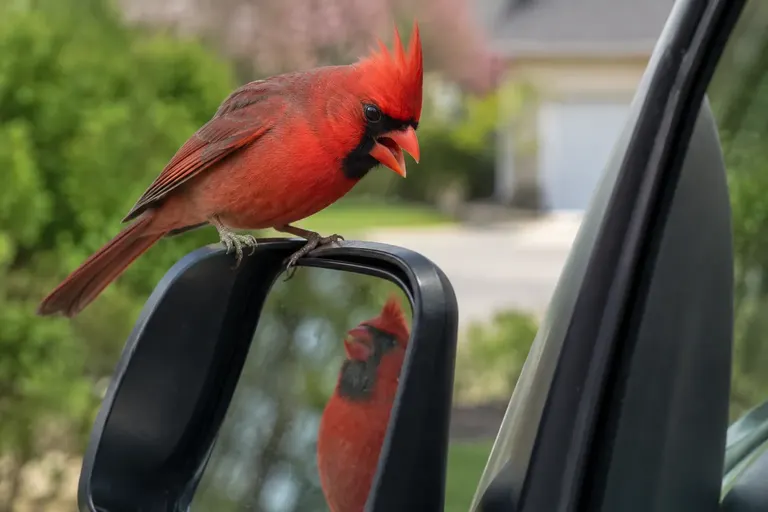
Cardinals are year-round residents, and males can sing in any month, but fall is their quiet season. Birds of the World summarizes studies showing that in Tennessee cardinal song is most common from February to September and least common in November and December. So if you hear a cardinal’s “cheer-cheer-cheer” on a mild October morning, enjoy it, but expect much more from late winter onward. Female cardinals also sing, though their song season is shorter than the males’.
American Robin: quiet subsong in flocks
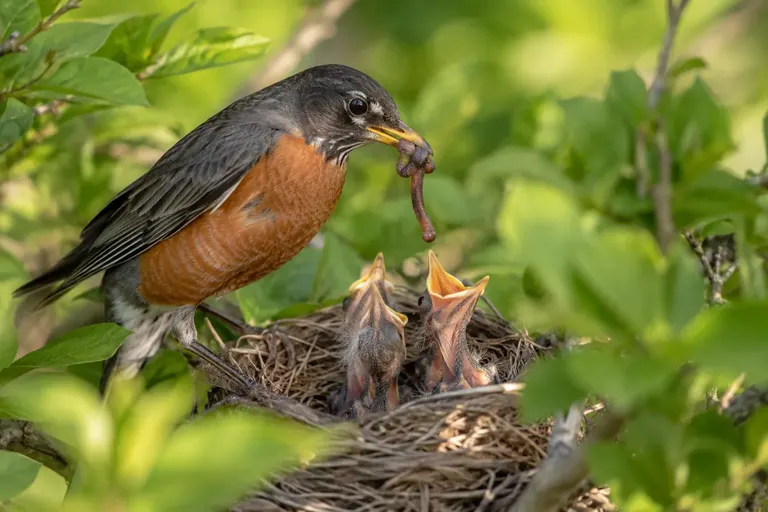
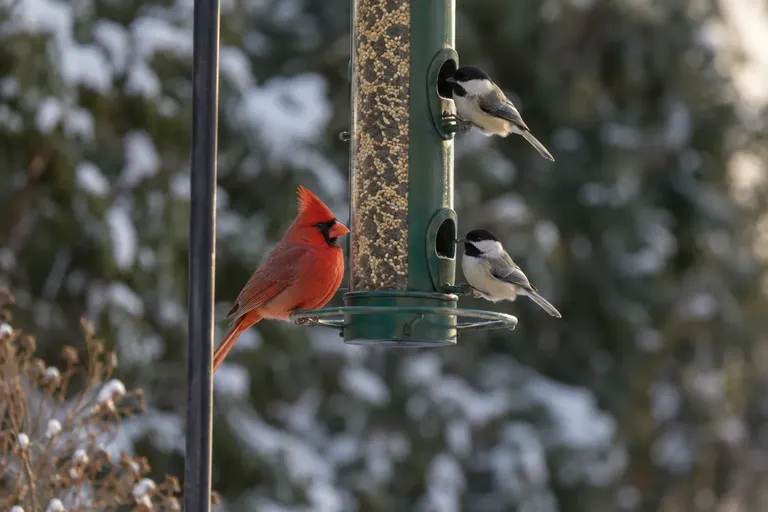
American Robins are not big fall singers. Their caroling “cheerily, cheer-up” song is a sound of spring and summer. In fall and winter, robins gather in flocks to feed on fruit, and you may hear quiet, rambling subsong from birds in these flocks, especially as winter moves toward spring.
What is the European Robin’s autumn song?
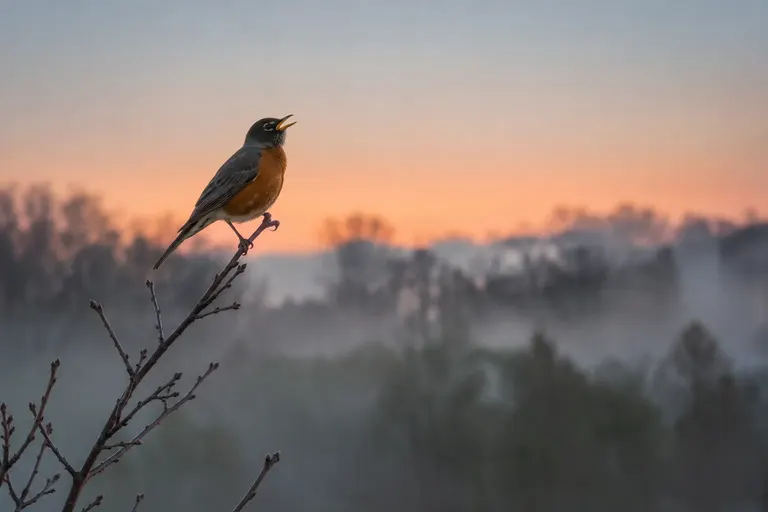
The European Robin is the world’s best-known fall singer. After a summer silence while it molts, it starts singing again from around early September, and both males and females sing to defend separate winter territories. That female song is unusual among familiar European garden birds, and it is the reason the robin’s “autumn song” is so well documented.
A few details make the robin a useful model for understanding fall song in general:
- Each bird holds its own patch. Vogelbescherming Nederland, the Dutch BirdLife partner, notes that robins live solitary lives outside the breeding season and that even former mates become rivals. Every robin, male and female, marks its winter territory with song.
- Many females migrate. In Britain and Germany, robins are partial migrants, and females are more likely than males to fly south for the winter. The ones that stay sing to hold their ground.
- The song changes character. British and Dutch observers describe the autumn song as calmer, softer and more wistful than the spring song, with longer phrases.
- Females sing as well as males. A 2022 study in Animal Behaviour found no difference between male and female robins in two measures of vocal performance during spontaneous song, which supports the idea that the song is used against rivals of either sex.
If you live in North America, this is a different bird from the American Robin, which is a thrush.
Do hormones make birds sing in the fall?
Partly. Birds sing less in fall because hormone levels are low, but a modest autumn revival of reproductive physiology helps explain why some species pick up again. Birders sometimes call this “autumnal recrudescence.” The research picture is more nuanced than a simple testosterone spike, and it varies by species.
Shorter days reset the system
After summer, most temperate songbirds are photorefractory: long days no longer stimulate their reproductive system. Short days reset that. In European Starlings, a 2024 study in Frontiers in Behavioral Neuroscience notes that birds become photosensitive again in autumn once day length falls below about 11.5 hours. Around the fall equinox, days pass through roughly the same lengths as in early spring. In some species, that reset comes with a small, short-lived rise in reproductive activity and some singing, though nothing close to a real breeding season.
Testosterone is not the whole story
Experiments show that fall song and fall aggression do not always depend on testosterone:
- Male European Robins have low testosterone in autumn. In a 1991 study in Hormones and Behavior, Schwabl and Kriner found that a drug blocking androgens reduced spring territorial aggression but did not affect autumn aggression, and did not significantly reduce singing in either season.
- Female European Robins show a different pattern. Kriner and Schwabl reported in Ethology (1991) that free-living females had elevated testosterone during their winter singing phase, and that testosterone treatment made captive females sing.
- Song Sparrows defend territories aggressively in fall and winter with very low testosterone in the blood. Research by Kiran Soma and John Wingfield found that blocking the conversion of hormones to estrogen reduced this winter aggression, suggesting the brain may produce or activate the hormones it needs locally.
- House Finches given testosterone in fall sang more, in a 2008 study by Strand and colleagues, showing that the capacity to sing is there even outside the breeding season.
The takeaway: fall song is real territorial behavior, run by the same brain circuits as spring song, but switched on through a mix of day length, local hormone production and social pressure from neighbors.
Why is fall birdsong quieter and less structured?
Fall song usually sounds softer, shorter or more rambling than spring song for four reasons:
- Smaller song centers in the brain. In several seasonal songbirds, the brain areas that control song are larger in spring than in fall, according to a 2001 review of photoperiod and seasonality by Dawson and colleagues. Less brain hardware can mean less polished song.
- Lower hormone levels. Even with a small autumn stir, hormone levels stay far below spring peaks.
- A different message. A keep-out signal between wintering neighbors does not need the elaborate performance that impresses a potential mate.
- Many singers are beginners. A large share of fall song comes from young birds that are still learning.
Female song also plays a part. The female robin’s song is described by NABU, Germany’s largest nature conservation group, as similar to the male’s but quieter and shorter.
How do young birds practice singing in the fall?
Young songbirds hatched in spring and summer spend fall practicing. Most learn their song by listening to adults during a sensitive period early in life, then rehearse it. The first stage is subsong: quiet, variable babbling, often delivered from inside dense cover. It gradually becomes plastic song, which sounds closer to the adult version but still wanders. In many migratory species, the song only settles into its final, fixed form the following spring, when the bird claims its first breeding territory.
For backyard listeners, this has two practical effects:
- Odd songs in shrubs are usually juveniles. A soft, warbling jumble from a hedge in September is more likely a young bird practicing than a rare species.
- Apps struggle with it. Sound ID tools are trained mostly on adult song. Our guide on using Merlin Sound ID without getting fooled explains how to double-check.
The full learning process, from memorization to crystallized song, is covered in how do birds learn songs?
Which birds can you hear singing in October and November?
Here is a short list for most of the eastern and central United States, plus the European example for comparison. Timing varies with latitude and weather.
| Bird | What you hear in October and November | Why it sings |
|---|---|---|
| White-throated Sparrow | Thin, whistled “Oh-sweet-Canada” from brush and feeders | Migrants and winter arrivals sorting out foraging space |
| Carolina Wren | Loud “teakettle-teakettle” all fall | Pair holds its territory year-round |
| Northern Mockingbird | Long strings of repeated phrases, fading in November | Both sexes set up winter territories around fruit |
| Northern Cardinal | Occasional “cheer-cheer” on mild mornings | Year-round residents, lowest song in Nov-Dec |
| American Robin | Quiet, rambling subsong in fruit-eating flocks | Low-motivation off-season song |
| Young songbirds of many species | Soft, jumbled warbling from dense shrubs | Juveniles practicing subsong and plastic song |
| European Robin (Europe) | Soft, wistful song from September onward | Males and females defend separate winter territories |
Does fall song mean birds think it is spring?
No. Fall song is not a mistake or confusion about the season. It is a normal behavior with its own purposes, mainly holding a winter territory, keeping a year-round pair in place and practicing for next year. The small hormonal revival in autumn, if it happens in a species, stays far below breeding levels, and birds do not start nesting in October because of it.
A few myths are worth clearing up:
| Myth | Fact |
|---|---|
| Birds that sing in fall are confused by warm weather | Fall song is regular territorial behavior in many species |
| Only males sing | Female European Robins, Northern Mockingbirds and white-striped White-throated Sparrows sing too |
| Fall song means a bird is about to nest | Nesting does not follow; the song is about winter space |
| All fall song is testosterone-driven | In several species, fall song and aggression continue with low testosterone |
| A bird singing an odd song is a rarity | It is more often a young bird still learning |
What does fall song mean for your yard?
Fall song tells you which birds consider your yard part of their winter territory. That is useful information if you feed birds or plan your garden.
- A singing Carolina Wren or mockingbird has settled in. Dense shrubs, brush piles and berry-bearing plants help keep them.
- White-throated Sparrows singing near your feeders are staying for the season. They feed on the ground, so scatter some millet or mixed seed below feeders.
- Singing birds need fuel. Fall and winter are when high-energy food helps most. See our guide to winter bird feeding for what to offer as it gets cold.
- Listen at dawn and on mild, still days. Fall song is often strongest in the early morning and after a spell of calm, mild weather.
Common mistakes when listening to fall song
- Assuming a quiet, rambling song is a rare bird. Check for young birds of common species first.
- Trusting an app’s first answer. Juvenile and female song often trip up automated ID.
- Expecting cardinals and robins to sing as they do in spring. Both are mostly quiet in November.
- Forgetting that “robin” means two different birds. The famous autumn singer is the European Robin, not the American Robin.
The bottom line
Birds that sing in the fall are mostly defending real estate for the winter, keeping year-round territories or practicing for next spring. In the US, the Carolina Wren, Northern Mockingbird and White-throated Sparrow carry the fall chorus; in Europe, the robin leads it, with females singing alongside males. Shorter days may give some species a small autumn lift, but fall song runs on a mix of day length, local hormones and competition with neighbors. It is quieter than spring song, and a lot of it comes from young birds still finding their voice.
Sources
- Cornell Lab of Ornithology, All About Birds: White-throated Sparrow sounds
- Cornell Lab of Ornithology, All About Birds: Carolina Wren life history
- Birds of the World: Northern Cardinal sounds and vocal behavior
- Audubon: How a White-throated Sparrow’s new tune went viral
- Smithsonian’s National Zoo: Northern Mockingbird
- Schwabl and Kriner (1991), Territorial aggression and song of male European robins in autumn and spring, Hormones and Behavior
- Kriner and Schwabl (1991), Control of winter song and territorial aggression of female robins by testosterone, Ethology
- Vogelbescherming Nederland: Roodborsten bezetten winterterritoria

Frequently asked questions
Why is a bird singing in my yard in October?
Most likely it is claiming a winter feeding territory or keeping hold of a year-round one. In much of the eastern United States the usual October singers are Carolina Wrens, Northern Mockingbirds and newly arrived White-throated Sparrows. Young birds hatched that summer also practice quiet, rambling subsong in shrubs. None of this means the bird is confused about the season.
Do birds sing in the fall to find a mate?
Mostly no. Fall song is chiefly about space and food: it tells rivals that a patch is taken for the winter. Some pairs that stay together year-round, such as Carolina Wrens, keep singing to hold their shared territory. Unpaired young mockingbirds may start forming relationships in fall, but serious courtship song belongs to late winter and spring.
Why does fall birdsong sound quieter or messier than spring song?
Hormone levels are low after the breeding season, and the brain areas that control song are smaller in fall than in spring in several species. The goal is also different: a keep-out signal does not need the polish of a courtship song. Many of the rough, rambling songs you hear are young birds still learning their species' song.
Do female birds sing in the fall?
In some species, yes. European Robin females sing in fall and winter to defend their own feeding territories, and female Northern Mockingbirds also sing in fall, usually more softly than males. White-striped female White-throated Sparrows sing too. In many other North American songbirds, most song comes from males.
Which bird sings in the fall in Europe?
The European Robin is the classic example. After its summer molt it starts singing again from around early September, and both males and females sing to hold separate winter territories. Eurasian Wrens and Common Starlings also sing through much of the fall, and Mistle Thrushes start their loud song from about November.