Why Do Birds Puff Up? What Fluffed Feathers Mean
Why do birds puff up? Mostly to trap warm air, but also to rest, preen, sunbathe, look bigger to rivals or court a mate. Learn when a fluffed bird may be sick.
In this article
- Quick answer: reasons birds puff up
- How do birds puff up their feathers?
- Why do birds puff up when it’s cold?
- Why do birds puff up when they sleep?
- Why do birds puff up and shake? (preening and rousing)
- Why do birds puff up in the sun?
- Why do birds puff up at each other?
- Why do baby birds look puffed up?
- Is a puffed-up bird sick?
- How can you tell a cold bird from a sick bird?
- Which birds are famous for puffing up?
- Myths vs facts about puffed-up birds
- What does this mean for backyard birders?
- Common mistakes when you see a puffed-up bird
- Quick facts
- Sources
- Frequently asked questions
Why do birds puff up? Mainly to stay warm through winter nights that can mean more than 14 hours without food. By raising their feathers, they trap a thicker layer of air next to the skin, which works like the loft in a down jacket. Fluffing has other meanings too: birds puff up to rest and sleep, to preen and settle their plumage, to sunbathe, to look bigger to a rival or predator, and to court a mate. Occasionally, a bird that stays fluffed and listless is sick.
The trick is reading the context. This guide explains how birds raise their feathers, the main reasons they do it, how to tell a cold bird from a sick one, and what it means for your feeders.
Quick answer: reasons birds puff up
| Reason | What it looks like | Typical context |
|---|---|---|
| Keeping warm | Round, evenly fluffed body, legs often hidden | Cold mornings, winter, wind |
| Resting or sleeping | Fluffed, still, bill tucked into back feathers | Night roosts, midday naps |
| Preening and rousing | Brief fluff, then a full-body shake | After bathing or grooming, before flight |
| Sunbathing | Feathers raised, wings or tail spread toward sun | Sunny patches, often after rain or during molt |
| Threat display | Specific feathers raised, body angled at a rival | Feeder squabbles, territorial disputes |
| Courtship | Neck, chest or crown puffed, often with calls | Spring, breeding season |
| Illness | Fluffed, lethargic, eyes closed, easy to approach | Any season, often on or under feeders |
How do birds puff up their feathers?
Each feather grows from a follicle in the skin, and each follicle is controlled by tiny muscles. By contracting these muscles, a bird can lift its feathers away from the body, flatten them tight, or raise only certain tracts, such as the crest or the back. Biologists call feather-raising ptiloerection. It is broadly comparable to the goosebumps that lift hair on a mammal’s skin, though bird feather control is far more precise.
Feathers also grow in defined tracts rather than evenly across the skin, with bare areas between them. When feathers are sleeked down, the tracts overlap into a smooth, weatherproof surface. When they are raised, the overlap loosens and the downy bases of the feathers open up, creating a deeper, fluffier coat.
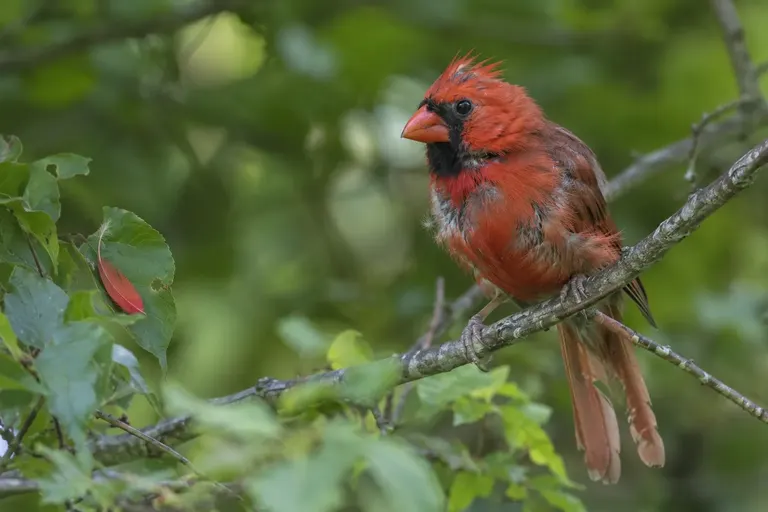
That is why the same bird can change shape so dramatically. A sleek, slim Northern Cardinal in July and a round, fluffy one in January are the same size; only the arrangement of the feathers has changed.
Why do birds puff up when it’s cold?
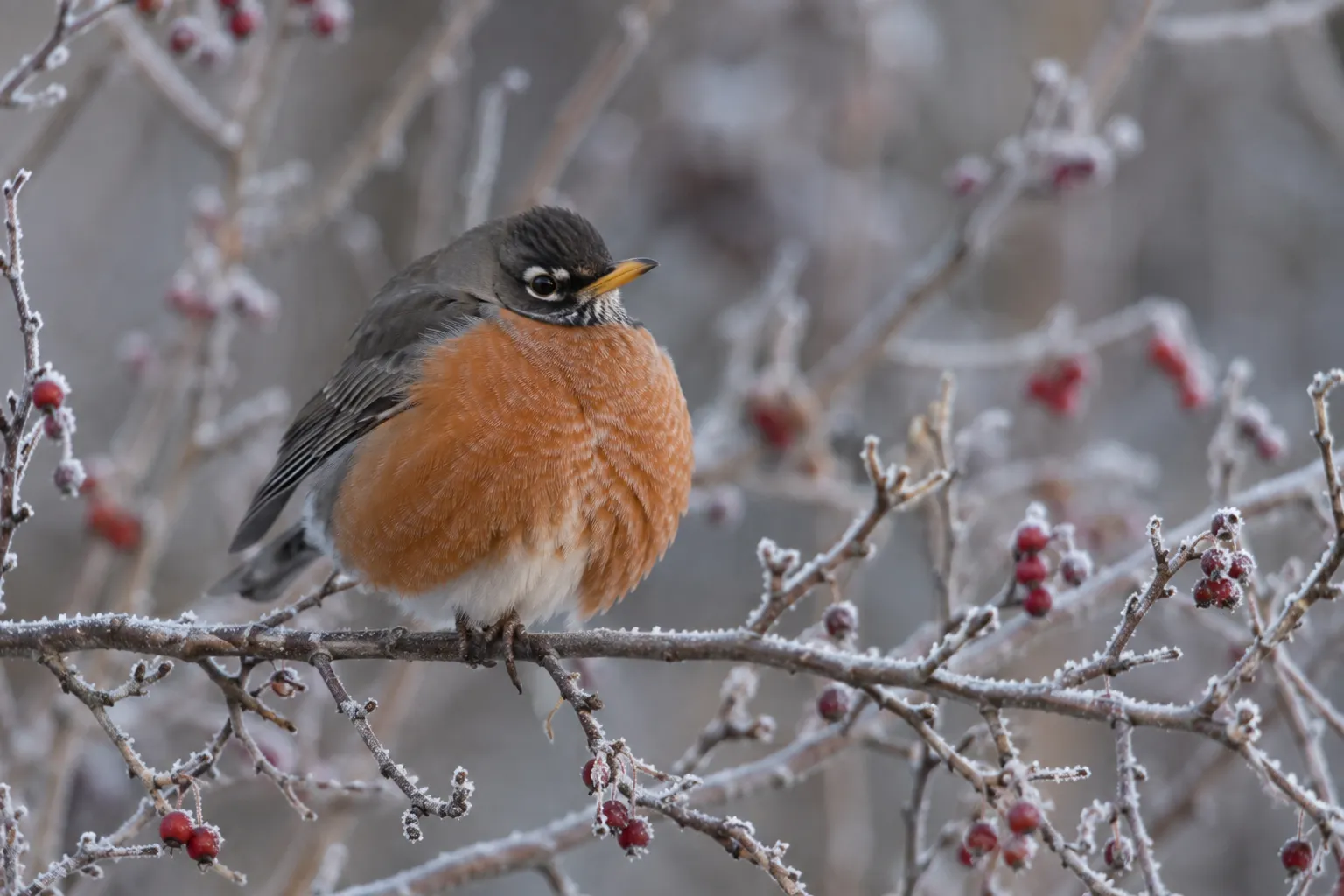
Insulation is the most common reason by far. Still air is a poor conductor of heat, and the downy parts of feathers trap air in countless tiny pockets. Raising the feathers increases the thickness of that air layer, and thicker insulation slows heat loss.
Small birds have a lot to gain. Their small bodies lose heat quickly, and a winter night can mean more than 14 hours without food. Fluffing reduces the amount of stored fat a bird must burn to stay warm. Birds also tuck their legs into their belly feathers and turn their heads to bury the bill in their back feathers, so almost nothing is left exposed.
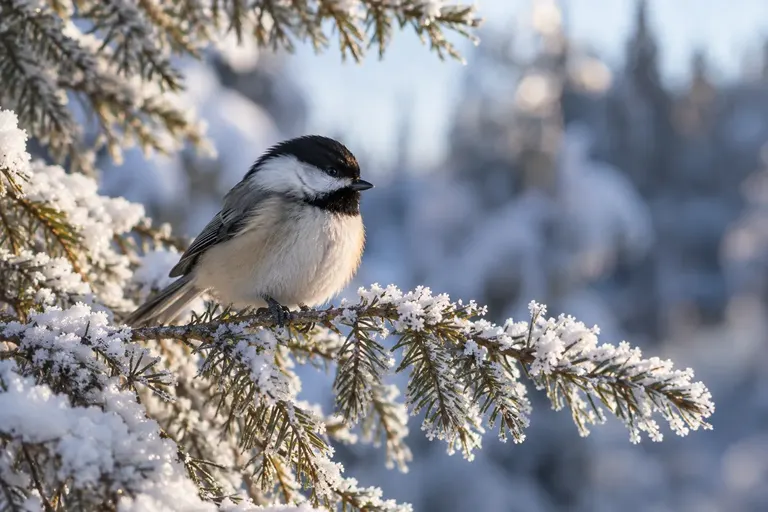
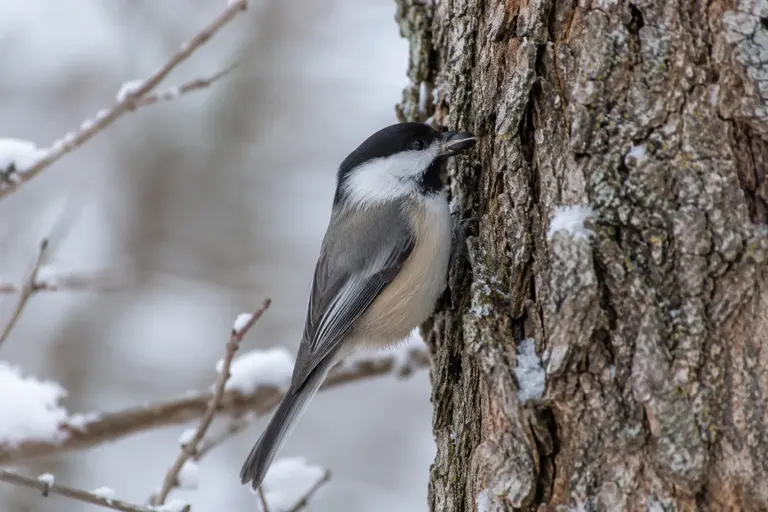
The effect can be adjusted in seconds. On a cold morning, a chickadee may be fully fluffed on its roost, sleek down as it warms up in flight, then fluff again when it sits still. For the full picture of winter survival, including shivering, fat reserves and overnight cooling, see how birds stay warm in winter.
What do birds do when it’s hot?
The opposite. In hot weather, birds press their feathers flat against the body to release trapped air, hold their wings slightly away from the body to expose thinly feathered skin, and pant or flutter the throat to lose heat by evaporation. So a sleek bird on a hot day and a puffed bird on a cold day are using the same feathers to solve opposite problems.
Do all birds look round in winter?
Many small songbirds do, including chickadees, tits, sparrows, finches, juncos and robins. Birds in winter plumage often have fresh, dense feathers after their late-summer molt, which adds to the effect. Ground-feeding birds such as Mourning Doves and European Robins can look almost spherical on frosty mornings.
Why do birds puff up when they sleep?
Resting birds fluff up for the same reason as cold birds: they are not moving, so they are not generating heat from muscle activity, and they want to keep what they have. A sleeping bird typically fluffs its body feathers, draws one leg up into its belly feathers, and rests its head on its back with the bill tucked under the shoulder feathers. Some species sleep with the head forward instead.
This posture is so standard that it is one of the clearest signs of a relaxed bird. A backyard bird dozing in a sunny shrub at midday, fluffed and with its eyes half closed, is usually just taking a break. Birds also sleep this way on a perch without falling, helped by leg tendons and a grip that is thought to need little muscular effort.
Why do birds puff up and shake? (preening and rousing)
A bird that suddenly fluffs every feather, then shakes its whole body with a rattling ruffle, is rousing. This quick motion resets feathers into place after preening, bathing, sleeping or a scuffle. It also shakes off water, dust and loose feather sheaths. Birds commonly rouse just before taking flight, as if tidying their plumage for the trip.
Puffing is also part of preening itself. To reach the base of each feather and spread preen oil from the gland near the tail, a bird raises sections of feathers, works through them with its bill, then settles them back down. During the annual molt, when new feathers are emerging from waxy sheaths, birds may preen and fluff more often. See why birds molt for the timing.
After bathing, whether in water or dust, birds fluff up to shake off water or particles and speed drying. A sparrow puffed into a ball on a fence after a bath is simply drying off. We explain dust baths in why birds take dust baths.
Why do birds puff up in the sun?
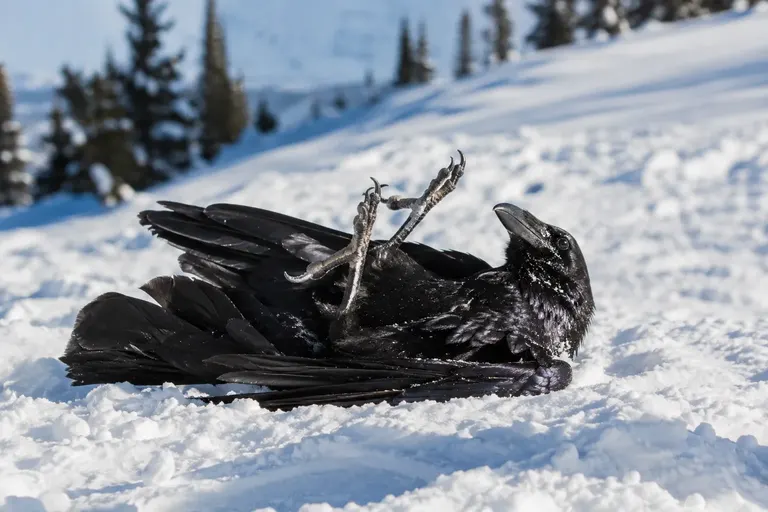
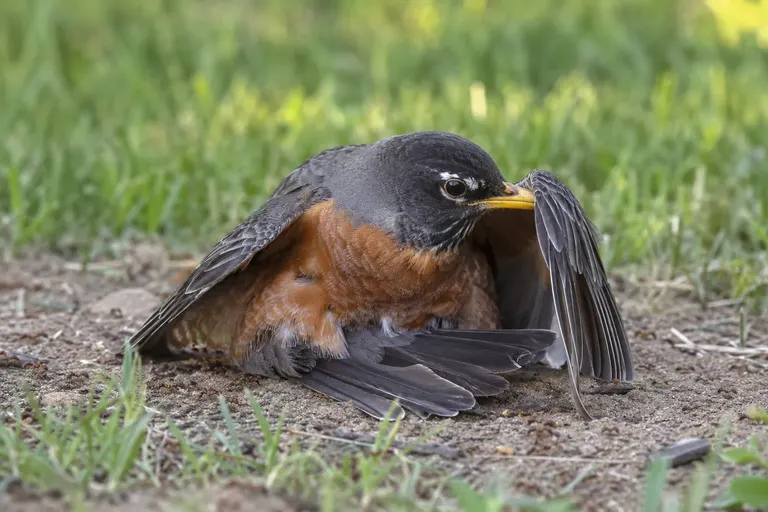
Sunbathing birds often raise their feathers to let sunlight reach the skin and feather bases. The postures can look alarming: a bird may lie flat on the ground with wings spread, tail fanned and feathers fluffed, sometimes with its bill open, looking stunned. It is usually normal behavior. Researchers think sunbathing may help birds warm up, spread preen oil and dislodge or discourage feather parasites. Our guide on why birds sunbathe covers the evidence.
Why do birds puff up at each other?
Feathers are a communication tool, and raising them can change a bird’s message instantly.
Threat and aggression
A bird that raises its feathers looks bigger. In disputes over food, perches or territory, many species fluff their body or particular patches while facing an opponent. At feeders, you might see a House Finch or a sparrow puff up, lower its head and gape at a rival before a short chase. Blue Jays and Steller’s Jays raise their crests when excited or aggressive, while Tufted Titmice and Northern Cardinals raise and lower their crests in response to disturbances and rivals.
Owls are famous for threat displays. A cornered owl may fluff its body feathers and spread its wings into a wide, rounded shape while clacking its bill, which can make it look startlingly large.
Courtship
In the breeding season, puffing can mean something else entirely. Male Rock Pigeons puff out their neck feathers, fan their tails and circle while cooing at females, and many doves perform similar displays. Male House Sparrows hop around females with wings drooped, tail raised and chest puffed. In some species, such as grouse and prairie-chickens, males combine raised feathers with inflatable, brightly colored skin or air sacs on the neck, but that is a separate structure from feather fluffing.
Fear and camouflage
Interestingly, frightened birds often do the opposite of puffing. A bird that feels threatened but hopes to stay hidden may flatten its feathers and stretch tall and thin. Eastern Screech-Owls are known for this: when disturbed, they sleek down, raise their ear tufts and narrow their eyes so they look like a broken branch. The sleek look is a sign of alarm, and the relaxed, fluffed look returns when the threat passes.
Why do baby birds look puffed up?
Nestlings and fledglings often look fluffy for two reasons. Their feathers are still growing, with downy bases and soft, loosely structured tips. And young birds have less control over their body temperature than adults, so they fluff up more readily. Many fledglings sit puffed up on a branch while waiting for a parent to bring food, then flutter their wings and beg when the parent arrives. A round, fluffy young robin or sparrow on the ground in early summer is usually a healthy fledgling, not a sick bird.
Is a puffed-up bird sick?
Sometimes, and this is the question that matters most for people who feed birds. Illness makes birds feel cold because a sick bird often cannot maintain its body temperature efficiently. So sick birds fluff up, sit still and conserve energy.
Signs a fluffed bird may be ill
Look for a combination of signs, not puffing alone:
- Fluffed in mild weather. A bird that stays puffed on a warm afternoon is more concerning than one fluffed on a frigid dawn.
- Lethargy. It sits in one spot for long periods, often on a feeder tray or the ground beneath.
- Eyes closed or swollen. Red, swollen or crusty eyes in House Finches and some other finches are a classic sign of mycoplasmal conjunctivitis, often called House Finch eye disease.
- Approachability. A normally wary bird lets you get unusually close.
- Messy plumage. Soiled vent feathers, matted feathers or obvious feather loss.
- Labored breathing. Tail bobbing with each breath, or an open bill in cool weather.
What to do if you see a sick bird at your feeder
- Do not try to catch or treat it yourself. Contact a licensed wildlife rehabilitator if you think it can be helped. See what to do with an injured bird.
- Take feeders down for about a week or two. This disperses birds and reduces transmission. Many conservation groups recommend this whenever sick birds appear.
- Clean everything. Scrub feeders and birdbaths with a dilute bleach solution, rinse well and dry before refilling.
- Rake up spilled seed and droppings under feeders.
- Report it. Community science projects such as Project FeederWatch collect reports of sick birds.
Our full guide to sick birds at the feeder explains common diseases, including salmonellosis, avian pox and trichomonosis, in more detail.
How can you tell a cold bird from a sick bird?
Context is everything. Here is a quick way to judge what you are seeing:
| Question | Probably fine | Possibly ill |
|---|---|---|
| What is the weather? | Cold, windy or early morning | Mild or warm |
| Is it feeding normally? | Yes, moves between feeders and cover | Sits in one spot, barely eats |
| Does it fly off when you approach? | Yes, at a normal distance | Stays put or flies weakly |
| How do the eyes look? | Bright and clear | Closed, swollen or crusty |
| How long does it stay fluffed? | Changes posture as it moves | Fluffed for hours |
| Are other birds nearby similar? | Many birds fluffed on a cold day | Several lethargic birds of one species |
Which birds are famous for puffing up?
Fluffing is universal, but some birds have turned it into a signature.
- Wild Turkeys. Displaying males, or toms, raise nearly every body feather, fan the tail into a wheel and drop their wings while strutting and gobbling. A strutting tom can look twice the size of a relaxed one.
- Snowy Owls and other Arctic birds. Birds of very cold places carry dense plumage, and a resting Snowy Owl fluffed against the wind can look like a white mound on a snowbank.
- Eurasian Bullfinches and Eurasian Robins. In European gardens these birds are the classic round winter silhouettes on Christmas cards, largely because they fluff up so much in the cold.
- Emperor Penguins. Their dense feathers can be raised and lowered to adjust insulation, and they fluff and preen constantly to keep the coat working through the Antarctic winter.
- Doves worldwide. From Mourning Doves in North America to Eurasian Collared Doves in Europe and Turkey and Eared Doves in Brazil, doves are frequent fluffers in cold weather and frequent neck-puffers during courtship.
Myths vs facts about puffed-up birds
Myth: A puffed-up bird is always fat. Most of that roundness is air between the feathers. A fluffed bird can look almost twice its sleek size without weighing any more.
Myth: Birds puff up because they are angry. Anger or threat is only one of many reasons, and it usually involves specific feathers and body postures. Most fluffing is about temperature and rest.
Myth: A bird that looks round in winter is in trouble. A round bird on a cold day is doing exactly what it should. Worry only when fluffing combines with the illness signs above.
Fact: Birds control feathers in sections. A bird can raise just its crest, its head feathers, its back or its rump. Cardinals and jays raise crests, and some species flash colored patches this way.
What does this mean for backyard birders?
Once you know the reasons behind fluffing, your feeder becomes a behavior lesson.
- Cold mornings bring the roundest birds. Offer high-energy food such as suet, black oil sunflower and unsalted peanuts, especially late in the day before long nights. Our winter bird feeding guide covers this.
- Shelter lets birds rest safely. Dense evergreens and shrubs near feeders give fluffed, resting birds cover from wind and hawks.
- Water helps feathers work. Clean feathers insulate and fluff properly. A clean birdbath, heated in freezing climates, supports this year-round.
- Watch for disease signs. A lethargic, fluffed bird on a mild day is the one to note.
- Learn body language. Our guide to reading bird behavior explains other postures and what they mean.
Common mistakes when you see a puffed-up bird
- Assuming it is injured and picking it up. Most fluffed birds are healthy. Handling is stressful and, for wild birds, often illegal without a permit.
- Bringing a cold bird indoors to warm it up. Healthy wild birds are adapted to the cold. Warm rooms can stress them.
- Ignoring feeder hygiene when sick birds appear. Leaving dirty feeders up can spread disease through the flock.
- Mistaking fledglings for sick birds. Round, fluffy young birds with short tails are usually just waiting for their parents.
Quick facts
- Feather-raising is controlled by small muscles at the base of each feather.
- Puffing thickens the insulating air layer, reducing heat loss.
- In heat, birds do the opposite and press their feathers flat.
- Rousing is a quick fluff and shake that resets feathers.
- Owls puff up in threat displays; screech-owls sleek down to hide.
- Male pigeons and doves puff neck feathers while courting.
- A bird fluffed and lethargic in mild weather may be ill.
Sources
Frequently asked questions
Why do birds puff up when it's cold?
Puffing up thickens the layer of air trapped between the feathers. Still air is a poor conductor of heat, so a thicker layer means better insulation, much like a down jacket. Birds raise their feathers using small muscles in the skin at the base of each feather, which lets them adjust their insulation within seconds as the temperature changes.
Is a puffed-up bird sick?
Usually not. Most puffed-up birds are cold, resting or preening. A bird may be ill if it stays fluffed for long periods in mild weather, sits still on a feeder or the ground, lets people approach closely, or shows swollen, crusty eyes or ruffled, dirty feathers. If several such birds appear, clean or take down your feeders for a couple of weeks.
Why do birds puff up when they sleep?
Sleeping birds fluff their feathers to hold in heat while they are inactive, often tucking the bill into the back or shoulder feathers. Resting birds make little heat from movement, so extra insulation reduces the energy needed to stay warm. The same fluffed, round look is common when birds doze during the day.
Why do birds puff up at other birds?
Raised feathers can make a bird look larger and more intimidating to a rival or predator. Many species fluff specific areas, such as the head, crown or back, during threat displays and territorial disputes. Courting males of some species, including pigeons and doves, also puff their neck and chest feathers while displaying to females.
Why do birds puff up and shake?
A quick fluff followed by a shake is called rousing. It resets feathers into their proper position after preening, bathing or a period of rest and helps shed dust and loose bits of feather. Birds often rouse just before flying off, so it is a normal, healthy maintenance behavior rather than a sign of distress.