Why Do Birds Stand on One Leg? Heat, Balance and Rest
Why do birds stand on one leg? Mainly to save body heat through bare legs, and it takes very little effort. Here is the science, from flamingos to gulls.
In this article
- Quick answer: reasons birds stand on one leg
- How do birds lose heat through their legs?
- Does standing on one leg really keep birds warmer?
- Why don’t birds get tired standing on one leg?
- Do birds stand on one leg in hot weather?
- How much heat does a bird save?
- Why do some birds sit down instead?
- Do birds swap legs?
- Do birds sleep on one leg?
- Which birds stand on one leg most?
- Is a bird standing on one leg injured?
- Are there other theories?
- Myths and facts about birds on one leg
- Quick facts
- Sources
- Frequently asked questions
Why do birds stand on one leg? Mainly to save body heat. Their legs and feet are usually bare of feathers, so they lose warmth to cold air and water, and tucking one leg up into the belly feathers cuts that heat loss roughly in half. A 2017 study on flamingos also suggests the pose takes surprisingly little muscle effort, so for many birds it is simply a comfortable, stable way to rest.
You will see it everywhere once you look: flamingos in a lagoon, herons at the edge of a pond, gulls on a parking lot, ducks on an icy bank and even robins on a frosty lawn. This guide explains the science behind the pose, the main theories, the evidence from flamingos and what it means when a backyard bird does it.
Quick answer: reasons birds stand on one leg
| Reason | How it helps | Strength of evidence |
|---|---|---|
| Saving heat | Halves the area of bare leg exposed to cold air or water | Strong, supported by field and lab studies |
| Resting with little effort | Joint and skeletal locking keeps the bird balanced with minimal muscle | Supported in flamingo studies |
| Stability while dozing | Some birds sway less on one leg when resting | Supported in flamingos |
| Resting one leg at a time | May reduce fatigue by swapping legs | Plausible, less tested |
| Injury | Bird cannot use one leg | Occasional, easy to spot with other signs |
How do birds lose heat through their legs?
Most birds have excellent insulation over their bodies. Feathers trap a layer of warm air, and many species fluff up to thicken it, as our guide on why birds puff up explains. But the lower legs and feet of most birds are covered in scales rather than feathers. That bare skin is a weak point.
Heat moves from warm to cold. A bird with a body temperature of roughly 104°F (about 40°C) standing in near-freezing water or on snow would lose heat quickly through its legs if nothing prevented it. Water draws heat away much faster than air, so wading birds face an especially large challenge.
The countercurrent heat exchanger
Birds have a clever solution built into their legs. The arteries carrying warm blood down to the feet run closely alongside the veins carrying cold blood back up to the body. As they pass each other, heat moves from the outgoing arterial blood into the returning venous blood. By the time blood reaches the feet it is already much cooler, and by the time it returns to the body it has been rewarmed.
In some birds these vessels form a dense network called a rete mirabile, Latin for “wonderful net.” This countercurrent system means a duck’s or gull’s feet can sit near freezing without draining heat from its core. It is a big reason birds rarely suffer frostbite, which we cover in our guide on whether birds get frostbite.
The system is very effective, but not perfect. Some heat is still lost. Pulling one leg up into the feathers is a simple extra step that removes about half of the remaining exposed surface.
Does standing on one leg really keep birds warmer?
The evidence says yes. Several lines of research support the heat-saving explanation.
Gulls and waders in the cold
Studies of gulls and shorebirds have found that birds are more likely to stand on one leg, or to sit down and cover both legs, when temperatures drop. On a mild day, the same birds stand on two legs more often. This link between temperature and posture is exactly what the heat-saving idea predicts.
Flamingos in water
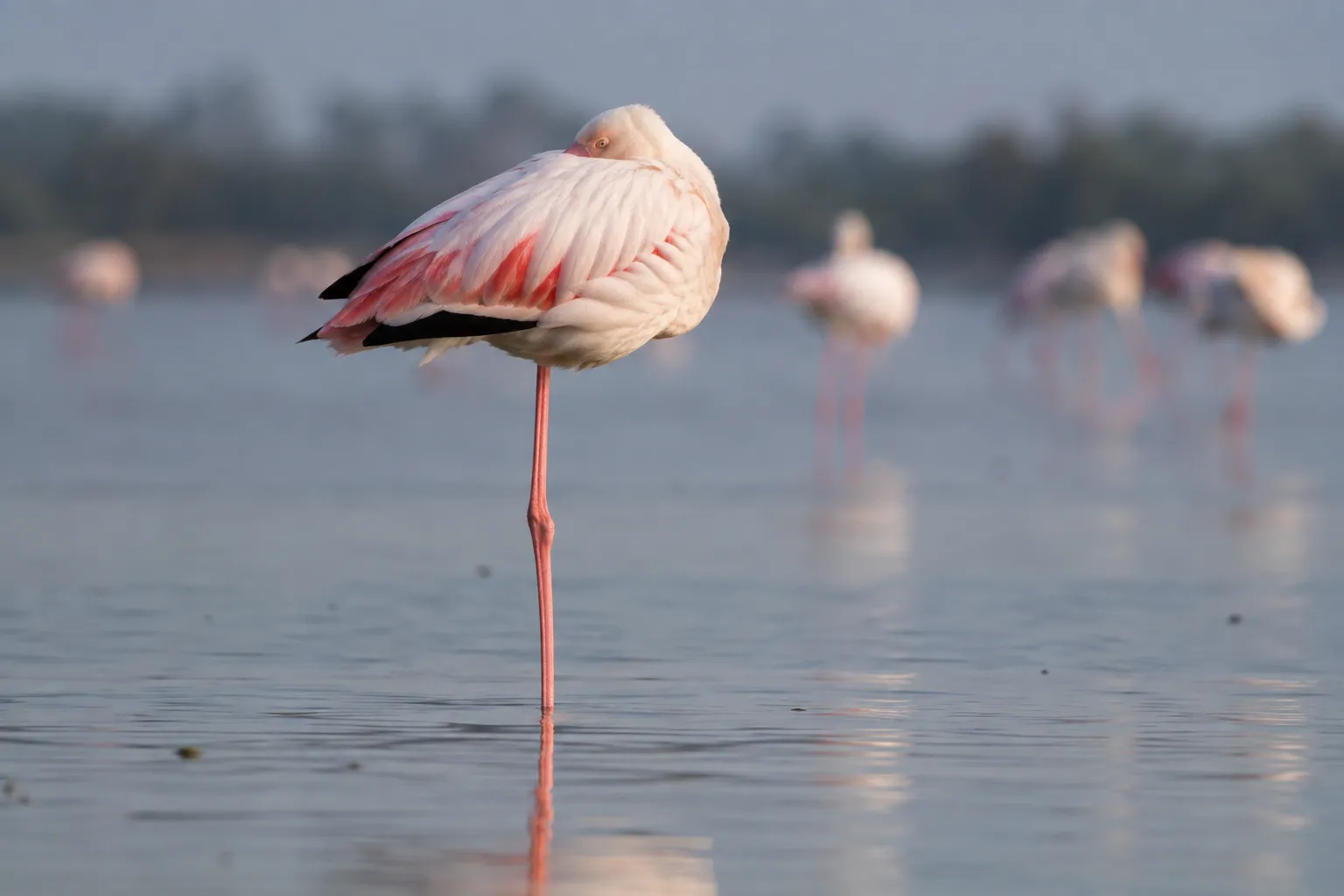
Flamingos spend long hours standing in water, often cooler than their bodies. In a study at Philadelphia Zoo published in 2010, Matthew Anderson and Sarah Williams reported that captive Caribbean Flamingos were more likely to rest on one leg when standing in water than on land, and that one-legged resting increased as temperatures fell. Their conclusion was that one-legged standing likely helps flamingos conserve body heat.
Ducks and geese on ice
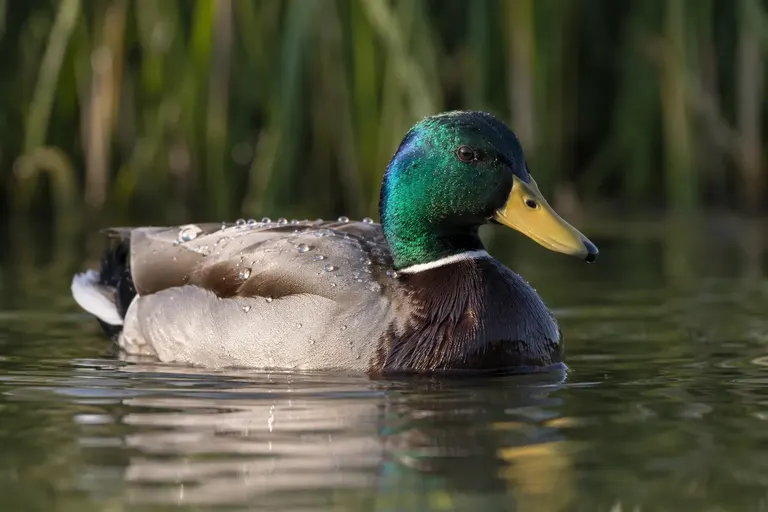
In winter, ducks and geese resting on ice or frozen ground often stand on one leg or lie down with both feet tucked into the belly feathers. Mallards in North America and Europe and Ruddy Shelducks on frozen lakes in Turkey and Central Asia show this in cold weather, while on warm summer days they stand on two feet much more often.
Why don’t birds get tired standing on one leg?
This was a puzzle for years. A person standing on one leg quickly tires and wobbles. Why don’t flamingos?
The 2017 flamingo study
In 2017, Young-Hui Chang and Lena Ting of Georgia Tech and Emory University published a study in the journal Biology Letters that changed how scientists think about the pose. They found two key things:
- Living flamingos sway less on one leg when resting. When the birds dozed on one leg, their bodies moved less than when they were more alert. This suggests the pose is stable, not a balancing act.
- Dead flamingos could be posed on one leg without support. When the researchers placed flamingo cadavers in a one-legged posture, the body held that position on its own. In a two-legged posture it did not. This pointed to a passive “gravitational stay” mechanism, in which the arrangement of bones and joints locks the leg under the body’s weight.
The practical upshot is that flamingos seem to spend very little muscle effort holding the one-legged pose. It may actually be easier for them than standing on two legs.
Why a bird’s “knee” is not what it seems
Part of the confusion comes from bird anatomy. The joint that looks like a backward-bending knee halfway down a flamingo’s leg is actually the ankle. The real knee is higher up, hidden inside the body feathers. When a flamingo stands on one leg, it shifts its body so that the foot sits almost directly under its center of mass, and the joints settle into a locked position. That positioning is what makes the pose stable.
Other birds may have similar tricks
The Chang and Ting study focused on flamingos, and it is not yet known how widely the same mechanism applies. But many birds already have anatomical features that reduce the effort of holding a posture. Perching songbirds, for example, have tendon arrangements in the legs and toes that help keep the toes curled around a branch. Our guide on how birds perch without falling when asleep explains that mechanism.
Do birds stand on one leg in hot weather?
They do, although less often, and the reasons are more mixed. Flamingos on hot tropical lakes and herons in summer heat can still be seen resting on one leg. Part of the explanation is probably the low-effort stability described above: if the pose is comfortable and steady, birds may use it for resting whatever the temperature. Water can also be cooler than the air even on a warm day.
But in real heat, bare legs become an asset rather than a liability. Because blood flow to the legs and feet can be increased, birds can use them to shed excess heat, a little like a radiator. Some storks and New World vultures go further and excrete onto their own legs, a behavior called urohidrosis, so that evaporation cools the blood flowing through them. Wood Storks in the southern United States and Brazil, and White Storks in Europe and Turkey, are known for this. Birds that are trying to lose heat therefore tend to stand on two legs, often with wings held slightly away from the body and the bill open.
This contrast is useful evidence. If birds favor one leg in the cold and two legs in the heat, heat balance is clearly part of the story.
How much heat does a bird save?
Precise numbers vary by species, size and conditions, so treat any single figure with caution. What the research shows is that bare legs and feet can account for a meaningful share of a wading bird’s heat loss when it stands in cold water, even with the countercurrent exchanger working. Tucking one leg away roughly halves the exposed surface, and pulling the head in and fluffing the feathers reduces losses further.
For a large bird such as a heron or flamingo, the savings over a long cold night may be modest in absolute terms. For smaller birds, whose surface area is large compared with their body weight, the relative benefit is greater. Across hours of resting every day, through a whole winter, small savings add up to less food needed just to stay warm.
Why do some birds sit down instead?
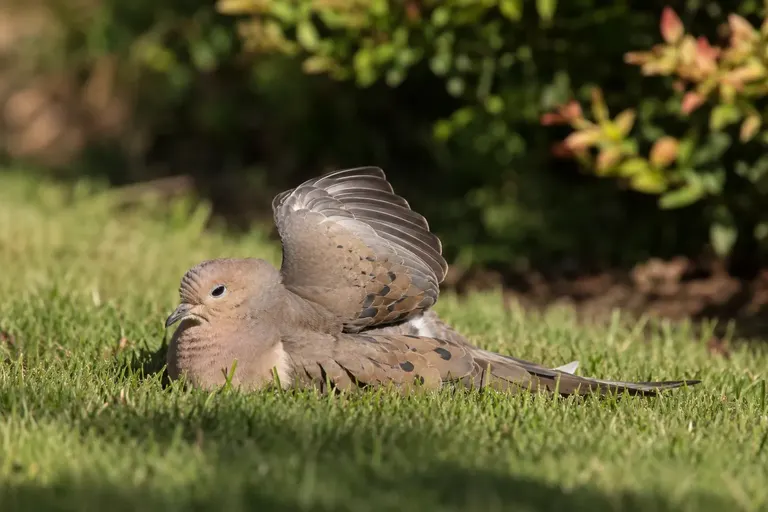
Many short-legged birds get the same benefit a different way: they sit. Ducks, geese, gulls and sandpipers on snow or ice often lower their bodies so the belly feathers cover both legs and feet completely. Pigeons and doves on a cold roof often do the same. Songbirds on perches crouch low so the body feathers drape over the toes.
Long-legged birds such as flamingos, herons, storks and cranes find sitting awkward and slow to get out of, especially in water. For them, tucking up one leg is the practical way to cover half the problem while staying ready to walk or take off. In a sense, one-legged standing is the long-legged bird’s version of sitting down.
Do birds swap legs?
Yes. Birds that rest on one leg for long periods often switch to the other leg from time to time. One idea is that switching helps prevent fatigue or reduces the time either foot spends in cold water. In flamingos, some observers have reported individual birds favoring one leg more than the other, but studies have not found a consistent “footedness” across whole flocks. Leg switching may also simply reflect the bird shifting its position as it wakes and dozes.
Do birds sleep on one leg?
Often, yes. Many birds rest or sleep in the one-legged pose, usually with the head turned back and the bill tucked into the back or shoulder feathers. That posture cuts heat loss from the bill and face too.
Birds also have the ability to sleep with one half of the brain at a time, called unihemispheric sleep, keeping one eye open and partly alert. That makes it possible to doze on one leg in an exposed place, such as a mudflat or a lakeshore, while still watching for predators. Our guide on where birds go at night covers the wider picture of how birds rest.
Which birds stand on one leg most?
The pose is common in birds with long, bare legs that spend time standing in cold water or open, windy places. Examples from around the world include:
- Flamingos. Greater Flamingos in southern Europe, Turkey’s Gediz Delta and Lake Tuz, Africa and western Asia; American Flamingos in the Caribbean and Florida; Chilean Flamingos in South America.
- Herons and egrets. Great Blue Herons in North America, Grey Herons across Europe and Turkey, Cocoi Herons and Great Egrets in Brazil.
- Storks. White Storks across Europe and Turkey, Wood Storks in the southern United States and Brazil, and Jabirus in the wetlands of Brazil’s Pantanal.
- Cranes. Sandhill Cranes, Common Cranes and many others.
- Gulls. Ring-billed, Herring and Black-headed Gulls on beaches, lakeshores and even parking lots.
- Shorebirds. Sandpipers, oystercatchers, godwits and plovers resting at high tide, sometimes in dense flocks on one leg.
- Ducks and geese. Especially on ice or cold ground.
- Spoonbills and ibises. Roseate Spoonbills in Florida and Brazil, Eurasian Spoonbills and Glossy Ibises in Europe and Turkey.
Do songbirds stand on one leg?
Some do, especially in cold weather, though it is harder to notice. American Robins on a frosty lawn, European Robins in winter and sparrows perched on a cold fence may tuck one foot into the belly feathers. On a branch or feeder perch, many small birds simply crouch so their feathers cover both feet, which achieves the same effect. For more on how small birds survive cold nights, see our guide on how birds stay warm in winter.
Is a bird standing on one leg injured?
Usually not. But it can be, and a few signs help you tell the difference.
Signs of normal resting
- The bird looks relaxed, perhaps fluffed and dozing.
- It puts the second foot down when it walks or shifts.
- Both legs look normal when it moves.
- Other birds nearby are doing the same.
Signs of a possible injury
- Hopping instead of walking. A bird that always hops on one foot may not be able to use the other.
- A dangling or oddly angled leg. The leg hangs loosely or sticks out.
- Swelling, wounds or missing toes. Fishing line and thread are common causes of foot injuries in gulls, pigeons and waterbirds.
- Difficulty feeding or perching. The bird struggles to hold on or balance.
Many birds with an old foot injury survive well and feed normally. If a bird seems to be in real distress, cannot fly or has line wrapped around a leg, contact a local wildlife rehabilitator. Our guide on what to do with an injured bird walks through the steps.
Are there other theories?
Over the years, several other explanations have been suggested. They are less well supported but worth knowing.
- Muscle fatigue. The idea that birds rest one leg at a time to reduce muscle fatigue made sense before the flamingo study showed how little effort the pose takes. It may still play a small role in other species.
- Readiness to flee. Some suggested one leg is “ready to go.” There is little evidence for this, and birds typically put both feet down before taking off.
- Parasites or hygiene. A suggestion that keeping a foot out of water reduces exposure to parasites has not been well tested.
- Camouflage. A one-legged heron may look more like a reed or stick. This is an appealing idea but hard to test.
Myths and facts about birds on one leg
Myth: Flamingos stand on one leg to balance better. Fact: The pose appears stable and low-effort, but the main benefit is probably heat saving, with stability a helpful side effect.
Myth: A bird on one leg has lost the other. Fact: Almost always, the other leg is simply tucked into the belly feathers.
Myth: Standing on one leg must be tiring. Fact: For flamingos, research suggests it takes less muscle effort than you would think.
Myth: Birds’ knees bend backward. Fact: The backward-bending joint is the ankle. The knee is higher up, inside the feathers.
Myth: Only flamingos do it. Fact: Herons, gulls, ducks, shorebirds, storks, cranes and even some songbirds rest on one leg.
Quick facts
- The main reason birds stand on one leg is to save body heat.
- Bare legs lose heat, especially in cold water, and tucking one leg up halves the exposed surface.
- A countercurrent heat exchanger in the legs keeps feet cool and the body warm.
- Flamingos can hold a one-legged pose with very little muscle effort.
- The joint that looks like a backward knee is the ankle.
- Birds often sleep on one leg with the bill tucked into the back feathers.
- Hopping, a dangling leg or visible wounds suggest an injury.
Sources
Frequently asked questions
Why do birds stand on one leg?
Mainly to save body heat. Bird legs and feet are usually bare, so they lose heat to cold air and water. Tucking one leg into the warm belly feathers halves that loss. Research on flamingos also suggests one-legged standing takes very little muscle effort, so it may be a comfortable, stable way to rest.
Why do flamingos stand on one leg?
Flamingos probably stand on one leg to reduce heat loss, since they spend long hours in water that is often cooler than their bodies. A 2017 study found that flamingos can hold a one-legged pose with very little muscle activity, and that they sway less on one leg when resting. So the posture is both warm and energy-efficient.
Is it tiring for a bird to stand on one leg?
Apparently not. Studies of flamingos suggest their skeleton and joints lock into a stable one-legged position that needs little active muscle force. Many birds also have tendon arrangements in the legs and toes that help them hold a grip or posture with little effort, which is why they can rest and even sleep while standing or perching.
Do birds sleep standing on one leg?
Many do. Flamingos, herons, storks, gulls, ducks and shorebirds often rest or doze on one leg, frequently with the head turned back and the bill tucked into the back feathers. Birds can sleep with one half of the brain at a time, which lets them stay partly alert to predators while resting.
Is a bird standing on one leg injured?
Usually not. It is a normal resting posture. A bird may be injured if it never puts the second foot down, hops when it moves, holds the leg at an odd angle, or has a visible wound, swelling or missing toes. If a bird cannot fly, feed or move normally, contact a local wildlife rehabilitator.