How to Attract Red-bellied Woodpeckers: Suet, Nuts, Fruit
How to attract red-bellied woodpeckers: offer suet, peanuts, sunflower and fruit near large trees, keep dead limbs standing, and limit starlings near nests.
In this article
- Quick answer: what red-bellied woodpeckers need
- Red-bellied woodpecker at a glance
- How to identify a red-bellied woodpecker
- Where do red-bellied woodpeckers live?
- What do red-bellied woodpeckers eat?
- Best feeders for red-bellied woodpeckers
- Plants and habitat for red-bellied woodpeckers
- Water
- Red-bellied woodpecker nesting
- Seasonal calendar
- Common problems and fixes
- Common mistakes when attracting red-bellied woodpeckers
- Sources
- Frequently asked questions
Here is how to attract red-bellied woodpeckers: offer suet, shelled peanuts and sunflower seed near large trees, and add fruit such as orange halves in warmer months. These loud, bold woodpeckers are common year-round across the eastern United States and readily visit suburban feeders, so if you are within their range and have mature trees nearby, a good suet setup usually works. Leaving safe dead limbs gives them nest sites, which are usually below 50 feet.
Quick answer: what red-bellied woodpeckers need
| Need | What works best | Notes |
|---|---|---|
| Food | Suet, peanuts, sunflower seeds, fruit | The Cornell Lab also notes occasional visits to hummingbird feeders |
| Feeder | Large suet feeder, tail-prop suet feeder, peanut feeder, platform for fruit | A mid-sized, heavy woodpecker |
| Trees | Mature deciduous or mixed woods, oaks and hickories especially | They forage on trunks and main branches |
| Nesting | Dead trees, dead limbs, old fence posts | Some pairs use nest boxes |
| Water | Bird bath, heated in winter | Year-round use |
| Timing | All year in most of the range | Very vocal in spring and summer |
Red-bellied woodpecker at a glance
| Trait | Detail |
|---|---|
| Size | 9.4 in long, 2.0 to 3.2 oz, wingspan 13.0 to 16.5 in |
| Range | Eastern and central US, expanding northward |
| Season | Year-round |
| Diet | Insects, spiders, nuts, acorns, seeds and fruit |
| Feeder foods | Suet, peanuts, sunflower seeds, fruit, occasionally nectar |
| Nesting | Excavates cavities in dead wood; sometimes uses nest boxes |
| Clutch | 2 to 6 white eggs, 1 to 3 broods a year |
Figures come from the Cornell Lab of Ornithology’s All About Birds account.
How to identify a red-bellied woodpecker
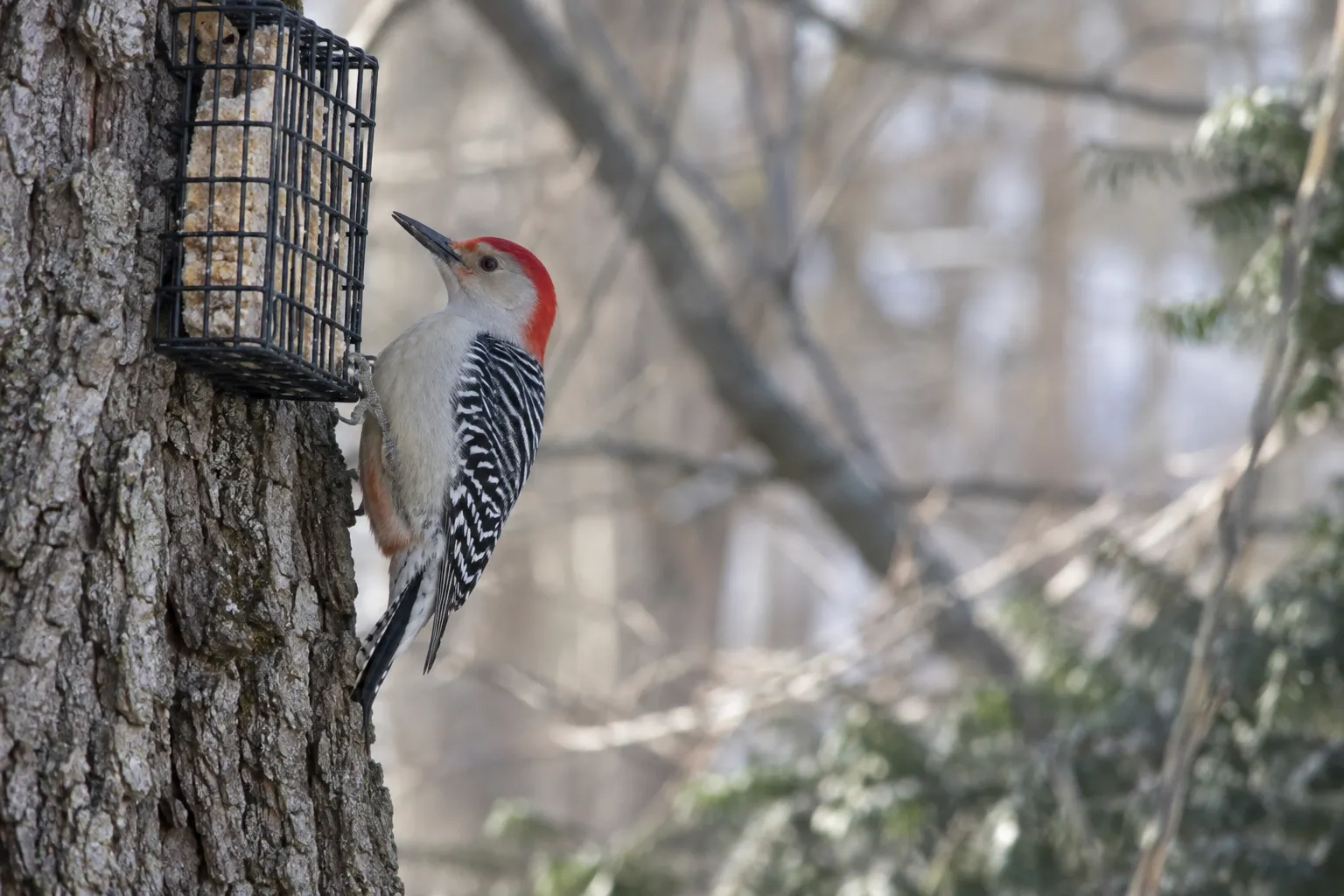
Red-bellied woodpeckers are about the size of a hairy woodpecker and roughly three-quarters the size of a northern flicker. The Cornell Lab describes them as pale woodpeckers with strikingly barred backs and gleaming red caps.
Key marks:
- A boldly black-and-white barred, “zebra” back.
- Pale gray-buff face and underparts.
- Red on the head: across the crown and nape in males, on the nape only in females.
- White patches near the wingtips that flash in flight.
- A faint reddish wash on the lower belly that is usually hidden.
The Cornell Lab notes that the red belly is most often obscured by surrounding feathers and difficult to see, which is why the name confuses so many people.
Male vs female red-bellied woodpecker
| Feature | Male | Female |
|---|---|---|
| Crown | Red from bill base over the top of the head | Gray-buff |
| Nape | Red | Red |
| Tongue | Longer, with a wider tip | Shorter |
The tongue difference is invisible in the field, but the Cornell Lab notes it lets males and females forage in slightly different ways within the same territory.
Juveniles
Young birds are grayer overall and lack red on the head entirely. A dull, gray-headed bird with a barred back in summer is usually a juvenile red-bellied.
Red-bellied vs red-headed woodpecker
Many people call this bird a “red-headed woodpecker.” The real red-headed woodpecker looks very different:
| Feature | Red-bellied woodpecker | Red-headed woodpecker |
|---|---|---|
| Head | Red cap and nape only; pale face | Entire head and throat deep red |
| Back | Black-and-white barred | Solid black |
| Wings | Barred, small white flashes near tips | Large solid white wing patches |
| Underparts | Pale buff with faint red belly | Clean white |
Other similar species
The Cornell Lab lists golden-fronted woodpecker, ladder-backed woodpecker, northern flicker and downy and hairy woodpeckers. Golden-fronted woodpeckers, found mainly in Texas and Oklahoma, have yellow-orange on the nape and above the bill. Ladder-backed woodpeckers are smaller birds of dry southwestern habitats. Flickers are brown rather than gray and spend a lot of time on the ground. See our guide on attracting northern flickers for more.
Calls
The Cornell Lab notes red-bellied woodpeckers are loud and call frequently in spring and summer. Their rolling churr or kwirr call is one of the most familiar woodpecker sounds in eastern neighborhoods. They also drum to advertise territories.
Where do red-bellied woodpeckers live?
The species lives year-round in the eastern and central United States. Audubon notes that birds at the northern edge, such as in Michigan, may move south in severe winters, but most are resident. The range has been expanding northward, and the Cornell Lab records a population increase of about 0.8 percent per year from 1966 to 2019.
Habitat
According to the Cornell Lab, red-bellied woodpeckers use forests, woodlands and wooded suburbs, including oak-hickory and pine-hardwood forests, maple stands and southern pine flatwoods. In the South they favor river bottoms and wetlands, and they typically stay below about 2,000 feet elevation. Audubon adds suburbs, orchards, farm groves and city parks.
In practice, any eastern yard with mature hardwoods nearby is potential habitat.
What do red-bellied woodpeckers eat?
Red-bellied woodpeckers are true omnivores. The Cornell Lab lists insects, spiders and other arthropods as primary foods, supplemented by acorns, nuts, pine cones and seeds, plus fruit such as grapes, hackberries, oranges and mangoes. Audubon notes that plant material can make up more than half the diet in some seasons. Occasionally they take lizards, tree frogs, nestling birds, eggs and even small fish.
A remarkable tongue
The Cornell Lab notes this woodpecker can extend its tongue nearly 2 inches past the tip of its bill. The tip is barbed and coated in sticky saliva, which helps it pull insects out of deep crevices.
Caching food
Red-bellied woodpeckers wedge nuts and seeds into bark crevices and cracks in fence posts, storing food for later. If you see one fly off with a peanut and tuck it into a tree, that is normal caching behavior.
Best foods for red-bellied woodpeckers at feeders
- Suet. The Cornell Lab highlights suet in winter. Use plain suet in cold weather and no-melt blends in warmer months. Our roundup of the best suet cakes and suet blends compares options.
- Peanuts. Shelled peanuts, whole or in pieces, are a favorite. A mesh peanut feeder or a platform both work.
- Sunflower seeds. Black oil sunflower in a hopper or large tube feeder. See our guide to black oil sunflower seed.
- Fruit. Orange halves, grapes and other soft fruit on a platform or fruit spike, especially in spring and summer. Remove leftovers before they spoil.
- Nectar. The Cornell Lab notes red-bellied woodpeckers occasionally drink from hummingbird feeders. It is not a reason to put out nectar for them, but it explains why one may appear at yours.
At feeders, the Cornell Lab notes red-bellied woodpeckers dominate most species except blue jays, so expect them to push smaller birds aside while they feed.
Best feeders for red-bellied woodpeckers
| Feeder type | Food | Why it works | Watch out for |
|---|---|---|---|
| Tail-prop suet feeder | Suet cakes | Lets a heavier woodpecker brace naturally | Takes up more space |
| Large or double suet cage | Suet cakes | Room for a bigger bird | Starlings may crowd it |
| Mesh peanut feeder | Shelled peanuts | Clinging access; limits whole-nut hauling | Clean regularly |
| Platform feeder | Peanuts, fruit, sunflower | Holds fruit and nuts easily | Also attracts squirrels and grackles |
| Hopper feeder | Sunflower | Stable perch space | Smaller perches may be awkward |
Our roundups of the best suet feeders and the best platform and tray feeders cover specific designs.
Where to place feeders
Place feeders near mature trees so the woodpecker can approach along trunks and branches. A suet feeder attached to a large tree trunk is often the quickest way to get a first visit. For current guidance on distance from windows and cover, see our guide on where to put a bird feeder. The old fixed-distance window rule is no longer considered valid.
How to get a first visit faster
Red-bellied woodpeckers are loud and conspicuous, so you will often hear one in the neighborhood long before it visits. A few steps help turn that bird into a regular:
- Start in fall or early winter. Insects are scarce, the birds are caching nuts, and feeders become more valuable.
- Fix suet to a trunk the bird already uses. Watch where you hear the churr call and where the bird forages, and put a suet feeder there first.
- Add shelled peanuts on a small platform. Peanuts are highly visible and appeal to a caching bird.
- Keep food available every day. Red-bellied woodpeckers check reliable food sources on a routine; gaps send them elsewhere.
- Move the feeder closer to the house gradually, a few feet at a time, if you want better views once the bird is visiting.
Red-bellied woodpeckers at oriole and hummingbird feeders
Because they eat fruit and sometimes drink nectar, red-bellied woodpeckers occasionally show up at feeders set out for orioles and hummingbirds. They can empty a jelly cup or orange half quickly. If that is a problem, offer smaller portions more often, or place a separate fruit offering on a platform nearer the trees so the woodpecker has an easier option.
Are red-bellied woodpeckers bad for other birds?
They are mostly a benefit, but the full picture includes a few less welcome habits. The Cornell Lab lists nestling birds among occasional foods, and Audubon mentions bird eggs. The Cornell Lab also notes that red-bellied woodpeckers sometimes take over nests of other species, including endangered red-cockaded woodpeckers in the South. In a typical backyard, these events are uncommon and part of normal woodland ecology. There is no reason to discourage the species; simply make sure nest boxes for small songbirds have entrance holes sized for their intended occupants, which keeps larger birds out.
Will the range expansion bring them to my yard?
Audubon notes the range has been expanding northward, and the Cornell Lab’s long-term population trend is upward. If you live just north of the mapped range, sightings may be becoming more frequent. Check recent reports for your county on eBird to see whether the species is regular near you before expecting it at your feeders.
Plants and habitat for red-bellied woodpeckers
Nut and acorn trees
Oaks, hickories, beeches and other nut trees supply both insects and hard mast. If your yard already has mature oaks or hickories, protect them; they are the backbone of red-bellied habitat.
Native fruiting trees, shrubs and vines
The Cornell Lab notes berry trees such as hawthorn provide seasonal food, and lists grapes and hackberries among natural foods. Other native options in the East include dogwoods, black cherry, serviceberry, American holly and Virginia creeper. Choose species native to your area; a cooperative extension office can suggest what grows well locally.
Leave dead trees and dead limbs when safe
The Cornell Lab suggests dead trees encourage natural foraging and nesting. Red-bellied woodpeckers nest in dead trees, dead limbs of live trees and even fence posts. Pairs often reuse the same tree year after year, digging a new hole below the previous year’s nest. Where a dead tree is not a hazard, leaving it standing may give a pair a long-term home.
Water
A shallow bird bath with a gently sloping basin works well. In winter, a heated bath is one of the best ways to bring woodpeckers and other birds into view. Our winter bird feeding guide covers heated water and cold-weather feeding in more detail.
Red-bellied woodpecker nesting
According to the Cornell Lab and Audubon:
- Site: dead trees, dead limbs of living trees, fence posts and stumps, usually below 50 feet.
- Who digs: the male selects the site, excavates and attracts a female with calling and soft tapping; the female helps finish the cavity and chooses which one to use.
- Cavity: roughly 9 to 12.5 inches deep, with a chamber about 3.5 by 5 inches, and eggs laid on leftover wood chips.
- Eggs: 2 to 6 smooth white eggs.
- Incubation: about 12 days.
- Nestling period: 24 to 27 days.
- Broods: 1 to 3 per year.
Starlings: the main nesting problem
European starlings are aggressive cavity competitors. The Cornell Lab notes starlings take over as many as half of all red-bellied woodpecker nests in some areas. You cannot control starlings in the wider neighborhood, but you can avoid attracting large flocks with foods they favor near nest trees. Our guide to keeping starlings and grackles off feeders explains feeder choices that help.
Nest boxes
Audubon notes red-bellied woodpeckers may use a nest box, a natural cavity or an old woodpecker hole. Most pairs still excavate their own. If you try a box, choose one designed for medium-sized woodpeckers, mount it on a tree or pole near mature woods, and monitor it so starlings or house sparrows do not take it over.
Seasonal calendar
| Months | What red-bellied woodpeckers are doing | What to do |
|---|---|---|
| January to March | Heavy suet and peanut use; calling and drumming begin | Keep suet stocked; offer open water |
| April to June | Excavating, laying and raising first brood | Leave dead limbs; watch for starlings at cavities |
| June to August | Additional broods in some areas; family groups at feeders | Switch to no-melt suet; offer fruit |
| September to November | Caching nuts and acorns | Offer peanuts in the shell or shelled |
| December | Steady feeder use | Keep suet and peanuts consistent |
Common problems and fixes
Red-bellied woodpecker takes over the feeder
They are dominant birds. Add a second feeding station a short distance away so smaller birds have options.
Drumming or pecking on the house
Spring drumming on siding and gutters is usually territorial and fades once nesting begins. Temporary netting or flashing over the favorite spot may redirect the bird. Holes in wood can indicate insects, so check for an infestation.
Fruit attracts insects
Put out only what birds eat in a day, remove old fruit, and clean the platform often.
Squirrels raid the peanuts and fruit
Platform feeders stocked with peanuts and fruit are just as attractive to squirrels. Mount the platform on a pole with a properly sized baffle, well away from branches, fences and roofs that squirrels can jump from. Offering peanuts in a mesh feeder rather than loose on a tray also slows squirrels down, while a clinging woodpecker can still feed easily. Hot-pepper suet is another option, since birds are not sensitive to capsaicin the way mammals are.
Suet melts or spoils
Use no-melt suet in summer, smaller portions and shade. Discard anything rancid.
Common mistakes when attracting red-bellied woodpeckers
- Hanging suet in open lawn far from trees.
- Removing every dead limb and old fence post.
- Letting fruit rot on the feeder.
- Ignoring starlings near nest trees.
- Confusing the species with the red-headed woodpecker and looking for the wrong bird.
Sources
Frequently asked questions
What is the best food to attract red-bellied woodpeckers?
Suet, peanuts and sunflower seeds are the core foods. The Cornell Lab lists suet in winter, peanuts, sunflower seeds and occasionally hummingbird nectar, and notes the species also eats fruit such as oranges, grapes and hackberries. Offering suet plus shelled peanuts near large trees covers most of what draws them to feeders.
Why is it called a red-bellied woodpecker if the head is red?
The name refers to a faint reddish or pinkish wash on the lower belly. The Cornell Lab notes that the red belly is usually hidden by surrounding feathers and hard to see. The obvious red on the head leads many people to call it a red-headed woodpecker, but that is a different species with an all-red head and large white wing patches.
How can you tell a male from a female red-bellied woodpecker?
Look at how far the red extends. Males have red from the base of the bill across the crown to the nape. Females have red only on the nape, with a gray-buff crown. Juveniles are grayer overall and lack red on the head. The male and female also differ in tongue length, which the Cornell Lab links to slightly different foraging.
Do red-bellied woodpeckers use birdhouses?
Sometimes. Audubon notes they may nest in a natural cavity, an abandoned hole of another woodpecker, or a nest box, though most pairs excavate their own cavities in dead trees, dead limbs or fence posts. Leaving safe dead wood standing is the most dependable way to support nesting in your yard.
Where do red-bellied woodpeckers live?
They live year-round in the eastern and central United States, in woodlands, river bottoms, swamps and wooded suburbs, usually below about 2,000 feet according to the Cornell Lab. Audubon notes the range has been expanding northward, and the species now reaches areas where it was once uncommon.