Why Do Owls Hoot? What Their Calls Mean and When
Why do owls hoot? Mostly to claim a territory and keep in touch with a mate. Calling peaks in autumn and winter, when owls court and young owls seek homes.
In this article
- Why do owls hoot at all?
- Is twit-twoo one owl or two?
- When do owls hoot the most?
- What do different owl calls mean?
- How can you tell a male owl from a female by its call?
- Why are owls so loud at night near houses?
- Does an owl hooting mean anything bad?
- How can you find the owl that’s hooting?
- How do owls hear each other so well?
- Can you help owls near your home?
- Sources
- Frequently asked questions
Why do owls hoot? Mostly to say “this territory is taken” and to keep in touch with a mate in the dark. A hoot carries through woods at night, when most owls are active. Calling peaks in autumn and winter, when young owls look for a home of their own and adult pairs court before an early nesting season.
So a hoot outside your window in October isn’t random. It’s usually a resident owl telling neighbors and newcomers where its border runs, or a pair checking in with each other. The details change by species, and this guide walks through what each call means, when you’ll hear it, and how to tell who is calling.
Why do owls hoot at all?
Owls hoot to advertise and defend a territory and to communicate with their partner. Because they hunt at night, sound does the job that bright plumage or daytime song does for other birds.
Two kinds of message are mixed together:
- “Keep out.” The Cornell Lab says Great Horned Owls advertise their territories with deep, soft hoots, and mated pairs defend them with vigorous hooting. The BTO notes that Tawny Owl pairs on established territories call to discourage young birds from settling nearby.
- “I’m here.” Partners answer each other. Tawny Owls trade a hoot and a sharp contact call, and Great Horned and Barred Owl pairs perform duets.
Territory matters a lot to an owl. The BTO says Tawny Owls can live for more than 20 years and often keep the same territory, even the same nest hole or nest box, for life. A pair that holds a good wood or park has every reason to keep announcing it.
Is twit-twoo one owl or two?
Usually two. The famous too-whit too-woo is a conversation between a female and a male Tawny Owl, not a single bird’s song.
The Woodland Trust puts it plainly: the female gives a sharp “ke-wick” (the twit), mainly as a contact call, and the male answers with a wavering “hoo-hoo” (the twoo) to mark his territory. The BTO describes the same thing, with the female’s too-whit answering the male’s hooting too-woo. Vogelbescherming Nederland and the LPO in France give the same split: the long, wavering hoot is the male, the ke-wick or ki-wik is the female.
The phrase itself is old. Shakespeare’s song “Winter” in Love’s Labour’s Lost has the “staring owl” singing “Tu-whit, tu-who”, which is probably why so many people think of it as one sound.
When do owls hoot the most?
Autumn and winter, with a second burst in late winter for many species. Here’s why the season matters:
- Autumn: young owls move out. Owlets that hatched in spring become independent and look for a territory of their own. The BTO says Tawny Owls are most vocal in autumn as residents push those youngsters away. The Cornell Lab also notes Great Horned Owl hooting in fall, when young leave the area.
- Autumn and early winter: courtship. NABU says the Tawny Owl’s call is heard most in autumn and winter because that is courtship and pairing time. The Woodland Trust says Tawny Owls call most on autumn evenings, when pairs begin courting.
- Late winter: before eggs. Owls nest early. The LPO says Tawny Owl pairs often meet in November and December, first matings start in January, and eggs follow in early March. NABU adds that city Tawny Owls often lay as early as January. The Cornell Lab says Great Horned Owls defend territories with vigorous hooting, especially in the winter before egg-laying.
By late spring, when the young are in the nest, hooting usually drops off, and you’re more likely to hear the hungry begging calls of fledglings.
What do different owl calls mean?
Each species has its own repertoire, and not every owl hoots. This table pulls together the calls you’re most likely to hear in Europe and North America.
| Owl | Typical call | Who calls | When it peaks | Where |
|---|---|---|---|---|
| Tawny Owl | Long, wavering hoo-hoo, answered by a sharp ke-wick | Hoot by the male, ke-wick mainly by the female | Autumn evenings, courtship into winter | Europe, including Britain |
| Great Horned Owl | Deep, soft hoots with a stuttering rhythm | Both sexes, female higher-pitched; pairs duet | Winter before egg-laying, also fall | North America |
| Barred Owl | 8 to 9 hoots, “Who cooks for you? Who cooks for you-all?” | Both; pairs give loud courtship duets | Courtship season | North America |
| Long-eared Owl | Soft, low hoo, like blowing over a bottle | Male low, female higher | Early spring | Europe, North America |
| Barn Owl | Shrill screech, not a hoot | Males screech to attract a mate | Start of the spring breeding season | Worldwide |
| Little Owl | Short woop or sharp kiew kiew | Mostly males advertising | From April | Europe |
| Eastern Screech-Owl | Whinny that drops in pitch, and an even trill | Pairs and families | Year-round, territory and contact | Eastern North America |
Sources for the table: BTO, Woodland Trust, Cornell Lab of Ornithology, Vogelbescherming Nederland and LPO, linked below.
How can you tell a male owl from a female by its call?
In many species the female’s voice is different, often higher. That gives you a quick way to work out whether you’re hearing one bird or a pair.
- Tawny Owl: the long hoot is the male. A sharp ke-wick nearby is usually the female answering. The LPO says the male is the only one that truly hoots.
- Great Horned Owl: both hoot, but the Cornell Lab says the female’s voice is recognizably higher in pitch than the male’s. When a pair duets, you’ll hear two alternating voices.
- Long-eared Owl: the Woodland Trust describes the male’s call as a soft hoo and the female’s as a higher-pitched hoo.
If you only ever hear hoots and never an answer, you may be listening to an unpaired male advertising for a mate, or a male whose partner is out of earshot.
Why are owls so loud at night near houses?
Because many owls live closer to people than you’d think. Vogelbescherming Nederland says Tawny Owls (bosuil) use city parks, farmyards and green residential areas with old trees, not only woods. NABU also notes that Tawny Owls breed in towns and use parks and gardens, provided old hollow trees remain.
Tawny Owls are common birds, too. The LPO counts about 260,800 pairs in mainland France (2025), where it is the most common owl. Sovon estimates 5,200 to 6,400 pairs in the Netherlands (2018 to 2020), and the BTO gives about 50,000 pairs for the UK. With numbers like that, a street lined with mature trees can easily sit inside one pair’s territory, and the calls carry well on still autumn nights.
Does an owl hooting mean anything bad?
No. Folklore in many countries links owl calls to bad luck, but the biology is simple: a hoot is a territorial and social signal, the owl version of a robin singing from a fence post. Hearing one is a good sign that your area has old trees, enough small mammals to hunt and a quiet place to roost.
If owls keep you awake, they rarely do it for long. Peaks come in autumn and late winter, and calling drops once the breeding season is under way.
How can you find the owl that’s hooting?
Listen first, look second. Owls are hard to spot, so use their calls to narrow down where they are.
- Go out at dusk on calm, dry evenings in autumn. That’s when Tawny Owls are most vocal, according to the BTO and the Woodland Trust.
- Note the direction and wait. A calling owl often moves between a few favorite perches along its territory edge.
- Record it. A sound ID app can help confirm the species. Our guide to Merlin Sound ID explains how to get reliable results and when to double-check.
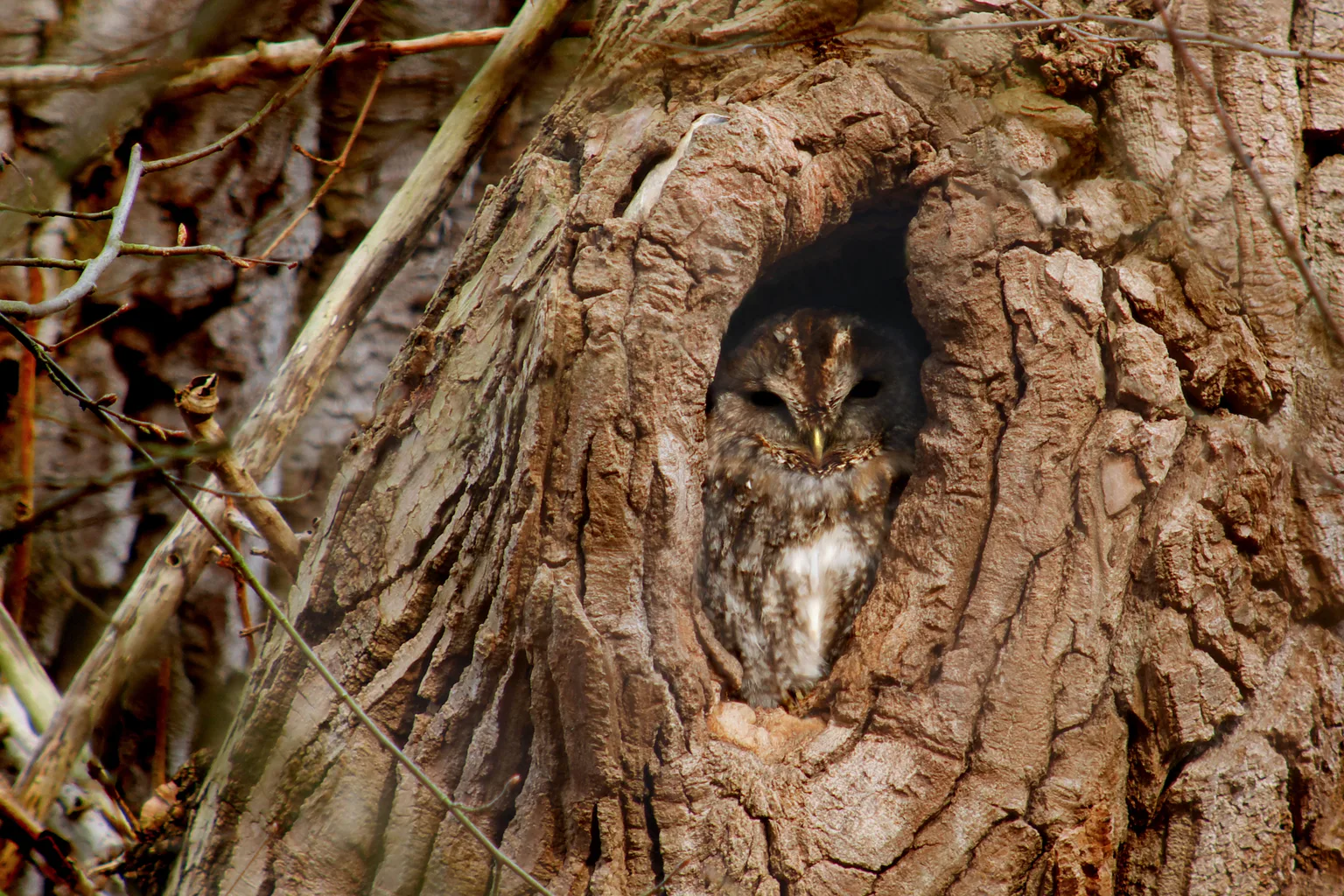
- Scan by day for roosts. Look for an owl tucked into ivy, a dense conifer or a hollow trunk, like the one in the photo above. Small birds mobbing and scolding one spot can give a roosting owl away.
- Keep your distance. Don’t play recordings to draw owls in, especially in the breeding season, and don’t shine bright lights at them.
A good pair of binoculars helps with dusk views. Our guide to binoculars for backyard birding covers models that handle low light well.
How do owls hear each other so well?
Owls rely on hearing more than most birds, which suits a life of calling and listening in the dark. A hoot only works as a signal if the neighbors can hear it and tell where it came from, and owls are built for exactly that kind of listening. You can read more about how bird hearing works in our explainer on whether birds have ears.
Their quiet flight helps too. Soft feathers muffle wing noise, so an owl can keep listening while it moves. Our article on why owls are silent in flight explains how that works, and how owls turn their heads so far covers another part of the toolkit.
Can you help owls near your home?
Yes, mainly by keeping old trees and avoiding rodent poison. NABU asks for old hollow trees in towns to be protected from overzealous tree-safety cutting, and recommends avoiding rodenticides in gardens and green spaces, because owls eat poisoned rodents.
Where natural holes are scarce, a nest box can help. Our owl box guide gives sizes and placement for Tawny, Barn and Little Owls and for North American species. If you’re curious about the other night voices you hear, see why birds chirp at night, and for owls of North America, our profiles of the Great Horned Owl and Barred Owl cover their habits in more detail.
Sources
- BTO BirdFacts: Tawny Owl
- Woodland Trust: How to identify owl calls
- Cornell Lab, All About Birds: Great Horned Owl sounds and life history
- Cornell Lab, All About Birds: Barred Owl sounds and Eastern Screech-Owl sounds
- NABU: Waldkauz, Vogel des Jahres
- Vogelbescherming Nederland: Bosuil
- LPO: Chouette hulotte

Frequently asked questions
Why do owls hoot at night?
Most owls that hoot are active at night, so that's when they defend their patch and talk to their partner. A hoot tells neighbors that a territory is taken and helps a pair keep track of each other in the dark. The Cornell Lab describes Great Horned Owls advertising their territories with deep hoots, and the BTO says Tawny Owl pairs call to keep young owls from settling nearby.
Is the twit-twoo call made by one owl?
No. The classic too-whit too-woo of the Tawny Owl is usually two birds. The Woodland Trust explains that the female gives a sharp ke-wick, mainly as a contact call, and the male answers with a wavering hoo-hoo that marks his territory. The BTO describes the same exchange. Hearing both parts close together usually means a pair is nearby.
Why do owls hoot more in autumn and winter?
Autumn is when young owls leave their parents and look for a territory, and established pairs call to keep them out. NABU says Tawny Owls are heard most in autumn and winter because that is courtship time, and the LPO notes that pairs often meet in November and December. Great Horned Owls hoot hard in winter before egg-laying, according to the Cornell Lab.
Do both male and female owls hoot?
It depends on the species. In Tawny Owls the long hoot belongs to the male and the female answers with ke-wick, though the LPO notes the male is the only one that truly hoots. In Great Horned Owls both sexes hoot, and the Cornell Lab says the female's voice is noticeably higher. Barred Owl pairs also duet during courtship.
Do all owls hoot?
No. Barn Owls give a shrill screech rather than a hoot, according to the Woodland Trust. Little Owls make a short woop or a sharp kiew. Eastern Screech-Owls mostly use a whinny and an even trill, which the Cornell Lab says help defend territory and keep families in touch. Hooting is typical of Tawny, Great Horned, Barred and Long-eared Owls.