Why Do Some Birds Lay Eggs in Other Birds' Nests?
Why do some birds lay eggs in other birds' nests? Brood parasites like cuckoos and cowbirds skip the costs of parenting so they can lay many more eggs instead.
In this article
- Quick answer: the main brood parasites
- What is brood parasitism?
- Why would a bird give up raising its own young?
- How does the Common Cuckoo trick its hosts?
- How does the Brown-headed Cowbird do it?
- How do hosts fight back?
- What other brood parasites are there around the world?
- Is brood parasitism always bad for the host?
- Myths vs facts
- What does this mean for backyard birders?
- Quick facts
- Sources
- Frequently asked questions
Why do some birds lay eggs in other birds’ nests? Because it lets them skip the costly work of building nests, incubating and feeding chicks, and put that energy into laying more eggs instead. Biologists call this brood parasitism. Roughly 100 species, about 1 percent of the world’s birds, including many cuckoos and the Brown-headed Cowbird, depend on it completely and never raise their own young.
The strategy is risky for hosts, which can lose their entire brood. That has driven one of the clearest evolutionary arms races in nature: parasites evolve better tricks, and hosts evolve better defenses.
Quick answer: the main brood parasites
| Group | Where | Notable features |
|---|---|---|
| Common Cuckoo and other Old World cuckoos | Europe, Asia, Africa, Australia | Egg mimicry; chick ejects host eggs |
| Brown-headed Cowbird | North America | Uses a very wide range of hosts |
| Shiny Cowbird | South America, spreading into the Caribbean | Widespread in Brazil and Argentina |
| Honeyguides | Africa, Asia | Chicks of some species kill host young with a hooked bill tip |
| Indigobirds and whydahs | Africa | Chicks mimic host chicks’ mouth markings |
| Cuckoo-finch | Africa | Parasitizes small warblers and cisticolas |
| Black-headed Duck | South America | Ducklings leave the host nest within a day or two |
What is brood parasitism?
Brood parasitism means relying on other individuals to raise your offspring. It comes in two main forms.
Obligate brood parasites
These birds never raise their own young. A female Brown-headed Cowbird or Common Cuckoo finds the nests of other species, lays eggs in them and leaves. The host parents incubate the eggs, feed the chicks and, in many cases, care for them after they leave the nest.
Intraspecific (conspecific) brood parasitism
Many birds that do raise their own young also sometimes slip eggs into the nests of neighbors of the same species. This is common in waterfowl. Wood Ducks and goldeneyes can produce “dump nests” with far more eggs than one female could lay. It has also been documented in European Starlings, swallows and many other species. Cliff Swallows have even been recorded carrying eggs in their bills to other nests, a behavior described by researchers Charles and Mary Brown in their long-term Nebraska studies.
This occasional parasitism probably acts as a kind of insurance. A female who has lost her own nest, or who cannot find a good site, may still produce some offspring by laying in another nest.
Why would a bird give up raising its own young?
Parenting is expensive. A pair of songbirds may make hundreds of feeding trips a day at the peak of the nestling period, and a single pair can usually raise only one clutch at a time. A brood parasite avoids all of that.
More eggs, less work
Freed from parental care, a female parasite can put her energy into producing eggs. Female Brown-headed Cowbirds are estimated to lay dozens of eggs in a breeding season, far more than a typical songbird, which might lay a handful per brood. Common Cuckoo females also lay many more eggs than a single nesting attempt would allow.
Spreading risk
A songbird that puts all its eggs in one nest can lose everything to a single raccoon or snake. A parasite spreads its eggs across many nests, so a single predator rarely wipes out a whole season’s reproduction.
How did it evolve?
Brood parasitism is thought to have evolved independently several times in birds: at least once in cuckoos, once in cowbirds, once in honeyguides, once in the indigobirds and whydahs, and separately in the Cuckoo-finch and Black-headed Duck. One widely discussed idea is that it began from occasional egg dumping within a species, which then extended to other species when conditions favored it. Researchers still debate the exact pathways, and they may differ between groups.
For cowbirds, a popular historical hypothesis links parasitism to following roaming bison herds on the Great Plains, where staying at one nest would have been difficult. It is an appealing story, but it remains a hypothesis rather than established fact.
How does the Common Cuckoo trick its hosts?
The Common Cuckoo is the most studied brood parasite, thanks largely to decades of work in Britain by Nicholas Davies and colleagues at the University of Cambridge. It uses a series of tricks at every stage.
Egg mimicry
Female cuckoos belong to host-specific lineages sometimes called gentes. A cuckoo that parasitizes Eurasian Reed Warblers lays eggs that resemble reed warbler eggs, while one targeting Meadow Pipits lays pipit-like eggs. Females appear to inherit their egg type through the female line. A famous exception is the Dunnock, which accepts cuckoo eggs that do not resemble its own at all, suggesting it has not evolved strong egg rejection.
Speed and stealth
A female cuckoo watches host nests, waits for the owners to leave, then lays very quickly, often in a matter of seconds, and typically removes one host egg. The adult cuckoo’s gray barred underside resembles a Eurasian Sparrowhawk, and research suggests this may intimidate small birds or reduce mobbing.
A head start
Cuckoo eggs have relatively short incubation periods, and research suggests females hold the egg internally for about a day before laying, so the embryo has already begun developing. The cuckoo chick usually hatches first.
Eviction
Within a day or two of hatching, the blind, naked cuckoo chick maneuvers each host egg or chick onto a hollow in its back and pushes it over the rim of the nest. The host parents are left raising a single cuckoo, which may grow much larger than the adults feeding it.
Vocal trickery
A lone cuckoo chick could struggle to get enough food from hosts used to feeding a full brood. Studies with Eurasian Reed Warblers found the cuckoo chick’s rapid begging calls sound like a whole brood of warbler chicks, stimulating the hosts to bring more food.
How does the Brown-headed Cowbird do it?
The Brown-headed Cowbird takes a different approach: it is a generalist. The Cornell Lab of Ornithology reports that cowbirds have been recorded laying eggs in the nests of more than 200 bird species, and well over 100 of those have raised cowbird young.
Cowbird chicks do not usually evict host eggs. Instead they win by competing. Cowbird eggs hatch quickly, often after about 10 to 12 days, so the chick frequently hatches before its nestmates. It grows fast, begs loudly and often gets more food than host chicks, which can starve, especially in small host species.
Some hosts are poor choices
Not every host works well. House Finches feed their young mostly plant material, and research has found cowbird chicks rarely survive in their nests. Species with large chicks or cavity nests can also be poor hosts. The cowbird’s broad approach includes many failed eggs, balanced by the large number laid. See our House Finch guide and Song Sparrow guide for two common backyard birds in the cowbird story, one a poor host and the other a frequent one.
The “mafia” hypothesis
One striking study, published in 2007 by Jeffrey Hoover and Scott Robinson, examined cowbirds and Prothonotary Warblers in Illinois. When researchers removed cowbird eggs from warbler nests, those nests were destroyed more often than nests where the cowbird egg was left. The results suggested that cowbirds may retaliate against hosts that reject their eggs, making acceptance the safer choice. This “mafia” behavior has been supported in some studies and remains an active research topic.
How do young cowbirds know they are cowbirds?
A cowbird raised by warblers still grows up to court and mate with cowbirds. Research suggests young cowbirds respond to a distinctive cowbird call, sometimes described as a “password,” which helps them recognize their own species. They also leave their host families and join cowbird flocks.
How do hosts fight back?
Hosts under heavy parasitism evolve defenses, and parasites evolve counter-defenses. This is known as coevolution.
- Mobbing and guarding. Many hosts attack or mob adult parasites near the nest. Reed warblers mob cuckoos more when cuckoos are common locally.
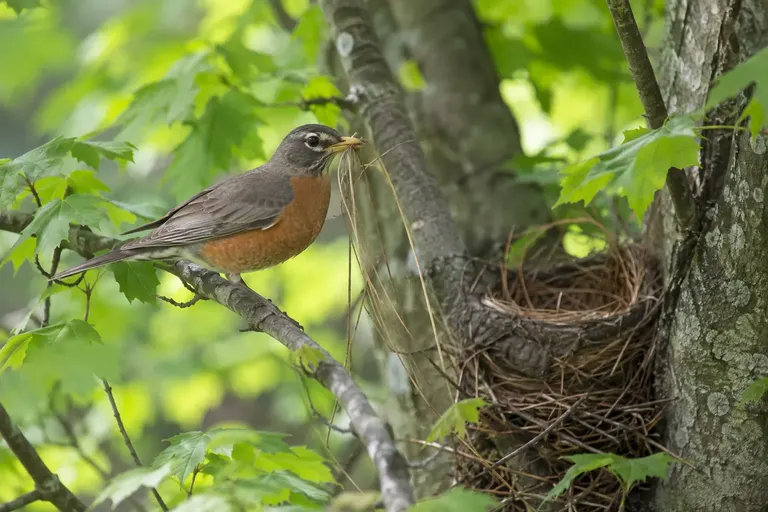
- Egg rejection. Some species puncture or throw out foreign eggs. In North America, Gray Catbirds and American Robins are well-known “rejecter” species that usually eject cowbird eggs. See our American Robin guide.
- Burying the egg. Yellow Warblers often build a new nest floor over a cowbird egg, sometimes burying their own eggs too, and start again. Multi-layered Yellow Warbler nests have been found.
- Abandoning the nest. Some hosts desert a parasitized nest and rebuild elsewhere.
- Chick rejection. Rare, but documented in some Australian hosts of bronze-cuckoos, where hosts may abandon a cuckoo chick. In turn, those cuckoo chicks show striking resemblance to host chicks.
Why do hosts often accept parasite eggs?
Rejection carries risks. A host may damage or eject its own egg by mistake, and parasites that retaliate raise the price of rejection. Where parasitism is rare, accepting the occasional foreign egg may cost less than a defense that sometimes goes wrong. For newer hosts, evolution may simply not have caught up yet.
What other brood parasites are there around the world?
Cuckoos and cowbirds get most of the attention, but brood parasites have found very different solutions on every inhabited continent.
Honeyguides: chicks armed with a hook
Honeyguides of Africa and Asia are best known for leading people to bees’ nests, but they are also brood parasites. They typically lay in the nests of hole-nesting birds such as barbets, bee-eaters and woodpeckers. Newly hatched Greater Honeyguide chicks have a sharp hook on the tip of the bill, which they use to attack and kill the host’s chicks in the dark cavity. The hook is lost as the chick grows. Research in Zambia by Claire Spottiswoode and colleagues filmed this behavior inside host nests.

Indigobirds and whydahs: copying the host’s chicks
The indigobirds and whydahs of Africa parasitize small finches called estrildids, such as firefinches and waxbills. Estrildid chicks have elaborate, colorful markings inside the mouth and on the palate, and parents respond to those patterns. Indigobird and whydah chicks closely mimic the mouth markings of their particular host species. The males also learn and sing the songs of their host species, which appears to help females choose mates raised by the same host.
Cowbirds and cuckoos in South America
In Brazil, Argentina and much of South America, the Shiny Cowbird is a widespread generalist parasite, much like the Brown-headed Cowbird farther north. It has spread through the Caribbean and reached Florida. The Screaming Cowbird is more of a specialist, relying heavily on a single host, the Grayish Baywing. The Striped Cuckoo, a New World cuckoo, is also a brood parasite across much of Central and South America.
Parasites that choose big hosts
Some cuckoos target large, intelligent hosts. In Australia and nearby islands, the Channel-billed Cuckoo, a large cuckoo, lays in the nests of crows and currawongs. Across South Asia, the Asian Koel commonly parasitizes House Crows. The Great Spotted Cuckoo, discussed below, uses magpies and crows in Europe, Turkey and Africa.
The Black-headed Duck: a hands-off parasite
The Black-headed Duck of southern South America is the only obligate brood parasite among waterfowl. It lays in the nests of coots, gulls and other ducks. Its ducklings are so precocial that they leave the host nest within a day or two and fend for themselves, so the host bears little cost beyond incubation.
Is brood parasitism always bad for the host?
Usually, yes, but there is at least one fascinating exception. The Great Spotted Cuckoo, found in southern Europe, Turkey, the Middle East and Africa, parasitizes magpies and crows. Its chicks do not evict host young. Research on Carrion Crows in Spain, published in 2014, found that cuckoo chicks release a foul-smelling secretion when disturbed that may deter predators, and in some years parasitized crow nests were more successful than unparasitized ones. Whether this is a benefit overall depends on local predation pressure.
Myths vs facts
Myth: Cowbirds are invasive pests. Fact: Brown-headed Cowbirds are native to North America and protected by federal law. Their range expanded as forests were cleared and farms spread, which brought them into contact with new hosts.
Myth: All cuckoos are parasites. Fact: Many cuckoos, including North America’s Yellow-billed and Black-billed Cuckoos and the roadrunners, raise their own young.
Myth: Host parents are “fooled” because they are unintelligent. Fact: Hosts face a genuine tradeoff. Feeding a begging mouth in the nest is almost always the right choice for a parent, and parasites exploit that rule.
Myth: Parasitized nests always fail. Fact: Many hosts raise both their own chicks and a cowbird, especially larger hosts. Losses depend on host size, number of parasite eggs and food supply.
What does this mean for backyard birders?
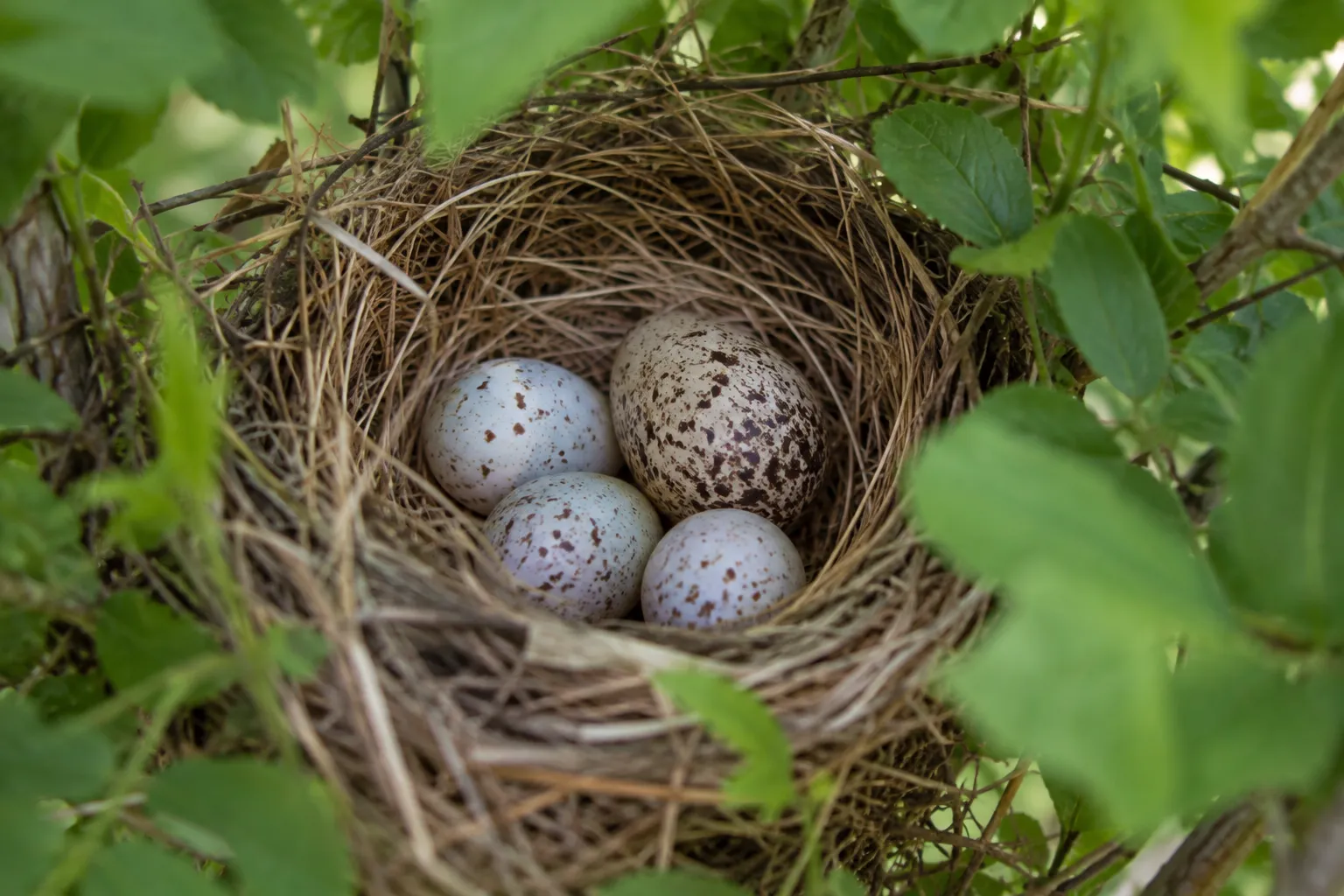
- Learn the eggs. Cowbird eggs are typically whitish with brown speckles and often larger than the host’s own eggs. An odd egg in a sparrow, warbler or vireo nest may be a cowbird’s.
- Do not remove eggs or chicks. In the US this is illegal without a permit, and interference can cause the hosts to abandon the nest.
- Watch for fledgling surprises. A small songbird feeding a much larger, plain gray-brown juvenile is a classic sight in summer. That begging youngster is often a cowbird.
- Record what you see. Nest observations submitted to Cornell’s NestWatch, and sightings logged on eBird, help researchers track parasitism. Our guide on how to use eBird covers the basics.
- Support habitat. Cowbirds tend to parasitize more heavily near forest edges and fragmented habitats. Larger, connected native habitats generally favor hosts.
Cowbird control has been used, under permit, to help endangered species. Trapping in Michigan helped the Kirtland’s Warbler recover, and the species was removed from the US endangered species list in 2019. This kind of management is carried out by wildlife agencies, not homeowners.
For more on the eggs and chicks involved, see how long bird eggs take to hatch, how birds build nests and what baby birds eat.
Quick facts
- About 1 percent of bird species, roughly 100, are obligate brood parasites.
- Brood parasitism has evolved independently several times.
- Common Cuckoo eggs often mimic the eggs of the host species a female specializes on.
- Cuckoo chicks push host eggs and chicks out of the nest; cowbird chicks usually outcompete them instead.
- The Brown-headed Cowbird has been recorded using more than 200 host species.
- Many birds, especially ducks, sometimes lay eggs in nests of their own species.
- Cowbirds are native and protected in the US; removing their eggs requires a permit.
Sources
Frequently asked questions
What is a brood parasite?
A brood parasite is a bird that lays its eggs in the nests of other birds and leaves the hosts to incubate the eggs and raise the young. Obligate brood parasites, such as the Common Cuckoo and Brown-headed Cowbird, never build nests or raise their own chicks. Some other birds, especially ducks, occasionally lay extra eggs in nests of their own species.
Should I remove cowbird eggs from a nest?
In the United States, no. The Brown-headed Cowbird is a native bird protected under the Migratory Bird Treaty Act, so removing its eggs or chicks without a permit is illegal. Cowbird control is carried out under permit for a few endangered species, such as Kirtland's Warbler. For backyard birders, the best approach is to watch and record, not intervene.
Do all cuckoos lay eggs in other birds' nests?
No. Only some cuckoo species are brood parasites. In North America, Yellow-billed and Black-billed Cuckoos normally build their own nests and raise their own young, though they occasionally lay eggs in other birds' nests. The Common Cuckoo of Europe, Asia and Africa is the best-known obligate brood parasite.
Why don't host birds recognize the strange egg or chick?
Many hosts do recognize foreign eggs and reject them, which is why cuckoo eggs often mimic host eggs. But rejection has costs: a bird may throw out its own egg by mistake. Chick recognition is even rarer, possibly because learning the wrong chick after being parasitized once could be very costly. Parasites also exploit strong parental instincts to feed any begging mouth.
How many bird species are brood parasites?
Roughly 1 percent of the world's bird species, about 100 species, are obligate brood parasites. They include many Old World cuckoos, several cowbirds, honeyguides, indigobirds and whydahs, the Cuckoo-finch and the Black-headed Duck of South America. Brood parasitism is thought to have evolved independently several times.