Why Do Birds Throw Seed Out of the Feeder?
Why do birds throw seed out of the feeder? Mostly they are sorting: flicking aside cheap filler, husks and spoiled seed to reach the food they want.
In this article
- Quick answer: the main reasons birds toss seed
- Why do birds sort through seed instead of just eating it?
- What seeds do birds throw out most often?
- Are the husks under my feeder really thrown-away seed?
- Do birds throw out seed that has gone bad?
- Which birds throw the most seed?
- Is seed on the ground bad for birds or my yard?
- How can you stop birds from throwing seed out?
- What does seed sorting tell you about the birds in your yard?
- Do busy feeders make birds throw more seed?
- Myths and facts about birds throwing seed
- A worldwide view: seed sorting everywhere
- Quick facts
- Sources
- Frequently asked questions
Birds throw seed out of the feeder mainly because they are sorting it. A finch or sparrow rakes through a mix with its bill, flicking aside the grains it does not want to reach the ones it does, usually sunflower. They also drop empty shells after husking seeds and reject food that is damp, moldy or clumped.
So the seed on your lawn is rarely random mess. It is a record of choices. Once you know what birds are rejecting, and why, you can cut the waste sharply and keep the ground under your feeder cleaner. This guide explains the behavior, which birds do it most, what it tells you about your seed, and what to change.
Quick answer: the main reasons birds toss seed
| Reason | What you see | What it tells you |
|---|---|---|
| Sorting out filler | Small round red or tan grains piling up below | Your mix contains seed your birds do not like |
| Dropping husks | Split, empty shells under the feeder | Normal eating, not waste |
| Rejecting spoiled seed | Birds toss seed they used to eat | Seed may be wet, moldy or old |
| Searching for a favorite | Rapid raking, sideways flicks of the head | Birds are digging for sunflower or peanuts |
| Wrong food for the feeder | Seed falls out as birds try to feed | Port size or feeder style does not suit the seed |
| Competition and hurry | Grabbing, fumbling, sweeping during busy periods | Many birds, little room |
Why do birds sort through seed instead of just eating it?
Because not all seed is equal to a bird, and sorting is how wild birds eat anyway. In nature, a finch feeding on a seed head or a sparrow picking through leaf litter constantly tests and discards items. Each seed is handled in the bill, judged by size, shape, hardness and probably taste, and either eaten or dropped. Your feeder simply concentrates that behavior in one spot.
Seed-eating birds such as finches, sparrows and buntings have strong, conical bills built for cracking. They hold a seed in a groove in the bill, crush or slice the husk with sideways movements of the lower mandible, work the kernel free with the tongue and drop the shell. That whole process takes energy and time. A bird that spends its effort on a high-fat sunflower kernel gets far more food value per second than one that works just as hard to husk a small, starchy grain it does not favor.
Birds are also very good at learning what a food is worth. Studies of foraging behavior in finches and tits suggest they quickly learn which seeds give the best return and then choose them consistently. When a bird lands on a feeder full of mixed seed, it is running that calculation in real time. The “wrong” seeds get pushed out of the way.
What does raking look like?
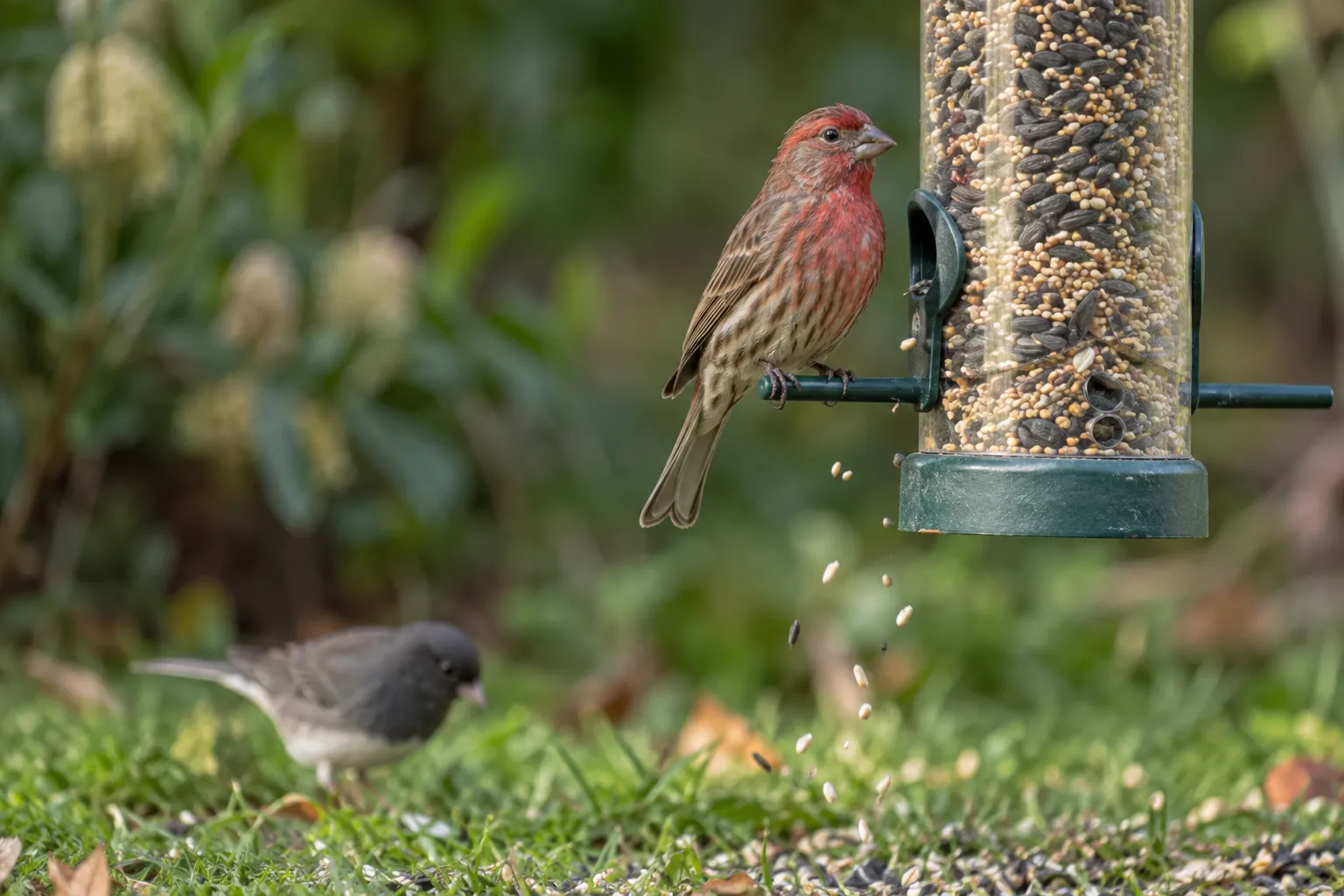
Watch a House Finch or a European Greenfinch at a tray or tube feeder and you will often see a fast, sideways sweep of the head. The bill moves through the seed like a small shovel, scattering unwanted grains over the edge. Sparrows do something similar with a quick flick. Grackles and blackbirds can sweep a whole tray in seconds. This is not play or aggression toward the seed. It is digging.
What seeds do birds throw out most often?
The most commonly rejected seeds are cheap fillers found in many bargain mixes. These include:
- Red millet. Small, round and reddish. Many feeder birds ignore it even when white proso millet in the same bag is eaten.
- Milo (sorghum). Larger, round, reddish-brown grains. Popular with some ground birds in the western US, such as quail and doves, but ignored by most eastern feeder birds.
- Wheat and oats. Often left untouched by finches, chickadees and titmice.
- Flax and rapeseed. Present in some mixes and often left behind.
- Cracked corn in a hanging feeder. Doves, jays, sparrows and blackbirds eat it, but many small clinging birds will toss it aside to reach other seed.
When you see a mat of small red or tan seed under a feeder that nothing seems to touch, filler is almost always the cause. The birds have eaten the sunflower and left the rest.
Which seeds do birds usually keep?
Across North America, black oil sunflower is taken by the widest range of feeder birds, including chickadees, titmice, nuthatches, cardinals, finches and grosbeaks. Hulled sunflower hearts or chips, white proso millet (for ground birds), Nyjer (for goldfinches and siskins), safflower (for cardinals and some others), peanuts and suet round out the most popular foods. In Europe, sunflower hearts, peanuts and nyger are staples for tits, finches and siskins. You can read more in our guide to the best bird seed to attract the most species and our explainer on black oil sunflower seed.
Are the husks under my feeder really thrown-away seed?
Often they are not. A lot of what people see as “thrown seed” is actually empty shells. When a finch, cardinal or sparrow cracks a sunflower seed, it keeps the kernel and drops the hull. Over a busy winter week, that can add up to a thick layer of split, striped or black husks under the feeder.
A quick test tells you which you have. Pick up a handful and look closely. Split, hollow shells with nothing inside mean normal eating. Intact, whole seeds mean rejection. Most feeders have some of each.
Husks are not harmful in small amounts, but in large piles they can smother grass, hold moisture and hide spilled seed that goes moldy. Sunflower hulls also appear to contain compounds that can suppress the growth of some plants, which may be why lawns often thin out under long-used sunflower feeders. The effect is not fully understood, so treat it as a likely factor rather than a certainty.
Do birds throw out seed that has gone bad?
Yes, and this is one of the most useful signals a feeder can give you. Birds tend to reject seed that is damp, clumped, moldy, sprouting or infested with insects such as pantry moths or weevils. A bird that normally eats sunflower but suddenly flings it out may be finding caked or musty seed.
Common causes include:
- Rain getting into the feeder. Tube feeders without good drainage can hold a wet plug of seed at the bottom.
- Humid storage. Seed kept in a damp garage or shed can spoil before it reaches the feeder.
- Old seed. Seed loses oil quality over time and may go rancid, especially in heat.
- Overfilling. A large feeder that takes weeks to empty gives seed more time to spoil.
If birds are dumping more than usual, empty the feeder completely, check for clumps, webbing or a sour smell, and clean and dry it before refilling. Our guide on how to clean a bird feeder covers the details.
Which birds throw the most seed?
Not every species treats a feeder the same way. Knowing who does what helps you interpret the mess.
The sorters
- House Finch and Purple Finch (North America). Frequent rakers at mixed seed, often scattering filler to reach sunflower.
- House Sparrow (worldwide). Found near people from the US and Europe to Turkey, Brazil and beyond. Busy, social and often messy at trays and tubes.
- Greenfinch and Chaffinch (Europe and western Asia). Greenfinches sit at feeders shelling seed at length, dropping husks. Chaffinches often feed on the ground below.
- Goldfinches. American Goldfinches and European Goldfinches both favor small, high-oil seeds such as Nyjer and sunflower hearts and will pick through a mix for them.
- Grackles, blackbirds and starlings. Common Grackles and Red-winged Blackbirds in North America can empty and scatter a tray quickly. See our guide to keeping starlings and grackles off feeders if they are overwhelming smaller birds.
The one-seed-and-go birds
Chickadees, titmice, nuthatches and, in Europe and Turkey, Great Tits and Blue Tits behave differently. They usually pick out a single seed, often after a brief shuffle to find a good one, then fly to a branch to open it or hide it. They may knock a few seeds out while choosing, but they are not the main source of seed on the ground.
That short “test and pick” moment is interesting in its own right. Research on tits and chickadees suggests some individuals handle several seeds before choosing, possibly judging weight. A heavier seed usually means a bigger kernel, so choosing carefully can pay off.
The ground crew
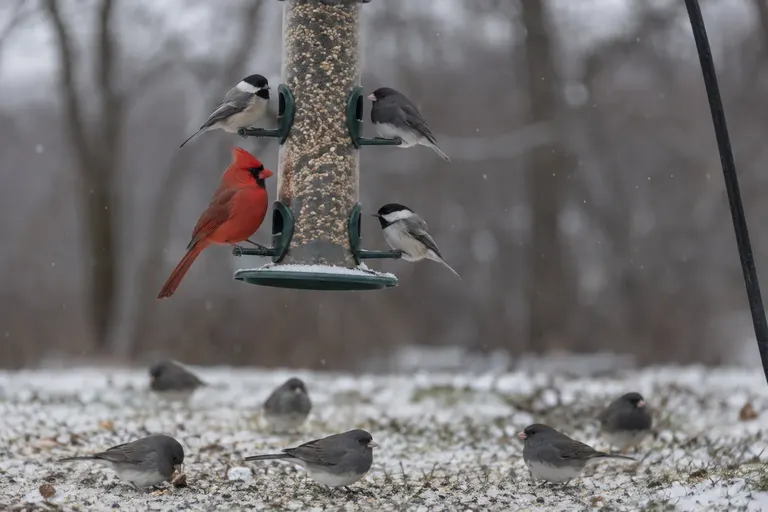
Juncos, doves, towhees, many sparrows and, in Europe, Dunnocks and Chaffinches feed mostly on the ground. In Brazil, Rufous-collared Sparrows, Saffron Finches and Ruddy Ground Doves often work the ground below feeders and platforms. These birds benefit from what others drop. In moderation, spilled seed is part of how a feeding station supports more species.
Is seed on the ground bad for birds or my yard?
A modest scatter is harmless and useful. The trouble starts when seed builds up, especially in wet weather. Large piles can:
- Grow mold and bacteria. Damp, rotting seed can harbor fungi, including some that produce toxins. Ground-feeding birds are most exposed.
- Spread disease. Crowding at a pile of spilled seed brings birds into close contact and allows droppings to contaminate food. Salmonellosis outbreaks in finches and siskins have been linked to crowded, dirty feeding areas.
- Attract rodents. Rats and mice are drawn to reliable spilled food, particularly at night. See our guide on keeping rats away from bird feeders.
- Attract larger mammals. Raccoons, deer and in some areas bears will visit.
- Sprout weeds. Millet, milo and sunflower seeds can germinate in lawns and flower beds.
If you spot birds that sit fluffed, sluggish or with crusty eyes near a feeder, clean the area thoroughly. Our page on sick birds at the feeder explains what to look for.
How can you stop birds from throwing seed out?
You cannot change how birds eat, but you can change what you give them. The goal is to offer food with nothing to reject.
Step-by-step: cut feeder waste
- Switch to no-filler foods. Use straight black oil sunflower, or better, hulled sunflower hearts or chips. With no husk and no filler, almost everything gets eaten. A good no-mess seed blend does the same job.
- Read the ingredient list. If a mix lists red millet, milo, wheat, oats or “grain products” near the top, expect waste.
- Match seed to feeder. Nyjer belongs in a finch feeder with small ports. Large seeds belong in tubes with large ports or on trays. Mismatches cause birds to fumble and drop food.
- Offer foods separately. A tube of sunflower, a finch feeder of Nyjer and a small tray of millet for ground birds leads to less sorting than one bowl of everything.
- Fill less, refill more often. Smaller quantities stay fresh and give birds less to dig through.
- Keep seed dry. Use feeders with drainage holes and a roof, and store seed in sealed metal or hard plastic bins.
- Add a catch tray. A seed tray or platform under a hanging feeder turns fallen seed into a second feeding spot and keeps it off the grass. Our guide to platform and tray feeders explains the options.
- Rake and clean regularly. Clear heavy build-up weekly, and after rain.
Will changing seed reduce the number of birds?
Usually not, and often it increases variety. Sunflower hearts and chips are taken by nearly every seed-eating feeder bird. You may lose a few ground-feeding birds that relied on millet, which is why many birders keep a small separate tray or ground offering of white proso millet.
What does seed sorting tell you about the birds in your yard?
The seed you find below the feeder is a quiet survey. If red millet piles up, your birds are mostly clinging finches and tits that do not want it. If millet disappears but sunflower is left, you likely have more doves, sparrows and juncos. If husks dominate and whole seeds are rare, your birds are eating well and your mix suits them.
It also helps explain changes in behavior. A feeder that birds suddenly stop using, while seed pours out of it, often has a spoilage problem. A feeder where birds swarm and sweep seed out fast may simply be too popular, and a second feeder can spread the pressure.
Do busy feeders make birds throw more seed?
Often, yes. When a feeder is crowded, birds feed in a hurry. They have less time to handle each seed carefully, they are watching neighbors and predators, and they are often pushed off a perch mid-bite. A finch that is jostled drops the seed it was holding. A sparrow that knows a larger bird is about to arrive may grab and sweep rather than pick. Dominance plays a part too. At many feeders, a few bold individuals hold the best perches while others wait nearby, and quick, clumsy feeding by lower-ranking birds adds to the scatter.
Weather matters as well. On very cold mornings, and just before a storm, birds feed intensely to build fat reserves for the night. Activity jumps, and so does spillage. Spreading food across two or three feeders, spaced a few feet apart, usually calms things down and reduces the mess.
Myths and facts about birds throwing seed
Myth: Birds throw seed because they are wasteful or full. Fact: They are selecting. Birds are efficient foragers and discard items that give poor returns for the effort.
Myth: Birds throw seed out to feed other birds. Fact: There is no good evidence of that. Ground birds benefit, but it is a side effect.
Myth: A messy feeder means the birds are sick. Fact: Mess is normal. Sick birds are more often signaled by lethargy, fluffed feathers in mild weather and eye problems, not by seed on the ground.
Myth: Expensive seed is just marketing. Fact: Price is not the point, content is. Hulled seed costs more per bag but often less per bird fed, because little of it is thrown away.
Myth: Only certain feeders cause mess. Fact: Feeder design matters a little, but the seed matters more. Filler will be thrown out of nearly any feeder.
A worldwide view: seed sorting everywhere
The same pattern appears wherever people feed birds. In the UK, the RSPB and BTO have long recommended sunflower hearts and good-quality seed with little filler, partly because tits, finches and siskins pick through cheap mixes. In Turkey and southeastern Europe, House Sparrows, Great Tits, Eurasian Collared Doves and Goldfinches visit feeders and balcony trays and sort mixes in similar ways. In Brazil, Saffron Finches, Rufous-collared Sparrows and doves often feed on platforms stocked with millet or broken rice, and they, too, leave behind what they do not want. The species change, but the logic of a seed-eating bird holding each grain, judging it and dropping the poor ones stays the same.
Quick facts
- Most “thrown seed” is filler such as red millet, milo, wheat and oats, or empty husks.
- Finches and sparrows sort the most. Chickadees, tits and nuthatches usually take one seed and leave.
- Birds reject damp, moldy, clumped or insect-infested seed.
- Hulled sunflower hearts produce almost no waste.
- Ground feeders such as juncos, doves and chaffinches use some spilled seed.
- Large wet piles of seed can spread disease and attract rodents.
- A catch tray and regular raking keep the area clean.
Sources
- House Finch overview, Cornell Lab of Ornithology, All About Birds
- American Goldfinch overview, Cornell Lab of Ornithology, All About Birds
- Dark-eyed Junco overview, Cornell Lab of Ornithology, All About Birds
- Project FeederWatch, Cornell Lab and Birds Canada
- Royal Society for the Protection of Birds
- British Trust for Ornithology
Frequently asked questions
Why do birds throw seed out of the feeder?
Mostly because they are sorting. Birds rake through a seed mix with their bills, flicking aside grains they do not want, such as red millet, milo, wheat or oats, to reach favorites like sunflower. They also drop empty husks after shelling seeds, and they reject seed that is damp, moldy or clumped. It looks wasteful, but to the bird it is selective foraging.
Which birds throw the most seed out of feeders?
Seed-sorting finches and sparrows are the usual culprits. House Finches, House Sparrows, goldfinches and, in Europe, greenfinches often rake through a mix. Grackles and blackbirds can sweep out large amounts quickly. Chickadees, titmice and nuthatches rarely throw seed on purpose, because they take one seed at a time and fly off to eat or store it.
How do I stop birds from throwing seed out of the feeder?
Offer foods with no filler and no shell. Hulled sunflower hearts, chips or a no-mess blend give birds nothing to reject, so almost all of it is eaten. Match the seed to the feeder, for example Nyjer in a finch feeder, keep seed dry and fresh, and add a seed tray under the feeder to catch what still falls.
Is seed on the ground under a feeder a problem?
A little is fine, and ground-feeding birds like juncos, doves and sparrows will eat it. Large, damp piles are a problem. They can grow mold, attract rats and mice, and spread disease among birds that feed on the ground. Rake up heavy spills, especially after rain, and reduce the filler in your mix so less seed ends up there.
Are birds throwing seed because it has gone bad?
Sometimes. Birds often reject seed that is wet, clumped, moldy, sprouting or infested with insects. If birds suddenly start dumping a food they used to eat, check the feeder for caked seed at the bottom, smell it for mustiness and look for webbing. Empty it, clean and dry the feeder, and refill with fresh seed.