How to Attract Downy Woodpeckers: Suet, Food and Habitat
How to attract downy woodpeckers: offer suet, peanuts and black oil sunflower, keep native plants with seed heads and galls, and leave safe dead limbs standing.
In this article
- Quick answer: what downy woodpeckers need
- Downy woodpecker at a glance
- How to identify a downy woodpecker
- Where do downy woodpeckers live?
- What do downy woodpeckers eat?
- Best feeders for downy woodpeckers
- Plants and habitat that attract downy woodpeckers
- Water
- Downy woodpecker nesting
- Seasonal calendar
- Common problems and fixes
- Common mistakes when attracting downy woodpeckers
- Sources
- Frequently asked questions
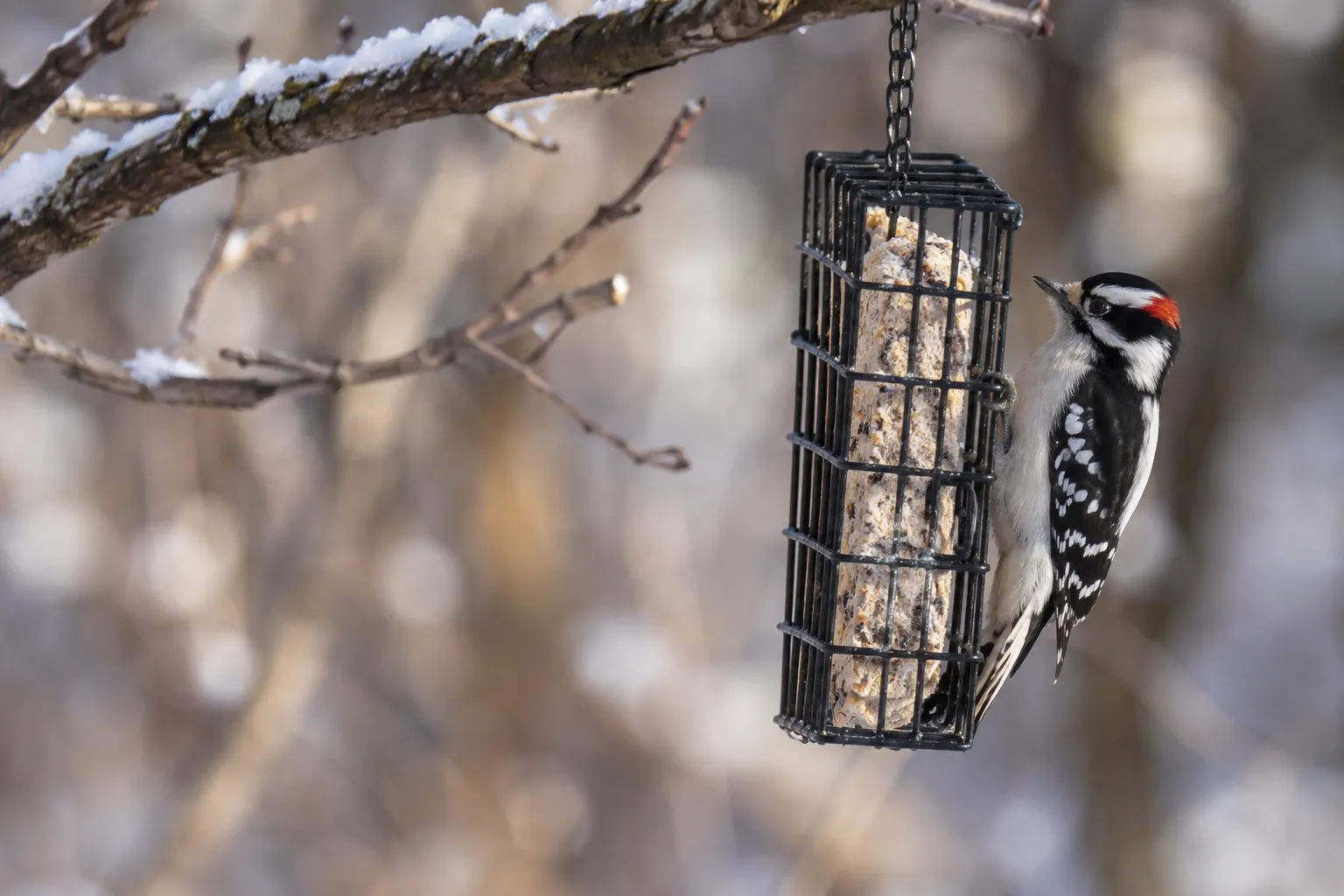
Here is how to attract downy woodpeckers: hang suet, add peanuts or black oil sunflower seed, and keep native plants and a few safe dead limbs in the yard. The Cornell Lab calls the downy the woodpecker most likely to visit a backyard feeder, and it lives year-round across most of the US, so a basic suet feeder near trees is often enough to bring one in within a season. Habitat keeps them nesting nearby: the Cornell Lab notes they excavate dead stubs averaging about 7 inches in diameter.
Quick answer: what downy woodpeckers need
| Need | What works best | Notes |
|---|---|---|
| Food | Suet, black oil sunflower, peanuts, chunky peanut butter | All listed by the Cornell Lab as downy feeder foods |
| Feeder | Suet cage, tail-prop suet feeder, tube or mesh peanut feeder | They cling easily, so most feeders work |
| Habitat | Deciduous trees, shrubs and tall weedy stems | They forage on twigs and plant stalks as well as trunks |
| Nesting | Small dead limbs and stubs left standing | They excavate new cavities each year |
| Water | Shallow bird bath, heated in winter | Used year-round |
| Timing | All year, busiest at feeders in fall and winter | Mostly non-migratory |
Downy woodpecker at a glance
| Trait | Detail |
|---|---|
| Size | 5.5 to 6.7 in long, 0.7 to 1.0 oz, wingspan 9.8 to 11.8 in |
| Range | Most of the US and Canada; absent from the arid Southwest |
| Season | Year-round in most areas |
| Diet | Mostly insects, with berries, acorns and grains making up roughly a quarter |
| Feeder foods | Suet, black oil sunflower, millet, peanuts, chunky peanut butter |
| Nesting | Excavates a cavity in a dead stub, lined only with wood chips |
| Clutch | 3 to 8 white eggs, usually one brood a year |
Figures are from the Cornell Lab of Ornithology’s All About Birds account.
How to identify a downy woodpecker
The downy is the smallest woodpecker in North America, barely larger than the chickadees and nuthatches it often forages with. The Cornell Lab puts it between a sparrow and a robin in size, and about two-thirds the size of a hairy woodpecker.
The overall look is checkered black and white:
- Black wings checked with white spots.
- A broad white stripe down the center of the back.
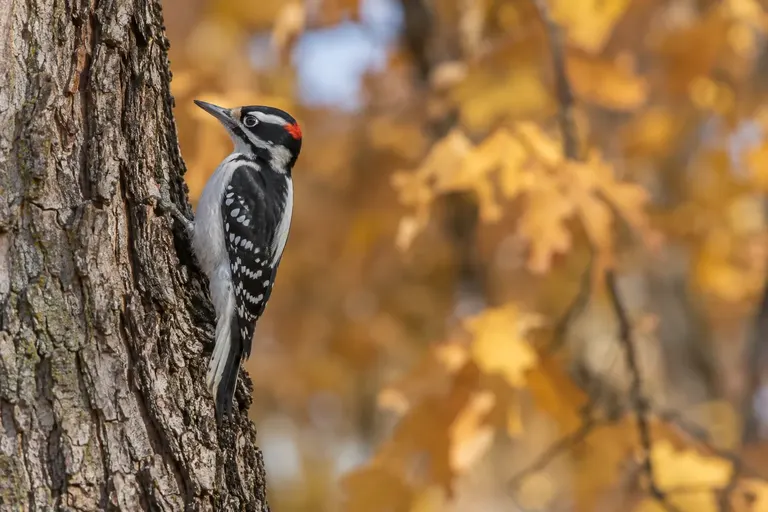
- A boldly striped black-and-white head.
- Clean white underparts.
- White outer tail feathers with some black spots or bars.
- A short, stubby bill that looks small for the bird’s head.
Male vs female downy woodpecker
- Males have a small red patch on the back of the head.
- Females lack the red and show a black-and-white head only.
Juveniles
The Cornell Lab notes that juvenile downies show red feathering on the cap, farther forward on the head than the adult male’s nape patch. Seeing a “red-capped” downy in summer usually means a young bird, not a different species.
Downy vs hairy woodpecker: how to tell them apart
This is one of the first identification challenges most backyard birders face, and the Cornell Lab calls it exactly that. The two species look nearly identical in pattern.
| Feature | Downy woodpecker | Hairy woodpecker |
|---|---|---|
| Length | 5.5 to 6.7 in | 7.1 to 10.2 in |
| Weight | 0.7 to 1.0 oz | 1.4 to 3.4 oz |
| Bill | Short and stubby, much shorter than head depth | Long and chisel-like, about as long as head depth |
| Outer tail feathers | White with black spots or bars | Plain white |
| Call | Soft pik, and a whinny that descends in pitch | Sharp, loud peek, and a whinny that stays level |
| Where it forages | Small branches, twigs, weed stems, galls | Trunks and large limbs |
The bill is the most reliable single mark, because size is hard to judge when a bird is alone. Picture the distance from the base of the bill to the back of the head. On a downy the bill covers only a fraction of that distance. On a hairy it covers most or all of it.
Our guide on how to attract hairy woodpeckers covers the larger species in detail.
Other similar species
The Cornell Lab also lists ladder-backed woodpecker, Nuttall’s woodpecker, red-cockaded woodpecker and yellow-bellied sapsucker. The first two are western and southwestern species with barred backs rather than a white back stripe. Red-cockaded woodpeckers are rare birds of southeastern pine forests. Sapsuckers have a large white wing patch and a mottled back.
Where do downy woodpeckers live?
Downy woodpeckers are found across most of North America. Audubon describes them as permanent residents in much of the continent, avoiding the arid Southwest. The northernmost birds may move some distance south in winter, and some mountain birds descend to valleys.
Habitat
According to the Cornell Lab, downies prefer open woodlands, especially deciduous woods and streamside trees. They adapt well to people and are common in orchards, parks, suburbs and city yards, using fencerows for nesting and tall weeds for feeding. Audubon notes they tend to avoid conifer-only forest except where deciduous groves are mixed in.
That makes most leafy suburban yards with a few mature trees and some shrubs good downy habitat already.
What do downy woodpeckers eat?
Downy woodpeckers are mainly insect eaters. The Cornell Lab lists beetle larvae living in wood or bark, ants and caterpillars as main foods, along with crop pests such as corn earworms and bark beetles. Plant foods make up roughly 25 percent of the diet: berries, acorns and grains.
Their small size lets them reach food larger woodpeckers cannot. The Cornell Lab notes they forage on tiny branches and on the stems of weeds, and are known to dig fly larvae out of goldenrod galls in winter. Audubon adds that they do more tapping and excavating in winter and more gleaning from surfaces in summer.
Why males and females forage in different places
The Cornell Lab notes that males and females divide up winter foraging locations. In general, males tend to use smaller branches and weed stems, while females work larger branches and trunks. For your yard, this means variety helps: a mix of big trees, small trees, shrubs and tall perennials gives both sexes somewhere to feed.
Best foods for downy woodpeckers at feeders
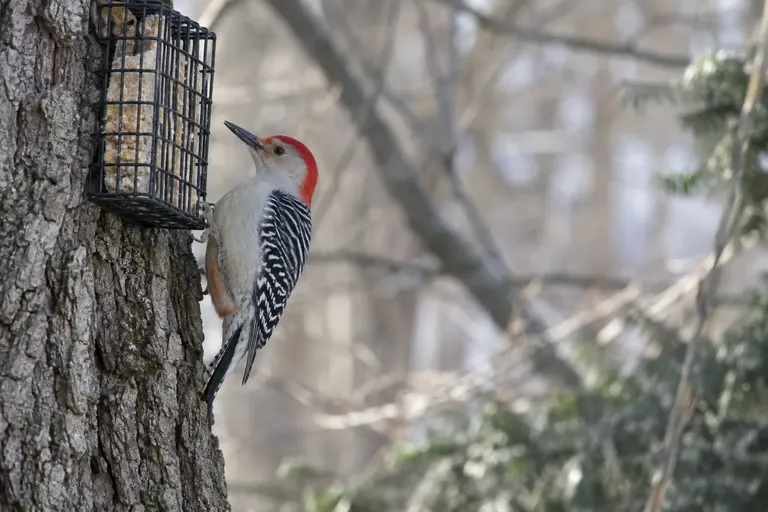
- Suet. The standard downy food and the easiest way to get a visit. Plain beef suet works in cold weather; no-melt blends hold up better in warm months. See our roundup of the best suet cakes and suet blends.
- Black oil sunflower seed. Thin-shelled and high in fat. Downies take it from tube and hopper feeders. Our guide to black oil sunflower seed explains why it suits so many feeder birds.
- Peanuts. Shelled peanuts or peanut pieces in a mesh feeder are popular with downies and many other clinging birds.
- Chunky peanut butter. Listed by the Cornell Lab as a downy food. Smear a little into bark crevices or the holes of a log feeder. Use a plain product without added sugar or salt where possible.
- Millet. The Cornell Lab lists millet, though it is a minor food for downies compared with suet and sunflower.
Best feeders for downy woodpeckers
| Feeder type | Food | Why it works | Watch out for |
|---|---|---|---|
| Suet cage | Suet cakes | Simple and cheap, downies cling easily | Starlings may crowd plain cages |
| Tail-prop suet feeder | Suet cakes | Extension lets woodpeckers brace with their tail as on a trunk | Takes more space |
| Upside-down suet feeder | Suet cakes | Woodpeckers can feed from below; many larger birds struggle to | Some birds adapt over time |
| Mesh peanut feeder | Shelled peanuts | Birds peck out small pieces | Needs regular cleaning |
| Tube feeder | Black oil sunflower | Keeps seed dry | Perches can be short for woodpeckers |
| Log feeder | Suet plugs, peanut butter | Mimics natural bark foraging | Clean holes often |
Our roundup of the best suet feeders compares specific designs, including tail-prop and upside-down models.
Where to place a downy woodpecker feeder
Hang suet on or near a tree trunk or on a pole a short hop from trees. Woodpeckers feel safer with cover close by, and downies often move between a feeder and nearby branches. Our guide on where to put a bird feeder covers distances, height and window safety in more detail. The old fixed-distance rule for windows is no longer considered valid, so use that guide’s current advice.
How long does it take for a downy woodpecker to find a new feeder?
There is no fixed timeline. Downies often travel with mixed winter flocks of chickadees, titmice and nuthatches, so once those birds find your feeders, a downy may follow. In a yard with mature trees and existing chickadee traffic, that can happen quickly. In a new development with few trees, it can take much longer. A few things speed discovery:
- Start in fall. Insects become scarce and mixed flocks settle into winter ranges, so birds are actively looking for reliable food.
- Hang suet where it is visible from trees. A cage fixed to the side of a trunk, or on a pole within a short flight of branches, is easy for a passing bird to spot.
- Add a sunflower feeder nearby. Chickadee and titmouse activity at a seed feeder draws attention to the whole station.
- Keep it stocked. A feeder that is empty half the week teaches birds to look elsewhere.
Watching downy woodpeckers up close
Downies are tame by woodpecker standards and often feed at close range, which makes them a good species for learning field marks. A pair of binoculars at the window lets you check the bill length and tail spots that separate them from hairy woodpeckers. Our guide to the best binoculars for watching birds from your window covers models suited to short indoor distances.
Plants and habitat that attract downy woodpeckers
Feeders bring downies in. Habitat keeps them nesting and foraging nearby for most of the year.
Keep tall perennials standing through winter
Because downies feed on weed stems and galls, cutting every perennial back in fall removes winter food. Leave goldenrod, native sunflowers, asters and other sturdy stalks standing until spring. Goldenrod galls in particular are a known downy food source.
Native trees and shrubs that help
Choose plants native to your region; your cooperative extension office or native plant society can confirm the right species.
- Oaks. Oaks host a wide range of insects and produce acorns, both downy foods.
- Native fruiting shrubs. Dogwoods, serviceberry, viburnums and elderberry supply berries in late summer and fall.
- Willows, birches and aspens. Soft-wooded trees used by many small cavity nesters, and often rich in insects.
- Sumac and bayberry. Fruits that persist into winter in many regions.
Leave dead limbs and snags where safe
Downy woodpeckers need dead wood to nest. A dead branch, a small dead tree or a tall stump that poses no risk to people, buildings or power lines can become a nest site. When an arborist removes a hazardous tree, ask whether a tall, safe stub can be left.
Water
A shallow bird bath with a gentle slope and no more than 1 to 2 inches of water at the center suits downies and most small birds. In freezing weather, a heated bath offers open water when little else does. For more on cold-weather feeding and water, see our winter bird feeding guide.
Downy woodpecker nesting
Downy woodpeckers excavate a new nest cavity each spring rather than reusing old ones.
- Site: dead trees or dead parts of live trees. The Cornell Lab notes they typically choose small stubs averaging about 7 inches in diameter, often angled, with the entrance on the underside. Audubon gives typical nest heights of 12 to 30 feet.
- Excavation: both sexes dig, over 1 to 3 weeks.
- Entrance: round, 1 to 1.5 inches across.
- Cavity: 6 to 12 inches deep, widening toward the bottom, lined only with wood chips.
- Eggs: 3 to 8 white eggs.
- Incubation: about 12 days, shared by both sexes.
- Nestling period: 18 to 21 days.
- Broods: usually one per year; Audubon notes possibly two in the South.
The Cornell Lab also notes that downies have been found nesting inside the walls of buildings.
Will downy woodpeckers use a nest box?
Occasionally, but it is not the way to plan. NestWatch’s birdhouse guide does not list the downy among its featured nest box species, and the birds’ habit of excavating fresh cavities means standard boxes are often ignored. Some people pack a box full of wood chips so a woodpecker can “excavate” it, but treat this as an experiment. Old downy holes are used later by other small cavity nesters, which is another good reason to leave dead wood standing.
Seasonal calendar
| Months | What downy woodpeckers are doing | What to do |
|---|---|---|
| January to March | Heavy feeder use; drumming begins in late winter | Keep suet stocked; keep water open |
| April to May | Pair formation, courtship flights, excavating nests | Leave dead limbs; tolerate some drumming |
| June to July | Feeding nestlings insects; fledglings appear at feeders with adults | Switch to no-melt suet in heat; clean feeders often |
| August to October | Juveniles on their own; more fruit and seed in diet | Keep perennials standing as they go to seed |
| November to December | Feeder use rises as insects decline | Resume regular suet; add peanuts |
Common problems and fixes
Starlings take over the suet
European starlings can clear a suet cage quickly. An upside-down suet feeder often helps, since woodpeckers feed from below while starlings find it harder. See our guide to keeping starlings and grackles off feeders for more options.
Suet goes rancid or melts in summer
Use no-melt blends in warm weather, offer smaller amounts, and hang suet in shade. Replace anything that smells off or looks moldy.
A downy is drumming on the house
Drumming on siding, gutters, vent caps and metal is territorial signaling, mostly in late winter and spring. The Cornell Lab notes downies drum on wood or metal to communicate. It usually stops once nesting is under way. Covering the favorite spot with lightweight netting or a strip of flashing may redirect the bird. Actual holes in wood siding can indicate insects, so it is worth checking.
Squirrels raid the suet
Pole-mount the feeder with a baffle, away from branches and fences. Hot-pepper suet is another option; birds do not react to capsaicin the way mammals do.
Common mistakes when attracting downy woodpeckers
- Cutting every perennial down in fall. Seed heads and galls are winter food.
- Removing all dead wood. Safe snags and dead limbs are nest sites.
- Letting suet spoil in summer heat. Switch to no-melt blends and smaller amounts.
- Relying on a nest box. Downies prefer to excavate their own cavities.
- Hanging suet far from trees. Downies prefer a short hop to cover.
Sources
Frequently asked questions
What is the best food to attract downy woodpeckers?
Suet is the most reliable draw, especially in winter. The Cornell Lab also lists black oil sunflower seeds, millet, peanuts and chunky peanut butter as foods downy woodpeckers take at feeders. Offer suet in a cage or tail-prop feeder and peanuts or sunflower in a tube or mesh feeder, and you cover most of what they eat at feeding stations.
How do I tell a downy woodpecker from a hairy woodpecker?
Look at the bill and the tail. A downy's bill is short and stubby, clearly shorter than the depth of its head, while a hairy's bill is roughly as long as its head is deep. Downy woodpeckers usually show black spots or bars on the white outer tail feathers; hairy woodpeckers have plain white outer tail feathers. Downies are also about two-thirds the size.
Do downy woodpeckers use birdhouses?
Not often. Downy woodpeckers excavate a fresh cavity in dead wood each year, and the Cornell Lab describes nests in small dead stubs averaging about 7 inches in diameter. The most dependable way to give them nest sites is to leave dead limbs and small snags standing where they pose no hazard. Some backyard birders try a box packed with wood chips, but results are unpredictable.
Why is a downy woodpecker pecking on my house?
Most spring hammering on siding, gutters or metal is drumming, a way of advertising territory and attracting a mate, not feeding. The Cornell Lab notes downies drum loudly on wood or metal to communicate. Drumming usually fades after the breeding season starts. Persistent holes in wood siding can mean insects are present, so it is worth checking for an infestation.
Do downy woodpeckers migrate?
Mostly no. Audubon describes the downy woodpecker as a permanent resident across much of North America, though northernmost birds may move some distance south in winter and mountain birds may move downslope to valleys. In most backyards you can see them all year, with feeder visits heaviest in fall and winter when insects are harder to find.