How to Attract Pileated Woodpeckers: Dead Wood and Suet
How to attract Pileated Woodpeckers: keep dead trees and logs, offer suet in a feeder with a tail prop, and live near mature woods. What works and what doesn't.
If you buy through links on this page we may earn a commission, at no cost to you. It never decides what we recommend. How we earn
In this article
- Pileated Woodpecker at a glance
- What a Pileated Woodpecker looks like
- Where Pileated Woodpeckers live, and whether your yard qualifies
- What Pileated Woodpeckers eat
- The best feeder foods for Pileated Woodpeckers
- Choosing a suet feeder a Pileated can actually use
- Dead trees, stumps and logs: the most powerful habitat step
- Native plants that support Pileated Woodpeckers
- Nest boxes and nesting: what to expect
- A year with Pileated Woodpeckers
- Common problems and how to handle them
- Common mistakes when trying to attract Pileated Woodpeckers
- Sources
- Gear mentioned in this guide
- Frequently asked questions
Here is how to attract Pileated Woodpeckers: keep dead wood, the single strongest draw, in a yard in or next to mature woods. That means standing snags, stumps and fallen logs full of carpenter ants, which the Cornell Lab lists as about 40 percent of the diet. Suet in a long feeder with a tail prop is the best way to bring one into view. If you live in open suburbs far from large trees, no feeder will reliably pull one in.
Pileated Woodpecker at a glance
| Trait | Details |
|---|---|
| Size | 15.8 to 19.3 in long, wingspan 26 to 29.5 in, 8.8 to 12.3 oz (nearly crow-sized) |
| Range | Eastern US and southern Canada, across the boreal forest, and the Pacific Northwest into northern California and the northern Rockies |
| Season | Year-round resident, does not migrate |
| Natural diet | Carpenter ants, woodboring beetle larvae, termites, other insects, wild fruit and nuts |
| Feeder food | Suet first, occasionally sunflower seed, peanuts and fruit |
| Feeder type | Long suet feeder with a tail prop, or suet on a tree trunk |
| Nesting | Excavates a new cavity in a dead tree each year, 3 to 5 white eggs, one brood |
| Habitat needed | Mature or second-growth forest with large trees and dead wood |
What a Pileated Woodpecker looks like
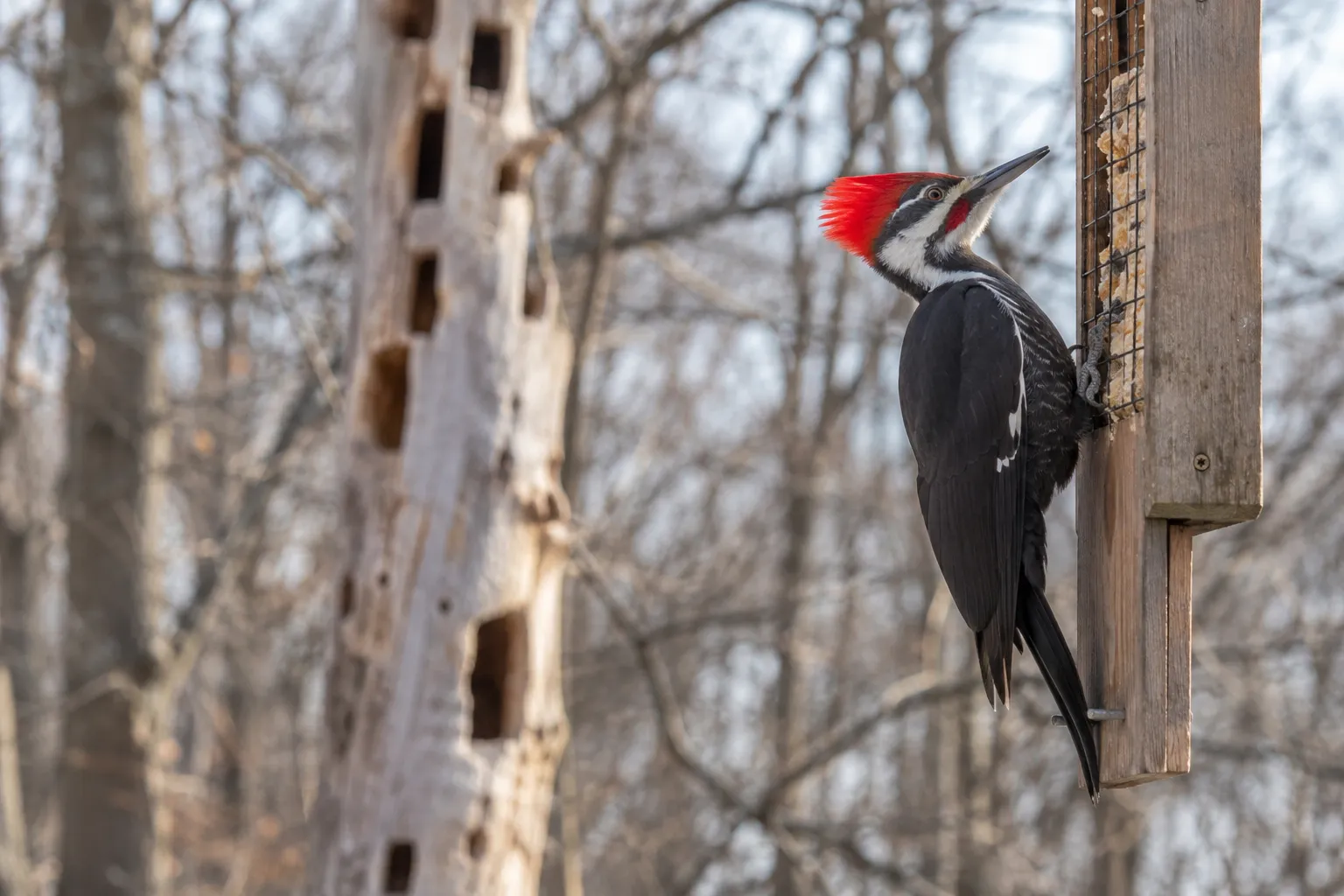
The Pileated is the largest woodpecker most North Americans will see. The Cornell Lab describes it as nearly the size of an American Crow, black with bold white stripes down the neck and a flaming red crest. In flight it shows big white patches under the wings and small white crescents on the upper side of the wings. The flight itself is strong but slow and slightly undulating, which can make a flying Pileated look more like a crow than a woodpecker at first glance.
Male vs. female
Both sexes have the red crest, which makes sexing them easy once you know the trick:
- Male: a red stripe on the cheek (sometimes called a mustache or malar stripe) running back from the bill, and red that reaches all the way forward to the base of the bill.
- Female: no red cheek stripe, a dark stripe there instead, and a gray-black forehead in front of the red crest.
Pairs stay together on their territory all year, so if you see one regularly, watch for the second bird. The Cornell Lab notes that seeing more than two Pileateds together is rare outside the family period after fledging.
Juveniles
Young birds leave the nest in early summer and stay with their parents for a while. They look much like adults but are generally duller and less crisply marked. In late summer you may see three to five birds moving together through the woods, which is the one time of year a small group is normal.
Similar species
- Red-headed Woodpecker: much smaller, with an entirely red head (not just a crest), a white body and big white wing patches. It has no crest at all.
- American Crow: similar size and black, but no crest, no white on the head, and a very different flight and call.
- Ivory-billed Woodpecker: historically confused with the Pileated in southern swamps. Sightings claimed today are almost always Pileateds, which also show a lot of white in the wing in flight.

Sounds
You often hear a Pileated before you see it. The Cornell Lab describes deep, loud drumming and shrill, whinnying calls. The call is a series of loud, ringing notes that can sound like a Northern Flicker’s call but wilder. Drumming is slower and more resonant than a Downy’s. Logging what you hear in a sound app helps confirm a pair is nearby; see our guide on how to use Merlin Sound ID without getting fooled.
Where Pileated Woodpeckers live, and whether your yard qualifies
Honest expectations matter with this species. Pileateds need big trees. The Cornell Lab describes their habitat as mature deciduous or mixed woodland of nearly every type, from western hemlock stands to beech and maple forests and cypress swamps. It also notes they do well in younger forests with scattered large dead trees or decaying logs, and in suburban areas with substantial trees and woodland patches.
Audubon notes the species was once rare because of forest clearing but has made a gradual comeback since around 1900 and may be adapting to second-growth woods and people. The Cornell Lab reports populations steadily increased from 1966 to 2019.
In practice, your odds are good if:
- Your yard backs onto woods, a wooded ravine, a park or a greenbelt with large trees.
- You have heard their calls or drumming, or seen large rectangular holes in dead trees or stumps nearby.
- There are standing dead trees (snags) within a few hundred yards.
Your odds are low if you are in a new subdivision, a dense city center or open farmland with few large trees. Pairs hold large territories, so even in good habitat one yard may sit at the edge of a territory and get only occasional visits.
What Pileated Woodpeckers eat
The Cornell Lab lists carpenter ants as about 40 percent of the diet, and up to 97 percent in some individuals. Audubon puts carpenter ants at up to 60 percent. The rest is woodboring beetle larvae, termites, flies, caterpillars, other insects and wild fruit and nuts.
The feeding method is what makes the Pileated distinctive. It digs large rectangular excavations, which the Cornell Lab says can be a foot or more long, into dead or decaying wood to reach ant galleries. It then uses a long, barbed tongue to pull out ants and larvae. Those holes are so broad and deep, the Lab notes, that they can cause small trees to break in half, and other birds often visit them afterward.
Wild fruits to know
The Cornell Lab lists greenbrier, hackberry, sassafras, blackberries, sumac, poison ivy, holly, dogwood, persimmon and elderberry among the fruits Pileateds eat. That list is a useful planting guide, covered below.
The best feeder foods for Pileated Woodpeckers
Suet: the main draw
The Cornell Lab says Pileateds visit feeders especially for suet. That is the one food worth committing to. Good options:
- Plain rendered beef suet or suet cakes with peanuts and tree nuts. High fat matters most in cold weather.
- Nut-heavy blends in winter. Our roundup of the best suet cakes and blends compares ingredient lists.
- No-melt suet dough in warm months, since raw suet goes rancid and soft in heat.
Avoid suet mixes that are mostly cheap grain filler. Woodpeckers want the fat and the nuts.
Other foods they sometimes take
Pileateds occasionally eat black oil sunflower seed, peanuts and fruit at feeders, but these are secondary. Do not expect a tube feeder full of mixed seed to attract one. If you already feed peanuts or sunflower for other woodpeckers, a Pileated may sample them.
What not to offer
Skip bread, kitchen scraps and salted or seasoned nuts. Our guide on what not to feed birds covers why.
Choosing a suet feeder a Pileated can actually use
This is where many people go wrong. A standard single-cake cage is a small target for a bird that is 16 to 19 inches long. A Pileated props its stiff tail against the trunk as it feeds, and on a short cage its tail has nothing to brace against, so it flaps, struggles and often gives up.
What works better:
- A long feeder with a tail prop. Tail-prop feeders are built so the bird hangs on the cage and braces its tail on a board below, just as it would on a trunk.
- A feeder mounted on or against a large tree trunk. A suet cage screwed or strapped to a big trunk gives the bird the trunk itself as a tail prop.
- A log feeder. A section of log with drilled holes packed with suet mimics natural foraging. Hang it vertically.
- Placement near the woods edge. Pileateds are wary. Put the feeder where the birds can approach from tree cover.
Many squirrel-proof suet feeders use small cage openings or weighted shrouds designed for small birds, which can exclude a Pileated. Our suet feeder roundup notes which designs suit large woodpeckers and which are for small birds only.
Placement details
- Hang the feeder 5 to 6 feet or higher, within view of a window you actually watch.
- Keep it close to mature trees. Project FeederWatch suggests about 10 feet from cover as a good compromise between safety from hawks and giving squirrels and cats jump-off points.
- For window safety, follow the advice in our guide on how to stop birds hitting windows. A panicked Pileated flushed by a hawk is a big bird to hit a pane.
- Expect raccoons and squirrels to try for suet. A baffle on the pole or a cage around the cake helps; see where to put a bird feeder.
Dead trees, stumps and logs: the most powerful habitat step
If you do one thing for Pileated Woodpeckers, leave dead wood where it is safe to do so. The Cornell Lab stresses that dead trees are essential, both as food sources and as cavities used by many other species.
Snags
A standing dead tree, or a live tree with large dead limbs, is a feeding site and a potential nest or roost tree. If a snag is not leaning toward a house, driveway, play area or power line, consider leaving it. When a tree must come down for safety, ask an arborist about cutting it into a tall stub of 10 to 20 feet rather than removing it entirely, which keeps much of the wildlife value while reducing the risk.
Stumps and logs
Pileateds forage low as well as high. Old stumps and fallen logs in shaded, damp spots often host carpenter ants, and the birds will work them close to the ground. A few large logs laid at the woodland edge are one of the cheapest and most effective habitat features you can add.
Why ant activity matters
Carpenter ants in a stump at the back of the lot are Pileated food. Carpenter ants in your house are a pest problem to solve. Treat the house, but do not spray the woods and stumps. Broad insecticide use removes the food that makes your yard worth visiting.
Native plants that support Pileated Woodpeckers
Fruit is a meaningful part of the diet, especially in fall and winter. Choose plants from the Cornell Lab’s fruit list that are native to your area:
| Region | Native fruiting plants Pileateds eat |
|---|---|
| Eastern and southeastern US | Flowering dogwood, American holly, persimmon, sassafras, hackberry, elderberry, greenbrier, blackberry |
| Midwest and Great Lakes | Hackberry, gray and roughleaf dogwood, elderberry, staghorn and smooth sumac, blackberry |
| Pacific Northwest | Elderberry (red and blue), native blackberries and other brambles, dogwoods such as red-osier and Pacific dogwood |
| Northern forests and Canada | Red-osier dogwood, elderberry, sumac, brambles |
Large native trees are just as important. Oaks, maples, beech, hickories, tulip trees, pines and, in the West, Douglas-fir and western hemlock all support the insect life and eventual dead wood Pileateds depend on. Check a local native plant society or extension office to confirm species for your county.
Nest boxes and nesting: what to expect
How Pileateds nest
According to the Cornell Lab, nest trees are typically dead, in mature stands or even urban settings. Cavity depth ranges from 10 to 24 inches, entrance holes are oblong rather than round, and building takes 3 to 6 weeks. Nests are rarely reused. Audubon notes nests are typically 15 to 80 feet up and that both sexes excavate.
| Nesting detail | Pileated Woodpecker |
|---|---|
| Clutch | 3 to 5 white eggs |
| Incubation | 15 to 18 days |
| Nestling period | 24 to 31 days |
| Broods per year | 1 |
| Hatchlings | Naked and helpless |
Old Pileated cavities are valuable to other wildlife. The Cornell Lab notes Pileateds battle for ownership of cavities with Wood Ducks, European Starlings and other woodpeckers, and abandoned holes later house owls, ducks, bats and more.
Can you put up a Pileated nest box?
NestWatch publishes a plan. Its specifications:
- Entrance hole: 4 inches
- Inside depth: 24 inches
- Floor: 11.25 by 11.25 inches
- Height: 15 to 20 feet above the ground
- Habitat: the interior of a mature hardwood forest, on a dead or live tree
- Spacing: about 330 feet between boxes
- Fill: pack the box completely full of tamped sawdust so the woodpecker can excavate its own cavity
Be realistic. Pileateds strongly prefer to dig their own nest in a dead tree each year, and a box 15 to 20 feet up in woods is a serious project that needs a ladder and safe access for cleaning. A box that Pileateds ignore may still be used by other cavity nesters such as owls or ducks where they occur. Keeping snags standing does far more for nesting Pileateds than any box.
Roost holes
Outside the nesting season, Pileateds sleep in roost cavities, often in hollow trees, and a single tree may have several entrance holes. If you find a tree with multiple large oblong holes, watch it at dusk.
A year with Pileated Woodpeckers
| Season | What is happening | What you can do |
|---|---|---|
| Winter | Pairs on territory, most likely to use suet | Keep suet stocked, add a second cake on cold days |
| Late winter to early spring | Drumming and calling as pairs defend territory and court | Listen at dawn, note where drumming comes from |
| Spring | Excavating a new nest cavity in a dead tree | Leave snags alone, avoid tree work near active holes |
| Early summer | Young fledge after about 24 to 31 days in the nest | Watch for family groups, switch to no-melt suet |
| Late summer to fall | Family breaks up, fruit becomes a major food | Let dogwood, elderberry and other fruit ripen, keep logs in place |
Courtship displays, according to Audubon, include spreading the wings to show the white wing patch, raising the crest and swinging the head back and forth. If you see this in late winter or spring, a pair is settling in.
Common problems and how to handle them
A Pileated is excavating a live tree near my house
Large holes in a tree usually mean carpenter ants or beetle larvae are already inside, often in decaying heartwood. Have an arborist assess whether the tree is structurally sound. Remember Pileated Woodpeckers are protected under the Migratory Bird Treaty Act, so harming the birds or disturbing an active nest is not an option.
A Pileated is drumming on or damaging my house
Woodpeckers sometimes drum on siding, gutters or chimneys to advertise territory, or dig into wood siding where insects live. Check for insect infestation, cover the spot temporarily with hardware cloth or netting, and hang reflective flash tape. Offering suet away from the house can also help. Persistent damage may be a wildlife-control question for your state extension service.
Starlings are emptying the suet
European Starlings love suet. Upside-down suet feeders frustrate them because starlings struggle to feed hanging upside down, but that design is hard for a bird the size of a Pileated too. A better approach is to offer suet on a tail-prop feeder near the woods edge, away from open lawn where starlings flock. Our guide to keeping starlings and grackles off feeders has more options.
Suet goes rancid in summer
Raw suet spoils in heat. Switch to no-melt suet dough in warm months, or offer smaller amounts and replace it often. Clean the feeder regularly as described in how to clean a bird feeder.
Common mistakes when trying to attract Pileated Woodpeckers
- Using a tiny suet cage. A single-cake cage with no tail prop is awkward for a crow-sized bird.
- Removing every dead tree and stump. This removes the Pileated’s main food source.
- Spraying for ants and beetles outdoors. Broad pesticide use removes their food.
- Hanging suet in the middle of an open lawn. Pileateds prefer to approach from cover.
- Expecting quick results. Territories are large, so visits may be irregular, especially at first.
- Giving up in summer. Suet visits drop when natural food is abundant, which is normal. Visits usually pick up again in cold weather.
Sources
Gear mentioned in this guide
Birds Choice Suet Feeder with Tail Prop
A long, two-cake suet feeder with a 9.5 in tail prop, sized so a crow-sized woodpecker can brace itself the way it does on a tree trunk.
- Best for
- Wooded yards where Pileateds are already seen or heard nearby.
- Skip it if
- You are in open suburbs with no large trees within sight; a Pileated is unlikely to find it.
- Capacity
- 2 suet cakes
- Size
- 8 x 3 x 22.5 in
- Tail prop
- 9.5 in
- Weight
- 2.5 lb
Cole's Special Feeder Suet Cake
A rendered beef suet cake with roasted peanuts and tree nuts, the high-fat mix large woodpeckers take most readily in cold weather.
- Best for
- Winter feeding, when Pileateds are most likely to visit suet.
- Skip it if
- You want to discourage starlings, which eat any suet heavy in nuts and grain.
- Main ingredients
- Rendered beef suet, roasted peanuts, oats, corn, mixed tree nuts
- Cake size
- 11 oz

Frequently asked questions
What is the best food to attract Pileated Woodpeckers?
Suet is the food Pileated Woodpeckers visit most often. The Cornell Lab notes they come to feeders especially for suet. Offer plain or nut-based suet cakes in a long feeder with a tail prop so the bird can brace itself. They occasionally take black oil sunflower seed, peanuts and fruit, but their natural diet is mainly carpenter ants and beetle larvae found in dead wood.
How big is a Pileated Woodpecker?
It is nearly the size of an American Crow. The Cornell Lab lists a length of 15.8 to 19.3 inches, a wingspan of 26 to 29.5 inches and a weight of 8.8 to 12.3 ounces. That makes it the largest woodpecker most people in North America will ever see, and far larger than the Downy or Red-bellied Woodpeckers at a typical feeder.
How can I tell a male Pileated Woodpecker from a female?
Both sexes have a flaming red crest. The male also has a red stripe on the cheek, running back from the base of the bill, and his red crest extends all the way to the bill. The female has a black or dark stripe on the cheek instead and a gray-black forehead in front of the red crest.
Will Pileated Woodpeckers use a nest box?
Rarely, but it is possible. NestWatch publishes a Pileated plan with a 4 inch entrance, 11.25 by 11.25 inch floor and 24 inch depth, mounted 15 to 20 feet high in mature forest, and packed full of tamped sawdust so the birds can excavate. Most pairs dig a fresh cavity in a dead tree each year instead.
Are Pileated Woodpeckers damaging my trees?
Usually not in the way people fear. Pileateds dig large rectangular holes mainly where carpenter ants or beetle larvae are already living inside the wood, so the holes are often a sign of existing insect damage or decay. A tree with heavy Pileated activity is worth having an arborist check for internal rot, especially if it stands near a house.
Do Pileated Woodpeckers migrate?
No. Pileated Woodpeckers are year-round residents across their range, and a pair usually stays together on its territory all year. That means a pair that finds your suet in winter may keep visiting for years, and you may hear their drumming and whinnying calls in every season.