How to Attract Hairy Woodpeckers: Suet, Trees and Snags
How to attract hairy woodpeckers: offer suet, peanuts and black oil sunflower in winter, keep mature trees near feeders, and leave safe dead trees standing.
In this article
- Quick answer: what hairy woodpeckers need
- Hairy woodpecker at a glance
- How to identify a hairy woodpecker
- Where do hairy woodpeckers live?
- What do hairy woodpeckers eat?
- Best feeders for hairy woodpeckers
- Plants and habitat for hairy woodpeckers
- Water
- Hairy woodpecker nesting
- Seasonal calendar
- Common problems and fixes
- Common mistakes when attracting hairy woodpeckers
- Sources
- Frequently asked questions
Here is how to attract hairy woodpeckers: offer suet, peanuts and black oil sunflower seed in fall and winter, and make sure there are mature trees close to your feeders. The Cornell Lab recommends exactly that trio of foods, plus leaving dead trees or dead limbs standing when it is safe, since over 75 percent of the hairy woodpecker’s diet is insects, mainly beetle larvae. Hairy woodpeckers need bigger trees than downies do, so yards near woodlots, parks or wooded streams have the best chance.
Quick answer: what hairy woodpeckers need
| Need | What works best | Notes |
|---|---|---|
| Food | Suet, peanuts, black oil sunflower | Recommended by the Cornell Lab, especially in winter |
| Feeder | Tail-prop or cage suet feeder, mesh peanut feeder, sturdy tube or hopper | A larger, heavier bird than the downy |
| Trees | Medium to large mature trees, any mix of conifer and deciduous | They forage on trunks and main branches |
| Nesting | Dead trees and large dead limbs, especially with heartrot | They excavate their own cavities |
| Water | Bird bath, heated in winter | Year-round use |
| Timing | All year; feeder visits peak in fall and winter | Mostly non-migratory |
Hairy woodpecker at a glance
| Trait | Detail |
|---|---|
| Size | 7.1 to 10.2 in long, 1.4 to 3.4 oz, wingspan 13.0 to 16.1 in |
| Range | Most of North America, from Alaska and Canada south into Central American mountains |
| Season | Year-round in most areas |
| Diet | Over 75 percent insects, mainly wood-boring and bark beetle larvae; also fruit, seeds, sap |
| Feeder foods | Suet, black oil sunflower, peanuts |
| Nesting | Excavates a cavity in a dead stub or tree, lined only with wood chips |
| Clutch | 3 to 6 white eggs, one brood a year |
Measurements and nesting figures are from the Cornell Lab of Ornithology’s All About Birds account.
How to identify a hairy woodpecker
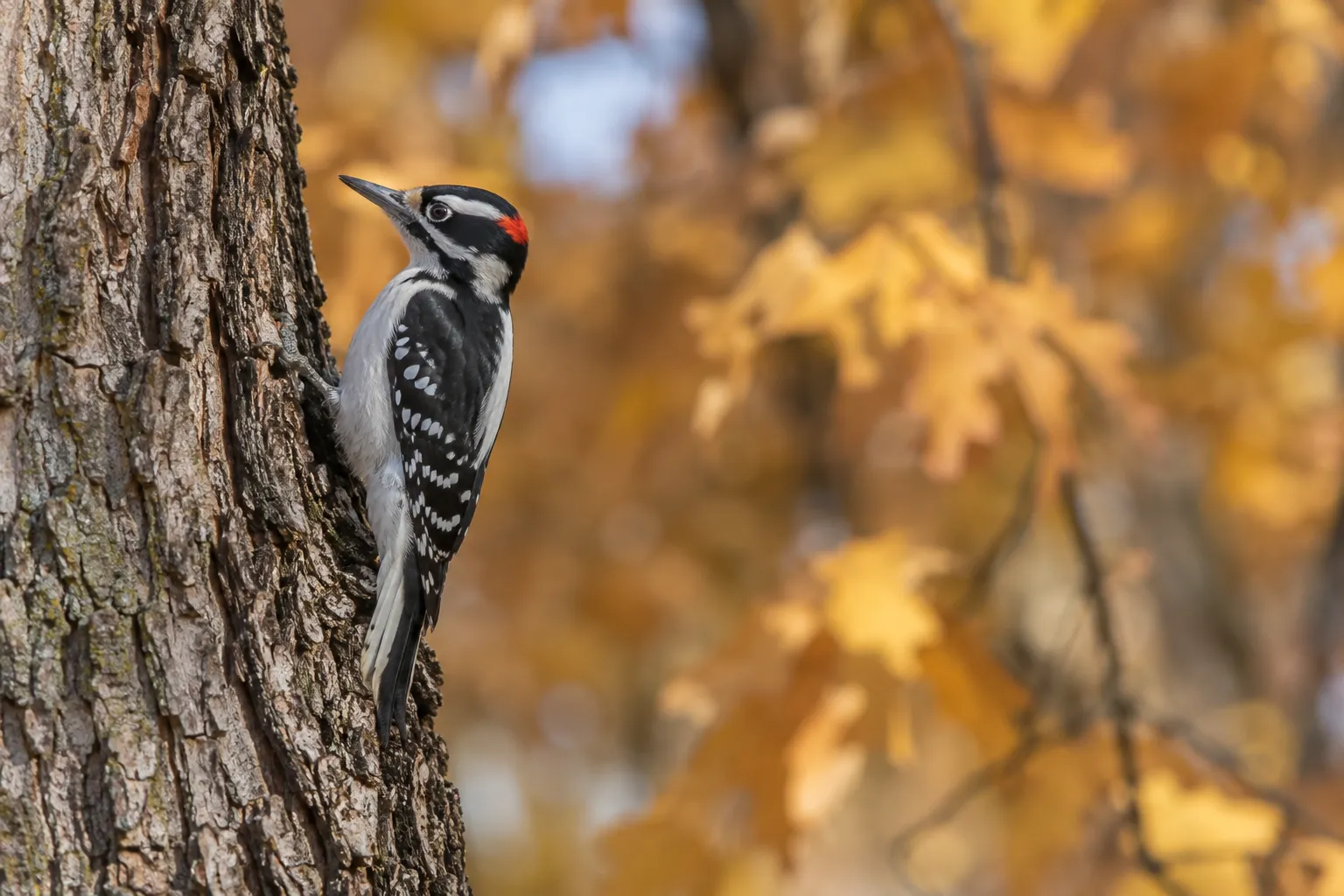
The Cornell Lab describes the hairy woodpecker as “a small but powerful bird” with a soldierly look: an erect, straight-backed posture on tree trunks and a cleanly striped head.
In eastern birds the pattern is:
- Black wings checkered with white spots.
- A broad white patch down the center of the back.
- A black-and-white head with two white stripes.
- Clean white underparts.
- Plain, unmarked white outer tail feathers.
- A long, straight, chisel-like bill.
Male vs female hairy woodpecker
- Males have a red patch at the back of the head.
- Females lack the red.
Juveniles
The Cornell Lab notes that juvenile males show a red patch on the crown in all regional populations. That red sits on top of the head rather than at the back, so a young hairy in summer can look slightly different from an adult male.
Regional variation
Hairy woodpeckers look different across the continent, which surprises many people who move or travel. According to the Cornell Lab:
- Eastern birds have heavily white-spotted wings and white underparts.
- Rocky Mountain birds have mostly black wings with little spotting.
- Pacific Northwest birds can look brownish and “coffee-stained” on the underparts and face.
If a hairy woodpecker at your feeder looks darker or dingier than the field guide picture, regional variation is the likely reason.
Hairy vs downy woodpecker: the key differences
| Feature | Hairy woodpecker | Downy woodpecker |
|---|---|---|
| Length | 7.1 to 10.2 in | 5.5 to 6.7 in |
| Weight | 1.4 to 3.4 oz | 0.7 to 1.0 oz |
| Bill length | About equal to head depth | Much shorter than head depth |
| Outer tail feathers | Plain white | White with black spots or bars |
| Main call | Loud, sharp peek | Softer pik |
| Foraging spots | Trunks and large limbs | Twigs, small branches, weed stems |
| Posture | Erect, “soldierly” | More compact and acrobatic |
Size is hard to judge on a lone bird, so use the bill first. Imagine the distance from the base of the bill to the back of the head. A hairy’s bill covers roughly all of that distance; a downy’s covers only a fraction. The outer tail feathers are the second check. For the smaller species, see our guide on how to attract downy woodpeckers.
Other similar species
The Cornell Lab lists ladder-backed woodpecker, Nuttall’s woodpecker, American three-toed woodpecker and yellow-bellied sapsucker. Ladder-backed and Nuttall’s have barred backs instead of a clean white stripe. American three-toed woodpeckers have barred flanks and a yellow cap on males. Sapsuckers show a long white wing patch.
Sounds and drumming
The Cornell Lab describes an abrupt whinny and an explosive peek call, along with energetic tapping. The peek is noticeably louder and sharper than the downy’s call, and learning it is often the fastest way to find a hairy in woods. Both species drum in late winter and spring to claim territory.
Where do hairy woodpeckers live?
Hairy woodpeckers range across most of North America, from sea level high into the mountains. Audubon describes them as mostly permanent residents. Some birds from the northern edge of the range move well south in winter, and some western mountain birds move to lower elevations. In Central America they are restricted to higher mountain forests.
Habitat
The Cornell Lab describes their core habitat as mature woodlands with medium to large trees, and notes they are equally common in coniferous, deciduous and mixed forests up to about 6,500 feet. They also use woodlots, suburbs, parks, cemeteries, forest edges, areas around beaver ponds, recently burned forest, swamps, open pine, oak and birch woodland, and orchards.
The common thread is large trees. A newer subdivision with young street trees may get downies but few hairies. An older neighborhood with big oaks, maples or pines, or a yard backing onto woods, is much more promising.
What do hairy woodpeckers eat?
The Cornell Lab states that over 75 percent of the hairy woodpecker’s diet is insects, mainly the larvae of wood-boring beetles and bark beetles, along with ants and moth pupae. They also take bees, wasps, caterpillars, spiders and millipedes. The rest is mostly fruit and seeds.
They forage along trunks and main branches of large trees, probing, scaling off bark and excavating into dead wood. Audubon notes that males tend to work more deliberately, staying longer in one spot. Unlike downies, hairy woodpeckers do not forage on the stems of weeds and wildflowers.
Two less-expected behaviors, both noted by the Cornell Lab:
- They drink sap from wells drilled in bark by sapsuckers.
- They follow pileated woodpeckers, sometimes appearing when they hear a pileated excavating and then investigating the holes it leaves. See our guide on how to attract pileated woodpeckers.
Hairy woodpeckers also help control insect outbreaks. The Cornell Lab cites codling moths in orchards as one example.
Best foods for hairy woodpeckers at feeders
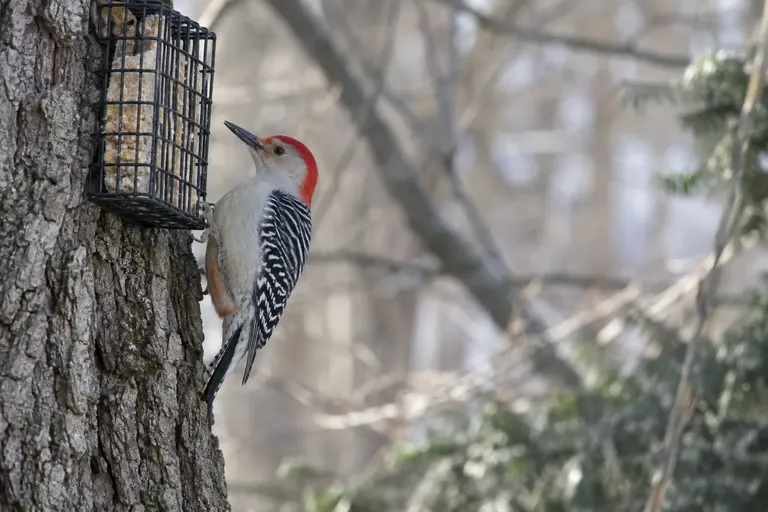
- Suet. The top choice, especially in winter. Plain rendered suet in cold weather, no-melt blends in warm months. Our roundup of the best suet cakes and suet blends covers options.
- Peanuts. Shelled peanuts or peanut pieces supply fat and protein. A mesh feeder lets the bird chip off pieces.
- Black oil sunflower seed. Taken readily from sturdy tube or hopper feeders.
Because hairy woodpeckers are heavier than downies, choose feeders with enough room and grip. A larger suet feeder with a tail prop lets them brace the way they do on a trunk.
Best feeders for hairy woodpeckers
| Feeder type | Food | Why it works for hairies | Watch out for |
|---|---|---|---|
| Tail-prop suet feeder | Suet cakes | Lets a heavier woodpecker brace naturally | Takes more space |
| Double suet cage | Suet cakes | More room and a longer feeding session | Starlings may crowd it |
| Upside-down suet feeder | Suet cakes | Woodpeckers feed from below; many other birds struggle | Some hairies take time to adjust |
| Mesh peanut feeder | Shelled peanuts | Clinging access, no whole nuts carried off | Clean regularly |
| Hopper or large tube | Black oil sunflower | Stable perch for a bigger bird | Small perches suit hairies poorly |
For specific models, see our roundup of the best suet feeders.
Where to put feeders for hairy woodpeckers
Hairy woodpeckers are warier than downies. Place feeders close to large trees, or fix a suet feeder directly to a trunk, so the bird can approach along bark and retreat quickly. Feeders far out in open lawn are less likely to attract them.
Mount feeders where they are easy to clean and refill, and think about windows. The old fixed-distance window rule is no longer considered valid by the Cornell Lab. Our guide on where to put a bird feeder explains current placement advice.
How to confirm a hairy woodpecker is visiting
Many people assume they have both species when they only have downies, or miss an occasional hairy among regular downy visitors. A simple routine helps:
- Listen before you look. A loud, sharp peek from the trees near your feeders is a strong hint that a hairy is nearby.
- Compare with a known bird. When a downy and a hairy use the same feeder, the size difference is obvious. Alone, either can fool you.
- Check the bill length against the head. This is the most dependable mark from a window.
- Look at the outer tail feathers. Plain white points to hairy; black spots or bars point to downy.
- Note the posture. Hairies tend to sit upright and still on a trunk; downies move about more on small branches and feeders.
Binoculars make the bill and tail checks far easier, even at 15 to 30 feet. Our guide to the best binoculars for watching birds from your window covers models suited to short distances indoors. If you log your sightings, a clear note on how you separated the two species makes your records more useful.
Plants and habitat for hairy woodpeckers
Protect mature trees
The most useful thing you can do for hairy woodpeckers is keep large trees healthy and standing. Big oaks, maples, hickories, beeches, pines, spruces and firs all host the bark and wood insects they eat. Planting for the future helps too, but a mature tree takes decades to replace.
Leave dead trees and dead limbs when safe
Hairy woodpeckers nest in dead stubs and dead trees, particularly those softened by heartrot. The Cornell Lab suggests leaving dead trees or dead sections standing if it is safe to do so. A dead tree that could fall on a house, a path or a power line needs professional attention, but an arborist can often reduce it to a tall, stable snag rather than removing it entirely.
Old hairy woodpecker holes are later used by other cavity nesters, from chickadees and nuthatches to small owls, so a snag supports more than one species.
Native fruiting plants
Fruit and seeds make up a minority of the diet, but they still matter in fall and winter. Choose species native to your region, such as dogwoods, serviceberry, native cherries, hollies or viburnums in the East, and region-appropriate equivalents in the West. A cooperative extension office can suggest what grows well locally.
Water
A bird bath with a shallow, gently sloping basin works for hairy woodpeckers and most other backyard species. In freezing climates, a heated bath is one of the most reliable ways to attract woodpeckers and other birds in winter. Refresh and scrub it regularly. Our winter bird feeding guide covers winter water in detail.
Hairy woodpecker nesting
According to the Cornell Lab and Audubon:
- Site: dead stubs or dead trees, particularly with heartrot. Audubon gives typical heights of 4 to 60 feet, usually in deciduous trees in the East and in aspens or dead conifers in the West.
- Entrance: about 2 inches tall by 1.5 inches wide, often on the underside of an angled branch.
- Cavity: 8 to 12 inches deep, widening at the bottom, with only wood chips as bedding.
- Excavation: both sexes dig.
- Eggs: 3 to 6 all-white eggs.
- Incubation: 11 to 12 days per the Cornell Lab; Audubon gives about 14 days.
- Nestling period: 28 to 30 days, noticeably longer than a downy’s.
- Broods: one per year.
The Cornell Lab describes courtship displays in which birds stretch out their necks, point their bills up and bob their heads, sometimes chasing each other through the trees. In conflicts they raise both wings at about a 45-degree angle and give shrill calls.
Nest boxes
Hairy woodpeckers rarely use nest boxes, and NestWatch’s birdhouse guide does not feature them. Standing dead wood is the practical way to offer nest sites. The Cornell Lab notes that European starlings compete with hairy woodpeckers for nest holes, which is another reason to avoid feeding starlings heavily near nest trees.
Seasonal calendar
| Months | What hairy woodpeckers are doing | What to do |
|---|---|---|
| January to March | Relying on feeders and bark insects; drumming starts | Keep suet and peanuts stocked; keep water open |
| April to May | Courtship, excavation and egg laying | Leave snags; avoid tree work near active nests |
| June to July | Long nestling period; families visit feeders | Use no-melt suet in heat; clean feeders often |
| August to October | Young independent; more fruit in diet | Keep fruiting shrubs; start restocking suet |
| November to December | Feeder use rises | Offer suet, peanuts and sunflower consistently |
Common problems and fixes
“I only ever get downies”
Your yard may lack large trees, or feeders may be too exposed. Move suet closer to big trunks, add a peanut feeder, and be patient through winter. Hairy woodpeckers are generally less numerous than downies, so fewer sightings are normal.
Starlings empty the suet
Try an upside-down suet feeder, which many starlings find awkward. Our guide to keeping starlings and grackles off feeders covers other fixes.
Drumming on the house
In late winter and spring, drumming on siding or metal is usually territorial. It typically stops once nesting begins. Temporary netting or flashing over the favored spot may help. Real holes in wood can signal insects inside, so check.
Suet spoils in warm weather
Use no-melt blends, smaller portions and shade. Discard anything rancid or moldy.
Common mistakes when attracting hairy woodpeckers
- Placing feeders far from trees. Hairies are warier than downies and prefer a short, covered approach.
- Using feeders that are too small. A heavy woodpecker needs room to brace.
- Taking down every dead tree. Safe snags are their nest sites.
- Stopping suet in spring. Adults feeding young still use it; switch to no-melt instead.
- Assuming every large “downy” is a hairy. Check the bill and tail feathers before counting it.
Sources
Frequently asked questions
What attracts hairy woodpeckers to a yard?
Mature trees and winter food. The Cornell Lab recommends suet, peanut and black oil sunflower feeders, especially in winter when natural food is scarce, and suggests leaving dead trees or dead limbs standing when it is safe. Hairy woodpeckers are birds of medium to large trees, so yards near woodlots, parks or wooded streams have the best odds.
Is it a hairy or a downy woodpecker?
Check the bill first. A hairy woodpecker's bill is long and chisel-like, about as long as the head is deep; a downy's is short and stubby. Hairy woodpeckers also have plain white outer tail feathers, while downies usually show black spots there. Hairy woodpeckers are about one-third larger, 7.1 to 10.2 inches long compared with 5.5 to 6.7 inches.
Are hairy woodpeckers rarer than downy woodpeckers?
They are common and widespread, but usually less numerous at feeders. Partners in Flight, cited by the Cornell Lab, estimates about 8.9 million hairy woodpeckers compared with about 13 million downies. Hairy woodpeckers also need larger trees and are less at home in open suburbs, so many backyard birders see downies far more often.
Do hairy woodpeckers use nest boxes?
Rarely. Hairy woodpeckers excavate their own cavities, typically in dead stubs or trees softened by heartrot, with an entrance about 2 inches tall and 1.5 inches wide. NestWatch's birdhouse guide does not feature them as a nest box species. Leaving safe dead trees and large dead limbs standing is the most reliable way to offer nest sites.
Do hairy woodpeckers stay all winter?
Yes, in most areas. Audubon describes them as mostly permanent residents. Some birds from the far north may move well south in winter, and some from western mountains move to lower elevations. Winter is when they are most likely to use feeders, since suet and sunflower replace the insects that are harder to find in cold weather.