Bird Seed Catcher Trays: Stop the Mess and the Rats
The best bird seed catcher for most tube feeders is a matched clip-under tray. Compare seed hoops and pole trays, and how to keep rats and disease away.
If you buy through links on this page we may earn a commission, at no cost to you. It never decides what we recommend. How we earn
In this article
- Quick picks
- How we chose
- Why rats under feeders are the real problem
- Droll Yankees Omni Seed Tray: best bird seed catcher overall
- Songbird Essentials Seed Hoop: best universal seed hoop
- Brome Seed Buster Seed Catcher Tray: best seed catcher tray for pole
- Brome Tube Solution Seed Tray: best for Brome tube feeders
- Aspects 050 Round Seed Tray: best for Aspects feeders
- Comparison table
- Do seed catchers attract rats?
- Seed hoop, clip-on tray or pole tray: which bird feeder tray catcher should you get?
- How do you fit and position a bird seed catcher?
- How do you clean a seed tray?
- Are seed catcher trays safe for birds?
- What are the alternatives to a bird seed catcher?
- Seed tray not working? Common problems and fixes
- Common mistakes with seed catchers
- Sources
- Frequently asked questions
The best bird seed catcher for most tube feeders is a tray made for that exact feeder, and our top pick is the Droll Yankees Omni Seed Tray. It screws to the base of Droll Yankees tube feeders, catches the hulls and seed birds drop, and stops a pile from building up where rats and mice feed at night. A tray only helps if you empty it daily, though. In the UK, the RSPB now advises against seed-catching trays altogether, so read the hygiene section before you buy.
Quick picks
- Best overall: Droll Yankees Omni Seed Tray. 10.5 in polycarbonate, threaded plug, fits most Droll Yankees tubes.
- Best universal seed hoop: Songbird Essentials Seed Hoop. 16 in mesh on four cords, fits almost any feeder.
- Best for pole mounting: Brome Seed Buster Seed Catcher Tray. 20 in resin tray with drainage on the perch.
- Best for Brome tube feeders: Brome Tube Solution Seed Tray. 11 in, sloped base with drain holes.
- Best for Aspects feeders: Aspects 050 Round Seed Tray. 8.5 in, fits 2.75 in Aspects tubes.
Droll Yankees Omni Seed Tray
A clear 10.5 in polycarbonate tray that attaches under Droll Yankees tube feeders with an included threaded plug, no tools needed.
- Best for
- Droll Yankees tube feeders that drop a lot of hulls and mixed seed.
- Skip it if
- Your tube feeder is from another brand with a different base.
- Diameter
- 10.5 in (27 cm)
- Material
- UV-stabilized polycarbonate
- Fits
- Droll Yankees Classic, Onyx Clever Clean, New Generation, Ring Pull, Bird Lovers
- Mounting
- Threaded plug under feeder; pole adapter sold separately
Songbird Essentials Seed Hoop
A 16 in mesh hoop on a steel frame that hangs under almost any feeder on four adjustable cords with hooks.
- Best for
- Hopper, cage and odd-shaped feeders that have no matching tray.
- Skip it if
- Your feeder hangs in strong wind, where a corded hoop swings and tips seed.
- Size
- 16 in (41 cm); 24 in version SEIA30024
- Material
- Vinyl-coated fiberglass mesh, tempered steel frame
- Mounting
- 4 adjustable nylon cords, 36 in, with hooks
Brome Seed Buster Seed Catcher Tray
A wide 20 in black resin tray that clamps onto a feeder pole with two adjustable collars and a wraparound perch with drainage.
- Best for
- A pole station with several feeders that drop seed over a wide area.
- Skip it if
- Your pole is not one Brome or the retailer lists as compatible.
- Diameter
- 20 in (51 cm)
- Material
- Black resin
- Mounting
- Pole collars; Brome lists the BirdsUP Single Pole
- Drainage
- Wraparound perch with built-in drainage
Brome Tube Solution Seed Tray
An 11 in clear tray with a sloped, drained base that hangs from Brome Tube Solution feeders without tools.
- Best for
- Owners of Brome Tube Solution feeders who want a tray that fits exactly.
- Skip it if
- You use a Squirrel Buster model; Brome says it is not compatible.
- Diameter
- 11 in (28 cm), 1.25 in deep
- Material
- Clear plastic, UV resistant
- Fits
- Brome Tube 100, 150 and 200 only
- Drainage
- Drain holes on a sloped base
Aspects 050 Round Seed Tray
A compact 8.5 in polycarbonate tray made to fit all Aspects feeders with a 2.75 in tube.
- Best for
- Small yards and patios with an Aspects tube feeder.
- Skip it if
- You need to catch seed from a big feeder or a busy flock.
- Diameter
- 8.5 in (22 cm), 1 in deep
- Material
- UV-stabilized polycarbonate
- Fits
- Aspects feeders with a 2.75 in diameter tube
How we chose
We haven’t fitted these trays in our own yard yet. This guide is research-based. We compared manufacturer and retailer specifications for diameter, material, drainage, mounting and which feeders each tray fits, and we confirmed each model is listed on Amazon. We read feeder and hygiene guidance from Project FeederWatch, the Cornell Lab of Ornithology, the RSPB, the BTO and Germany’s NABU, and looked for consistent patterns in verified owner reviews, especially fit problems, wobbling, standing water and rats. We gave extra weight to trays that drain, come apart easily for cleaning and fit a specific feeder securely, because a tray that tips or holds water causes more problems than it solves.
Why rats under feeders are the real problem
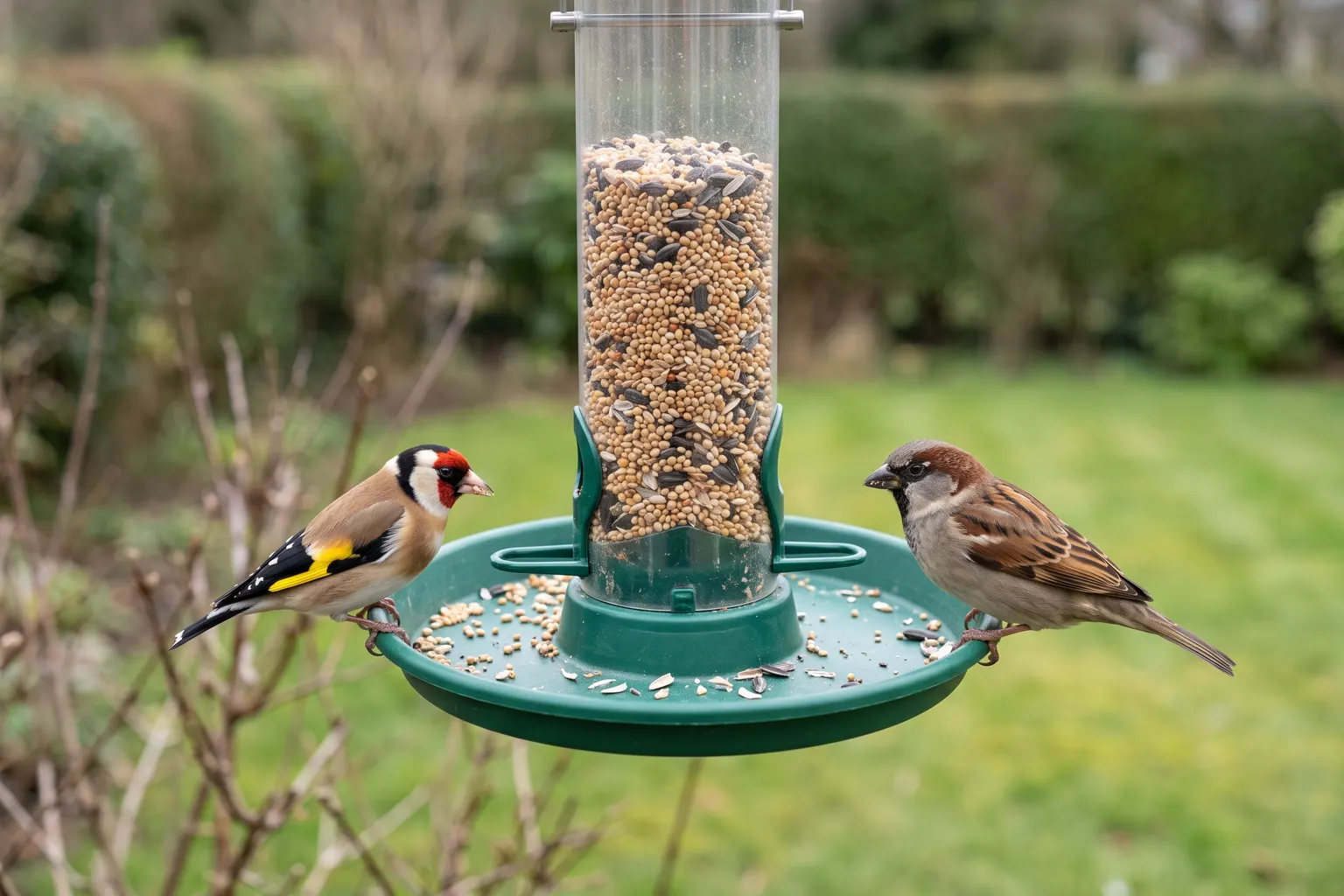
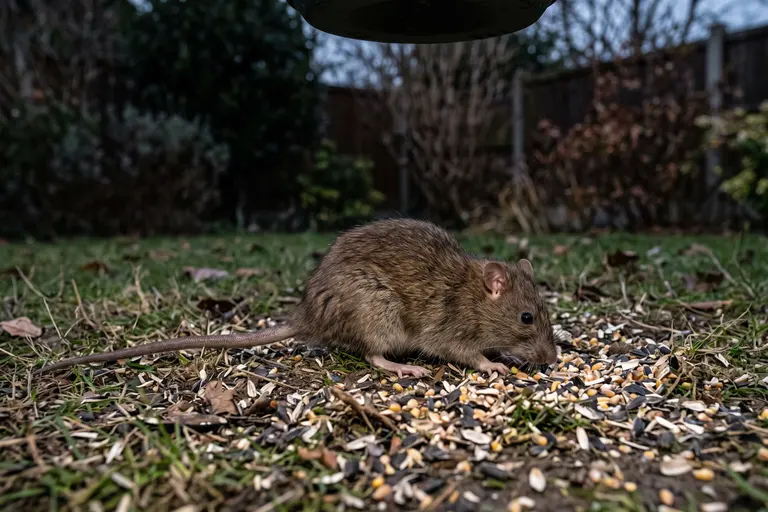
Most people shopping for a seed catcher are not worried about a few hulls. They have seen a rat. Birds are messy eaters. They flick out seeds they don’t want, drop hulls and knock food off perches, and our guide to why birds throw seed out of the feeder explains why. All of that lands under the feeder.
Project FeederWatch warns that bird food scattered on the ground can attract rodents, and advises raking or sweeping below feeders regularly and moving feeders now and then so waste doesn’t build up. The RSPB gives the same message: clear debris from underneath and don’t let seed accumulate on the ground. In Germany, NABU recommends fitting catch trays that rats cannot reach under feeders, and removing leftover food below feeding spots every day. The LBV in Bavaria says dropped food should be caught with trays or similar, and that feeding should stop for a while if rats or mice appear.
A tray also solves smaller problems. Hulls from sunflower seed can kill the grass under a feeder, sprouted seed grows weeds, and patios get sticky. A catcher keeps the mess in one place you can empty.
There is a catch. A tray is a flat surface, and flat surfaces collect droppings and wet seed. That is why the RSPB changed its advice in 2026. We cover that trade-off in full below.
Droll Yankees Omni Seed Tray: best bird seed catcher overall
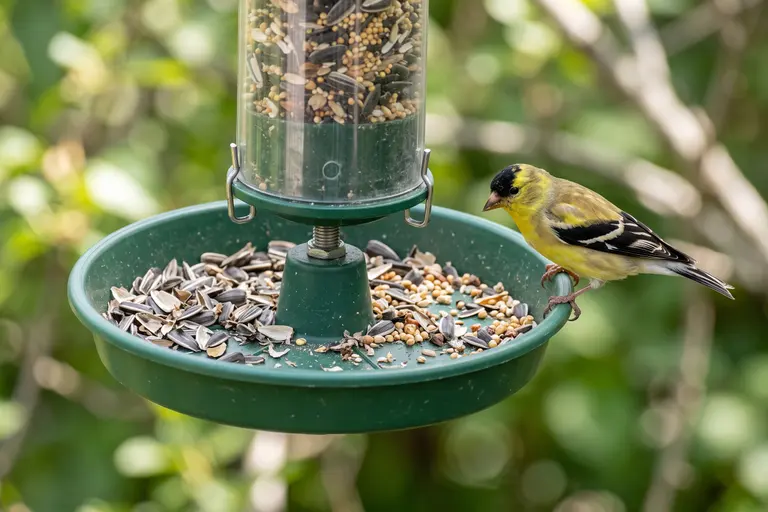
What it is: A round, clear tray for Droll Yankees tube feeders. The maker lists a diameter of 10.5 in (27 cm) and UV-stabilized polycarbonate that won’t yellow with age. It fits the Classic, Original Onyx Clever Clean, New Generation, Ring Pull and Bird Lovers feeders.
Why it stands out: Fit. It attaches to the feeder base with an included threaded plug, so it can’t swing or tip like a hanging tray. Droll Yankees sells a Wing Nut for faster removal when you clean it, a Pole Adapter if you want to mount the feeder on a 1 in pole, and a Suet Link to hang suet below. Birds that prefer to feed flat, such as cardinals, also get a place to land.
Owner patterns: Owners mostly praise how much less seed ends up on the ground, and that the clear tray doesn’t hide the birds. The recurring caution is cleaning: the maker’s page does not mention drain holes, so seed can sit in rainwater. Plan to tip it out after every shower.
Key specs: 10.5 in, UV-stabilized polycarbonate, threaded plug mount, fits most Droll Yankees tubes.
- Best for: Droll Yankees tube feeders. See our tube bird feeder guide if you are choosing a feeder first.
- Skip it if: Your tube is from another brand. Check the base before you buy.
See available listings on Amazon
Songbird Essentials Seed Hoop: best universal seed hoop
What it is: A seed hoop bird seed catcher: a round mesh net on a hoop, hung below the feeder. Retail listings give the 16 in (41 cm) model as vinyl-coated fiberglass mesh on a tempered steel wire frame, with four adjustable 36 in nylon cords and corrosion-resistant hooks. A 24 in version (SEIA30024) has six hooks and cords that reach up to 40 in.
Why it stands out: It adapts to nearly any feeder, including hoppers, cage feeders and peanut feeders that have no matching tray. The mesh lets rain through, so seed dries faster than in a solid dish. It also works as a hanging platform feeder on its own.
Owner patterns: In verified reviews, owners like that it fits feeders other trays don’t. Two complaints come up: some hooks need pliers to close securely, and one owner found it would not fit a flat feeder about as wide as the hoop. On windy sites a corded hoop can swing and spill.
Key specs: 16 in mesh (24 in available), steel frame, four 36 in adjustable cords.
- Best for: Odd-shaped feeders and anyone without a branded tray option.
- Skip it if: Your feeder hangs in a windy, exposed spot.
See available listings on Amazon
Brome Seed Buster Seed Catcher Tray: best seed catcher tray for pole
What it is: A large pole-mounted catch tray. Duncraft lists a 20 in (51 cm) diameter in durable black resin, a two-piece design with adjustable collars, large thumb screws for tool-free assembly and a wraparound perch with built-in drainage.
Why it stands out: Size. A 20 in tray catches seed from more than one feeder on a station pole. The collars come off for cleaning without taking the pole apart, which matters if you scrub it weekly. On a pole with a good baffle below, rats have no easy route to the tray.
Owner patterns: Owners report a clear drop in seed on the lawn and more ground-feeding birds using the tray. The point to check before buying is the pole: Brome’s own listing says it requires a BirdsUP Single Pole, while Duncraft lists it for 7/8 to 1 in poles. Measure yours.
Key specs: 20 in, black resin, adjustable pole collars, drainage built into the perch.
- Best for: Feeding stations. Our guide to bird feeder poles and baffles covers the hardware.
- Skip it if: You hang feeders from a branch or hook.
See available listings on Amazon
Brome Tube Solution Seed Tray: best for Brome tube feeders
What it is: An add-on tray for Brome’s Tube Solution feeders. Duncraft lists an 11 in (28 cm) diameter, 1.25 in depth and clear plastic. Brome says it only works with Tube 100, 150 and 200.
Why it stands out: Drainage. The base slopes toward the edge and has drain holes, so seed stays drier longer than in a flat dish. It installs by hand without tools, and Brome describes it as chew proof and easy to clean.
Owner patterns: Owners like the exact fit and the extra perching room. The main source of returns is compatibility: it does not fit Brome’s Squirrel Buster range, and Brome says so on the listing.
Key specs: 11 in, 1.25 in deep, clear plastic, sloped drained base, Tube 100, 150 and 200 only.
- Best for: Brome Tube Solution owners.
- Skip it if: You own a Squirrel Buster, or any other brand.
See available listings on Amazon
Aspects 050 Round Seed Tray: best for Aspects feeders
What it is: A small clip-on tray for Aspects tube feeders. The listing gives 8.5 in (22 cm) diameter, 1 in depth and UV-stabilized polycarbonate. It fits all Aspects feeders with a 2.75 in diameter tube.
Why it stands out: It is the right size for a patio. A small tray fills less, so less food sits around to spoil or attract mice, and it lifts off quickly for cleaning. It also gives birds extra perching space.
Owner patterns: Owners value how easily it comes off. The trade-off is reach: an 8.5 in tray catches less of what birds flick away than a hoop or pole tray.
Key specs: 8.5 in, 1 in deep, UV-stabilized polycarbonate, fits 2.75 in Aspects tubes.
- Best for: Small yards and Aspects tube feeders.
- Skip it if: Big flocks empty your feeder and scatter seed widely.
See available listings on Amazon
Comparison table
| Seed catcher | Type | Diameter | Material | Drainage | Fits |
|---|---|---|---|---|---|
| Droll Yankees Omni Seed Tray | Clip-under tray | 10.5 in | Polycarbonate | Not listed | Most Droll Yankees tubes |
| Songbird Essentials Seed Hoop | Hanging mesh hoop | 16 in (24 in option) | Coated mesh, steel frame | Mesh | Almost any feeder |
| Brome Seed Buster | Pole tray | 20 in | Black resin | Built into perch | BirdsUP pole (check yours) |
| Brome Tube Solution Seed Tray | Clip-under tray | 11 in | Clear plastic | Drain holes, sloped | Brome Tube 100, 150, 200 |
| Aspects 050 Round Seed Tray | Clip-under tray | 8.5 in | Polycarbonate | Not listed | Aspects 2.75 in tubes |
Do seed catchers attract rats?
A seed catcher reduces rats only when rats can’t reach it and it is empty by dusk. Otherwise it becomes a raised feeding table for them. Rats climb well, and a tray full of seed overnight is an easy meal.
That is why NABU specifically recommends catch trays that rats cannot reach. In practice that means:
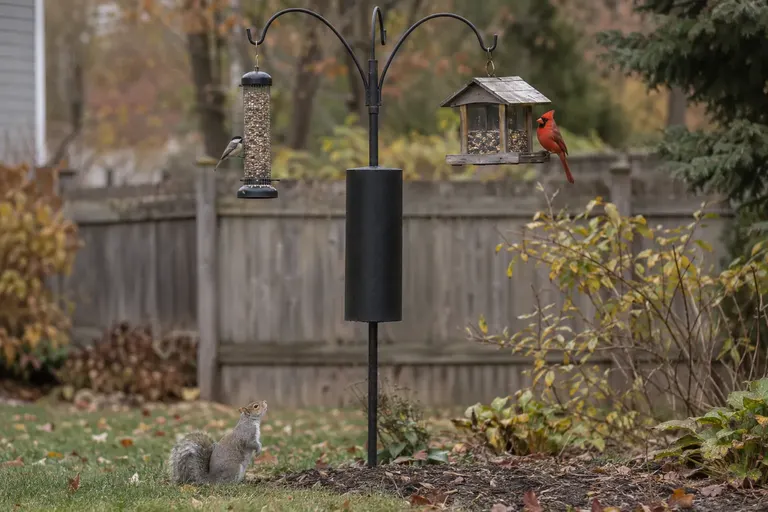
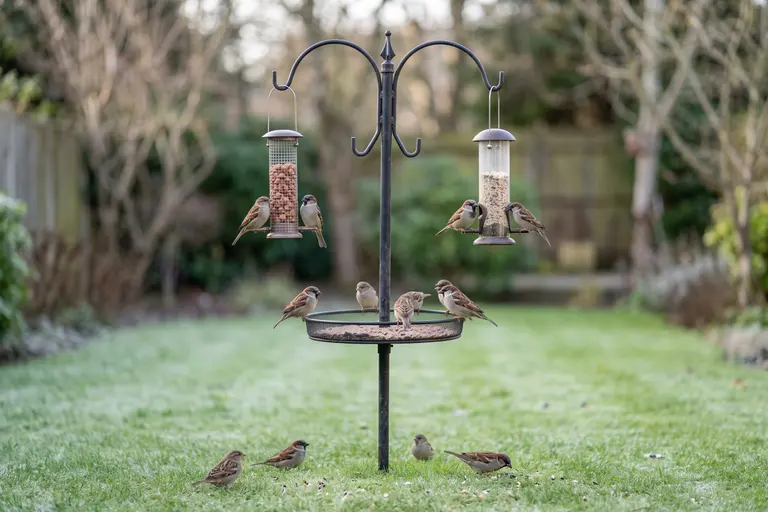
- Mount on a pole with a baffle below the tray, away from fences, walls and shrubs.
- Empty the tray every evening. Feed amounts birds finish during the day. The LBV advises filling open feeders only so far that they are eaten empty by dusk.
- Stop feeding for a few weeks if rats are already visiting, as the LBV and our full guide to keeping rats away from bird feeders both recommend.
Seed hoop, clip-on tray or pole tray: which bird feeder tray catcher should you get?
Choose by feeder and mounting, not by tray. A seed catcher for a bird feeder only works if it sits close and stays level.
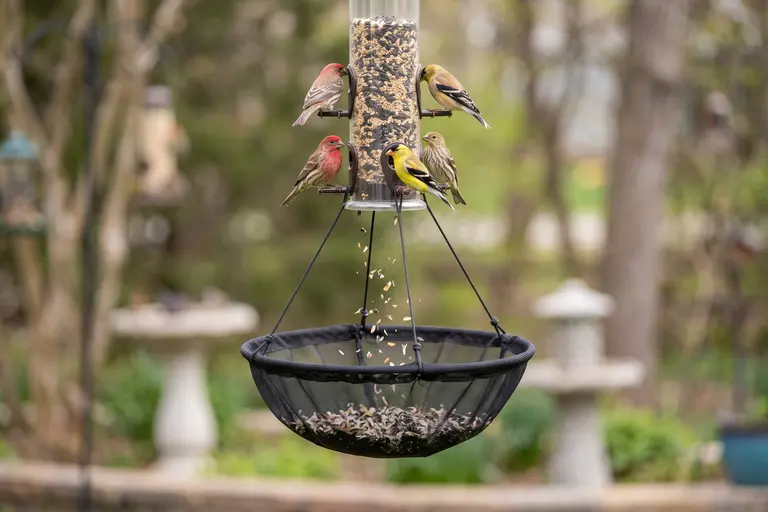
- Clip-on tray (bird seed catcher tray): best for branded tube feeders. It fixes to the base, can’t swing, and lifts off for cleaning. Buy the maker’s own tray for your feeder.
- Seed hoop: best for hoppers, cage feeders and anything without a matching tray. Hang it 4 to 8 in (10 to 20 cm) below the feeder so it catches flicked seed.
- Pole tray: best for a multi-feeder station. The bigger the tray, the more it catches, and the more you have to clean.
Bigger is not always better. A wide open tray works like a platform feeder, drawing doves, starlings and squirrels. If those are a problem, a small tray right under the ports is the better choice.
How do you fit and position a bird seed catcher?
Fit the tray so it sits tight under the ports, then place the whole setup where rats and squirrels can’t reach it.
- Attach the tray before you hang the feeder. For the Droll Yankees Omni Seed Tray, Perky-Pet’s instructions say to screw the tray to the feeder base with the included threaded black plug. Swap in the optional Wing Nut if you want to remove the tray without tools on cleaning day, or use the Pole Adapter to put feeder and tray on a pole.
- Hang a seed hoop close. Set the cords so the hoop sits 4 to 8 in (10 to 20 cm) under the lowest port. Lower than that and flicked seed sails past the rim.
- Pick the spot. Project FeederWatch says about 10 feet (3 m) from shrubs or trees is a good compromise: close enough for cover, far enough that squirrels and cats can’t jump across.
- Add a baffle. The Cornell Lab recommends a squirrel baffle on the support of tray-style feeders, because open trays draw squirrels, chipmunks and raccoons. On a pole, the baffle goes below the tray.
UK readers: the RSPB now advises against seed-catching trays, so skip this setup and see the safety section below.
How do you clean a seed tray?
Empty a seed tray daily and scrub it at least once a week. Trays need more care than the feeder above them, because droppings and wet seed collect there.
- Tip out the tray every day, ideally in the evening, and bin anything wet or clumped.
- Scrub weekly with hot soapy water and a brush, more often in wet weather. The RSPB advises cleaning feeders at least once a week.
- Disinfect. Project FeederWatch suggests a 10-minute soak in one part bleach to nine parts water, then a thorough rinse.
- Dry completely before refitting.
- Wear gloves and clean outdoors, away from kitchen sinks.
The Cornell Lab notes that moldy or decomposing seeds and hulls that build up on feeder trays can make birds sick. Our step-by-step guide to cleaning bird feeders covers every feeder type.
Are seed catcher trays safe for birds?
They carry a real disease risk, and in the UK the advice is now not to use them. In April 2026 the RSPB’s Will Peach said: “Flat feeder surfaces such as seed-catching trays and bird tables should no longer be used,” because they can retain regurgitated, damp food and bird faeces. The BTO lists the troughs on the bottom of some hanging feeders among flat surfaces that appear to carry a higher risk of onward transmission and are best avoided. Both link this to finch trichomonosis, which has driven steep Greenfinch declines in Britain.
The RSPB also now asks UK feeders to pause seeds and peanuts from 1 May to 31 October, and to clean and move feeders weekly.
Project FeederWatch in North America makes a similar point: tray feeders collect bird droppings that later birds eat, so consider removing trays if you see sick birds. Our guide to sick birds at the feeder explains the signs.
Our honest take: in North America and continental Europe, where NABU and Vogelbescherming Nederland still recommend catch trays against rats, a small tray that you empty daily and disinfect weekly is a reasonable trade-off. In the UK, follow the RSPB and skip the tray.
What are the alternatives to a bird seed catcher?
The best alternative is food that leaves nothing behind. No-mess bird seed, such as hulled sunflower hearts or no-waste blends, has no hulls and fewer seeds birds reject. Project FeederWatch notes hulled seed reduces debris under feeders but spoils faster, so keep it dry.
Other options:
- Move the feeder every week or two so waste never builds up in one spot. Both Project FeederWatch and the RSPB recommend it. Our guide on where to put a bird feeder helps you pick new spots.
- Rake or sweep the ground under the feeder regularly.
- Skip filler mixes. Milo, wheat and oats get kicked out and feed rodents.
- Hang feeders over a hard surface such as paving, so spills are easy to sweep up.
Seed tray not working? Common problems and fixes
Most seed catcher problems come down to water, the wrong visitors or too much food. The Cornell Lab’s advice on tray-style feeders covers all three: seed in an open tray gets wet and can sprout, mold or spoil, and a wide tray draws pigeons, starlings, House Sparrows and grackles that can crowd out smaller birds.
| Problem | Likely cause | Fix |
|---|---|---|
| Seed is soggy or moldy | Solid tray with no drainage | Tip it out after rain; choose a drained or mesh design. The Cornell Lab says a screened bottom drains better than a solid one |
| Tray is full every morning | Too much seed in the feeder | Fill less. The RSPB suggests putting out only what birds eat in a day or two |
| Pigeons and starlings take over | Tray is large and open | Use a smaller tray right under the ports |
| Squirrels sit in the tray | Tray works as a landing deck | Add a baffle and move the feeder away from jump-off points |
| Rats or mice visit at night | Seed left after dark, or a climbable pole | Empty by dusk, baffle the pole, pause feeding if rats stay |
Wet seed is the problem to take most seriously, because it is also a hygiene problem. The Cornell Lab advises offering only a couple of days’ worth of seed on tray-style feeders, then cleaning and restocking. If birds ignore the tray altogether, our guide to birds not coming to the feeder covers the usual reasons.
Common mistakes with seed catchers
- Leaving seed in the tray overnight. This feeds rats and mice.
- Not cleaning it. A dirty tray is worse for birds than spilled seed on grass.
- Buying the wrong fit. Most clip-on trays only fit their own brand.
- Adding a tray to a squirrel-proof feeder. It can give squirrels a perch to reach the ports.
- Ignoring local advice. UK readers should follow the RSPB’s 2026 guidance on flat surfaces.
Sources
- Project FeederWatch: Feeding birds FAQs
- Cornell Lab of Ornithology, All About Birds: How to clean your bird feeder
- Cornell Lab of Ornithology, All About Birds: How to choose the right kind of bird feeder
- RSPB: Small change, big impact, how to feed your garden birds
- RSPB: All about bird feeding
- BTO: Seasonal advice for feeding garden birds, FAQs
- NABU: Vogelfütterung
- Droll Yankees Omni Seed Tray instructions (Perky-Pet)
- Duncraft: Brome Seed Buster Seed Tray and Catcher
- Duncraft: Brome Tube Solution Seed Tray

Frequently asked questions
Do bird seed catchers really reduce rats?
They help if the tray is out of reach and emptied before dark. Project FeederWatch notes that bird food scattered on the ground can attract rodents, and Germany's NABU recommends catch trays that rats cannot reach. A tray left full overnight, or one a rat can climb to, simply moves the buffet off the ground, so pair it with a baffle and daily emptying.
How often should you clean a seed catcher tray?
Empty it every day and scrub it at least weekly. Trays collect droppings and wet seed faster than tube feeders, and the RSPB advises cleaning feeders at least once a week. Project FeederWatch suggests soaking clean parts for 10 minutes in one part bleach to nine parts water, then rinsing and drying fully before refitting.
Does the RSPB recommend seed catching trays?
No. In April 2026 the RSPB said flat feeder surfaces such as seed-catching trays and bird tables should no longer be used, because they can hold regurgitated, damp food and droppings that spread disease. The BTO lists troughs under hanging feeders among flat surfaces that are best avoided. UK readers should use no-mess food and clean ground instead.
Will a seed tray stop squirrels?
No, and it can make things worse. A tray gives squirrels a place to sit, and on weight-activated feeders it can let them reach the ports without touching the perch. Brome says its Tube Solution tray is not compatible with its squirrel-proof models for this reason. Use a baffle on the pole and place the feeder away from jump-off points.
What is the best alternative to a seed catcher?
Switch to no-mess food. Hulled sunflower hearts and no-waste blends leave no hulls and far less dropped seed, so there is less to catch. Project FeederWatch notes that hulled seed reduces debris under feeders but spoils faster, so keep it dry. Also rake under the feeder and move it now and then, as FeederWatch advises.