Nyjer Seed for Birds: Who Eats It and How to Keep It Fresh
Nyjer seed is a tiny, oily seed that goldfinches, siskins and redpolls love. Which birds eat it, why finches ignore old nyjer, and how to feed it well.
In this article
- Quick answer: is nyjer seed worth buying?
- What is nyjer seed?
- Which birds eat nyjer seed?
- Do goldfinches prefer nyjer or sunflower hearts?
- Why are finches not eating my nyjer?
- How do you store nyjer seed?
- What feeder do you need for nyjer?
- Should you buy straight nyjer or a finch mix?
- Is nyjer seed safe? Heat treatment, weeds and chemicals
- How do you keep a nyjer feeder clean?
- When should you feed nyjer seed?
- How can you attract more goldfinches without more seed?
- Common mistakes with nyjer seed
- Sources
- Frequently asked questions
Nyjer seed is a tiny, black, oil-rich seed from an African daisy-family plant, sold as bird food for small finches. Goldfinches, siskins and redpolls eat it eagerly from feeders with very small ports, while larger seed-eaters mostly ignore it. It works best fresh, dry and on its own, not mixed into cheap blends.
Quick answer: is nyjer seed worth buying?
Nyjer seed is worth buying if you want goldfinches, siskins or redpolls and you will keep it fresh. It is a poor buy if it sits in a feeder for weeks or if your garden is visited mostly by sparrows, doves or jays.
- Best for: American and Lesser Goldfinches, Pine Siskins and Common Redpolls in North America; European Goldfinches, Siskins and redpolls in Europe.
- Ignored by: most heavy-billed birds, including cardinals, grosbeaks, jays and many sparrows.
- Feeder: a tube with tiny ports or a fine mesh feeder. A standard seed tube spills it.
- Main mistake: buying a big bag and letting it go stale. Dry, dull nyjer is left untouched.
- Season: in Europe, mid-November to the end of March fits national advice; in North America it is fed year round, with extra cleaning in warm weather.
If you want one seed that feeds almost everything, black oil sunflower is still the safer base food. Nyjer is a specialist add-on.
What is nyjer seed?
Nyjer is the seed of Guizotia abyssinica, a yellow-flowered plant in the daisy family (Asteraceae). It was first cultivated in the Eritrean and Ethiopian highlands and is grown commercially in Africa, India and parts of Southeast Asia. Audubon reports that seed for American feeders comes mainly from India and Ethiopia.
In those countries the plant is an oil crop first. The seed yields roughly 30 to 35 percent of its weight in oil, and the oil is used for cooking. Wikipedia’s nutrition table lists oil at 30 to 40 percent, protein at 10 to 25 percent and fiber at 10 to 20 percent of the seed. Audubon puts that oil content in the same range as black oil sunflower seed, which explains why such a small seed is worth a bird’s time.
The seeds themselves are slim, black and needle-like, much smaller than a sunflower seed. Cornell’s seed guide describes them as tiny and black. That size is the whole story of nyjer at the feeder: a narrow-billed finch can work it, a big-billed bird gets little for its effort, and a normal feeder port lets it pour straight out.
Nyjer, niger, thistle: why so many names?
The same seed is sold under several names:
| Name on the bag | Where you see it | What it means |
|---|---|---|
| Nyjer | US and UK packs | Trade name registered by the Wild Bird Feeding Institute in 1998 |
| Niger or nyger | UK, Europe, older US packs | The older common name of the crop |
| Thistle seed | Older US packs and shop shelves | A marketing name; the seed is not from a thistle |
| Nigersaat, graines de niger, nigerzaad | Germany, France, Netherlands and Belgium | Local names for the same seed |
Audubon explains that the seed reached American feeders in the early 1960s as “niger” and was then often sold as thistle to link it with a plant finches already visit. Project FeederWatch is direct about it: nyjer is not related to North American thistles. If a bag says thistle seed and shows tiny black seeds, it is nyjer.
Which birds eat nyjer seed?
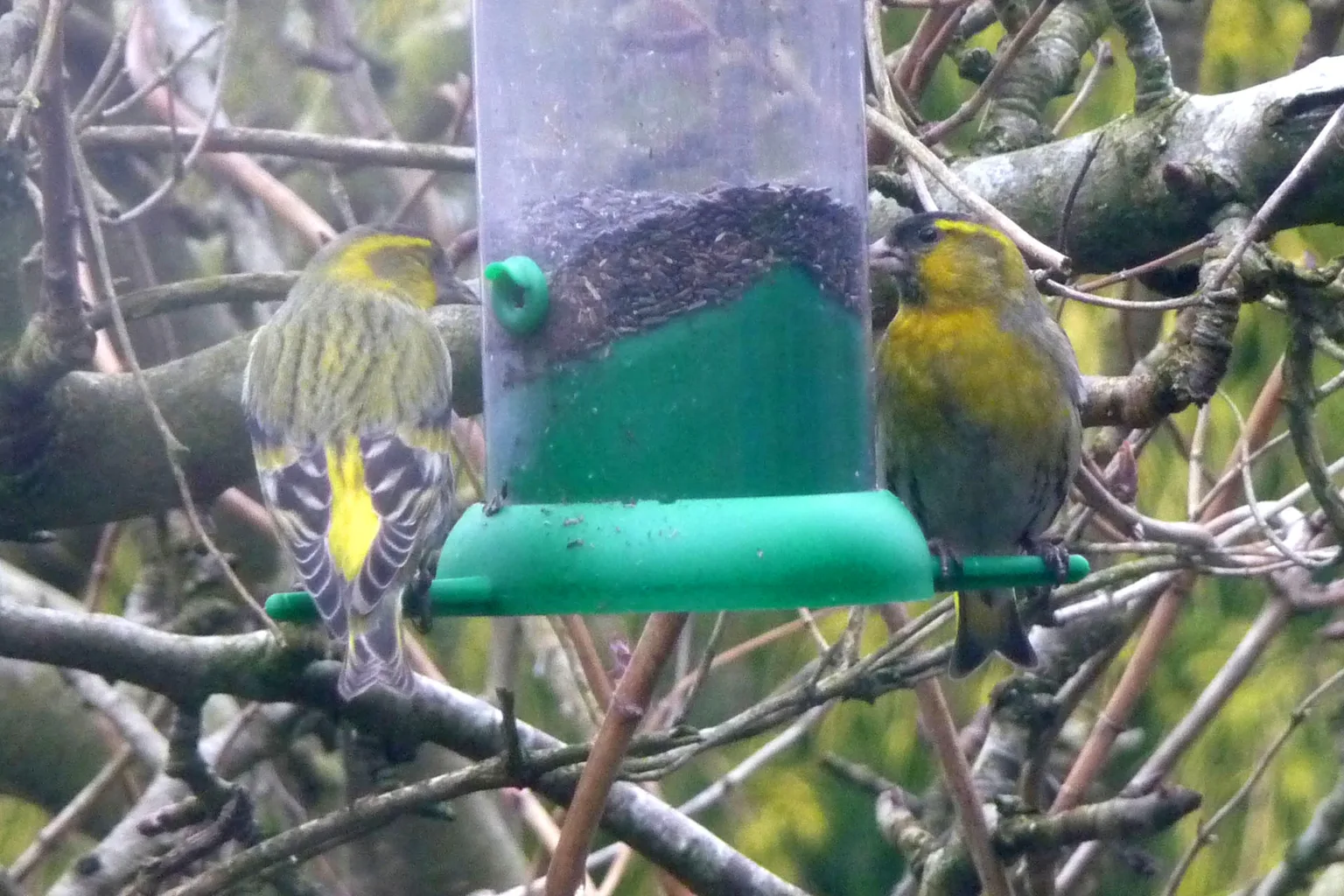
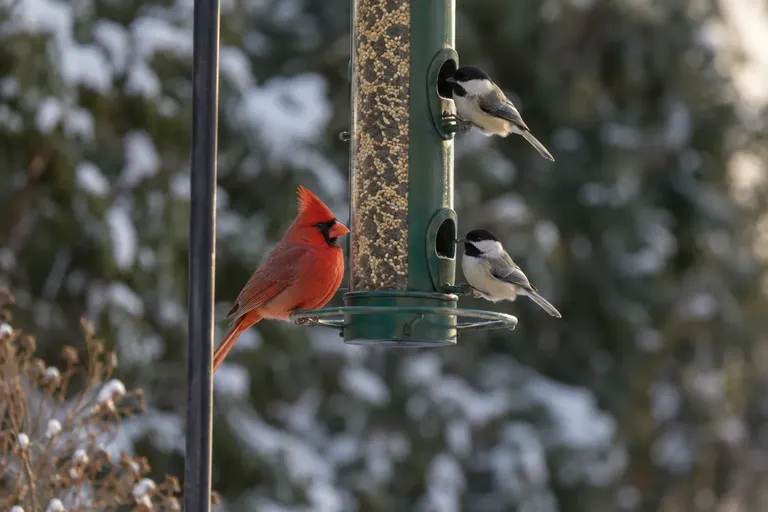
Small finches with fine, pointed bills eat nyjer most. Cornell’s All About Birds lists American Goldfinches, Lesser Goldfinches, Indigo Buntings, Pine Siskins and Common Redpolls as frequent eaters, and Project FeederWatch names American Goldfinch, Pine Siskin and Common Redpoll.
| Bird | Region | How much it uses nyjer |
|---|---|---|
| American Goldfinch | North America | Heavy user; the classic nyjer bird |
| Lesser Goldfinch | Western US | Frequent user |
| Pine Siskin | North America | Frequent user, often in irruption winters |
| Common Redpoll | Northern North America and Europe | Frequent user when present |
| European Goldfinch | Europe, introduced elsewhere | Frequent user, especially young birds |
| Eurasian Siskin | Europe | Frequent user in winter |
| European Greenfinch | Europe | Regular user |
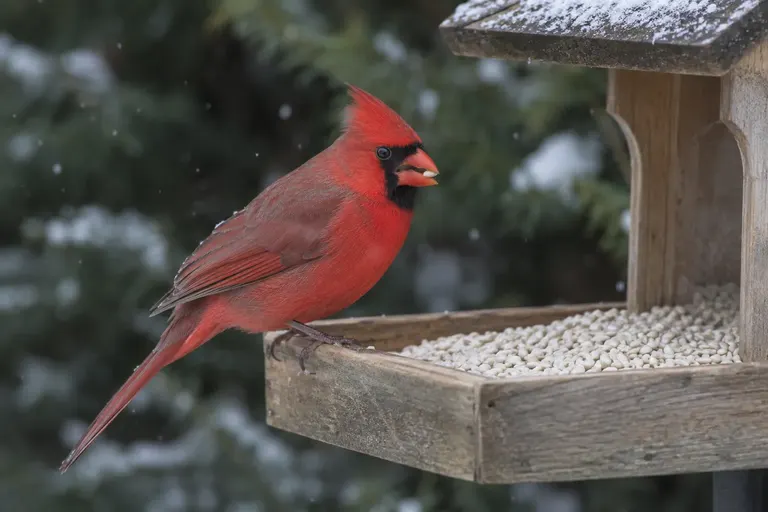
| Northern Cardinal, jays, doves | Both | Rarely interested |
For readers in Europe, the takers change but the pattern holds. Wikipedia notes that nyjer is a favorite of goldfinches and greenfinches and that in the UK it attracts finches and siskins. Vogelbescherming Nederland says goldfinches especially value small seeds such as niger seed, and the LPO in France sells its small niger feeder as a goldfinch feeder.
Want to know which birds you are actually seeing? Our American Goldfinch profile covers identification and behavior.
Why do big birds ignore it?
Bill shape decides it. The BTO describes the European Goldfinch bill as rather long and thin compared with other common finches, and notes that the fine nyjer seed suits that narrow bill and is often ignored by birds with heavier bills. A cardinal or a House Sparrow can crack sunflower and corn with ease, so a seed this small is not worth the effort.
That makes nyjer a quiet tool for steering food to small birds. It will not stop sparrows using your garden, but a nyjer tube is one feeder they rarely empty.
Do goldfinches prefer nyjer or sunflower hearts?
Many goldfinches now prefer sunflower hearts when both are offered. A BTO Garden BirdWatch article found that many people first attracted goldfinches with nyjer, but that once sunflower hearts were also available, goldfinches largely ignored the nyjer. The same article notes that juveniles used nyjer most, possibly because dominant adults kept them off the sunflower heart feeders.
That has two practical meanings:
- If you already feed sunflower hearts and goldfinches come, nyjer is a bonus, not a must. It gives younger and less dominant birds their own feeder.
- If you want a feeder that big finches and sparrows will not take over, nyjer still does that job better than hearts.
The BTO data also show how much garden feeding has changed for this bird. In its Garden BirdWatch, the mean peak count of goldfinches in winter rose from 0.01 birds in 1983/84 to 3.26 birds in the winter before the article was written, alongside an 85 percent rise in breeding numbers over 25 years. Better seed at feeders is one likely part of that story.
| Food | Size | Who takes it | Mess under the feeder | Best use |
|---|---|---|---|---|
| Nyjer | Tiny, needle-like | Goldfinches, siskins, redpolls | Low husk fall, but spills from wrong feeders | A dedicated small-finch feeder |
| Sunflower hearts | Medium, no shell | Almost every seed-eater, including goldfinches | Very low | The main seed in a small garden |
| Black oil sunflower | Medium, in shell | Almost every seed-eater | Shells pile up | Low-cost base food |
| White proso millet | Small, round | Sparrows, doves, juncos, buntings | Medium | Ground or tray feeding |
Why are finches not eating my nyjer?
Stale seed is the most common reason. Nyjer’s value is its oil, and once that dries out the seed loses its food value and taste, and birds stop eating it. Writing in BirdWatching, Laura Erickson explained that seed can already be drying out on a shop or distributor’s shelf, and that overheating during heat treatment can dry it too.
Work through these causes in order:
- Old or dried-out seed. Fresh nyjer looks shiny and black. Dull seed, or a bag with many brown seeds mixed in, may be old or overheated. The retailer quoted in the same article suggests buying only enough for a month or two.
- Wet, clumped seed. Birds shun nyjer that got wet and stuck together. A tube that lets rain in, or a mesh sock left out through days of drizzle, turns into a solid plug.
- A blocked or dirty feeder. Tiny ports clog with damp seed and droppings. Shake the feeder, look into each port and clean it if seed does not flow.
- Too much competition. If a sunflower heart feeder hangs right next to it, goldfinches may simply take the bigger reward first.
- New feeder, no visitors yet. Finches take time to find a new food source, often days to weeks. Hanging the nyjer feeder near a feeder they already use helps.
- Season. Goldfinches move around outside the breeding season and visit feeders most in autumn and winter in Europe. A quiet feeder in late summer may fill again when the weather turns.
If birds have stopped coming to every feeder, not only the nyjer, read why birds are not coming to your feeder for the wider list of causes.
A 30-second freshness check
Before you fill a feeder, check the seed:
| Check | Fresh nyjer | Stale or spoiled nyjer |
|---|---|---|
| Look | Glossy, mostly black | Dull, grey or with many brown seeds |
| Feel | Loose and dry | Dusty, or damp and clumping |
| Squeeze a seed | Leaves a slight oily trace | Dry and papery |
| Smell | Faint nutty smell | Musty or sour |
| Feeder test | Birds visit within days of filling | Seed level never drops |
None of these is a lab test, but together they catch most bad bags. If a bag smells musty or shows mold, throw it out; do not feed moldy seed to birds.
How do you store nyjer seed?
Store nyjer cool, dry and sealed, and buy small amounts. Because the oil is what birds want, the goal is to slow drying and stop damp getting in.
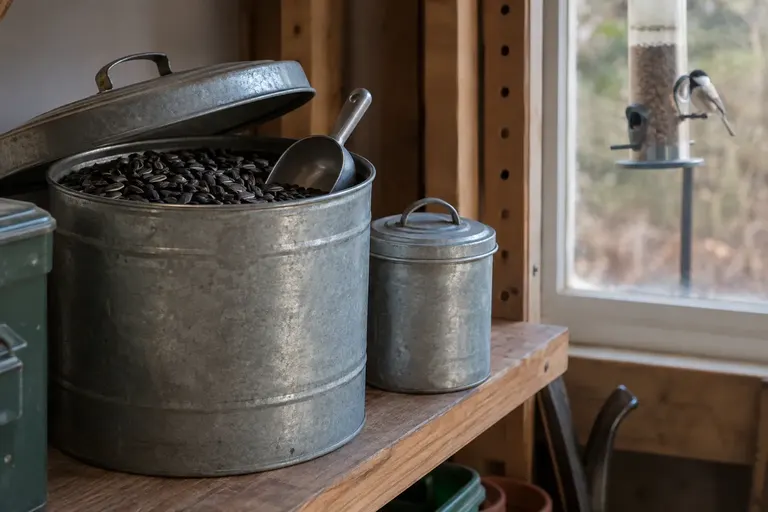
- Keep it in a sealed metal or rigid plastic bin, not the paper or woven sack it came in.
- Store it somewhere cool and shaded, such as a garage or shed, away from a sunny window or boiler.
- Buy what you will use in about a month or two, even if a larger bag looks better value.
- Do not top up a feeder over old seed. Let it run nearly empty, then refill, so seed at the bottom does not sit for weeks.
- Keep rodents out: a sealed lid matters as much as the dry location.
Our bird food storage guide covers bins, pests and how long other foods last.
What feeder do you need for nyjer?
You need a feeder with very small openings. Project FeederWatch notes that the seed is so small it needs a special feeder with tiny ports, which also stops it spilling onto the ground. Audubon describes mesh feeders made for the same purpose.
| Feeder type | How it works | Good points | Weak points |
|---|---|---|---|
| Nyjer tube with small ports | Clear tube, tiny slots beside each perch | Protects seed from rain, easy to see the level, many birds at once | Ports can clog; needs a brush to clean |
| Metal mesh feeder | Fine mesh cylinder; birds cling and pull seed | Many birds can feed at once, suits clinging siskins and redpolls | Seed gets wet in rain unless it has a roof |
| Fabric sock | Disposable mesh bag | Very cheap and light | Gets soaked, hard to clean, best for short use |
| Standard seed tube | Large ports for sunflower and mixes | None for nyjer | Seed pours out and is wasted |
A few placement tips help:
- Hang it where finches already feed, at about head height, so you can see the level and refill easily.
- Choose a spot sheltered from driving rain. A roofed tube or a small baffle above a mesh feeder keeps seed dry.
- Hang it near shrubs or a tree that gives cover, but not right beside dense cover where cats can wait.
For feeder picks and sizes, see our guide to the best finch feeders, which compares nyjer tubes, mesh feeders and socks.
Should you buy straight nyjer or a finch mix?
Buy straight nyjer if you are filling a nyjer feeder. Project FeederWatch advises feeding nyjer by itself rather than in a mix, to cut waste. When nyjer is blended into a general seed mix, birds that want the bigger seeds flick the tiny nyjer out, and it ends up on the ground, where few birds eat it.
Finch mixes, which combine nyjer with sunflower hearts or small seeds, can work in a mesh or small-port feeder. They spread the appeal to more species, but they also bring in the bigger birds that nyjer usually keeps away. If your aim is a feeder for goldfinches and siskins only, straight nyjer is better.
What to look for on the bag:
- One ingredient. The label should list nyjer, niger or Guizotia abyssinica only.
- Clean seed. A good bag has little dust, few husks and no sticks.
- A packing or best-before date. Fresher is better; avoid bags with no date at all.
- In Europe, a note on Ambrosia. EU feed rules have limited ragweed (Ambrosia) seed in compound feed with unground seeds to 50 mg per kg since 2012, and NABU advises that seed mixes should always be free of Ambrosia seeds. Many brands state that their seed is cleaned for it.
For the bigger picture on choosing seed, see our guide to the best bird seed.
Is nyjer seed safe? Heat treatment, weeds and chemicals
Nyjer sold for wild birds is generally a safe food when it is fresh and dry. The main questions people ask are about sprouting, weeds and pesticides.
Does nyjer seed sprout?
Very rarely. Wikipedia reports that in 1982 the U.S. Department of Agriculture began requiring heat sterilization of imported nyjer to kill the seeds of dodder, a parasitic weed, and that since 2001 the standard has been 120 °C for 15 minutes. Audubon reports that only four facilities worldwide are licensed for this treatment, two in India and two in the mid-Atlantic United States. Cornell notes the heat treatment limits the seed’s chance of spreading while keeping its food value.
The treatment was designed around dodder. Wikipedia notes that it did not kill the seeds of every other noxious weed, so a few unexpected seedlings under a feeder are not impossible. Raking up spilled seed now and then solves it.
Does nyjer contain pesticides?
Tests on bird seed have given mixed results, and none of them proves a risk from nyjer specifically. Laura Erickson cited an American Bird Conservancy analysis that found tested seed was free of pesticides or had amounts below harmful levels. In 2024, Pesticide Action Network Netherlands had nine general bird seed samples tested and found insecticide residues in all but the organic one, according to Dutch broadcaster NOS. Vogelbescherming Nederland said the real harm of those doses still needed to be examined. If this matters to you, organic or residue-tested seed is the cautious choice.
Is nyjer bad for birds in any way?
The food itself is not the problem; feeder hygiene is. Finches crowd onto nyjer feeders, and crowding spreads disease. The BTO reports that the disease trichomonosis has driven large declines in Greenfinch and Chaffinch numbers, with more than five million Greenfinches lost in the UK since 2009. Feeders can spread it through direct contact and through contaminated food, water and surfaces.
How do you keep a nyjer feeder clean?
Clean nyjer feeders regularly, more often in mild and wet weather, and stop feeding for a while if you see sick birds.
- Empty the feeder, throw away old or damp seed and scrub the tube and ports with hot soapy water. A long bottle brush and a small port brush make it far easier.
- Rinse well and let it dry completely before refilling, since wet seed clumps fast.
- Rake up spilled seed under the feeder so it does not mold or draw rats.
- NABU recommends feeder designs where birds cannot walk in the food, such as silos and tubes, and cleaning classic bird tables regularly with hot water.
- If you see finches that are fluffed up, lethargic or have food stuck around the bill, take all feeders down for a couple of weeks and clean them.
Our step-by-step guide on how to clean bird feeders covers products and schedules.
When should you feed nyjer seed?
In Europe, feed nyjer from late autumn through winter; in North America it is commonly fed year round. National advice has shifted in recent years, so it is worth checking where you live.
| Where you live | Current advice | What it means for nyjer |
|---|---|---|
| UK | BTO, updated May 2026: avoid seed and peanuts from 1 May to 31 October; keep feeding in winter | Put nyjer out in November, take it in from May |
| France | LPO: feed from mid-November, with the first frosts, to the end of March | Nyjer feeder up in November, down at the start of April |
| Netherlands and Belgium | Vogelbescherming encourages small seeds such as nyjer for goldfinches at feeders and silos | Winter feeding is the main window; plant seed heads for the rest of the year |
| Germany | NABU favors clean silo feeders and Ambrosia-free seed | Same winter window, with careful hygiene |
| North America | No single rule; many people feed all year | Clean more often in warm, wet weather and watch for sick birds |
Late autumn is a good time to start. Goldfinches, siskins and redpolls roam more widely in winter, and a feeder that is already in place when the cold arrives is easier for them to find. For a fuller winter plan, see what to feed birds in winter.
How can you attract more goldfinches without more seed?
Plants that set seed do much of the work. Vogelbescherming Nederland suggests sowing or planting sunflowers, teasel, globe thistles and evening primrose once the frost is out of the ground, and notes that goldfinches also feed on dandelions and almost all thistles. Teasel stands out: the BTO points out that the goldfinch is the only common British finch that can pull seeds from teasel heads.
A garden that pairs one clean nyjer feeder with a patch of seed heads left standing through winter gives finches both a reliable meal and natural food, and it costs less in seed.
Common mistakes with nyjer seed
- Buying a giant bag. It will go stale before you use it. Buy small and often.
- Putting nyjer in a sunflower tube. It pours out of large ports. Use a nyjer feeder.
- Mixing it into general seed. Birds flick it out. Feed it alone or in a dedicated finch mix.
- Filling in the rain. Wet seed clumps in hours. Fill on a dry day and use a roofed feeder.
- Topping up over old seed. Let the feeder empty first so the bottom layer stays fresh.
- Skipping cleaning. Crowded finch feeders need regular washing, especially in mild, damp weather.
- Giving up too fast. A new nyjer feeder can take days or weeks to be found. Hang it near feeders birds already use.
Sources
- Project FeederWatch: Nyjer
- Cornell Lab of Ornithology, All About Birds: Feeding birds, a quick guide to seed types
- Audubon: What’s the deal with Nyjer?
- BirdWatching: Why finches might not eat the Nyjer seed you provide (Laura Erickson, 2014)
- BTO: Going for gold, Goldfinch (Garden BirdWatch, Bird Table 67)
- BTO: Rethinking how we feed garden birds (May 2026)
- Vogelbescherming Nederland: Je tuin perfect voor putters
- Wikipedia: Guizotia abyssinica

Frequently asked questions
What birds eat nyjer seed?
Mostly small finches with fine bills. Cornell's All About Birds names American and Lesser Goldfinches, Pine Siskins, Common Redpolls and Indigo Buntings as frequent eaters. In Europe the main takers are European Goldfinches, Siskins, redpolls and Greenfinches. Heavier-billed birds such as cardinals, jays and most sparrows usually ignore it, which is part of its appeal.
Is nyjer seed the same as thistle seed?
No. Nyjer comes from Guizotia abyssinica, a daisy-family plant from the Ethiopian highlands, and it is not related to thistles. It was sold as thistle seed in early marketing because finches feed on thistles. The Wild Bird Feeding Institute trademarked the name Nyjer in 1998 to end the confusion, and Project FeederWatch also stresses that it is not a thistle.
Will nyjer seed grow under my feeder?
Very rarely. Seed imported into the United States must be heat treated, since 2001 at 120 °C for 15 minutes, so that it cannot sprout and spread weeds. Cornell notes the treatment keeps the food value. The heat step was aimed at dodder, and Wikipedia notes it did not kill every other weed seed, so clear spills from time to time.
Why are goldfinches not eating my nyjer?
The usual reason is stale seed. Nyjer's appeal is its oil, and once the seed dries out finches stop taking it. Seed that got wet and clumped is also ignored. Buy only what you will use in a month or two, keep it dry, and look for shiny black seed. Also check whether sunflower hearts nearby are drawing the goldfinches away.
When should I put out nyjer seed?
In most of Europe, from late autumn to the end of winter. The LPO advises feeding from mid-November, with the first frosts, to the end of March. In May 2026 the BTO updated its UK advice to avoid seed and peanuts from 1 May to 31 October because of disease risk. In North America many people feed nyjer all year, but hygiene matters more in warm months.