How to Attract American Tree Sparrows in Winter
How to attract American Tree Sparrows: scatter white millet on the ground near shrubs, leave seed heads standing and keep water open from fall to spring.
In this article
- American Tree Sparrow at a glance
- Where and when can you see American Tree Sparrows?
- What does an American Tree Sparrow look like?
- Is it an American Tree Sparrow or a Chipping Sparrow?
- What do American Tree Sparrows eat?
- What should you feed American Tree Sparrows?
- Do American Tree Sparrows come to bird feeders?
- How do you set up a yard for American Tree Sparrows?
- Where do American Tree Sparrows nest?
- Why is it called a tree sparrow if it feeds on the ground?
- Are American Tree Sparrows declining?
- Which feeder setup works best for a winter flock?
- Sources
- Frequently asked questions
To attract American Tree Sparrows, scatter white proso millet on the ground or on a low tray feeder within a short hop of shrubs or a brush pile, leave weedy seed heads standing through winter and keep some water open. These Arctic-breeding sparrows only visit yards in winter, so have everything ready by late fall.
The Cornell Lab of Ornithology describes them as plump, long-tailed sparrows that often come to bird feeders. Small flocks move onto snowy fields and into yards in winter, where they pick seeds off the ground. Everything below builds on that habit: food low, cover close and water that doesn’t freeze.
American Tree Sparrow at a glance
| Feature | Details |
|---|---|
| Scientific name | Spizelloides arborea |
| Length | 5.5 to 6.3 in (14 to 16 cm) |
| Weight | 0.6 to 1 oz (18 to 28 g) |
| Wingspan | 9.4 to 10.6 in (24 to 27 cm) |
| Key marks | Rusty cap, rusty eye line, gray face, two-toned bill, dark spot on a plain breast |
| Breeding range | Arctic tundra and scrub near the treeline in Alaska and northern Canada |
| Winter range | Northern and central North America, south to northern Arizona, Texas and Alabama |
| When you’ll see it | Late fall to early spring |
| Winter diet | Almost entirely grass and weed seeds |
| Best feeder food | White proso millet on the ground or a low tray |
| Nest boxes | Not used |
| Conservation | Common Bird in Steep Decline (Cornell Lab) |
Measurements are from the Audubon field guide. Range and diet are from the Cornell Lab.
Where and when can you see American Tree Sparrows?
You’ll only see them in winter across most of the US. They breed in the far north, where thickets of willow, alder, birch and spruce give way to open tundra, and they rarely appear south of northern Canada in summer.
The Cornell Lab’s range map shows them wintering across northern and central North America, reaching as far south as northern Arizona, Texas and Alabama. Females generally winter farther south than males. If you live south of that line, for example in Florida, a tree sparrow at your feeder would be unusual.
Audubon notes they migrate relatively late in fall and early in spring, mostly at night and often in flocks. Their spring departure lines up with snowmelt in the far North. Exact arrival dates shift with latitude and weather, so the quickest way to know when to put millet out is to check recent sightings for your county. Our guide to using eBird shows how to set up alerts and read the bar charts for your area.
What does an American Tree Sparrow look like?
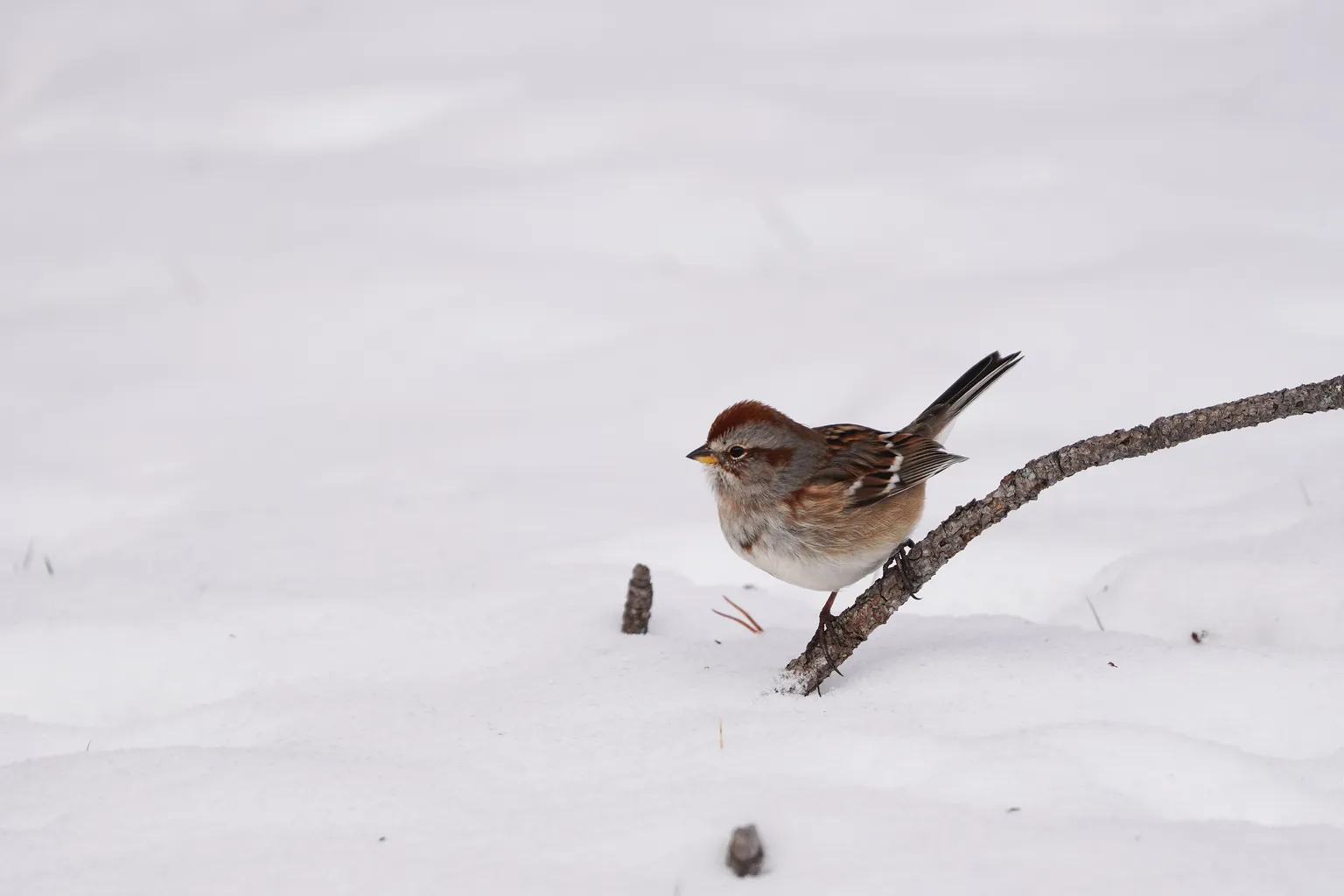
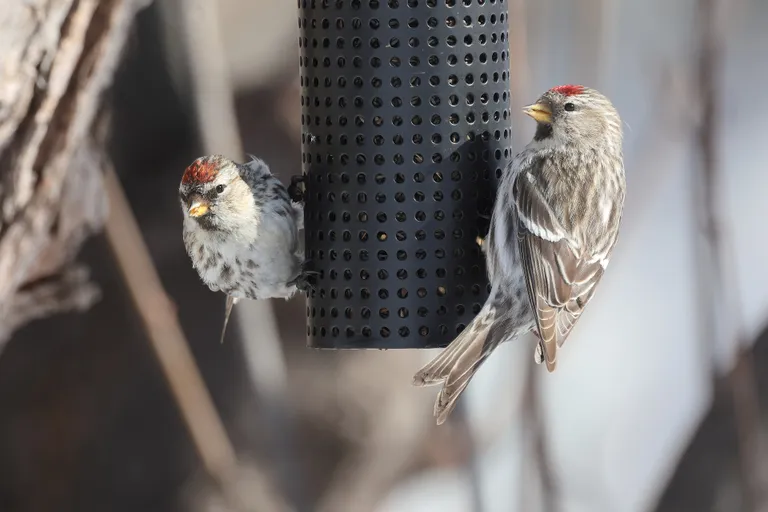
It’s a round-headed, plump sparrow with a long, thin tail, a rusty cap and a rusty line behind the eye on a gray face. The breast is plain gray to buff, often with a dark smudge right in the center, and the brown back is streaked.
Up close, the bill is the clearest mark. Project FeederWatch describes it as two-toned: a dark upper half and a yellow lower half. Audubon adds two white wingbars. Males and females look alike.
In cold weather they fluff their feathers, which makes them look even chubbier. The heavily streaked juvenile plumage is rarely seen outside the Arctic breeding grounds, so almost every tree sparrow at a winter feeder shows the clean adult pattern.
Flocks keep in touch with a soft, musical twitter as they hop about on the ground. They’ll also perch in the open on goldenrod stalks, shrubs or low branches between feeding bouts.
Is it an American Tree Sparrow or a Chipping Sparrow?
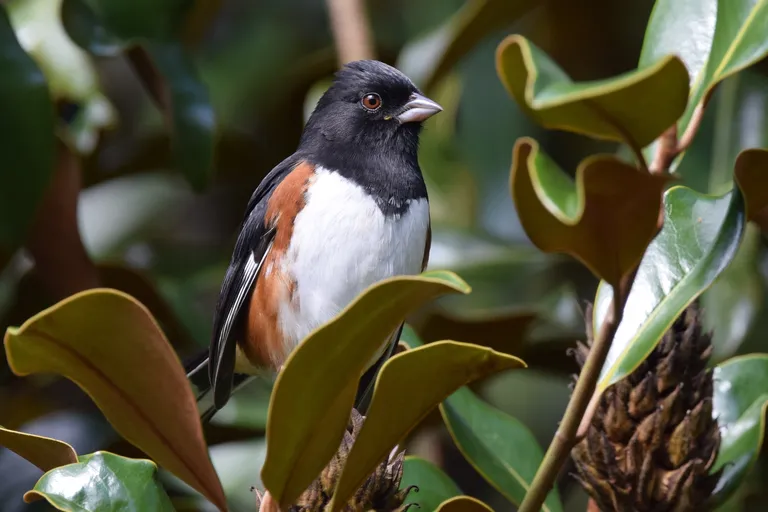
Check the eye line and the bill. A rusty eye line and a bill that’s yellow underneath mean American Tree Sparrow. A black or dark brown line through the eye and an all-pinkish bill in winter mean Chipping Sparrow.
The two can look alike because both wear a rusty cap. Project FeederWatch points out that their ranges usually overlap only during migration. The Cornell Lab’s range map shows northern Chipping Sparrows moving south for winter, as far as Mexico and Florida. That said, it also notes Chipping Sparrows are increasingly found north of their traditional winter range, so don’t rely on the calendar alone.
| Look at | American Tree Sparrow | Chipping Sparrow (winter) | Field Sparrow | Song Sparrow |
|---|---|---|---|---|
| Cap | Rusty | Duller reddish brown | Bright rufous | Brown and gray stripes |
| Eye line | Rusty | Black or dark brown | Rufous line behind the eye, white eye ring | Brown stripes |
| Bill | Dark above, yellow below | Pinkish | Pink | Grayish |
| Breast | Plain gray with a central spot (sometimes hidden) | Plain gray, no spot | Plain, pale gray with orange tones | Heavy brown streaks joining into a spot |
The Song Sparrow is the other bird with a central breast spot, but its spot sits on a heavily streaked chest. The tree sparrow’s chest is clean.
What do American Tree Sparrows eat?
In winter, they eat almost nothing but small seeds. The Cornell Lab lists grass, sedge, ragweed, knotweed and goldenrod seeds, plus the occasional berry. In summer on the breeding grounds, they switch to insects such as beetles, flies, leafhoppers and caterpillars, along with spiders and snails.
How they feed matters for your yard. Flocks scratch the ground for dried seeds and hop up at bent-over weeds. The Cornell Lab also describes them beating seed heads that stick up out of the snow with their wings to shake the seeds loose.
They run on a tight budget. According to the Cornell Lab, an American Tree Sparrow needs to take in about 30 percent of its body weight in food and a similar share in water every day, and a full day without food is usually fatal. A reliable feeding spot during a cold snap can matter a lot to a bird that small.
What should you feed American Tree Sparrows?
Offer white proso millet on the ground or a low tray. It’s the closest match to the tiny grass seeds they eat in the wild, and the Cornell Lab’s seed guide names it a favorite of native American sparrows and juncos.
| Food | Why it works | How to offer it |
|---|---|---|
| White proso millet | Small seed, favored by native sparrows and juncos | Scatter on the ground or a low tray |
| Cracked corn | Eaten by many ground feeders | Small amounts on a tray, since it also draws less welcome birds |
| Sunflower chips | No shells to crack, easy for small bills | Small, dry portions on a tray; they spoil quickly when wet |
| Seed dropped from hanging feeders | Tree sparrows forage below other feeders | Keep the ground under feeders clear of snow |
Keep portions to what the flock clears in a day or so, especially in wet weather. For a full rundown of winter seeds and fats, see what to feed birds in winter.
Do American Tree Sparrows come to bird feeders?
Yes. The Cornell Lab notes this species often comes to bird feeders, where small flocks feed on seeds on the ground. Because they forage on the ground, they’ll use seed scattered under your feeders or on a low platform far more than a hanging tube.
A platform feeder set close to the ground gives them a clean, open surface and keeps seed out of slush. If you already feed Dark-eyed Juncos, you’re most of the way there: juncos also favor white millet on the ground, so the same setup serves both.
How do you set up a yard for American Tree Sparrows?
Copy their winter habitat. The Cornell Lab describes them in weedy fields with hedgerows or shrubs, along forest edges and near marshes, so aim for seed, cover and open ground side by side.
- Feed low and near cover. Put millet within a few feet of shrubs, a hedge or a brush pile so the flock can duck out of sight when a hawk appears.
- Leave the weeds and grasses. Don’t cut back native grasses, goldenrod and other seed plants in fall. Stems that stand above the snow are exactly what tree sparrows beat with their wings for seed. Our list of seed heads to leave standing covers the best plants.
- Build a brush pile. A loose pile of branches in a corner gives shelter from wind and predators, right next to the feeding area. Here’s how to build a brush pile for birds.
- Keep water open. With a daily water need close to their food need, open water helps when everything else is frozen. See keeping a bird bath ice-free in winter.
- Clear the feeding patch after snow. Fresh snow buries fallen seed. Sweep or shovel a small patch and scatter millet again.
- Stay consistent through cold snaps. Since a day without food can be fatal for them, keep the ground station stocked during the hardest weather.
Where do American Tree Sparrows nest?
They nest in the Arctic, on or near the ground. The Cornell Lab says nests usually sit in grass tussocks at the base of shrubs, sometimes up to about 4 feet high in willow or spruce, or on mossy hummocks in open tundra.
The nest is an open cup of moss, grasses, shreds of bark and twigs, lined with fine grass and feathers, often from a ptarmigan.
| Detail | American Tree Sparrow |
|---|---|
| Clutch size | 4 to 6 eggs |
| Eggs | Pale blue with reddish speckling |
| Incubation | 11 to 13 days |
| Leaves the nest | 8 to 10 days after hatching; flies well at about 14 to 15 days |
| Broods per year | 1 |
Incubation and fledging figures are from Audubon. Because they breed so far north, there’s nothing to do for nesting tree sparrows in a typical backyard. Your role is the winter half of their year.
Why is it called a tree sparrow if it feeds on the ground?
The name is a leftover from European settlers. The Cornell Lab says they were reminded of the Eurasian Tree Sparrow back home and gave the American bird the same name, even though it feeds on the ground and nests on or near it.
The two aren’t closely related. The Eurasian Tree Sparrow (Passer montanus) is a relative of the House Sparrow with a chestnut cap and white cheeks marked by a black spot. It was released in St. Louis, Missouri, in 1870, and the Cornell Lab notes it has spread only into nearby parts of Missouri, Illinois and Iowa. Outside that small area, a “tree sparrow” at a North American feeder in winter is almost certainly the American species.
Are American Tree Sparrows declining?
Yes. The Cornell Lab lists the species as a Common Bird in Steep Decline, even though it’s still numerous. Partners in Flight estimates the global breeding population at about 26 million birds and gives it a Continental Concern Score of 10 out of 20, which means low concern.
Most of what harms the species happens on its breeding grounds and wintering fields, not in yards. Still, yards can help in winter. Leaving weedy edges uncut provides natural food, and clean feeding areas reduce disease risk where flocks gather. Tree sparrows can live a long time for a small bird: the oldest one on record was at least 10 years, 9 months old when it was recaptured in Connecticut.
Which feeder setup works best for a winter flock?
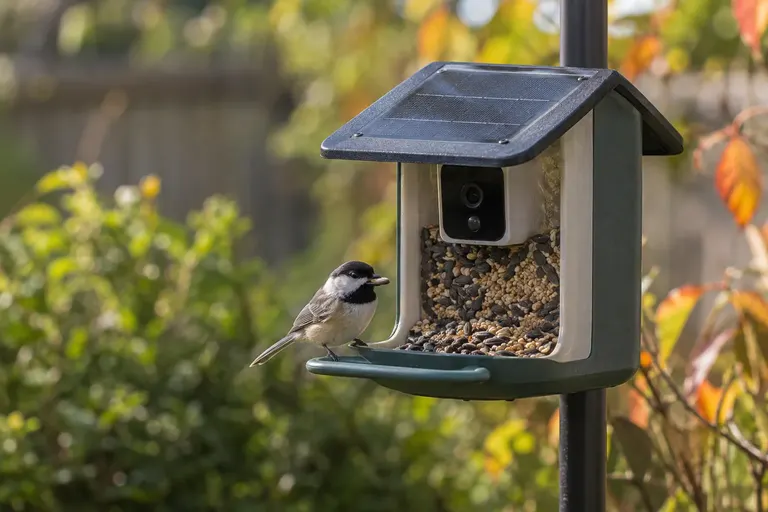
A mix of a hanging feeder for finches and chickadees plus a low tray or ground patch for sparrows and juncos covers most northern winter yards. Tree sparrows will use both the tray and the seed that others drop.
If you’re choosing new equipment, start with our best bird feeders guide and pair one hanging feeder with a low platform stocked with white millet.
Sources
- Cornell Lab of Ornithology, All About Birds: American Tree Sparrow overview
- Cornell Lab of Ornithology, All About Birds: American Tree Sparrow life history
- Cornell Lab of Ornithology, All About Birds: American Tree Sparrow range map
- Audubon Guide to North American Birds: American Tree Sparrow
- Project FeederWatch: Tricky Bird ID, American Tree Sparrow and Chipping Sparrow
- Cornell Lab of Ornithology: A Quick Guide to Seed Types

Frequently asked questions
What is the best food to attract American Tree Sparrows?
White proso millet is the best match. The Cornell Lab says white millet is a favorite of ground-feeding birds, including native American sparrows and juncos, and it works best scattered on the ground or on a low tray. In the wild, tree sparrows spend the winter eating small grass and weed seeds, so millet is close to their natural food.
When do American Tree Sparrows show up at feeders?
They're winter visitors. Audubon says the species migrates relatively late in fall and early in spring, mostly at night. Across southern Canada and the northern and central US, they're present roughly from late fall until the spring thaw, when they head back to the Arctic. Exact dates vary by latitude and by year, so check recent eBird sightings for your county.
How do you tell an American Tree Sparrow from a Chipping Sparrow?
Look at the eye line and bill. Project FeederWatch notes that the American Tree Sparrow has a rusty eye line and a two-toned bill, dark above and yellow below, plus a dark spot in the middle of a plain gray breast. A winter Chipping Sparrow has a black or dark brown eye line, a pinkish bill and no breast spot.
Do American Tree Sparrows use birdhouses?
No. They nest on or near the ground in the Arctic, usually in a grass tussock at the base of a shrub, according to the Cornell Lab. The nest is an open cup of moss, grass, bark and twigs, lined with fine grass and feathers. They don't breed anywhere near most backyards, so a nest box won't help them.
Is the American Tree Sparrow the same as the Eurasian Tree Sparrow?
No. They're different species. The Cornell Lab says European settlers named the American bird after the Eurasian Tree Sparrow they knew from home. The Eurasian Tree Sparrow has a chestnut cap and white cheeks with a black spot. A small introduced population lives around St. Louis, Missouri, and nearby parts of Illinois and Iowa.