How to Attract Great Horned Owls: Nest Platforms and Habitat
How to attract Great Horned Owls: keep big trees beside open ground, put up a nest cone 15 to 45 feet up by fall, skip rat poison and never lure with calls.
In this article
- Great Horned Owl at a glance
- How do you identify a Great Horned Owl?
- What does a Great Horned Owl sound like?
- Where do Great Horned Owls live?
- How do you attract Great Horned Owls to your yard?
- What nest platform do Great Horned Owls use?
- When do Great Horned Owls nest?
- Are Great Horned Owls a risk to pets, poultry and other birds?
- Why you should never use call playback to lure owls
- Common mistakes when trying to attract Great Horned Owls
- Sources
- Frequently asked questions
To attract Great Horned Owls, you need big trees next to open ground such as fields, meadows or large lawns, plenty of rodents and rabbits, and an old stick nest or a nest platform. NestWatch recommends a nest cone with a 12-inch opening, 15 to 45 feet up a live hardwood tree, installed by fall.
Great Horned Owls are the classic “hoot owl” of North America, and they’re far more adaptable than most owls. They live in forests, deserts, farmland, suburbs and city parks. This guide covers what habitat they need, how to set up a nest platform the way NestWatch describes, and the mistakes that keep owls away or put them at risk.
Great Horned Owl at a glance
| Feature | Details |
|---|---|
| Scientific name | Bubo virginianus |
| Length | 18.1 to 24.8 in (46 to 63 cm) |
| Weight | 32.1 to 88.2 oz (910 to 2,500 g) |
| Wingspan | 39.8 to 57.1 in (101 to 145 cm) |
| Range | North America to the northern tree line, plus much of South America |
| Habitat | Woods mixed with open ground, farmland, deserts, suburbs and city parks |
| Call | Deep, stuttering series of 4 to 5 hoots |
| Nest | Old stick nests of hawks, crows, ravens or herons, cavities, ledges, platforms |
| Clutch | 1 to 4 eggs |
| Incubation | 30 to 37 days |
| Nestling period | About 42 days |
| Migration | None regular; resident year-round in most of its range |
Size, nesting and diet figures come from the Cornell Lab of Ornithology’s All About Birds.
How do you identify a Great Horned Owl?
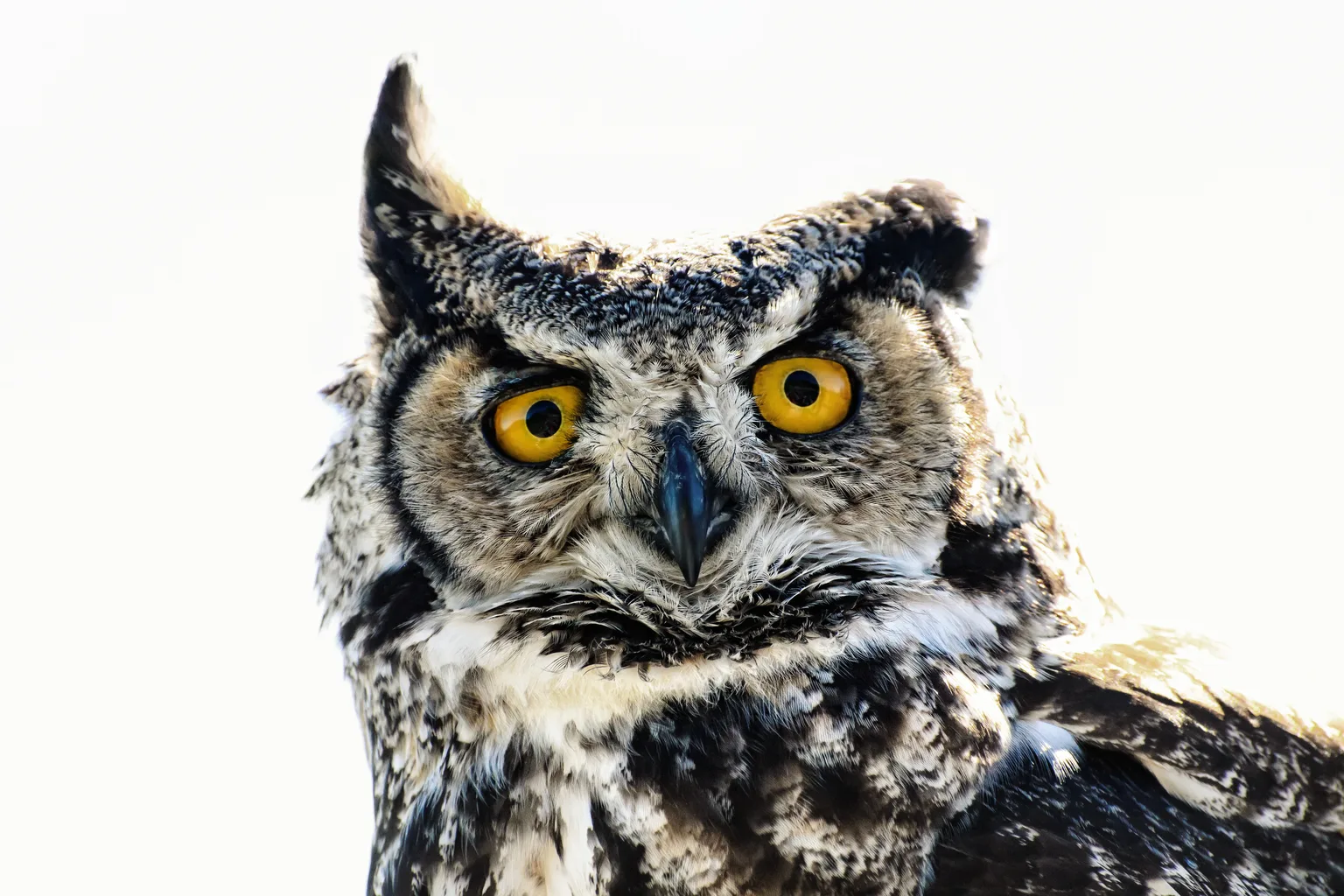
A Great Horned Owl is a big, bulky owl with two long feathered ear tufts, yellow eyes, mottled gray-brown plumage, a reddish-brown face and a white throat patch. The Cornell Lab says it’s slightly larger than a Red-tailed Hawk.
Color varies by region. Birds in the Pacific Northwest are dark and sooty, birds in the Southwest are paler and grayer, and some subarctic birds are almost white. The ear tufts are just feathers, not ears. In flight, look for broad, rounded wings and a blunt head.
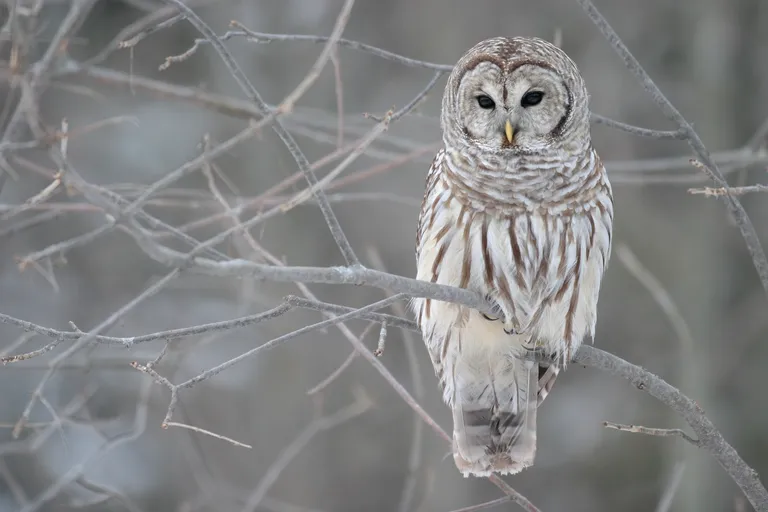
Compared with the Barred Owl, the Great Horned Owl is bigger, has ear tufts and yellow rather than dark brown eyes. Like all owls it flies almost silently, which our explainer on why owls are silent in flight covers. The Cornell Lab adds that it can turn its head more than 180 degrees.
What does a Great Horned Owl sound like?
The Great Horned Owl’s call is a deep, stuttering series of four to five hoots, according to the Cornell Lab. Audubon writes it as “hoo, hoo-hoo, hoo, hoo,” with the second and third notes shorter.
Pairs hoot back and forth to defend their territory, especially before breeding. Females are larger than males, but the male has the deeper voice. When threatened, these owls clap their bills, hiss, scream and make guttural noises.
Listening is the best way to learn whether Great Horned Owls already live near you. Their hooting carries far on calm winter evenings, when pairs are setting up for the nesting season. If you’re not sure what you heard, record it and check it with Merlin Sound ID. Owls that already hoot nearby are the ones most likely to use a platform.
Where do Great Horned Owls live?
Great Horned Owls live across North America up to the northern tree line and through much of South America. The Cornell Lab lists deserts, wetlands, forests, grasslands, backyards and cities among their habitats.
What they need is a mix: trees for roosting and nesting, plus open space for hunting. The Cornell Lab notes they favor young woods with fields or other openings, secondary-growth woodland, swamps, orchards and farmland. Wooded parks and suburbs with large trees work too.
They don’t migrate in a regular way. Audubon notes that some individuals wander in fall and winter, but most stay in the same area all year, so a pair that settles near you is a long-term neighbor.
How do you attract Great Horned Owls to your yard?
You attract Great Horned Owls with the right landscape, not with food. Tall trees beside open hunting ground, healthy prey populations, a nest site and a poison-free yard do the work.
Keep big trees and old nests
Great Horned Owls don’t build their own nests. They usually take over old stick nests built by hawks, crows, ravens or herons, Audubon says often 20 to 60 feet up. If an old hawk or crow nest sits in one of your trees, leave it. Dead and broken trees also matter, since the owls sometimes nest in cavities and on broken-off trunks.
Keep some open ground
These owls hunt from perches at the edge of open areas, swooping down on prey. Fields, meadows, pastures and big lawns next to trees give them hunting room. A yard that’s entirely dense woods suits a Barred Owl better.
Let prey thrive
The Cornell Lab says Great Horned Owls have the most varied diet of any North American raptor: mostly mammals and birds, especially rabbits, hares, mice and American Coots, plus voles, squirrels, skunks, ducks and even other owls and hawks. Long grass, brush and logs give small mammals cover, and through them feed the owls.
Never use rat poison
Rodenticides move up the food chain. Mass Audubon reports that a Great Horned Owl at its Habitat Education Center in Belmont, Massachusetts, died in November 2024 from secondary poisoning after eating poisoned prey, and that a 2020 study at a Massachusetts wildlife clinic found second-generation anticoagulant rodenticides in every Red-tailed Hawk tested. If you have a rodent problem, remove food sources and use traps. Our guide to keeping rats away from bird feeders covers non-poison options.
Keep night lighting low
Owls hunt in the dark. Leaving fields and wooded edges unlit keeps the night closer to what owls and their prey are used to.
What nest platform do Great Horned Owls use?
Great Horned Owls use an open nest cone or basket, not an enclosed box. NestWatch recommends a cone with a 12-inch opening, mounted 15 to 45 feet up in a live hardwood tree.
| Platform feature | NestWatch guidance for Great Horned Owl |
|---|---|
| Structure type | Open nest cone (woven stick basket) |
| Opening | 12 in (30 cm) across |
| Mounting height | 15 to 45 ft (4.6 to 13.7 m) |
| Attach to | Live hardwood tree at least 12 in (30 cm) in diameter |
| Habitat | Forest or open woodland |
| Spacing between platforms | 1.5 miles (2.4 km) |
| When to install | Fall, so owls find it by January |
| Main nesting season | January through March |
NestWatch’s plan builds the cone from sticks: a raft-like base, spoke-like vertical sticks and horizontal sticks attached in 6-inch segments with landscaping wire, with loops on the outside for mounting. NestWatch also suggests having a professional arborist install it, because 15 to 45 feet up a tree is no place for a ladder. For general hardware advice, see our guide to mounting a birdhouse on a pole, tree or wall.
NestWatch adds that nest cones placed in orchards or on farm woodlots can help control rodents. To compare this setup with the enclosed boxes used by screech-owls, Barn Owls and Barred Owls, read our owl box guide.
When do Great Horned Owls nest?
Great Horned Owls are among the earliest nesting birds in North America. NestWatch shows most nesting from January through March, and Audubon notes that in the north they start in late winter.
| Stage | What happens |
|---|---|
| Before nesting | Pairs hoot to claim and defend their territory |
| Eggs | 1 to 4, dull white and nearly round |
| Incubation | 30 to 37 days (Cornell Lab), mostly by the female |
| Nestling period | About 42 days |
| After fledging | Parents keep feeding the young for several months, Audubon says |
| Broods | 1 per year |
Because nesting starts so early, a platform put up in spring is too late for that season. Install it in the fall, and don’t climb up to inspect it once owls are sitting. Adults defend nests fiercely, so keep a respectful distance and watch through binoculars for backyard birding instead.
Are Great Horned Owls a risk to pets, poultry and other birds?
Yes, to a degree. Great Horned Owls are top predators that take prey as large as skunks, ducks and other raptors, so small animals left outside at night are at risk.
Lock chickens and ducks in a covered, closed coop before dusk. Keep cats and small dogs indoors at night, which also helps wild birds, as our guide to cats and birds explains. Owls also prey on other owls, so if you hope to host smaller owls such as screech-owls, know that a resident Great Horned Owl pair may make that harder.
Why you should never use call playback to lure owls
Playing recorded hoots makes a territorial owl think a rival has moved in. That can stress it and pull it away from hunting or tending eggs in the middle of winter.
The American Birding Association’s Code of Birding Ethics asks birders to limit the use of recordings and to be particularly cautious around active nests and roosts. Perch and Glass takes the stricter line: don’t use playback to lure Great Horned Owls at all. Listen at dusk instead and let the owls announce themselves.
Common mistakes when trying to attract Great Horned Owls
- Putting up an enclosed owl box. Great Horned Owls want an open cone or old stick nest, not a box with a hole.
- Installing too late. A platform put up in spring misses the January to March nesting season.
- Mounting it too low. NestWatch gives 15 to 45 feet in a sturdy live hardwood.
- Removing old hawk and crow nests. Those are ready-made Great Horned Owl nest sites.
- Using rat poison. It can kill the owls that eat poisoned rodents.
- Leaving poultry out at night. Close the coop before dusk.
- Using call playback. It stresses territorial owls during their nesting season.
Sources
- Cornell Lab of Ornithology, All About Birds: Great Horned Owl Identification
- Cornell Lab of Ornithology, All About Birds: Great Horned Owl Life History
- NestWatch, Cornell Lab of Ornithology: Great Horned Owl nest structure guidance
- Audubon Guide to North American Birds: Great Horned Owl
- Mass Audubon: Another Raptor Dies of Poisoning
- American Birding Association: Code of Birding Ethics

Frequently asked questions
Do Great Horned Owls use nest boxes?
Not enclosed boxes. Great Horned Owls normally take over old stick nests built by hawks, crows, ravens or herons, and they also use cavities, cliff ledges and platforms. NestWatch, run by the Cornell Lab of Ornithology, recommends an open nest cone with a 12-inch opening, mounted 15 to 45 feet up in a live hardwood tree at least 12 inches across.
When should I put up a Great Horned Owl nest platform?
Put it up in the fall. NestWatch advises installing nest cones in autumn so owls can find them by the following January, because most Great Horned Owl nesting happens from January through March. That makes them one of the earliest nesting birds in North America, and Audubon notes that in northern regions they begin in late winter.
What does a Great Horned Owl sound like?
The Cornell Lab describes the call as a deep, stuttering series of four to five hoots. Audubon writes it as low, far-carrying hoots, hoo, hoo-hoo, hoo, hoo, with the second and third notes shorter. Pairs hoot back and forth to defend their territory, and the male's voice is deeper than the female's even though she is the larger bird.
Are Great Horned Owls dangerous to pets and chickens?
They can be. The Cornell Lab says Great Horned Owls have the most varied diet of any North American raptor, taking prey from mice to rabbits, skunks, ducks and even other owls and hawks. Lock poultry in a covered, closed coop before dusk, and keep cats and small dogs inside at night, which also protects songbirds from cats.
Do Great Horned Owls live in Europe?
No. Great Horned Owls live only in the Americas, from the northern tree line through much of South America. Their closest counterpart in Europe is the Eurasian Eagle-Owl (Bubo bubo), a member of the same genus. The Eagle-Owl is larger, measuring 60 to 75 cm with a wingspan of up to about 1.88 m, and nests mainly on cliffs and quarry ledges.