How to Attract Barred Owls to Your Yard: Nest Box Guide
How to attract Barred Owls: keep mature trees near water, put up a large nest box 12 to 15 feet up, skip rat poison, and never lure owls with call playback.
In this article
- Barred Owl at a glance
- How do you identify a Barred Owl?
- What does a Barred Owl sound like?
- Where do Barred Owls live?
- How do you attract Barred Owls to your yard?
- What size nest box do Barred Owls use?
- Where and when should you put up a Barred Owl box?
- Why you should never use call playback to lure Barred Owls
- Barred Owl nesting: what to expect
- Why are Barred Owls a problem for Spotted Owls?
- Common mistakes when trying to attract Barred Owls
- Sources
- Frequently asked questions
To attract Barred Owls, you need mature forest with big trees, ideally near water, plus a large nest box or old hollow trees for nesting. NestWatch recommends a box with a 7-inch hole, a 13 by 13 inch floor and 23 inches of depth, mounted 12 to 15 feet up. Never use call playback to lure them.
Barred Owls are among the easiest large owls to hear in eastern North America, and some become regular neighbors in wooded suburbs. But they are forest owls first. This guide explains what habitat they need, how to set up a nest box that follows NestWatch guidance, and what to avoid.
Barred Owl at a glance
| Feature | Details |
|---|---|
| Scientific name | Strix varia |
| Length | 16.9 to 19.7 in (43 to 50 cm) |
| Weight | 16.6 to 37.0 oz (470 to 1,050 g) |
| Wingspan | 39.0 to 43.3 in (99 to 110 cm) |
| Range | Eastern North America, and since the 20th century also the Pacific Northwest and California |
| Habitat | Large blocks of mature mixed forest, swamps and streamsides |
| Call | “Who cooks for you? Who cooks for you-all?” |
| Nest | Natural cavity 20 to 40 ft up, old stick nests, or a nest box |
| Clutch | 1 to 5 eggs |
| Incubation | 28 to 33 days |
| Nestling period | 28 to 35 days |
| Migration | None; territorial year-round |
Size, clutch and timing figures come from the Cornell Lab of Ornithology’s All About Birds.
How do you identify a Barred Owl?
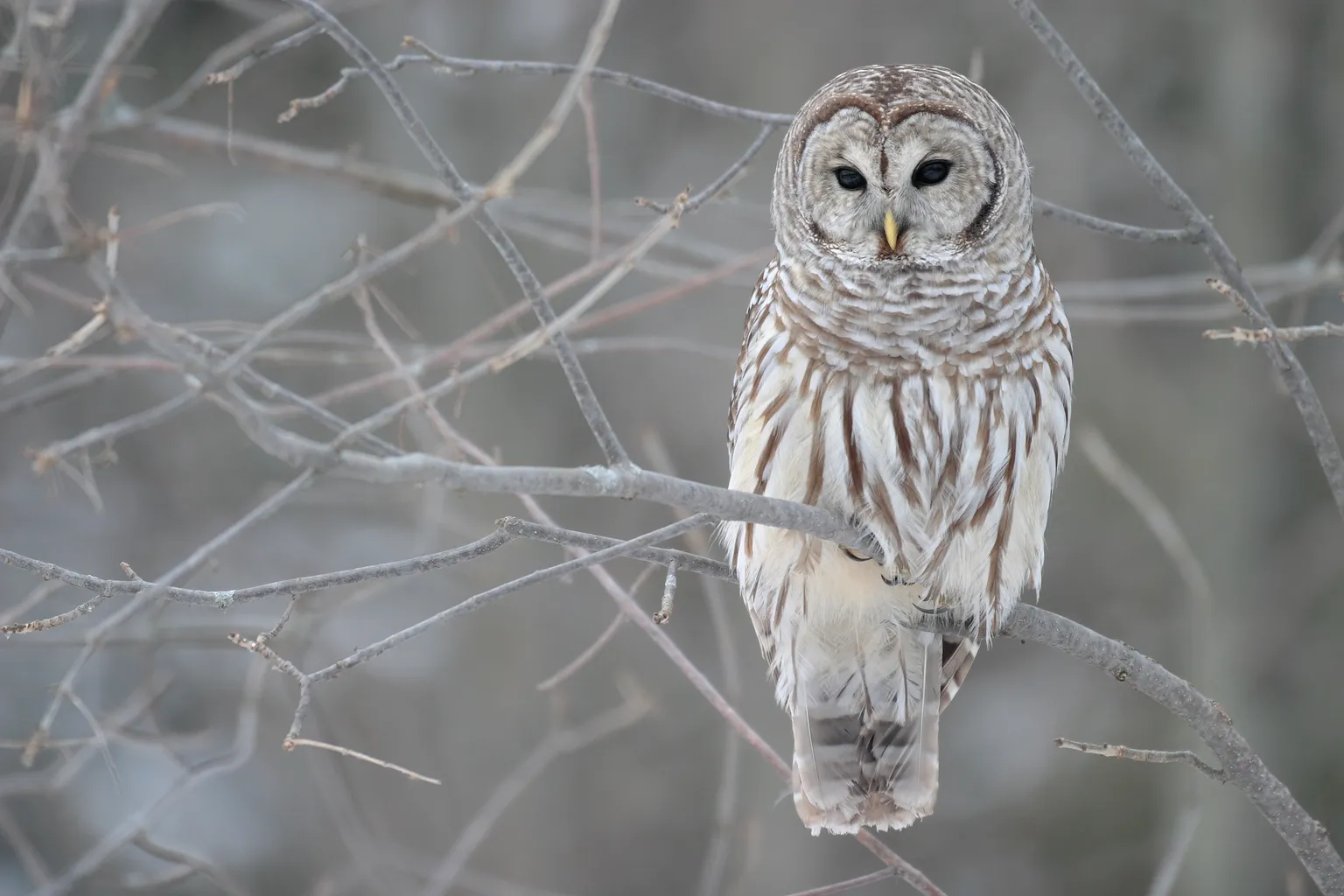
A Barred Owl is a large, round-headed owl with no ear tufts, dark brown eyes and brown-and-white barred plumage. The Cornell Lab describes horizontal brown bars across the upper breast and vertical brown streaks on a white belly.
It is smaller than a Great Horned Owl and larger than a Barn Owl. The dark brown eyes and the lack of ear tufts are the quickest clues. In flight, look for a blunt head and a medium-length, rounded tail. Like other owls, it flies almost without a sound, which our explainer on why owls are silent in flight covers in detail.
What does a Barred Owl sound like?
The Barred Owl’s signature call is a rhythmic hoot, “Who cooks for you? Who cooks for you-all?” The Cornell Lab says it has 8 to 9 notes and is its song, even though owls are not songbirds.
Pairs also duet with a wild mix of cackles, hoots, caws and gurgles, especially during courtship. Adults and young may snap their bills during confrontations. Audubon also lists a barking “hoo, hoo, hoo-hoo” and various screams.
Hearing is the best way to know whether Barred Owls already live near you. Step outside on a calm evening, listen, and if you are unsure, record the sound with a phone and check it with Merlin Sound ID. If you hear “who cooks for you” regularly, you have owls, and a box has a real chance.
Where do Barred Owls live?
Barred Owls live year-round in mixed forests of large trees, often near water. The Cornell Lab says they favor large, unfragmented blocks of mature forest, from swamps and streamsides to uplands.
Audubon describes their habitat as dense woods with only scattered clearings, especially in low-lying and swampy areas. They were originally birds of eastern North America and spread west in the 20th century into the Pacific Northwest and California.
They are sedentary. According to the Cornell Lab, of 158 banded Barred Owls later found again, none had moved farther than 6 miles. If Barred Owls are in your woods, they are there all year.
How do you attract Barred Owls to your yard?
You attract Barred Owls by protecting the forest they need, not by feeding them. Large trees, water, prey-rich ground and a safe nest site do the work.
Keep mature and dead trees
Barred Owls usually nest in natural cavities 20 to 40 feet high in large trees, according to the Cornell Lab. Old hollow trees and broken-off snags are prime real estate. If a dead tree is safe to leave standing, leave it. Cutting old trees removes future nest sites that no box fully replaces.
Protect water and wet woods
Streams, ponds and wooded swamps matter. NestWatch suggests placing a Barred Owl box within 200 feet of water where possible, and the Cornell Lab notes that Barred Owls may perch over water to catch fish.
Let prey thrive
Barred Owls eat squirrels, chipmunks, mice, voles, rabbits, birds, amphibians, reptiles and invertebrates. Leaf litter, logs and brush give that prey places to live. A brush pile at a woodland edge helps small mammals and, through them, owls.
Do not use rat poison
Rodenticides move up the food chain. A USGS study of 40 Barred Owls collected in Washington and Oregon forests from 2015 to 2017 found that 48 percent had been exposed to at least one anticoagulant rodenticide. If rodents are a problem, remove food sources and use traps instead. Our guide to keeping rats away from bird feeders covers non-poison options.
Keep lights low
Owls hunt by night. Leaving wooded parts of a property dark keeps the woods closer to what night-hunting owls and their prey are used to.
What size nest box do Barred Owls use?
NestWatch recommends a Barred Owl box with a 7-inch entrance hole, a 13 by 13 inch inside floor and 23 inches of inside depth. That is a big, heavy box, much larger than a screech-owl box.
| Box feature | NestWatch guidance for Barred Owl |
|---|---|
| Entrance hole | 7 in (18 cm) |
| Inside floor | 13 x 13 in (33 x 33 cm) |
| Inside depth | 23 in (58 cm) |
| Mounting height | 12 to 15 ft (3.7 to 4.6 m) |
| Attach to | Live tree or post |
| Habitat | Forest |
| Distance to water | Within 200 ft (60 m) if possible |
| Spacing between boxes | 0.5 mile (800 m) |
| Entrance direction | Any |
| Nest material | 3 to 4 in (8 to 10 cm) of wood chips in the bottom |
Owls do not build nests, so the wood chips are essential. NestWatch also advises mounting the box so no branches or leaves block the entrance. For how Barred Owl boxes compare with screech-owl and Barn Owl boxes, see our owl box guide.
Where and when should you put up a Barred Owl box?
Put the box in forest, on a large live tree or sturdy post, 12 to 15 feet up, with a clear flight path to the hole. Install it well before the nesting season.
NestWatch’s range chart shows Barred Owl nesting peaking from March through June. Because pairs hold territories all year, a box in place by fall or early winter gives the owls time to find it. The Cornell Lab notes that Barred Owls probably mate for life, so an established pair may return to a good site year after year.
A box this size is heavy. Use strong hardware and a safe ladder setup, and read our guide to mounting a birdhouse on a pole, tree or wall before you start. Space boxes at least half a mile apart, since Barred Owls defend their territory.
Be realistic about your land. A small suburban lot without big trees or nearby forest is unlikely to hold a pair, however good the box. A wooded property bordering a larger forest, creek or swamp is where a Barred Owl box has the best odds.
Why you should never use call playback to lure Barred Owls
Playing recorded owl calls makes a resident owl think an intruder is in its territory. That can stress the bird and pull it away from hunting, roosting or feeding young.
The American Birding Association’s Code of Birding Ethics asks birders to limit the use of recordings, particularly in heavily birded areas and for rare or threatened species, and to be particularly cautious around nests and roosts. Perch and Glass takes the stricter line: do not use playback to lure Barred Owls at all. Listen instead. Owls that live near you will announce themselves.
The same thinking applies to other luring tricks. Our article on pishing explains why less disturbance means better birding. For watching an owl you have found, a good pair of binoculars for backyard birding lets you enjoy it from a respectful distance.
Barred Owl nesting: what to expect
| Stage | What happens |
|---|---|
| Nest site | Natural cavity, broken snag, old hawk, crow or squirrel nest, or nest box |
| Eggs | 1 to 5 |
| Incubation | 28 to 33 days, mostly by the female while the male brings food |
| Nestling period | 28 to 35 days |
| Broods | 1 per year |
Young Barred Owls often leave the nest before they fly well. The Cornell Lab notes that they can climb trees by grasping the bark with their bill and talons. If you find a fluffy young owl on a low branch in spring, it is usually fine and its parents are nearby.
Adults defend nests. Keep your distance from an active box, keep pets inside at night and do not open or inspect the box during nesting.
Why are Barred Owls a problem for Spotted Owls?
In the western United States, Barred Owls compete with the threatened Northern Spotted Owl. The U.S. Fish and Wildlife Service says Barred Owls began expanding west of the Mississippi River around the turn of the 20th century and now outnumber Spotted Owls across much of their range.
Barred Owls are larger and more adaptable. The Service cites research showing that Northern Spotted Owl populations declined significantly on all 11 long-term study areas, by 2 to 9 percent a year. In August 2024 the Service adopted a Barred Owl Management Strategy for Washington, Oregon and California. It relies on willing land managers, uses trained professionals to remove Barred Owls in selected areas, allows no public hunting, and would remove at most less than one-half of 1 percent of the North American Barred Owl population each year. The plan has been debated in Congress, and a 2025 Senate attempt to block it failed.
What this means for you: in the East and Midwest, Barred Owls are native and welcome, and the Cornell Lab lists them as a species of low conservation concern whose numbers rose about 1.1 percent a year from 1966 to 2019. In Spotted Owl country in the Pacific Northwest and California, do not put up Barred Owl boxes. Help native owls there by protecting old forest instead, and check with your state wildlife agency before any owl project.
Common mistakes when trying to attract Barred Owls
- Putting up a box without forest. Barred Owls need large, mature woods. A box cannot replace missing habitat.
- Using a screech-owl box. A 3-inch hole is far too small. Barred Owls need the 7-inch hole and deep box NestWatch describes.
- Forgetting the wood chips. Owls lay eggs on whatever is in the box, so add 3 to 4 inches of chips.
- Hanging the box too low or behind leaves. Aim for 12 to 15 feet with a clear entrance.
- Using call playback. It stresses territorial owls. Listen instead.
- Putting out rat poison. It can poison the owls that eat poisoned rodents.
- Putting up a Barred Owl box in the Pacific Northwest or California. There it may add pressure on threatened Spotted Owls.
Sources
- Cornell Lab of Ornithology, All About Birds: Barred Owl Overview
- Cornell Lab of Ornithology, All About Birds: Barred Owl Life History
- NestWatch, Cornell Lab of Ornithology: Barred Owl nest box guidance
- U.S. Fish and Wildlife Service: Barred Owl Management
- American Birding Association: Code of Birding Ethics
- USGS: Anticoagulant rodenticides in Pacific Northwest forest owls

Frequently asked questions
What size nest box does a Barred Owl need?
NestWatch, run by the Cornell Lab of Ornithology, gives a 7-inch entrance hole, an inside floor of 13 by 13 inches and an inside depth of 23 inches. Mount it 12 to 15 feet up on a live tree or post in forest, ideally within 200 feet of water, and add 3 to 4 inches of wood chips because owls do not bring nest material.
What does a Barred Owl sound like?
The classic Barred Owl call is a rhythmic hoot usually written as "Who cooks for you? Who cooks for you-all?" The Cornell Lab says this call has 8 to 9 notes and carries well through forest. Paired owls also perform loud duets full of cackles, hoots, caws and gurgles, especially during courtship.
Should I play Barred Owl calls to attract one?
No. Playing recorded calls makes a territorial owl think a rival has moved in, which can pull it away from hunting, roosting or tending young. The American Birding Association's Code of Birding Ethics asks birders to limit recordings, especially around nests and for rare species. To find a Barred Owl, listen quietly at dusk instead and let the owl come to you.
Do Barred Owls live in the same place all year?
Yes. Barred Owls do not migrate and are territorial all year. The Cornell Lab reports that of 158 banded Barred Owls found again later, none had moved farther than 6 miles. That loyalty to one patch of woods means a pair that settles near you may stay for years, and it is also why protecting their home trees matters.
Are Barred Owls a problem for Spotted Owls?
In the Pacific Northwest and California, yes. Barred Owls are native to eastern North America but spread west during the 20th century, and they now outnumber Northern Spotted Owls across much of Washington, Oregon and California. The U.S. Fish and Wildlife Service links them to steep Spotted Owl declines and adopted a management strategy in 2024 to protect the threatened species.