How to Attract Baltimore Orioles to Your Yard
How to attract Baltimore Orioles: set out oranges, grape jelly and sugar water before they arrive in spring, then add tall shade trees and fruiting natives.
In this article
- Baltimore Oriole at a glance
- How to identify a Baltimore Oriole
- When do Baltimore Orioles arrive and leave?
- What do Baltimore Orioles eat?
- Best feeders for Baltimore Orioles
- Plants and habitat for orioles
- Baltimore Oriole nesting
- Step by step: set up an oriole station this spring
- Can you attract orioles in a small yard?
- Why are Baltimore Oriole numbers falling?
- Seasonal calendar for orioles
- Common problems attracting orioles
- Common mistakes
- Sources
- Frequently asked questions
Learning how to attract Baltimore Orioles starts with timing. Have food out before they arrive in spring: cut orange halves, a small dish of grape jelly and an oriole nectar feeder, placed in the open where a passing bird will see the color. Then keep them with tall deciduous shade trees for nesting, where Audubon puts nests 20 to 30 feet up, and native plants that produce caterpillars and dark ripe fruit. If the feeder goes up after the first migrants pass through, they have already settled elsewhere.
Baltimore Orioles are a spring highlight across the eastern half of the US and southern Canada. They are also relatively easy to host because they are comfortable around homes, parks and suburban trees, and because they come readily to fruit and sugar water.
Baltimore Oriole at a glance
| Trait | Details |
|---|---|
| Size | 6.7 to 7.5 in long, 1.1 to 1.4 oz, wingspan 9.1 to 11.8 in (a bit slimmer than a Red-winged Blackbird) |
| Range | Breeds east of the Great Plains, from southern Canada to the central and eastern US |
| Season | Spring through late summer; winters mainly in Central America and nearby tropics |
| Diet | Insects (especially caterpillars), ripe dark fruit and nectar |
| Feeder type | Orange halves on spikes, jelly dishes, oriole nectar feeders |
| Nesting | Woven hanging pouch high in deciduous trees |
| Eggs | 3 to 7 pale grayish or bluish eggs with dark markings, 1 brood a year |
| Conservation | Low concern, but populations fell about 36 percent from 1966 to 2019 |
How to identify a Baltimore Oriole
Baltimore Orioles are sturdy, medium-sized songbirds with a thick neck, long legs and a long, pointed, thick-based bill. They belong to the blackbird family (Icteridae), not to the orioles of Europe and Asia, which are unrelated despite the similar colors.
Male, female and immature
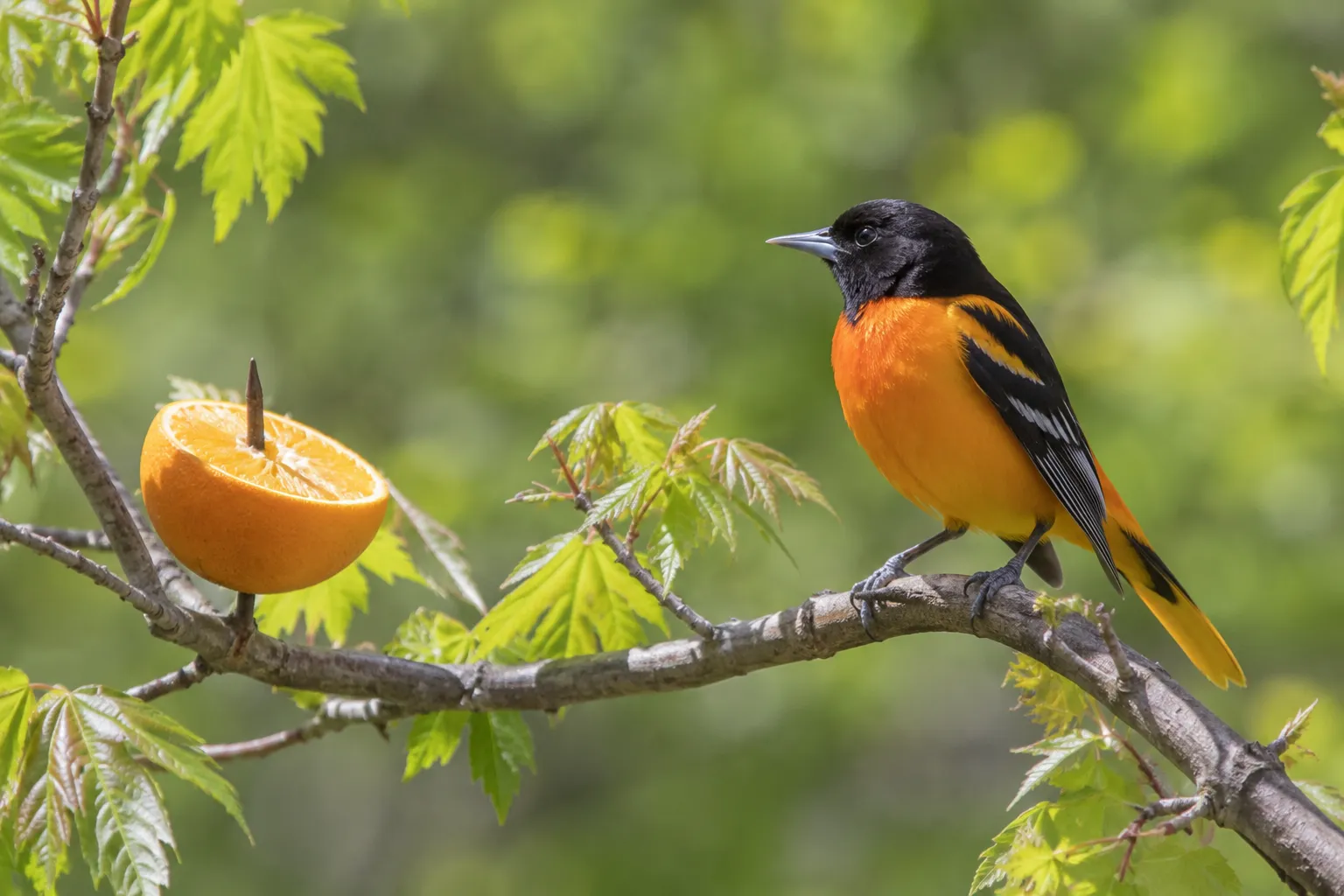
- Adult male: brilliant orange and black. The entire head is black, as is the upper back. The breast, belly, shoulder and rump are flame orange. Black wings show one white wing bar, and the outer tail feathers are orange.
- Adult female: highly variable, from brownish to yellow-orange on the head and back, with an orange-yellow breast and two white wing bars. The Cornell Lab notes females become deeper orange with each molt, and some older females are nearly as bright as males.
- Immature: young females are grayish on the back with pale yellow wash on the head and breast. Young males do not reach full bright plumage until their second year, so a dull, orange-tinged bird singing in spring may be a first-year male.
Similar species
- Orchard Oriole: smaller, with a shorter bill. Adult males are black and deep chestnut or brick red, not orange. Females are greenish-yellow rather than orange-yellow. Orchard and Baltimore Orioles often share the same yards.
- Bullock’s Oriole: the western counterpart. Males have an orange face with a black eye line and throat, plus a large white wing patch. Where the two ranges meet on the Great Plains they hybridize.
- American Robin: a quick glimpse of an orange breast can confuse beginners, but robins are larger, grayer above and forage on lawns rather than in treetops.
Song and calls
Males sing rich, flute-like whistles from high, exposed perches. Both sexes give a dry, rattling chatter that the Cornell Lab describes as distinctive among birds in their range. Hearing that chatter is often how you know orioles have arrived before you see them. Our guide to Merlin Sound ID explains how to confirm calls with an app.
When do Baltimore Orioles arrive and leave?
Across much of the eastern US, Baltimore Orioles return from their wintering grounds between mid-April and early May, arriving earlier in the South and later in the northern states and Canada. Exact dates vary by year and weather, so the most reliable method is to watch recent sightings near you on eBird, where birders log arrivals in real time.
Audubon notes that fall migration begins early, with many birds leaving in July and August. By September most have gone south to Central America, where they spend the winter in open woodland, gardens and shade-grown coffee and cacao plantations.
Why timing matters so much
Migrating orioles arrive hungry and look for reliable food. A bird that finds oranges and nectar on its first day in a neighborhood may stay to nest nearby. Put feeders out about one to two weeks before the usual first arrival date for your area. If none come, keep them fresh anyway: migrants passing through can show up days or weeks after local birds settle.
What do Baltimore Orioles eat?
Their diet changes with the season:
- Breeding season: mostly insects, which supply the protein nestlings need. The Cornell Lab lists beetles, crickets, grasshoppers, moths, flies, spiders and snails, and notes orioles eat tent caterpillars and spongy moth (formerly gypsy moth) caterpillars.
- Spring and fall migration: more nectar and ripe fruit, which supply quick energy.
The Cornell Lab also notes that orioles seem to prefer only ripe, dark-colored fruit, choosing the darkest mulberries and deepest-purple grapes. They feed with a technique called gaping: stabbing the closed bill into soft fruit and then opening it to create a pocket, then drinking the juice with the tongue.
Best foods to put out for orioles
- Orange halves. Cut oranges in half and spike them on a branch, nail or purpose-built oriole feeder, cut side out. Replace them every day or two before they dry out or ferment.
- Grape jelly. Offer small amounts in a shallow dish. The Cornell Lab recommends small amounts; a large pot of jelly can crowd out the insect-rich diet adults need while feeding young. Refresh the dish often and clean it when it gets sticky or attracts ants.
- Sugar water (nectar). Use plain white table sugar dissolved in water, with no red dye, honey or artificial sweetener. The 1 part sugar to 4 parts water mix used for hummingbirds works for orioles; see our hummingbird nectar recipe for the method.
- Mealworms. Some orioles take mealworms, particularly while feeding young. Offer them in a small cup near the fruit.
- Ripe dark fruit. Chopped dark grapes and ripe berries on a tray can work alongside oranges.
Avoid feeding sugar water that has turned cloudy, and never use honey, which can grow harmful fungi.
Best feeders for Baltimore Orioles
Oriole nectar feeders
An oriole nectar feeder looks like a large hummingbird feeder but has bigger feeding ports sized for an oriole’s bill, sturdy perches, and usually orange rather than red parts. Many also include built-in jelly cups and spikes for orange halves. Look for designs that come apart fully for cleaning, since jelly and nectar both get sticky.
Orioles sometimes drink from hummingbird feeders with perches. If you already have one, it may attract a few. Our roundup of hummingbird feeders explains which designs are easiest to clean and least prone to leaks, which matters just as much for oriole nectar.
Where to place oriole feeders
- In the open, visible from the air. Orioles spend most of their time high in trees, so place feeders where the orange color can be seen from treetops, near but not under a tall tree.
- Near a perching tree. Orioles like to land nearby and check the area before coming down.
- Out of full afternoon sun. Sugar water and jelly spoil fastest in heat.
- Away from hummingbird feeders by some distance. Orioles and hummingbirds usually coexist, but separate stations reduce squabbles.
Keeping it clean
Nectar spoils quickly in warm weather. Change it every few days (daily in heat), and clean the feeder each time you refill. Our step-by-step guide on how to clean bird feeders covers the right cleaning solution and brushes.
Stopping ants and bees
Jelly and nectar attract ants and bees. An ant moat hung above the feeder stops ants. Feeders with bee guards over the ports, and keeping the outside of the feeder free of drips, reduce wasp and bee trouble.
Plants and habitat for orioles
Feeders get orioles to stop; habitat gets them to stay and nest.
Tall deciduous trees
Orioles nest high in leafy deciduous trees, historically favoring American elms. The Cornell Lab lists elms, maples and cottonwoods as common choices, and Audubon notes Dutch elm disease reduced traditional nesting sites. Mature shade trees at the edge of an open lawn or along a street are ideal, because orioles prefer open woodland and forest edges over deep forest.
Native plants for food
| Plant type | Good choices | Why it helps |
|---|---|---|
| Native trees | Oaks, maples, cottonwoods, black cherry, native crabapples | Host caterpillars and other insects for nestlings; cherries and crabapples add fruit |
| Fruiting shrubs | Serviceberry, native raspberries and blackberries, elderberry, red mulberry | Ripe dark fruit orioles prefer |
| Vines | Native grapes, trumpet creeper | Fruit and nectar; trumpet creeper spreads aggressively, so give it room |
| Nectar flowers | Native honeysuckle (Lonicera sempervirens), red buckeye in the Southeast | Early nectar during spring migration |
The Cornell Lab specifically mentions raspberries, crab apples and trumpet vines as plants that help attract orioles. Oaks deserve special mention: they support a huge variety of caterpillars, the protein source orioles rely on while raising young.
Offer nesting material
Female orioles weave their nests from plant fibers, grapevine bark, grass, hair and even synthetic fibers. You can help by offering short lengths (a few inches) of natural fiber such as undyed cotton or wool yarn, or natural plant fluff, in a suet cage or mesh bag in spring. Keep pieces short: long strings and fishing line can tangle and trap birds. Avoid dryer lint, which falls apart when wet.
Baltimore Oriole nesting
The oriole nest is one of the most distinctive in North America: a woven, hanging pouch, often compared to a sock, suspended from the tip of a high branch.
| Stage | Details |
|---|---|
| Builder | Female, weaving an outer support bowl, a springy inner bowl and a soft lining over about a week |
| Height | Typically 20 to 30 feet up, near branch tips (Audubon) |
| Clutch | 3 to 7 eggs |
| Eggs | Pale grayish or bluish white, blotched with brown, black or lavender |
| Incubation | 11 to 14 days |
| Nestling period | 11 to 14 days |
| Broods | 1 per year |
Unlike many songbirds, orioles defend only the area right around the nest, so several birds may feed peacefully in the same yard. Once leaves fall in autumn, look up in tall street trees: old oriole nests often become visible for the first time.
Step by step: set up an oriole station this spring
If you are starting from scratch, this sequence covers the essentials in order.
- Look up your arrival window. Check recent Baltimore Oriole sightings in your county on eBird during the previous spring. Note the earliest dates.
- Pick the spot. Choose an open place within sight of a tall tree, visible from above, and shaded in the afternoon. A shepherd’s hook at the edge of a lawn often works well.
- Hang a nectar feeder with orange parts. Fill it only partway at first so less goes to waste while you wait for the first bird.
- Add fruit. Spike two orange halves nearby. The bright color is part of the signal to a bird flying over.
- Add a small jelly cup. A tablespoon or two is plenty to start. Top it up as it is used rather than filling a large bowl.
- Hang an ant moat. Put it above the nectar feeder before ants find it.
- Refresh on a schedule. Swap nectar every few days, oranges every day or two and jelly whenever it looks dried out or dirty.
- Listen for the chatter. Orioles are often heard before they are seen. Once one visits, keep everything fresh and consistent.
Can you attract orioles in a small yard?
Yes, with limits. Orioles are treetop birds, so a yard with no large trees nearby is less likely to host a nesting pair. But migrants and birds nesting on the same street will still visit a feeder in a small yard, on a deck or even a larger balcony, provided it is visible and near some tree cover. In a small space, focus on one nectar feeder with orange halves and keep it spotless. Planting a single native fruiting shrub such as serviceberry or elderberry adds food without taking much room.
Why are Baltimore Oriole numbers falling?
The Cornell Lab lists the Baltimore Oriole as low conservation concern with an estimated global breeding population of about 12 million, but also reports that populations declined about 36 percent between 1966 and 2019. The threats it names span the bird’s whole annual cycle:
- Loss of forest and woodland across both the North American breeding range and the Central American wintering range.
- Insecticide use, which reduces the caterpillars and other insects nestlings depend on.
- Night migration hazards, including collisions with tall lighted structures.
Backyard hosts can help with the parts close to home: plant native trees that support caterpillars, avoid spraying insecticides, turn off unnecessary outdoor lights during migration, and make windows safer. Our guide to stopping birds hitting windows explains the methods that work best.
On the brighter side, orioles can be long-lived for a songbird. The Cornell Lab reports the oldest known Baltimore Oriole was more than 12 years old.
Seasonal calendar for orioles
| Time of year | What orioles do | What to offer |
|---|---|---|
| Early to mid-April | Migrants moving north through the South | Put feeders out in southern states |
| Late April to May | Arrival across most of the range, pairing and territory | Oranges, jelly, nectar, nesting fibers |
| June | Nesting, heavy insect feeding | Keep nectar fresh; reduce jelly; native trees |
| Late June to July | Fledglings follow adults; families may visit feeders | Oranges, nectar, mealworms |
| July to September | Early fall departure | Keep nectar and fruit for passing migrants |
Common problems attracting orioles
Orioles came once in spring, then vanished
This is usually normal. Some birds were only passing through on migration. Local breeders switch to insects when nesting and visit feeders less. Keep a clean feeder up; many return with fledglings in early summer.
No orioles at all
Check the basics: is your area within the breeding range (east of the Great Plains), were feeders out before arrival, and are there tall deciduous trees nearby? A yard with no mature trees for blocks may get migrants but few nesters. Our guide to why birds are not coming to your feeder covers other causes.
Fruit damage in the garden
The Cornell Lab notes orioles sometimes damage crops such as raspberries and cherries. Netting over a few bushes and offering oranges nearby can help reduce losses.
Hummingbirds and orioles competing
They usually share. If one oriole dominates a hummingbird feeder, add a dedicated oriole feeder elsewhere. Our guide to Ruby-throated Hummingbirds explains how many hummingbird feeders to offer and where.
Common mistakes
- Putting feeders out too late. After the first wave passes, orioles have already found food elsewhere.
- Letting nectar or fruit spoil. Moldy oranges and cloudy nectar can drive birds away.
- Offering bowls of jelly all summer. Small amounts are the recommendation; nesting orioles need insects.
- Using red dye or honey in nectar. Plain white sugar and water only.
- Removing or never planting tall trees. Orioles nest high in deciduous trees.
- Spraying insecticides. The Cornell Lab lists insecticide use as a threat because it reduces the insects orioles feed their young.
Sources
Frequently asked questions
When should I put out oriole feeders?
Put feeders out a week or two before orioles usually arrive in your area, which in much of the eastern US falls between mid-April and early May, later farther north. Early arrivals are hungry after migration and settle where food is ready. Check eBird sightings near you to time it. Keep feeding into summer if they stay to nest.
What is the best food to attract Baltimore Orioles?
The Cornell Lab recommends cut orange halves, sugar-water feeders designed for orioles, and small amounts of jelly. Orioles also favor ripe, dark fruit such as mulberries and dark grapes. In the breeding season much of their diet is insects, so a yard with native trees full of caterpillars supports them best.
Do Baltimore Orioles drink from hummingbird feeders?
They can and sometimes do, especially if the feeder has perches, but many hummingbird feeders have ports too small for an oriole's bill. An oriole feeder has larger ports, sturdy perches and usually orange coloring. The same plain sugar-and-water solution without red dye works in both.
Why did the orioles stop coming to my feeder in summer?
Orioles usually visit feeders heavily in spring, then shift to insects while nesting and raising young, so feeder visits drop. They often return with fledglings in early summer. Audubon notes fall migration begins early, with many birds leaving in July and August, so late-summer quiet is normal.
Where do Baltimore Orioles build their nests?
The female weaves a hanging, sock-like pouch from plant fibers, grapevine bark, grass and hair, usually near the tip of a high branch of a tall deciduous tree such as an elm, maple or cottonwood. Audubon puts nests typically 20 to 30 feet up. She lays 3 to 7 eggs and raises one brood a year.