How to Attract Eastern Towhees to Your Yard
How to attract Eastern Towhees: scatter seed on the ground near dense shrubs, leave leaf litter, add a brush pile and low water. Diet, nesting and ID tips.
In this article
- Eastern Towhee at a glance
- What does an Eastern Towhee look like?
- What do Eastern Towhees eat?
- Do Eastern Towhees come to bird feeders?
- How do you make your yard towhee-friendly?
- What does an Eastern Towhee sound like?
- Where do Eastern Towhees nest?
- When will you see Eastern Towhees?
- Eastern Towhee or Spotted Towhee?
- Are Eastern Towhees declining?
- Who shouldn’t expect towhees?
- Sources
- Frequently asked questions
To attract Eastern Towhees, think ground level. Scatter seed on the ground or on a low platform a few feet from dense shrubs, let fallen leaves pile up under those shrubs, add a brush pile and keep a shallow bird bath near the ground. Towhees feed by scratching through leaf litter and rarely use hanging feeders.
They’re common birds of shrubby edges across eastern North America, yet many people never notice them. A towhee spends most of its day half hidden under bushes, and you’ll often hear the leaves rustling before you spot the bird.
Eastern Towhee at a glance
| Feature | Details |
|---|---|
| Length | 6.8 to 8.2 in (17.3 to 20.8 cm) |
| Weight | 1.1 to 1.8 oz (32 to 52 g) |
| Wingspan | 7.9 to 11.0 in (20 to 28 cm) |
| Male | Sooty black head, back and breast, rufous sides, white belly |
| Female | Same pattern, rich brown where the male is black |
| Eyes | Usually red; pale yellow in birds of southern Georgia and Florida |
| Diet | Seeds, fruits, insects, spiders, millipedes, centipedes, snails |
| Best yard foods | Millet, sunflower and cracked corn on the ground or a low platform |
| Habitat | Forest edges, overgrown fields, thickets, scrubby backyards |
| Nest boxes | Not used; nests on the ground or low in shrubs |
Size and plumage from the Cornell Lab’s All About Birds identification page.
What does an Eastern Towhee look like?
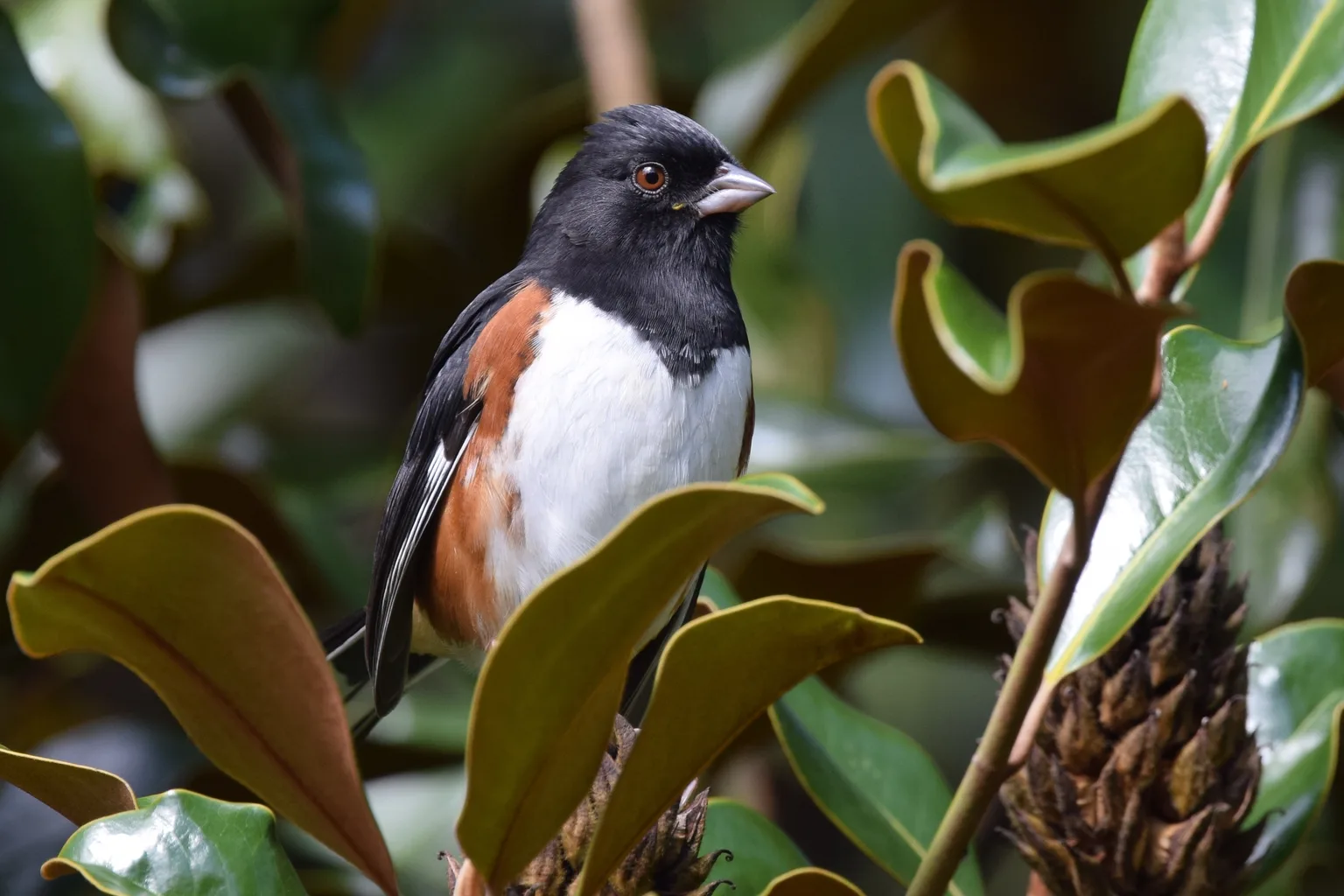
It’s a big, long-tailed sparrow with bold colors. The Cornell Lab describes the male as sooty black above and on the breast, with warm rufous sides and a white belly. The female has the same pattern but is rich brown where the male is black.
That makes it about 30 percent larger than a Song Sparrow and smaller than an American Robin. Both sexes flash white corners on the tail, especially when they fly or get nervous, and males show a small white mark on the wing.
Eye color varies by region. Most Eastern Towhees have reddish eyes, but the Cornell Lab notes that birds in southern Georgia and Florida have pale yellow eyes. Audubon describes these southeastern birds as white-eyed. Young towhees look quite different: brownish and heavily streaked from hatching into early fall.
What do Eastern Towhees eat?
Almost anything they can find on the ground. The Cornell Lab lists seeds, fruits, insects, spiders, millipedes, centipedes and snails, plus spring buds, acorns, blackberries, blueberries and the seeds of ragweeds, smartweeds and grasses.
Audubon adds beetles, caterpillars, moths, ants and other insects, and notes that towhees occasionally take small salamanders, lizards or snakes.
How they find food is the key to attracting them. Towhees scratch with a backward hop, using both feet at once to flip the leaves, then pounce on whatever turns up. Audubon says they forage mostly on the ground and only sometimes go up into shrubs and low trees. A yard with bare lawn and tidy beds gives them nothing to scratch through.
Do Eastern Towhees come to bird feeders?
Yes, but usually to the ground beneath the feeder rather than the feeder itself. The Cornell Lab says towhees visit yards with brushy, shrubby or overgrown borders and eat fallen seed near feeders.
Here’s what tends to work, based on advice from the Cornell Lab, the Maryland Department of Natural Resources and Birds and Blooms:
| Food or setup | Why it suits towhees | Source |
|---|---|---|
| White proso millet scattered on the ground | Small seed eaten where towhees naturally forage | Kenn and Kimberly Kaufman, Birds and Blooms |
| Sunflower seed | Listed as a towhee food in feeding charts | Maryland DNR |
| Cracked corn | Listed as a towhee food in feeding charts | Maryland DNR |
| Low platform feeder | Platforms draw birds that feed on the ground | Maryland DNR |
| Hanging tube feeder in the open | Rarely used; towhees feed below it on spilled seed | Cornell Lab |
A few practical points:
- Put food near cover. Place seed a few feet from dense shrubs so towhees can feed and dash back to safety. Our guide on where to put a bird feeder explains how to balance cover and visibility.
- Use a low tray. A platform feeder set close to the ground mimics the way towhees feed.
- Offer small amounts. Seed on the ground can get wet and moldy, so scatter only what birds will clear in a day.
- Choose a ground-feeder mix. Our best bird seed guide covers which seeds suit ground feeders such as towhees, sparrows and juncos.
Be patient. Kenn and Kimberly Kaufman note that even with good seed out, towhees may still prefer foraging naturally on the ground. The habitat around your feeder matters as much as the food in it.
How do you make your yard towhee-friendly?
Give them dense, low cover with leaf litter underneath. The Cornell Lab says Eastern Towhees need dense shrub cover with abundant leaf litter, in places like forest edges, overgrown fields, thickets and scrubby backyards.
1. Keep shrubs low and dense
Kenn and Kimberly Kaufman advise keeping shrub branches low and letting dry leaves accumulate under them. A shrub border, a hedge or a tangle of native vines gives towhees cover to hide in and a place to sing from.
2. Leave the leaves
Don’t rake out every bed. Leaf litter is where towhees scratch for insects, spiders and seeds all year. Our guide on why you should leave the leaves explains what fall cleanup takes away from ground-feeding birds.
3. Build a brush pile
A loose pile of branches and prunings near the feeding area gives towhees and other ground birds quick cover from hawks. See how to build a brush pile for birds for a simple layered design.
4. Add water at ground level
The Kaufmans suggest a ground-level bird bath with a dripper or another source of moving water. Our guide on where to put a bird bath covers placement near cover.
5. Protect ground feeders from cats
Towhees spend most of their time on the ground, which makes them vulnerable. Keeping cats indoors is one of the most useful things you can do; see cats and birds for practical options.
What does an Eastern Towhee sound like?
The song is a loud, ringing drink-your-tea, and the call is a rising chewink. The Cornell Lab says the song lasts about a second: the first note is sharp and metallic and the final note is a musical trill. Males sometimes start with several drink notes.
Both sexes give the two-part call, written as chewink, tow-hee or joree, often as an alarm. The Cornell Lab notes that it varies by region from clear whistles to hoarse or nasal sounds. That call gave the bird its name.
Listening is the easiest way to find out whether towhees already live near you. A sound ID app helps a lot here; our guide to Merlin Sound ID explains how to get reliable results.
Where do Eastern Towhees nest?
Usually on the ground, in a cup tucked into fallen leaves. The Cornell Lab says some nests are placed in shrubs or vine tangles up to about 4 feet high, and Audubon puts the usual height at less than 5 feet.
| Nesting detail | Eastern Towhee |
|---|---|
| Nest site | On the ground in leaves, or low in shrubs and vine tangles |
| Builder | Female, over about 5 days |
| Materials | Bark strips, twigs, dead leaves and stems, lined with fine grass, rootlets and hair |
| Clutch size | 2 to 6 eggs |
| Incubation | 12 to 13 days |
| Nestling period | 10 to 12 days |
| Broods per year | 1 to 3 |
Nesting data from the Cornell Lab’s life history page.
Towhee nests have a common problem. The Cornell Lab says Brown-headed Cowbirds lay eggs in more than half of towhee nests in some areas, and towhees can’t recognize the foreign eggs. If you find a nest, watch from a distance and leave that corner undisturbed until the young have left.
When will you see Eastern Towhees?
It depends on where you live. Audubon says many southern towhees are permanent residents, while most northern birds migrate. In the Southeast you can expect them all year; farther north they arrive in spring and leave in fall.
The range map on All About Birds shows year-round, breeding and wintering areas across eastern North America. For sightings close to home, check recent reports for your county on eBird.
Eastern Towhee or Spotted Towhee?
Check the back. The Cornell Lab describes the Spotted Towhee as having bright white spots on its wings and back, while the Eastern Towhee’s back is plain.
| Look at | Eastern Towhee | Spotted Towhee |
|---|---|---|
| Back and wings | Plain black (male) or brown (female), small white wing patch | Black or brown with bright white spots |
| Range | Eastern North America | Western North America |
| Habitat | Brushy edges, thickets, scrubby yards | Sun-baked thickets of the West |
The Cornell Lab says the two used to be considered the same species, and they still interbreed where their ranges overlap in the Great Plains. Outside that zone, your location usually settles it.
Are Eastern Towhees declining?
Yes. The Cornell Lab says the species has declined by about 60 percent since 1966, roughly 1.6 percent per year, and lists it as an Orange Alert species on the Tipping Point list. Audubon notes serious declines in the Northeast in recent decades.
There are still plenty of them. The Cornell Lab puts the global breeding population at about 29 million and gives the species a Continental Concern Score of 13 out of 20. Because towhees depend on shrubby, overgrown habitat, yards that keep dense shrubs and leaf litter can give them real help.
Who shouldn’t expect towhees?
Some yards are unlikely to draw them, whatever food you put out:
- Open lawn with no shrubs. Without dense, low cover and leaf litter, towhees have no reason to stay.
- Feeders only on a high balcony. Towhees feed on the ground and rarely come up to hanging feeders.
- Homes in the West. You’re in Spotted Towhee country instead, though the same yard plan works for that species too.
If that sounds like your yard, start with a shrub border and a leaf-filled bed before buying any feeder. Other ground feeders such as the Dark-eyed Junco benefit from the same changes.
Sources
- Cornell Lab of Ornithology, All About Birds: Eastern Towhee Overview, Identification, Life History and Sounds
- Cornell Lab of Ornithology, All About Birds: Spotted Towhee Identification
- Audubon Guide to North American Birds: Eastern Towhee
- Birds and Blooms: Meet the Towhee Birds Scratching up a Storm
- Maryland Department of Natural Resources: Supplemental Feeding Wild Birds (PDF)

Frequently asked questions
Do Eastern Towhees eat from bird feeders?
Mostly from the ground below them. The Cornell Lab of Ornithology says towhees eat fallen seed near feeders, and they rarely cling to hanging tube feeders. Seed scattered on the ground or a low platform feeder a few feet from dense shrubs works much better. The Maryland Department of Natural Resources lists sunflower seed and cracked corn as foods towhees take, and Kenn and Kimberly Kaufman suggest white proso millet.
What is the best food for Eastern Towhees?
Small seeds served on the ground near cover. Kenn and Kimberly Kaufman recommend quality seed such as white proso millet, and the Maryland Department of Natural Resources lists sunflower and cracked corn. In the wild, the Cornell Lab says towhees eat seeds, fruits, insects, spiders, millipedes, centipedes and snails, so leaf litter and berry shrubs feed them too. Offer small amounts that get eaten the same day.
Where do Eastern Towhees nest?
Usually on the ground. The Cornell Lab says the female builds a cup nest sunk into fallen leaves, or sometimes places it in a shrub or vine tangle up to about 4 feet high. She lays 2 to 6 eggs and incubates them for 12 to 13 days. Towhees don't use nest boxes, so the best nesting help is a quiet, leafy corner with dense shrubs that you leave alone in spring and summer.
What does an Eastern Towhee sound like?
The song is a loud drink-your-tea that lasts about a second, with a sharp first note and a musical trill at the end, according to the Cornell Lab. Both sexes give a rising chewink or tow-hee call, often as an alarm. You'll usually hear a towhee, or the rustle of leaves it's kicking, well before you see it under the shrubs.
How can I tell an Eastern Towhee from a Spotted Towhee?
Look at the back and wings. The Cornell Lab says the Spotted Towhee has bright white spots on its wings and back, while the Eastern Towhee's back is plain black in males and brown in females. Range helps too: Spotted Towhees live in the West and Eastern Towhees in the East. The two were once treated as one species and can hybridize where they meet in the Great Plains.