Bohemian Waxwing: Winter Irruptions and Where to Look
The Bohemian waxwing is a crested berry eater from the northern forests that floods south in irruption winters when rowan crops fail. How to find and ID one.
In this article
The Bohemian waxwing (Bombycilla garrulus) is a starling-sized, crested berry eater that breeds in the northern forests of Scandinavia, Russia and northern North America. In most winters only a few move south, but when the rowan berry crop fails up north, flocks pour into Britain and western Europe in what birders call an irruption.
That unpredictability is a big part of the appeal. One winter you won’t see a single waxwing; the next, a flock of fifty is stripping the berries off a shrub in a supermarket car park. This guide explains why that happens, when and where to look, and how to make your garden worth a stop.
What does a Bohemian waxwing look like?
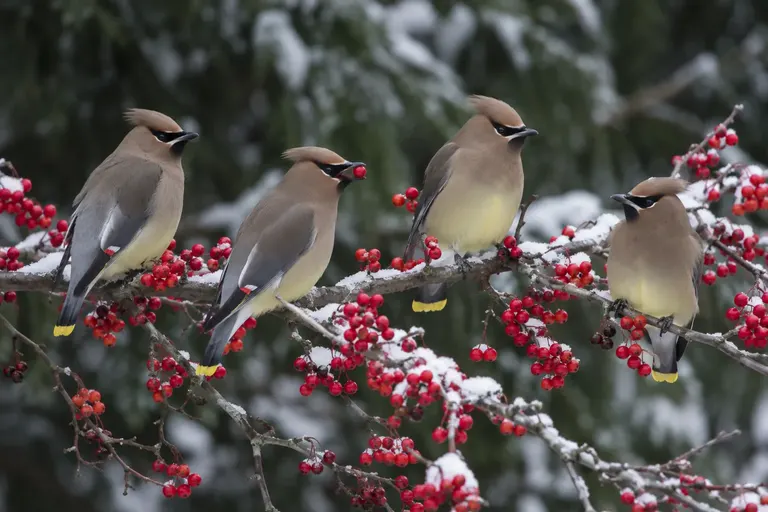
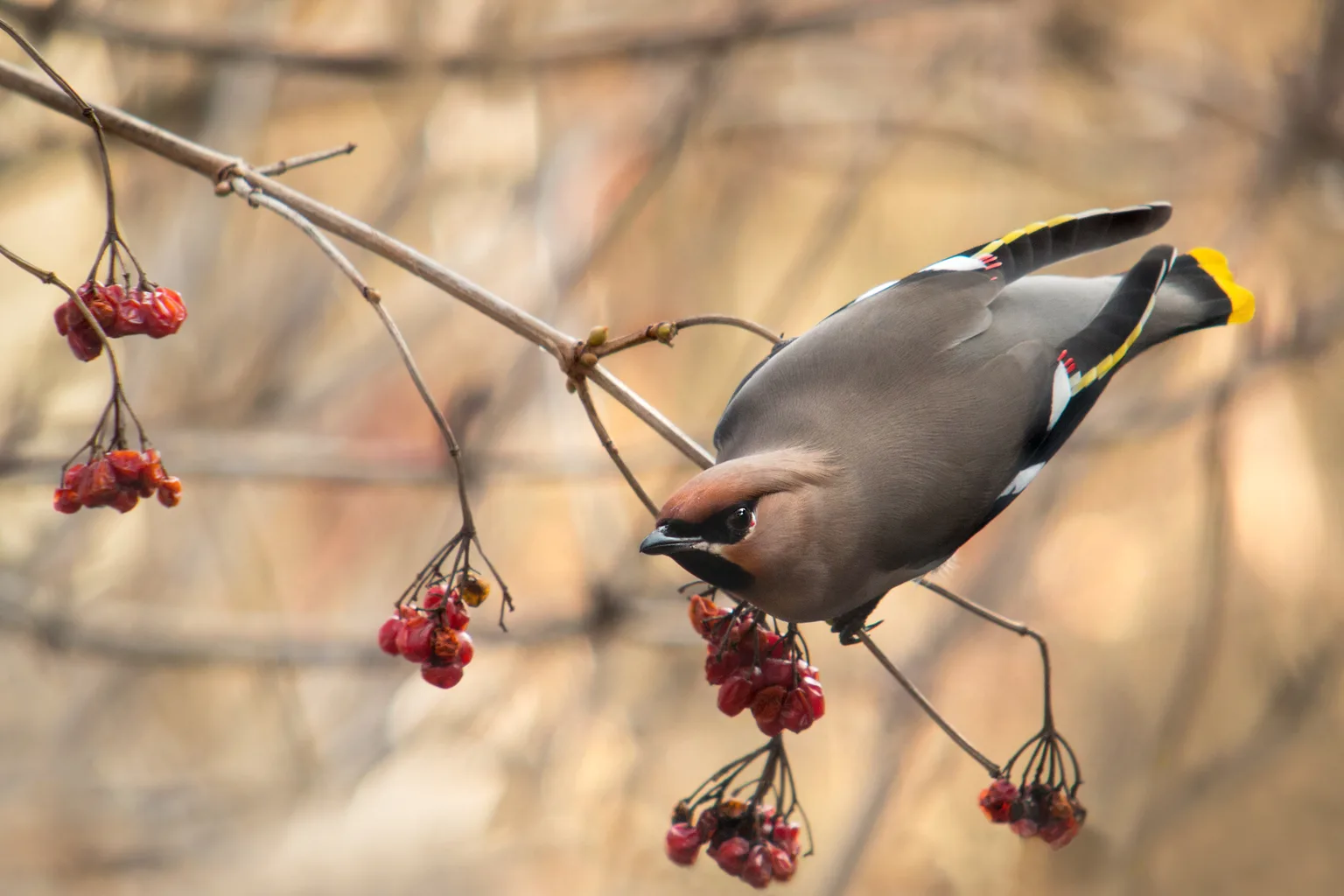
It’s a plump, pinkish-brown bird about the size of a starling, with a tall crest, a black mask and a black throat. The real giveaways are on the wings and tail: bright yellow tail tips and small red, wax-like tips on some wing feathers, which give the bird its name.
NABU and Vogelbescherming Nederland give a length of 18 to 21 cm, about 7 to 8 inches. The BTO puts the average adult weight at 58 grams, with a range of 51 to 66 grams. Up close you’ll also see white and yellow markings on the black wing tips and rusty-chestnut feathers under the tail.
According to the Cornell Lab, the red and yellow tips come from carotenoid pigments in the fruit the birds eat, and the tips get larger with age. Vogelbescherming Nederland adds that males tend to show a broader yellow tail band and more red tips than females.
| Feature | Bohemian waxwing | Cedar Waxwing | Starling |
|---|---|---|---|
| Range | Northern Europe, Asia and North America | North and Central America | Europe, widely introduced |
| Body colour | Pinkish grey-brown | Brown with a yellowish belly | Glossy dark, spotted in winter |
| Crest | Tall and obvious | Shorter | None |
| Under the tail | Rusty chestnut | White | Dark with pale edges |
| Wing marks | White and yellow marks, red waxy tips | Red waxy tips, no white or yellow | No bright marks |
At a distance, and especially in flight, a waxwing flock can look a lot like starlings. Oiseaux.net points out that size, shape, flight and flocking are similar. The trilling call usually settles it. The Cornell Lab notes that Bohemian waxwings don’t have a true song and keep in touch with high-pitched calls instead.
If you’re new to telling similar birds apart, our guide to how to identify birds covers the shape, behaviour and sound checks that work for any species.
Why do waxwings irrupt?
Waxwings irrupt because their winter food runs short in the north. The BTO says waxwings invade Britain when the rowan berry crop fails in Fennoscandia, and NABU describes the waxwing as a textbook example of an “invasion bird” whose winter numbers depend entirely on conditions in its breeding area.
The RSPB adds another layer: irruptions happen when the breeding population has grown too large for the food available. A run of good breeding seasons followed by a poor berry year is the classic recipe. Family groups then move further and further from home until they find fruit.
NABU notes that mass waxwing invasions have been recorded in central Europe since the late Middle Ages, so this is an old pattern, not a new one. The BTO highlights two big recent irruptions into Britain, in autumn 2008 and autumn 2010. In 2010 cold weather pushed birds as far as the English south coast, and the BTO says the waxwing’s winter range in Britain was more than ten times larger than in the early 1980s.
When do waxwings arrive?
Expect the first birds in October and the main arrival in November and December. Vogelbescherming Nederland gives October to February as the window in the Netherlands, with most sightings in November and December, and says birds are gone between February and April.
The BTO describes how the first birds reach the Northern Isles and the North Sea coast, then work their way south and west as they eat their way through each area’s berries. That’s why northern and eastern regions usually get waxwings first, and why a flock can vanish overnight once a street’s berries are gone.
| Where | Usual season | Best areas | Typical numbers |
|---|---|---|---|
| Britain | Late autumn to early spring | Northern Isles, North Sea coast, north and east England | About 10,000 a winter (BTO estimate, 2012-17), far more in irruption years |
| Netherlands | October to February | The north, gardens and parks with berry shrubs | 100 to 1,200 wintering, 2,000 to 10,000 passing through (Sovon) |
| Germany | Winter | The north and east | Varies hugely from year to year (NABU) |
| France | Winter, irregular | Wherever berries are plentiful in invasion years | Occasional, mainly during invasions (Oiseaux.net) |
| North America | September to March | Northern US and Canada | Roaming flocks, hard to predict (Cornell Lab) |
These figures shift a lot. Sovon says it can’t calculate a trend for the Netherlands at all, because numbers swing so much from one winter to the next.
Where can you see waxwings?
Look wherever there are lots of berries, including some unglamorous places. The RSPB says waxwings often turn up on suburban streets lined with berry bushes and in supermarket car parks, as well as near rowan and hawthorn trees, and that northern and eastern England give the best odds.
Vogelbescherming Nederland says the birds are mostly found in gardens and parks in built-up areas, wherever berry shrubs grow. In North America the Cornell Lab describes flocks of about 50 to 300 birds, sometimes thousands, roaming unpredictably and descending on fruiting trees. A flock can strip an isolated shrub in minutes.
A few practical tips:
- Listen first. The trilling call often gives a flock away before you see it.
- Check berry hot spots. Rowan, hawthorn, guelder rose and cotoneaster along roads, retail parks and new housing estates are prime spots.
- Follow local sightings. Bird club and rare bird news services post waxwing flocks quickly in irruption years.
A pair of binoculars makes the red wax tips and yellow tail band easy to see without getting close. Our guide to the best binoculars for backyard birding covers models that suit garden and street watching.
What do waxwings eat?
In winter waxwings eat almost nothing but fruit. The Cornell Lab says their non-breeding diet is almost entirely fruit, swallowed whole. NABU names juniper, rowan and guelder rose as favourites, and Vogelbescherming Nederland adds hawthorn, privet and cotoneaster.
They eat a remarkable amount. NABU says a waxwing can eat about twice its own body weight in a day, and that its large liver lets it cope with berries that have started to ferment. Oiseaux.net notes that mistletoe berries are a winter favourite in urban parks. In summer the diet changes: the birds catch insects in flight from a perch.
The Cornell Lab also notes that waxwings often drink water and eat snow to help digest all that fruit. In late winter they even sip sap from maple and birch trees.
How can you attract waxwings to your garden?
Plant berry shrubs and leave the fruit on them. Seed feeders won’t tempt a waxwing, but a garden full of berries might. Vogelbescherming Nederland recommends rowan, privet, hawthorn, guelder rose, cotoneaster and ornamental crab apples, and says gardens with plenty of these can be visited for longer.
NABU gives the same advice: plant berry-bearing trees and shrubs, and leave the wrinkled fruit hanging through the winter instead of tidying it away. Our guide to berry shrubs that feed birds all winter helps you choose plants that fruit at different times.
Water matters too. Because waxwings drink often, an open bird bath in freezing weather can help. See how to keep a bird bath ice-free in winter for safe ways to do that. Apples are on the Cornell Lab’s list of fruits waxwings eat, so windfall apples left on the lawn are worth a try in an irruption year, and they’ll feed blackbirds and thrushes either way.
For everything else in your winter garden, our guide to what to feed birds in winter covers seed, fat and fruit for the regulars.
Are Bohemian waxwings declining?
In Europe the species is doing fine. The BTO lists it as Green on the UK Birds of Conservation Concern list and Least Concern globally on the IUCN Red List. NABU rates it as not threatened, and Vogelbescherming Nederland says the same.
North America is a different story. The Cornell Lab lists the Bohemian waxwing as a Common Bird in Steep Decline there, though it doesn’t spell out the causes on its species page.
Are there other waxwings?
Yes, three species exist worldwide. Besides the Bohemian waxwing there’s the Cedar Waxwing of North America and the Japanese Waxwing of East Asia. If you live in North America you might see both of the first two in the same flock, since the Cornell Lab notes that Cedar Waxwings and American Robins sometimes join roaming Bohemian flocks.
For the North American species, see our guide on how to attract Cedar Waxwings. And if you’re wondering where your summer visitors are while the waxwings arrive, read where do birds go in winter or our list of winter birds arriving at your feeder.
Sources

Frequently asked questions
Why do Bohemian waxwings turn up in some winters and not others?
Their winter food is berries, above all rowan. The BTO explains that waxwings irrupt into Britain when the rowan crop fails in Fennoscandia, and NABU says the same for Germany. In a good berry year most birds stay further north and east, so you may see none. In a poor year flocks spread south and west, sometimes far beyond their usual range.
When is the best time to see waxwings?
Late autumn into early spring. Vogelbescherming Nederland says arrivals can start in October, with most sightings in November and December, and birds can stay until February. In North America the Cornell Lab gives September to March. Early arrivals land in the north and east first, then move on as each area's berries are eaten.
How can you tell a Bohemian waxwing from a Cedar Waxwing?
Look under the tail and at the wing. The Cornell Lab notes that Bohemian waxwings have rusty undertail feathers and white marks on the wings, which Cedar Waxwings lack. Bohemians are also greyer overall, while Cedars show a yellowish belly. In Europe only the Bohemian occurs, so any waxwing there is almost certainly this species.
Do waxwings come to bird feeders?
Rarely, because they eat fruit, not seed. The Cornell Lab says they feed almost entirely on fruit outside the breeding season. Your best chance is a garden with berry shrubs such as rowan, hawthorn, guelder rose or cotoneaster, which Vogelbescherming Nederland recommends. Leave the fruit on the branch through winter and keep a bird bath open, since waxwings drink often.
Are Bohemian waxwings endangered?
Not in Europe. The BTO lists the species as Green on the UK conservation list and Least Concern on the IUCN Red List, and NABU rates it not threatened. The Cornell Lab, however, lists it in North America as a Common Bird in Steep Decline, so the picture depends on where you look.