How to Attract Northern Flickers: Ants, Berries and Boxes
How to attract northern flickers: skip lawn insecticides so ants thrive, plant native berry shrubs, add a bird bath, and mount a wood-chip-filled nest box.
In this article
- Quick answer: what northern flickers need
- Northern flicker at a glance
- How to identify a northern flicker
- Where do northern flickers live?
- What do northern flickers eat?
- How to make your yard flicker-friendly
- Northern flicker nesting
- Seasonal calendar
- Common problems and fixes
- Why northern flickers need help
- Common mistakes when trying to attract northern flickers
- Sources
- Frequently asked questions
Here is how to attract northern flickers: focus on the ground, where they probe for ants with a tongue reaching about 2 inches past the bill: stop using lawn insecticides so ants can thrive, keep open patches of lawn or bare soil near trees, plant native berry shrubs, and add a bird bath. The Cornell Lab notes flickers rarely visit feeders but use nest boxes more readily than most woodpeckers. A box packed with wood chips can bring a pair to your yard.
Quick answer: what northern flickers need
| Need | What works best | Notes |
|---|---|---|
| Food | Ants and beetles in the soil; native berries in fall and winter | They are ground foragers |
| Yard layout | Open ground with scattered trees and forest edge | They avoid dense, unbroken forest |
| Feeders | Optional; some visit suet | Not a reliable draw |
| Water | Bird bath | The Cornell Lab notes they use baths |
| Nesting | Dead trees, or a large nest box packed with wood chips | NestWatch publishes box specs |
| Avoid | Lawn insecticides | They remove the ants flickers eat |
Northern flicker at a glance
| Trait | Detail |
|---|---|
| Size | 11.0 to 12.2 in long, 3.9 to 5.6 oz, wingspan 16.5 to 20.1 in |
| Range | Alaska and Canada south through the US to Nicaragua |
| Season | Year-round in much of the US; northern birds migrate south |
| Diet | Mainly ants and beetles; berries and seeds in winter |
| Feeder use | Occasional; not a habitual feeder bird |
| Nesting | Excavates cavities in dead or diseased trees; uses nest boxes |
| Clutch | 5 to 8 white eggs, one brood a year |
Measurements and nesting details come from the Cornell Lab of Ornithology’s All About Birds account.
How to identify a northern flicker
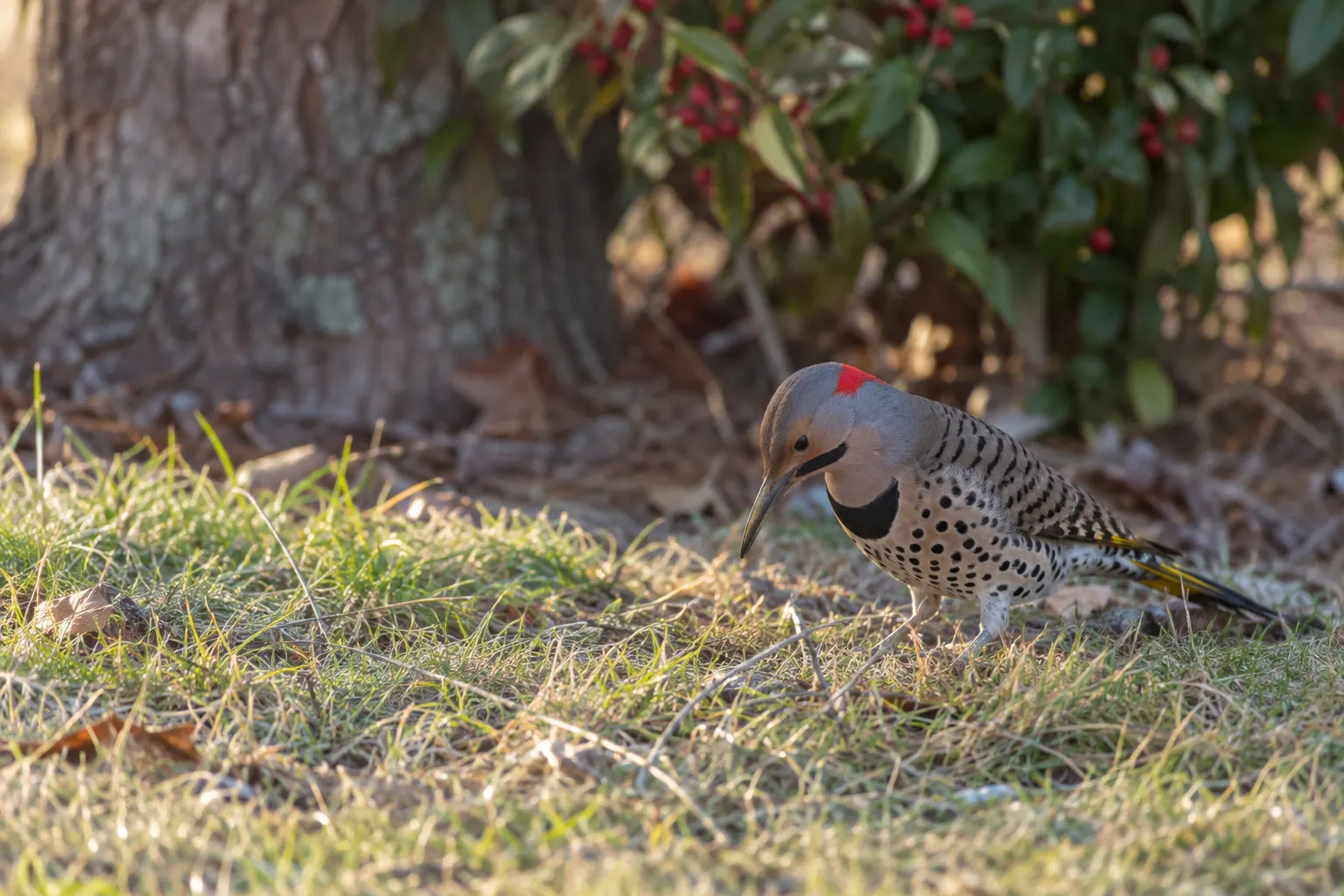
Northern flickers are large, brown woodpeckers, bigger than a robin and a little smaller than a crow. The Cornell Lab describes them as having a gentle expression and handsome black-scalloped plumage.
Key marks:
- Brown back barred with black.
- Buff or whitish underparts covered with round black spots.
- A black crescent across the upper chest.
- A bright white rump patch, very obvious when the bird flies away.
- Yellow or salmon-red color under the wings and tail, flashing in flight.
- A slightly curved bill, unusual for a woodpecker.
Behavior is a strong clue too. Flickers often feed on the ground, hopping across lawns and probing for ants. They also perch upright on horizontal branches, rather than always clinging to trunks like other woodpeckers. In flight they rise and fall in a smooth, undulating path, with heavy flaps between glides.
Yellow-shafted vs red-shafted flickers
The northern flicker has two main forms, which the Cornell Lab describes as follows.
| Feature | Yellow-shafted (East and North) | Red-shafted (West) |
|---|---|---|
| Underwing and tail color | Bright yellow | Salmon-red |
| Face | Tan, with a gray crown | Gray, with a brown crown |
| Male mustache | Black | Red |
| Female mustache | None | None |
| Red nape crescent | Yes, both sexes | No |
The two forms interbreed widely across a broad zone from Alaska to the Texas panhandle, and hybrids show a mix of traits, such as a red mustache with a red nape crescent. On the Great Plains, intermediate birds are common.
Male vs female
In both forms, the mustache stripe is the tell. Males have one, black in yellow-shafted birds and red in red-shafted birds. Females lack it.
Similar species
The Cornell Lab lists gilded flicker, Gila woodpecker and red-bellied woodpecker. Gilded flickers live in Sonoran Desert saguaro country and look like a red-shafted bird with yellow underwings. Gila woodpeckers and red-bellied woodpeckers are gray-faced with barred backs and lack the flicker’s spotted belly and black chest crescent. For the eastern lookalike, see our guide on attracting red-bellied woodpeckers.
Calls and drumming
The Cornell Lab describes a loud clear call, often written as kleer or kyeer. Flickers also give a long, rolling series of wick-wick-wick notes in spring. They drum on trees and on resonant objects, including metal, and the sound can carry a long way. A sound ID app can help confirm, but always check what you hear against what you see.
Northern flicker vs other backyard woodpeckers
Flickers behave so differently from other woodpeckers that the attraction strategy changes too. This comparison uses Cornell Lab measurements.
| Species | Length | Main foraging spot | Feeder habit | Nest box use |
|---|---|---|---|---|
| Northern flicker | 11.0 to 12.2 in | Ground, lawns, open soil | Occasional | Uses boxes packed with wood chips |
| Red-bellied woodpecker | 9.4 in | Trunks and main branches | Regular | Sometimes |
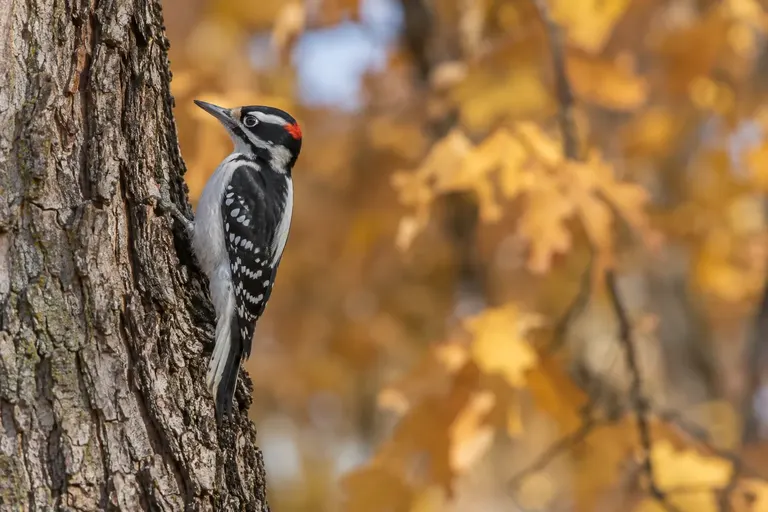
| Hairy woodpecker | 7.1 to 10.2 in | Trunks and large limbs of big trees | Regular in winter | Rarely |
| Downy woodpecker | 5.5 to 6.7 in | Twigs, small branches, weed stems | Very regular | Rarely |
If you already feed downy woodpeckers and hairy woodpeckers, the same suet setup may occasionally catch a flicker, but the lawn and the nest box matter far more for this species.
Watching flickers without flushing them
Flickers on the ground are wary and often fly up at the first movement, flashing the white rump as they go. Watching from indoors, through a window that faces the lawn, usually gives longer views than stepping outside. Binoculars help you pick out the mustache and nape markings that separate males from females and the two forms from each other. Our guide to the best binoculars for watching birds from your window covers models suited to that kind of viewing.
Where do northern flickers live?
Audubon describes the range as spanning Alaska to Nicaragua. Across much of the lower 48 states, flickers are present year-round, but the Cornell Lab notes they are one of the few strongly migratory North American woodpeckers. Northern birds move south for winter, while some individuals stay year-round even in northern areas.
Audubon adds that yellow-shafted birds from the North migrate southeast, with notable concentrations along the Atlantic Coast in fall. Red-shafted birds usually migrate shorter distances, often moving between elevations.
Habitat
The Cornell Lab lists woodlands, forest edges, open fields with scattered trees, city parks and suburbs, plus wet areas such as streamside woods, flooded swamps and marsh edges. In western mountains they use most forest types, including burned areas up to treeline. Audubon notes they avoid dense, unbroken forest and need open ground for foraging.
That makes a typical suburban yard, with lawn, scattered mature trees and a woodland edge nearby, close to ideal flicker habitat.
What do northern flickers eat?
Ants, above all
Audubon notes the northern flicker eats ants more than any other North American bird. The Cornell Lab explains that flickers dig for ants and beetles with their slightly curved bill, even hammering at soil the way other woodpeckers hammer at wood, and lap up ants and larvae with a long, barbed tongue. The tongue can extend about 2 inches beyond the tip of the bill.
Other animal foods include flies, butterflies, moths, snails, termites and caterpillars.
Winter fruits and seeds
When insects are scarce, the Cornell Lab lists berries and seeds of poison oak, poison ivy, dogwood, sumac, wild cherry, grape, bayberry, hackberry, elderberry, sunflower and thistle. Audubon notes flickers will perch in outer branches to reach fruit.
Do northern flickers come to bird feeders?
Not habitually, according to the Cornell Lab. Some flickers do take suet, peanuts or sunflower hearts, especially in cold weather when ground insects are hard to reach. If you want to try:
- Offer suet in a tail-prop feeder or large cage, so a big bird can brace.
- Place it near the ground-foraging areas the flicker already uses, and near trees.
- Add a platform with peanuts or hulled sunflower close to the ground.
- Be patient and keep expectations modest. Many yards with resident flickers rarely see them at feeders.
Our roundup of the best suet cakes and suet blends covers suet options, and the best suet feeders includes tail-prop designs suited to larger woodpeckers.
How to make your yard flicker-friendly
This is where most of the results come from. Flickers are attracted by food in and on the ground, cover and nest sites, not by seed.
1. Stop using lawn insecticides
Ants are the flicker’s main food, and broad-spectrum lawn insecticides remove them. NestWatch specifically advises avoiding lawn chemicals where flickers forage. A lawn with some ant activity is a flicker feeding station.
2. Keep some open ground
Flickers need open patches to forage. Short grass, thin turf, patchy areas and bare soil near trees all work. A yard that is entirely dense shrubs or deep mulch offers less.
3. Plant native fruiting shrubs and vines
Choose plants native to your region that hold fruit into fall and winter. Good starting points include dogwoods, sumac, native cherries, bayberry, hackberry, elderberry and native grapes. A cooperative extension office or native plant society can suggest what suits your area.
4. Leave standing dead wood when safe
Flickers excavate nests in dead or diseased trees. The Cornell Lab notes trembling aspen is commonly used in the North, and Audubon lists pine, cottonwood and willow. Where a dead tree poses no risk to people, buildings or power lines, leaving it standing, or cutting it back to a tall safe stub, can provide a nest site.
5. Add a bird bath
The Cornell Lab notes flickers use bird baths. A wide, shallow basin set at ground level or on a low pedestal suits a large, ground-foraging bird. In freezing climates, a heated bath helps in winter; see our winter bird feeding guide for more.
6. Keep cats indoors
Ground-foraging birds are especially exposed to cats. Indoor cats are the most effective protection.
Northern flicker nesting
According to the Cornell Lab and Audubon:
- Site: dead or diseased trees, typically 6 to 15 feet up (occasionally much higher). Flickers also reuse old cavities, their own or other species’.
- Excavation: both sexes dig.
- Entrance: about 3 inches in diameter.
- Cavity: 13 to 16 inches deep, widening at the bottom, with only a bed of wood chips.
- Eggs: 5 to 8 all-white eggs.
- Incubation: 11 to 13 days.
- Nestling period: 24 to 27 days.
- Broods: one per year.
In the breeding season, the Cornell Lab describes rival flickers holding “fencing duels,” facing each other with bills pointed up and bobbing their heads in rhythm.
Northern flicker nest box specs
NestWatch, the Cornell Lab’s nest-monitoring program, publishes these specifications:
| Spec | Value |
|---|---|
| Floor | 7.25 x 7.25 in |
| Interior depth | 24 in |
| Entrance hole | 2.5 in |
| Mounting height | 6 to 12 ft |
| Spacing | 330 ft between boxes |
| Mount | Dead tree, live tree, pole or post |
| Orientation | Entrance facing south or east |
| Fill | Pack to the top with white pine wood chips |
How to set up a flicker box, step by step
- Build or buy a box to the specs above, made of thick lumber. NestWatch suggests 1.5 inch boards.
- Cut shallow grooves inside the front wall below the entrance, about 0.25 inch deep and 0.5 inch apart, so nestlings can climb out.
- Pack the box to the top with white pine wood chips. Flickers want to excavate; filling the box gives them something to dig out.
- Mount it 6 to 12 feet up, facing south or east, angled slightly forward, in a shady spot near sparse trees with an open flyway.
- Add a baffle if you use a pole, and place the pole at least 10 feet from trees to deter squirrels.
- Replace the chips with fresh ones by April 1 every year, before nesting starts.
Starlings: the flicker’s main nesting competitor
Audubon identifies European starlings as a significant threat, because they take over freshly excavated flicker cavities. NestWatch advises managing starlings near flicker boxes. Monitoring the box and removing starling nesting material, which is legal because starlings are non-native and not protected under federal law, can help flickers keep the site. Avoid feeding foods that draw large starling flocks near the box. Our guide to keeping starlings and grackles off feeders explains how.
Seasonal calendar
This varies with latitude and with whether your flickers are residents or migrants.
| Months | What northern flickers are doing | What to do |
|---|---|---|
| January to February | Residents eating berries, seeds and some suet; migrants still south | Keep water open; leave fruiting shrubs unpruned |
| March to April | Migrants return north; calling and drumming | Refresh nest box chips by April 1 |
| May to June | Excavating, laying and incubating | Avoid lawn insecticides; watch for starlings |
| June to July | Feeding young; fledglings follow adults on lawns | Keep cats indoors; keep bath clean |
| August to October | Heavy ant feeding, then fall migration | Leave ant hills where practical |
| November to December | Berries and seeds dominate the diet | Offer suet if you want to try feeders |
Common problems and fixes
Flicker drumming on siding, gutters or a chimney cap
Spring drumming is territorial communication. It is loud on metal because metal resonates. The behavior usually fades once nesting begins. Temporary netting, padding or a strip of reflective tape over the spot can redirect the bird. Providing a nest box nearby may also help give the bird a better focus.
Flicker excavating holes in wood siding
Some flickers try to dig nest or roost holes in wooden siding, especially cedar. Covering the area promptly, offering a nest box a short distance away and checking for insect activity in the wall are reasonable first steps. Flickers are a protected native species, so harming them or disturbing active nests is illegal.
Flicker digging in the lawn
That is ant hunting. It is usually small, shallow probing and a sign your lawn supports insect life.
No flickers at the feeder
That is normal. Focus on habitat, water and a nest box instead.
Why northern flickers need help
The Cornell Lab reports a decline of about 1.2 percent per year between 1966 and 2021, a cumulative decline of about 49 percent, though the species is still widespread, common and of low conservation concern. Loss of dead trees, lawn pesticides and competition from starlings all make nesting and feeding harder. A chemical-free lawn, native plants and a well-maintained box are practical ways to help.
Common mistakes when trying to attract northern flickers
- Treating the lawn with insecticides. It removes the flicker’s main food.
- Expecting them at seed feeders. They are ground feeders first.
- Putting up an empty flicker box. Pack it with wood chips so they can excavate.
- Forgetting to refresh the chips each spring.
- Ignoring starlings. Monitor the box through nesting season.
- Removing every dead tree. Safe snags are prime nest sites.
Sources
Frequently asked questions
What attracts northern flickers to a yard?
Open ground full of ants, scattered trees and native berry plants. The Cornell Lab notes flickers eat mainly ants and beetles and do not habitually visit bird feeders, but they are drawn to yards with a mix of trees and open ground, and they use bird baths. Avoiding lawn insecticides, keeping fruiting shrubs and leaving safe dead trees make the biggest difference.
What do northern flickers eat?
Mostly ants. Audubon notes the northern flicker eats more ants than any other North American bird, digging them from soil with its slightly curved bill and lapping them up with a long barbed tongue. It also eats beetles, flies, moths and snails, and in fall and winter adds berries and seeds from plants such as dogwood, sumac, wild cherry, grape, bayberry and hackberry.
Will northern flickers use a nest box?
Yes, more readily than most woodpeckers, if the box is right. NestWatch recommends a 7.25 by 7.25 inch floor, about 24 inches of interior depth, a 2.5 inch entrance hole, mounting 6 to 12 feet up, and packing the box to the top with wood chips so the birds can excavate. Replace the chips with fresh ones by April 1 each year.
What is the difference between yellow-shafted and red-shafted flickers?
They are two forms of the same species. Yellow-shafted flickers, in the East and North, show yellow under the wings and tail; males have a black mustache and a red nape crescent. Red-shafted flickers, in the West, show salmon-red underwings; males have a red mustache and no nape crescent. The two interbreed widely on the Great Plains, producing intermediate birds.
Why is a flicker drumming on my house or chimney cap?
It is almost always communication, not feeding. Flickers drum on resonant objects, including metal flashing, gutters and chimney caps, to advertise territory and attract a mate in spring, and the Cornell Lab notes metal can carry the sound a long way. The behavior usually fades once nesting begins. Covering the spot temporarily with netting or padding can redirect the bird.