How to Attract Mourning Doves: Ground Feeding and Nesting
How to attract Mourning Doves: scatter millet and cracked corn on the ground or a platform near cover, add water, and plant dense trees or put up a nest cone.
In this article
- Mourning Dove at a glance
- How to identify a Mourning Dove
- Where Mourning Doves live
- What do Mourning Doves eat?
- Best feeders for Mourning Doves
- Water for Mourning Doves
- Plants and habitat for doves
- Nesting: how to help Mourning Doves raise young
- Step by step: set up a Mourning Dove feeding station
- Mourning Dove behavior worth watching
- Mourning Dove conservation and lead
- Seasonal calendar for Mourning Doves
- Common problems with Mourning Doves
- Common mistakes
- Sources
- Frequently asked questions
Here is how to attract Mourning Doves: feed them on the ground or a low platform: scatter white proso millet or cracked corn near shrubs or trees, add a birdbath, and give them dense branches or a nesting cone to build on. Seeds make up about 99 percent of their diet, and doves cannot cling to tube feeders, so if your yard only has hanging feeders they will simply clean up whatever other birds drop. A clear, open feeding area close to cover is what they want.
Mourning Doves are one of the most common and widespread birds in North America, and they adapt readily to towns, suburbs and farmland. Their soft cooing song is one of the most familiar backyard sounds, and they are easy to host once you understand how differently they feed from small songbirds.
Mourning Dove at a glance
| Trait | Details |
|---|---|
| Size | 9.1 to 13.4 in long, about 3 to 6 oz, wingspan about 17.7 in (robin-length, slimmer and longer-tailed) |
| Range | Southern Canada through the US to central Mexico |
| Season | Year-round in most of the US; northern birds move south in fall |
| Diet | Seeds, about 99 percent of the diet |
| Feeder type | Ground feeding, platform or tray, wide hopper ledges |
| Food | White proso millet, cracked corn, sunflower, safflower |
| Nesting | Flimsy twig platform in trees, shrubs, gutters, eaves; uses nest cones |
| Conservation | Low concern; about 150 million birds, down about 20 percent since 1966 |
How to identify a Mourning Dove
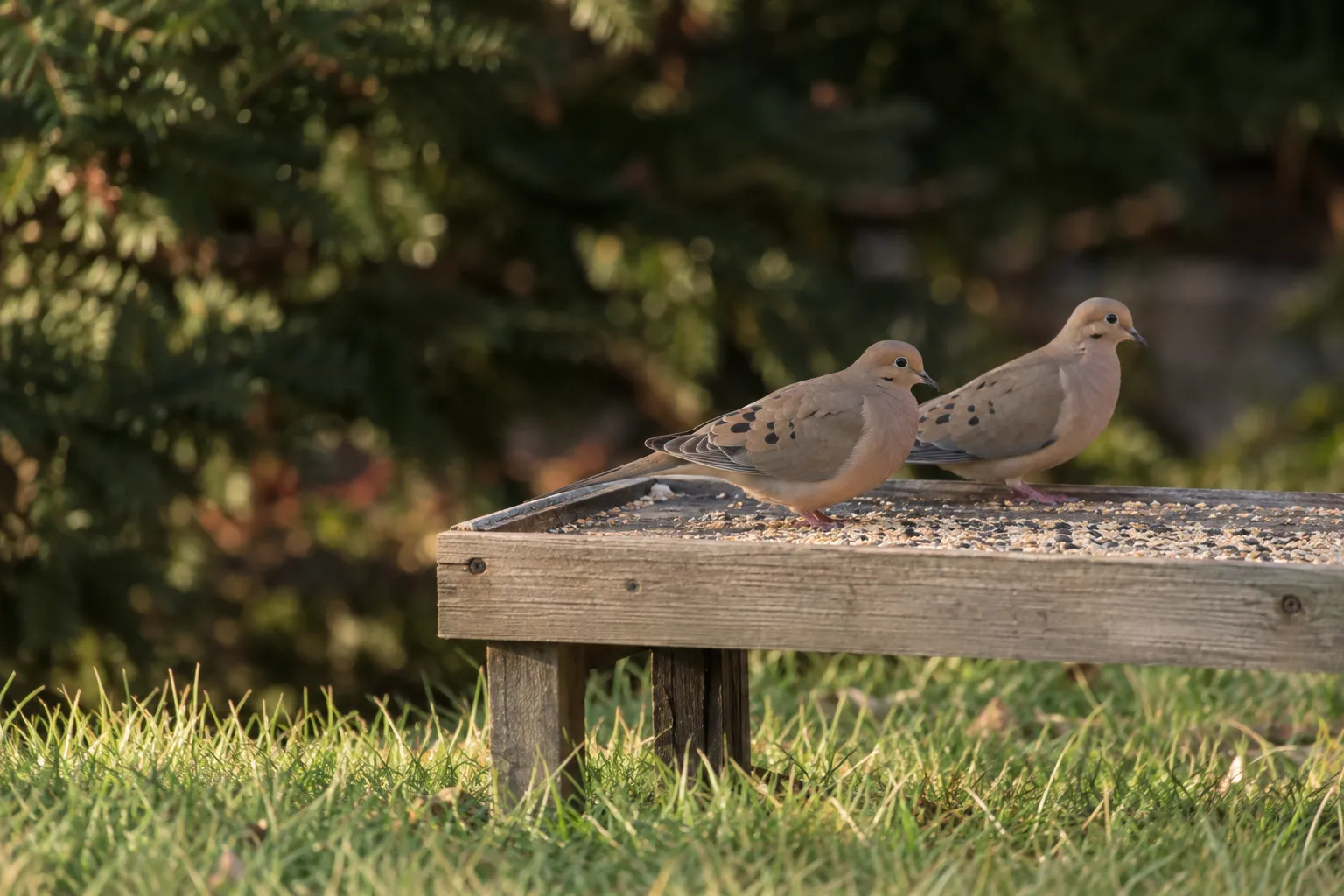
Mourning Doves are plump-bodied, long-tailed birds with short legs, a small rounded head and a small bill. The Cornell Lab notes the long, pointed tail is unique among North American doves, and it is the easiest mark to check.
Plumage
- Adults: delicate brown to buffy-tan overall, grayer on the back, with a pale peach or pinkish wash on the breast. Black spots mark the upper wings, and a small black spot sits on the side of the face below the eye. The tail feathers have white tips bordered in black, visible when the tail spreads on landing. The bill is thin and black and the legs are pinkish.
- Male vs female: very similar. Males tend to show a bluish-gray crown and a stronger pink wash on the breast, but in the field many birds cannot be sexed reliably. The Cornell Lab lists males as slightly heavier.
- Juveniles: show small white tips to most upperpart feathers, which gives them a scaly look, and lack the adult’s pink tones.
Voice and wing whistle
The male’s song is the soft, mournful “coo-OO-oo, oo, oo” that gives the species its name. People sometimes mistake it for an owl. When a dove takes off or lands, its wings make a high-pitched whistling sound, which the Cornell Lab describes as distinctive. Flight is fast and straight on powerful wingbeats.
Similar species
| Species | How to tell it from a Mourning Dove |
|---|---|
| Eurasian Collared-Dove | Larger and paler, with a bold black half-collar on the back of the neck and a squared-off tail |
| White-winged Dove | Bold white stripe along the wing, visible perched and in flight; shorter, square tail; mainly Southwest and Texas, expanding |
| Rock Pigeon | Stockier, with a short tail, often gray with dark wing bars; common in cities |
| Inca Dove | Much smaller, with a scaly pattern over the body; Southwest |
| Common Ground Dove | Tiny, short-tailed, with rufous in the wings in flight; Southern states |
Where Mourning Doves live
Audubon describes the range as southern Canada to central Mexico. They are present year-round across most of the lower 48 states, though many northern birds move south in fall, usually migrating by day in flocks.
They prefer open and semi-open country with scattered trees and woodland edges, and avoid unbroken forest. Farms, towns, roadsides, grasslands and suburban yards all suit them. The Cornell Lab suggests looking for them on telephone wires and other overhead perches, or on patches of bare ground.
What do Mourning Doves eat?
Seeds make up about 99 percent of a Mourning Dove’s diet, according to the Cornell Lab. That includes cultivated grains such as corn and wheat, wild grass seeds, and seeds of weeds and herbs such as ragweed. They occasionally eat berries and snails.
How doves feed
Doves feed quickly on the ground, pecking rather than scratching. Audubon notes they fill the crop fast, then fly to a safe perch to digest while resting. The Cornell Lab reports that a single dove’s crop has been found holding up to 17,200 bluegrass seeds, and that doves eat roughly 12 to 20 percent of their body weight per day. They also swallow grit, which helps grind seeds.
That feeding style has a practical consequence: a group of doves can clear a platform quickly, then sit nearby for long stretches doing nothing. It is normal behavior, not a sign they are waiting for more food.
Best foods for Mourning Doves
- White proso millet. The Cornell Lab’s top suggestion for doves. Small, round and inexpensive.
- Cracked corn. Readily eaten. It also attracts squirrels, blackbirds and other large birds, so offer small amounts.
- Black oil sunflower. Doves eat it, often picking up seed dropped from hanging feeders.
- Hulled sunflower chips. Easy to swallow, no shells.
- Safflower. Doves eat safflower, which many squirrels and some blackbirds tend to avoid. See our guide to safflower seed for its pros and cons.
- Milo. A filler in many cheap mixes that most songbirds leave behind, but doves and other ground birds will eat it in the West and Southwest.
Best feeders for Mourning Doves
Platform and tray feeders
A platform feeder is the ideal dove feeder. It gives a large, flat, stable surface for a heavy bird that cannot cling. A low tray a foot or so off the ground, or a ground-level tray with a screened bottom, keeps seed dry and cleaner than bare soil. Our guide to platform and tray feeders compares ground and pole-mounted designs.
Ground feeding
Scattering millet on the ground works well, as the Cornell Lab recommends, but scatter only what doves will eat in a day and move the spot now and then so wet seed and droppings do not build up.
Hopper feeders with wide ledges
Some large hopper feeders have wide ledges doves can stand on. Tube feeders with small perches do not work for them.
Where to place dove feeders
Doves want an open feeding area where they can see approaching danger, but with trees or shrubs close enough to escape into. The Cornell Lab stresses keeping cats indoors, because ground-foraging doves are especially vulnerable. Keep the feeding area away from dense bushes where a cat could hide right next to it, but within a short flight of taller trees for cover. Our guide on where to put a bird feeder covers distances and cover in more detail.
Water for Mourning Doves
Doves need to drink regularly, since their diet of dry seed contains little water. They are unusual among birds in that they can drink by suction, sipping continuously without tipping their heads back the way most songbirds do. The Cornell Lab even notes they can drink brackish water without dehydrating.
A birdbath with a wide, shallow rim is best, since doves are larger than most songbirds and like to walk into the water. Ground-level baths and wide pedestal baths both work. Keep water fresh, and open in winter with a heater.
Plants and habitat for doves
Seed-producing plants
Because they eat so many small seeds, doves benefit from gardens with seed heads left standing. Native grasses, sunflowers, coneflowers and other wildflowers all provide seed. Audubon suggests native seed-producing plants as a good way to support doves.
Dense trees and shrubs for nesting and roosting
The Cornell Lab suggests planting dense shrubs or evergreens for nesting. Doves nest in trees with dense foliage, including evergreens, fruit trees, and in the West mesquite and cottonwoods. In winter they roost in woodlots and dense conifers. Native evergreens such as eastern red cedar, junipers, pines and spruces give year-round cover.
Open ground
Doves like bare or sparsely vegetated patches for feeding and gathering grit. A gravel path, a garden bed edge or a short-mown area gives them that.
Nesting: how to help Mourning Doves raise young
Mourning Doves are remarkable breeders. Audubon notes they may raise up to six broods a year, more than any other native bird, and in warm southern areas nesting can occur in almost any month.
The nest
The Cornell Lab describes an unusual building process: the male gathers twigs and carries them to the female, often standing on her back to hand them over, and she weaves them into a nest about 8 inches across over 2 to 4 days. The result is flimsy, sometimes so thin you can see the eggs from below. Nests are often placed in trees and shrubs, and also on gutters, eaves, light fixtures and ledges. Western birds sometimes nest on the ground.
| Stage | Details |
|---|---|
| Clutch | 2 eggs |
| Eggs | Unmarked white |
| Incubation | About 14 days, shared by both parents |
| Nestling period | 12 to 15 days |
| Broods | 1 to 6 per year |
| Food for young | Crop milk from both parents |
Crop milk
For the first days after hatching, both parents feed the young, called squabs, a nutrient-rich secretion produced in the crop, known as crop milk or pigeon milk. Seeds are gradually added as the squabs grow. This is a trait shared by pigeons and doves, and it is why they can breed on a seed diet without needing insects for their young.
Nesting cones and platforms
Because their nests are so flimsy, many fail in wind and rain. The Cornell Lab suggests installing nesting cones before the breeding season. A cone of wire mesh or hardware cloth, or a small open platform, fastened securely in a sheltered spot in a tree fork, under an eave or on a porch beam, gives them a stable base. Doves do not use enclosed birdhouses.
Fledglings on the ground
Young doves leave the nest before they are strong fliers and may sit on the ground or low branches for a day or two. They are larger than songbird fledglings and often look old enough to fly well. If one is feathered and alert, it is usually being cared for. Our guide on finding a baby bird explains when to step in.
Step by step: set up a Mourning Dove feeding station
- Choose an open spot near cover. Pick a patch of lawn or ground with clear sight lines, within a short flight of trees or tall shrubs but not right beside a dense bush where a cat could hide.
- Add a low platform. A screened tray a few inches to a foot off the ground keeps seed drier than bare soil.
- Start with white proso millet. Add a little cracked corn if doves are slow to find it, but keep amounts small.
- Put out a measured amount each morning. Doves often feed early and again in late afternoon. Adjust so little seed is left overnight.
- Place water within sight. A wide, shallow bath nearby.
- Offer grit. A small dish of coarse sand or crushed oyster shell is optional, since doves usually find grit on their own, but it does no harm.
- Hang a nesting cone in late winter. In a sheltered spot in a tree or under an eave.
- Keep it consistent. Doves come to rely on a regular food source and often gather on nearby wires before feeding.
If seed hulls and mess under your other feeders are a problem, our guide to no-mess bird seed explains which hulled blends doves and ground birds eat without leaving debris.
Mourning Dove behavior worth watching
- Cooing perches. The Cornell Lab notes males defend favorite cooing perches against rivals. The same bird may sing from the same wire or rooftop day after day in spring.
- Courtship. Pair bonding involves gentle preening around the neck, which can progress to the pair grasping bills and bobbing their heads up and down together.
- Display flights. Males fly up with loud wingbeats, then glide down in a wide arc with wings held out. In the breeding season the Cornell Lab notes males also lead tight-formation flights with other doves.
- Sunbathing. On warm days doves often lie flat on the ground or a roof with one wing raised to the sun.
- Long lives for a few. Most doves live only a few years, but the Cornell Lab reports the oldest known Mourning Dove was at least 30 years, 4 months old.
Mourning Dove conservation and lead
Mourning Doves remain abundant, and the Cornell Lab lists them as low conservation concern. It also reports populations declined about 0.4 percent per year from 1966 to 2019, a cumulative drop of about 20 percent. Hunting takes more than 20 million each year, under state and federal regulation.
The Cornell Lab highlights lead as a specific threat: doves pick up spent lead shot along with grit and seed, and it estimates that in heavily hunted areas about 1 in 20 doves ends up swallowing lead, which can poison them. Nonlead shot avoids this.
For backyard hosts, the most useful steps are simple: keep cats indoors, avoid pesticides that reduce weed seeds and can harm birds, and keep feeding areas clean. In cold regions, our guide to winter bird feeding covers keeping food and water available through freezes.
Seasonal calendar for Mourning Doves
| Season | What doves are doing | What to offer |
|---|---|---|
| Winter | Flocks at feeders; some northern birds gone south | Millet, cracked corn on a platform; open water; evergreen cover |
| Early spring | Males coo from perches, pairs form, first nests | Nest cones in place, seed, water |
| Spring to summer | Multiple broods, fledglings on the ground | Seed, water, keep cats indoors |
| Fall | Flocks form; migration from the north; hunting season in many states | Seed, water, seed heads left standing |
Common problems with Mourning Doves
Doves crowding out smaller birds
Doves can occupy a platform feeder for long stretches. Offer millet on a separate ground tray away from your songbird feeders, so doves feed there and leave hanging feeders to smaller birds.
Hawks
Doves are a favorite prey of Cooper’s Hawks. A bird-eating hawk visiting your feeders is a natural event, but keeping feeding areas near cover helps. Our guide to hawks at feeders covers what to do if one is visiting daily.
Squirrels and blackbirds on the platform
Cracked corn and mixed seed on a platform attract squirrels, grackles and blackbirds. Switching to safflower or plain millet on the tray and mounting it on a baffled pole helps. Our guide to keeping squirrels off bird feeders explains the baffle setups that work.
Wet, moldy seed
Ground-fed seed spoils quickly in rain. Put out only what is eaten in a day and clean trays regularly.
Nests in awkward places
Doves often nest on porch lights, gutters and hanging planters. Once eggs are laid the nest is protected under the Migratory Bird Treaty Act, so wait until the young leave. The whole cycle takes about a month.
Common mistakes
- Using only tube feeders. Doves cannot perch on them.
- Scattering too much seed. Leftovers go moldy and attract rodents.
- Letting cats roam. Ground-feeding doves are especially vulnerable.
- Removing flimsy nests in use. They look abandoned, but may hold eggs or young.
- Skipping water. A seed diet makes water especially important.
Sources
Frequently asked questions
What is the best food for Mourning Doves?
Mourning Doves eat almost nothing but seeds, which the Cornell Lab puts at 99 percent of their diet. White proso millet scattered on the ground or on a platform feeder is the top choice. They also eat cracked corn, black oil and hulled sunflower, safflower and milo. They swallow seeds whole and fill their crop quickly, then digest while resting.
Why do Mourning Doves only eat off the ground?
Doves are built for ground feeding. They have short legs and a plump body and cannot cling to small perches on tube feeders. They walk and peck rather than scratch. A platform tray, a wide hopper ledge or open ground under other feeders suits them. The Cornell Lab recommends scattering millet on the ground or on platforms.
How many times a year do Mourning Doves nest?
The Cornell Lab lists 1 to 6 broods a year, and Audubon notes that is more than any other native bird. Each clutch is almost always 2 white eggs, incubated about 14 days by both parents. The young, called squabs, are fed crop milk and leave the nest roughly two weeks after hatching.
Do Mourning Doves use nesting cones or platforms?
Yes. The Cornell Lab suggests installing nesting cones before the breeding season. A cone of wire mesh or a small open platform, fixed in a sheltered spot in a tree, under an eave or on a porch beam, gives their flimsy twig nests a stable base. They do not use enclosed nest boxes.
What makes the whistling sound when a dove takes off?
The wings. The Cornell Lab notes Mourning Doves produce a distinctive high-pitched whistle with their wings as they take off and land. The sound is thought to act partly as an alarm signal to other doves. Their voice is the soft, mournful cooing song that gives them their name.
Why are Mourning Doves hunted?
They are the most frequently hunted bird in North America, with more than 20 million taken each year according to the Cornell Lab. The population is large, estimated at around 150 million birds by Partners in Flight. Hunting is regulated by state and federal wildlife agencies with set seasons and bag limits.