How to Attract Indigo Buntings: Habitat, Seed and Water
How to attract indigo buntings: leave a weedy, shrubby edge with native seed plants, add nyjer or live mealworms in spring, offer water and skip pesticides.
In this article
- Quick answer: what indigo buntings need
- Indigo bunting at a glance
- How to identify an indigo bunting
- Where and when to see indigo buntings
- What do indigo buntings eat?
- Plants and habitat that attract indigo buntings
- Water for indigo buntings
- Nesting: how to help indigo buntings raise young
- Indigo bunting seasonal calendar
- Why indigo bunting numbers are falling, and how yards can help
- How soon will indigo buntings use a new edge?
- Common problems and how to fix them
- Common mistakes when trying to attract indigo buntings
- Watching indigo buntings
- Sources
- Frequently asked questions
Here is how to attract indigo buntings: give them the habitat they want first: a weedy, shrubby edge where lawn meets trees, with dense cover 1 to 3 feet off the ground for nesting, native seed plants, a few tall song perches and no pesticides. Cornell Lab of Ornithology notes indigo buntings rarely visit feeders, though nyjer and live mealworms can draw them in. If your yard has an edge that stays a little wild, you have a real chance at hearing a male sing all summer.
This guide is research-led. It draws on the Cornell Lab’s All About Birds identification and life-history data, Audubon species accounts and well-established native plant practice.
Quick answer: what indigo buntings need
- Edge habitat: a shrubby, weedy strip where open ground meets trees.
- Seed plants: native goldenrods, native thistles, dandelions and grasses left to seed.
- Insects: summer food for adults and nestlings, so no broad-spectrum insecticides.
- Song perches: tall shrubs, small trees, snags or utility wires near the edge.
- Low nesting cover: dense shrubs and tall weeds 1 to 3 feet off the ground.
- Optional feeding: nyjer or live mealworms near cover in spring.
Indigo bunting at a glance
| Trait | Details |
|---|---|
| Size | 4.7 to 5.1 in long; 0.4 to 0.6 oz; wingspan 7.5 to 8.7 in |
| Range | Breeds across eastern North America and into the Southwest; winters in Mexico, Central America and the Caribbean |
| Season in your yard | Late spring through summer in most of the US |
| Natural diet | Insects in summer; seeds and berries year-round; buds in spring |
| Feeder foods | Nyjer and other small seeds, live mealworms (Cornell) |
| Best feeder types | Small tube or tray feeder near shrubby cover |
| Nesting | Open cup low in dense shrubs or weeds, usually 1 to 3 ft up |
| Conservation status | Low concern; declined about 28% from 1966 to 2019 (Cornell Lab) |
How to identify an indigo bunting
Breeding male
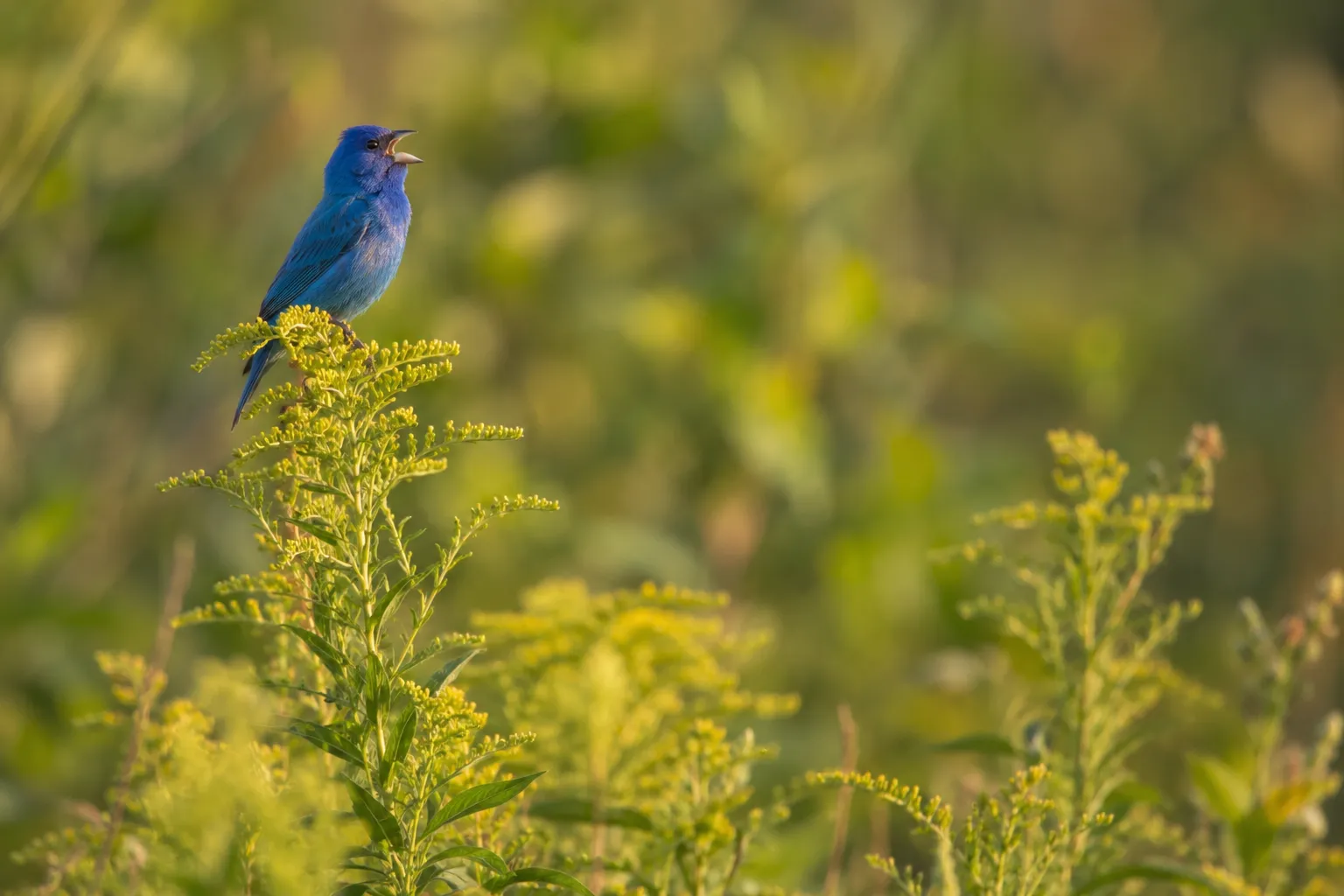
The breeding male is entirely blue, a little richer and more purplish-indigo on the head, with a conical silver-gray bill. Cornell describes it as sparrow-sized and slightly smaller than a House Finch, with a short tail. In direct sun the blue glows. In shade or backlight he can look almost black.
Why the blue changes with light
Indigo buntings have no blue pigment. Cornell explains that the color comes from microscopic structures in the feathers that refract and reflect blue light. The feathers themselves contain melanin, which is brown-black. That is why a male in poor light can look dark and dull, then turn brilliant when he moves into the sun.
Female
The female is brown, with faint streaking on the breast, a whitish throat and tan wingbars. Many females show a faint touch of blue on the wings, tail or rump. She is easy to overlook as “just a sparrow.”
Molting males and young birds
Males molting into or out of breeding plumage look blotchy, with patches of blue and brown. In fall, males become mostly brown with blue tinges on the wings or tail. Young males in their first spring can also look patchy. These birds often cause identification questions in late summer.
Similar species
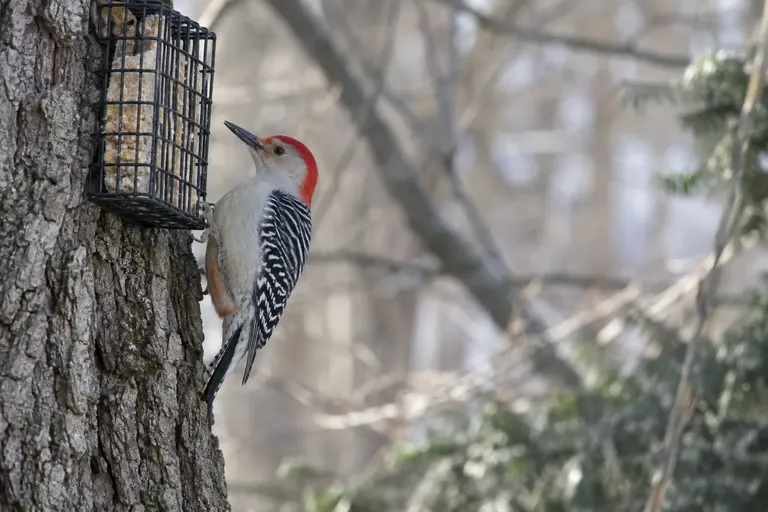
- Blue grosbeak: larger with a much bigger bill; males are darker blue with rusty wingbars.
- Lazuli bunting: a western species; males have an orange breast and white wingbars. Lazuli and indigo buntings overlap and sometimes hybridize in the Great Plains and parts of the West.
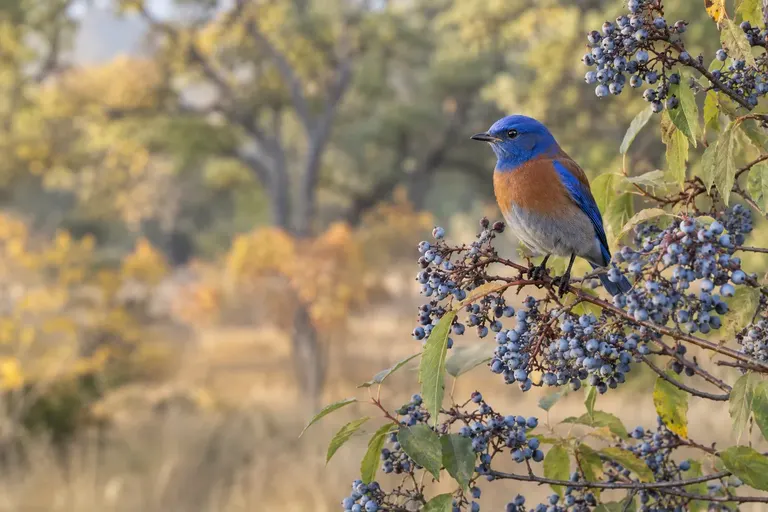
- Eastern bluebird: larger, with an orange breast and a thinner bill; perches upright on wires and posts. See how to attract Eastern bluebirds.
- Painted bunting: females and young are green, not brown.
- Female House Sparrow: similar at a glance to a female bunting, but larger with a gray-brown pattern and no blue.
The song
Males sing from the tallest perch around, from dawn to dusk, through summer. The song is a bright, fast series of paired phrases, often written as what! what! where? where? see it! see it! Hearing it is often the first sign buntings are nearby.
Where and when to see indigo buntings
Breeding range and habitat
Indigo buntings breed across eastern North America, from the Gulf states north into southern Canada and west across the Plains, with populations into the Southwest. Cornell describes their habitat as weedy fields and shrubby areas near trees, especially where fields meet forests: hedgerows, overgrown patches, brushy roadsides, woodland edges, stream corridors, logged areas and abandoned fields growing back to shrubs. Audubon notes that in the West they usually nest near streams.
Migration
Audubon and Cornell both note indigo buntings migrate at night and use the stars to orient, adjusting as the night goes on. Many cross the Gulf of Mexico. In the central and northern states they typically arrive from late April into May and leave in fall. During migration and winter they form flocks, sometimes large ones, in grassy and shrubby areas and even rice fields.
For exact local timing, eBird bar charts are the best tool. Our guide on how to use eBird shows how to read them and set alerts.
What do indigo buntings eat?
Natural diet by season
| Season | Main foods (Cornell and Audubon) |
|---|---|
| Spring arrival | Tree buds and leaves of aspen, cottonwood and oaks; seeds; early insects |
| Summer | Mostly insects and spiders: caterpillars, grasshoppers, aphids, cicadas, beetles including weevils and click beetles |
| Late summer and fall | Seeds of thistles, dandelions and goldenrods; berries such as blueberries, strawberries and elderberries |
| Winter (in the tropics) | Mostly seeds |
Cornell notes they even eat brown-tail moth caterpillars despite the toxic hairs. They forage from the ground up into shrubs and trees, hopping on the ground and clinging to stems and reeds.
Will indigo buntings come to feeders?
Sometimes, but it is not reliable. Cornell’s life-history account says they rarely visit feeders, while its backyard tips suggest two foods that work when they do:
- Nyjer (thistle) and other small seeds. A finch tube or small tray with nyjer can attract buntings along with goldfinches. Our roundup of finch feeders for nyjer seed compares options, and our guide to attracting American goldfinches covers nyjer freshness.
- Live mealworms. A small dish of live mealworms near shrubs may be taken, particularly on cold spring days when insects are scarce. See our guide to dried and live mealworms.
Some backyard birders also report buntings eating small seeds such as white proso millet or hulled sunflower chips from trays near cover. Treat that as worth trying rather than guaranteed.
When a feeder is most likely to work
The best window is spring, just after birds arrive. Insects can be slow to emerge during cool weather, and a hungry migrant may investigate a feeder it would ignore in July. Keep feeders stocked from mid-April into May and place them within a short hop of shrubs.
Plants and habitat that attract indigo buntings
The edge is everything
Indigo buntings are birds of edges and early growth, not deep woods or manicured lawns. The single most useful change is to stop mowing a strip along the back of the yard, fence line or woodland edge and let it grow into tall wildflowers, grasses and young shrubs. Cornell notes that roadside mowing is one of the pressures on this species, and the same logic applies at the yard scale.
Build an edge in five steps
- Choose a strip along a fence, property line or woods at least a few feet wide. Wider is better.
- Stop mowing it during the growing season, or mow only once in late winter.
- Plant native seed producers such as goldenrods, asters, coneflowers, native grasses and native thistles.
- Add a few shrubs and small trees for nesting cover and song perches.
- Leave seed heads standing through fall so buntings and goldfinches can feed on them.
Native plants for indigo buntings by region
Check with your state extension service or native plant society for local species.
Northeast and Midwest
- Goldenrods (many native species)
- Native asters and purple coneflower
- Common elderberry and blackberry or raspberry thickets
- Gray dogwood and native viburnums for nesting cover
- Little bluestem and other native grasses
Southeast
- Goldenrods and native asters
- American beautyberry
- Blackberry and native blueberries
- Wax myrtle for dense cover
- Native grasses such as broomsedge
Great Plains and Texas
- Goldenrods and native sunflowers
- Native prairie grasses such as switchgrass and little bluestem
- Rough-leaf dogwood for cover
- Wild plum thickets
Southwest (along streams)
- Native willows and cottonwoods for perches and insects
- Native sunflowers
- Seep willow and streamside shrubs
Cornell also lists dandelions and native thistles as seed sources. Dandelions left in a corner of the lawn are genuinely useful food. When planting thistles, choose native species; many nonnative thistles are listed as noxious weeds.
Water for indigo buntings
Buntings drink and bathe regularly, especially in hot summer weather. A shallow bath 1 to 2 inches deep, placed near shrubs or the edge of your wild strip, is most likely to be used. Moving water from a dripper or small fountain helps birds notice it. Clean and refill the bath every few days.
Nesting: how to help indigo buntings raise young
Indigo buntings do not use nest boxes. They build small open cups low in dense vegetation.
Nesting details
| Nesting fact | Cornell and Audubon data |
|---|---|
| Nest site | Low, concealed in shrubs, briars or tall weeds, in a fork with vertical support |
| Nest height | Usually about 1 to 3 ft off the ground |
| Builder | Female alone, over about 2 to 8 days |
| Materials | Leaves, grasses, stems and bark, wrapped with spider web; lined with fine grass, rootlets and thistle down |
| Clutch size | 3 to 4 eggs |
| Broods per year | 1 to 3 |
| Incubation | 11 to 14 days, by the female |
| Nestling period | 8 to 14 days |
| Egg color | Unmarked white |
How to help
- Leave dense low shrubs and briars at the yard edge.
- Delay cutting weedy areas until after the breeding season ends in late summer.
- Keep cats indoors, since nests are so close to the ground.
- Avoid insecticides, which remove the caterpillars and grasshoppers nestlings need.
Indigo bunting seasonal calendar
| Season | What indigo buntings are doing | What to do |
|---|---|---|
| Winter (Nov to Mar) | In Mexico, Central America and the Caribbean, in flocks | Plan and plant your edge; leave last year’s seed heads |
| Spring (Apr to May) | Night migration; males arrive and start singing | Nyjer and live mealworms near cover; water |
| Summer (Jun to Aug) | Nesting; up to three broods; males sing all day | Don’t mow the edge; no pesticides |
| Fall (Sep to Oct) | Brown plumage, flocking, eating seeds and berries | Leave goldenrod and other seed heads standing |
Why indigo bunting numbers are falling, and how yards can help
Indigo buntings are still common. Partners in Flight estimates about 77 million birds, and Cornell rates the species as low conservation concern. But Cornell also reports a decline of roughly 28% between 1966 and 2019. The pressures it lists are worth knowing, because several have backyard equivalents:
- Loss of shrubby edge habitat. Intensive agriculture removes hedgerows and weedy field borders, and abandoned fields that grow back into mature forest eventually lose the early-growth stage buntings need.
- Roadside and field-edge mowing. Mowing during the nesting season destroys low nests and removes seed plants.
- Collisions. Cornell lists vehicle collisions and building strikes during migration as significant sources of mortality.
- Trapping for the cage-bird trade on wintering grounds in Mexico.
A backyard cannot fix trapping in Mexico, but it can replace a small piece of edge habitat. A wild strip left unmown through summer, native seed plants, low shrubs for nesting and treated windows address three of the four pressures directly. If your neighbors do the same, a string of yards can act like a hedgerow.
How soon will indigo buntings use a new edge?
It depends on what surrounds you. Buntings disperse widely and quickly find new early-growth habitat, which is why they are often among the first birds to move into cleared or abandoned land. If you live near fields, powerline corridors, parks with brushy edges or a stream corridor, a new wild strip may attract a singing male in the first summer, especially once goldenrods and shrubs reach a few feet tall.
In a dense suburb with little shrubby habitat nearby, it can take longer. Keep the strip in place for two or three seasons before judging it. Adding a taller perch, such as a dead snag left standing or a small tree at the edge, makes the spot more visible to a male looking for a singing post.
Common problems and how to fix them
I see buntings nearby but never in my yard
Your yard may lack the edge they need. A clipped lawn with isolated shrubs offers little. Let a strip grow wild and add a few shrubs as perches and nest sites.
A male bunting keeps flying at my window
Territorial males sometimes attack their reflections during breeding season. Treat the outside of the glass with screening, film or markings to break up the reflection. Our guide on how to stop birds hitting windows covers the options. Collisions with buildings are also a real threat during migration, which Cornell lists among the pressures on this species.
Buntings came in spring, then stopped visiting the feeder
This is normal. Once insects are plentiful, buntings switch to natural food and spend more time nesting low in cover.
I only see “sparrows” at the nyjer feeder
Look again for faint blue on the wings or tail and a conical bill. Female and young indigo buntings are easy to overlook among sparrows and goldfinches.
Common mistakes when trying to attract indigo buntings
- Relying on a feeder alone. Habitat matters far more for this species.
- Mowing every edge. Buntings need tall weeds and shrubs to feed and nest.
- Cutting back seed heads in fall. Goldenrod and aster seeds are bunting food.
- Using pesticides. Summer insects feed adults and nestlings.
- Putting feeders in open lawn. Buntings stay near cover.
- Giving up after one season. A new wild edge may take a year or two to fill in.
Watching indigo buntings
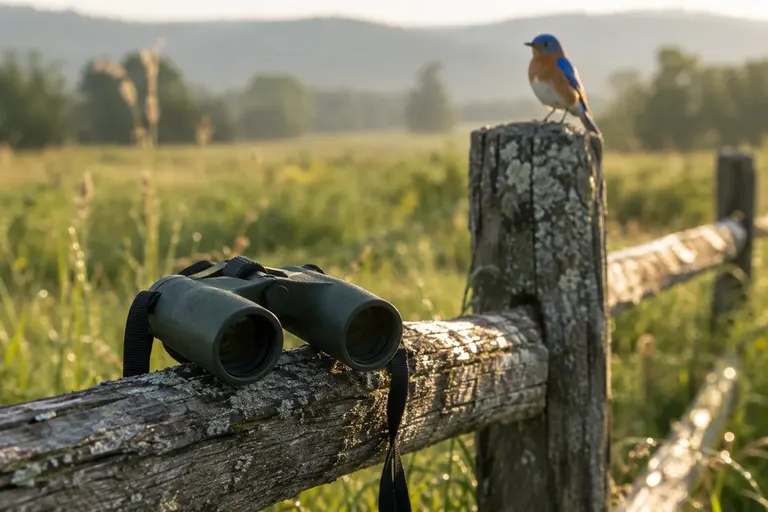
A singing male on a treetop is easy to find by ear, but the color only shows in good light. Watch in the early morning with the sun behind you. Binoculars that handle color well help; see our guide to binoculars for watching birds from your window. For more ways to turn a yard into habitat for many species at once, see our guide to backyard birding.
Sources
Frequently asked questions
What is the best way to attract indigo buntings?
Habitat beats feeders. Indigo buntings live where fields meet woods: weedy, shrubby edges, hedgerows and overgrown patches. Leave an unmown strip with native seed plants such as goldenrods and native thistles, plant a few shrubs and small trees for song perches, and skip pesticides. Cornell also suggests small seeds such as nyjer and live mealworms for feeders.
What do indigo buntings eat at feeders?
Indigo buntings rarely visit feeders, but the Cornell Lab of Ornithology suggests small seeds such as nyjer (thistle) and live mealworms to attract them. They are most likely to show up in spring shortly after arriving, when insects can be scarce. A tube or small tray feeder near shrubby cover gives them the best chance.
Why is my indigo bunting brown?
Only breeding adult males are fully blue. Females are brown with faint streaking, a whitish throat and sometimes a touch of blue on the wings, tail or rump. In late summer and fall, males molt into brownish plumage with blue patches, and young males look blotchy blue and brown. Those patchy birds are normal.
Are indigo buntings actually blue?
No. Indigo buntings have no blue pigment. Their feathers contain melanin, which is dark brown to black, and the blue color comes from microscopic structures in the feathers that scatter blue light. In poor or back lighting, a male can look almost black. In direct sun he appears brilliant blue.
When do indigo buntings arrive and leave?
Indigo buntings are long-distance migrants that winter in Mexico, Central America and the Caribbean. They migrate at night, crossing the Gulf of Mexico, and typically reach the central and northern states from late April into May. Most leave by fall. Check eBird records for your county to see local arrival dates.