How to Attract Rose-breasted Grosbeaks to Your Yard
How to attract rose-breasted grosbeaks: black oil sunflower or safflower on a sturdy feeder by trees, set out before spring migration, plus native berry shrubs.
In this article
- Quick answer: how to attract rose-breasted grosbeaks
- Rose-breasted grosbeak at a glance
- How to identify a rose-breasted grosbeak
- Where and when to see rose-breasted grosbeaks
- What do rose-breasted grosbeaks eat?
- Best feeders for rose-breasted grosbeaks
- Plants and habitat that attract rose-breasted grosbeaks
- Water for rose-breasted grosbeaks
- Nesting: how to help breeding grosbeaks
- Rose-breasted grosbeak seasonal calendar
- Rose-breasted or black-headed grosbeak: which will visit your yard?
- How to find grosbeaks in the treetops
- Common problems and how to fix them
- Common mistakes when trying to attract rose-breasted grosbeaks
- Sources
- Frequently asked questions
To attract rose-breasted grosbeaks, put out black oil sunflower seed on a sturdy feeder near trees before spring migration peaks, and keep leafy woodland edges, fruiting shrubs and water nearby. That combination catches grosbeaks passing through in spring and can hold a breeding pair all summer if you live in their range. These are large, heavy-billed birds of 1.4 to 1.7 ounces, so feeders need room to perch and seed they can crack easily.
This guide is research-led. It draws on the Cornell Lab of Ornithology’s All About Birds identification and life-history data, Audubon species accounts and well-established feeder practice.
Quick answer: how to attract rose-breasted grosbeaks
- Food: black oil sunflower seed first; safflower and raw peanuts as backups.
- Feeder: a sturdy hopper, tray or large-perch tube near trees.
- Timing: have feeders stocked from mid-April in the East and Midwest.
- Habitat: deciduous trees, forest edges, saplings and berry shrubs.
- Water: a birdbath, ideally with moving water.
- Safety: feeders near cover, with window treatments to reduce collisions.
Rose-breasted grosbeak at a glance
| Trait | Details |
|---|---|
| Size | 7.1 to 8.3 in long; 1.4 to 1.7 oz; wingspan 11.4 to 13.0 in |
| Range | Breeds in the northeastern US, Great Lakes, New England and southern Canada; winters in Central and South America |
| Season in your yard | Summer in the breeding range; spring and fall migration farther south |
| Natural diet | Insects, seeds, buds and berries, roughly half plant and half animal |
| Feeder foods | Black oil sunflower, safflower, raw peanuts |
| Best feeder types | Hopper, platform or tray, tube with large perches |
| Nesting | Loose stick cup in a sapling or small tree, often 5 to 20 ft or more up |
| Conservation status | Low concern; slow decline 1966 to 2019 (Cornell Lab) |
How to identify a rose-breasted grosbeak
Adult male
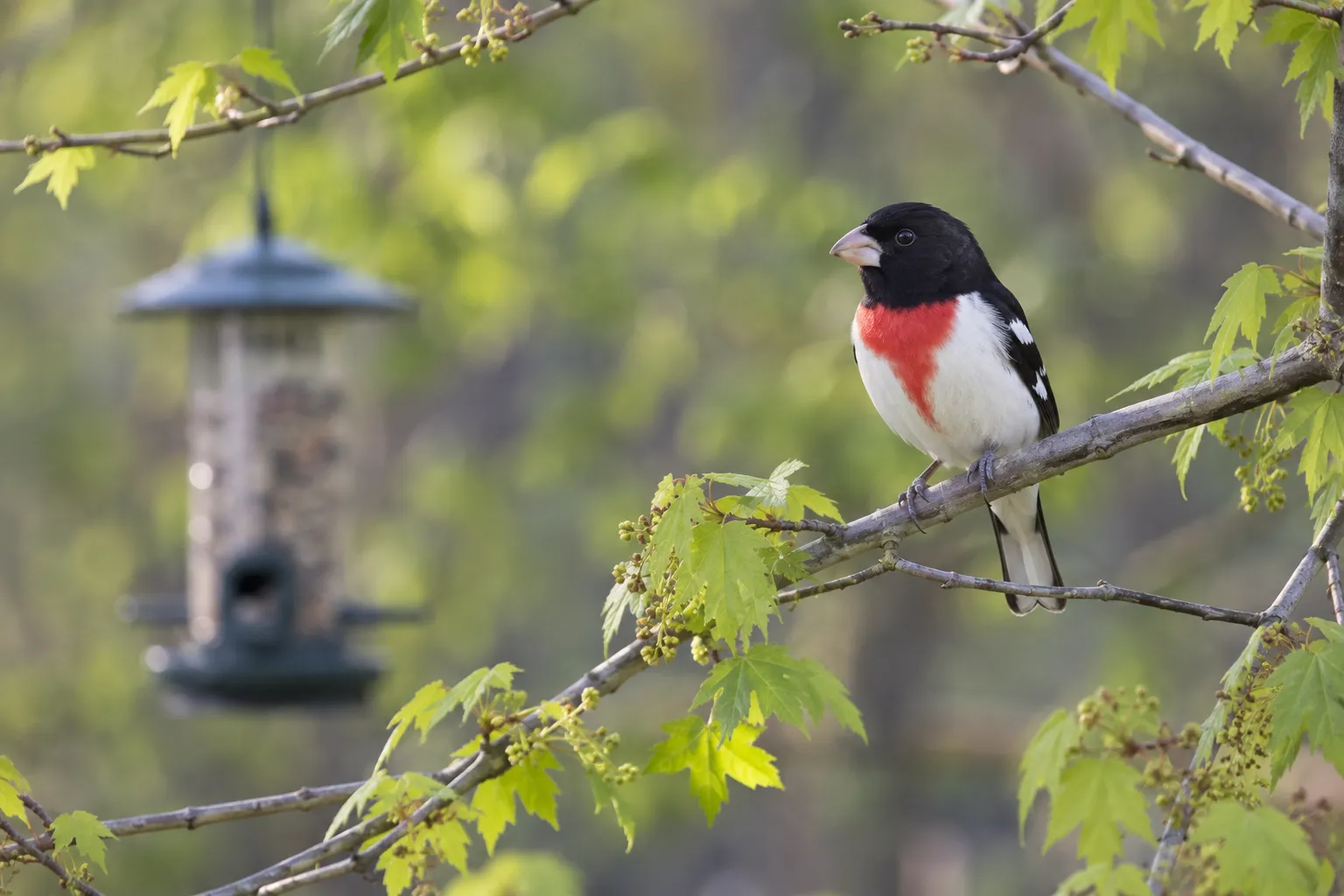
The male is unmistakable. Cornell describes a black and white bird with a rose-red chevron running down the center of the breast, like a splash of paint. The head, throat and back are black, the belly is white, and the black wings carry white patches that flash in flight. Under the wings, the linings are pink-red. The bill is huge, triangular and pale.
Female
The female looks completely different: heavily streaked brown and white, with a bold whitish stripe over the eye and another below the cheek. In flight her underwings show yellowish. She is often mistaken for an oversized sparrow or a female Purple Finch. The giant pale bill is the clue.
Immature males
Young males in their first year look like a blend of female and adult male: streaky brown with a smaller rosy wash on the breast and pinkish-red underwings. By their second spring they look like adult males.
Similar species
- Black-headed grosbeak: the western counterpart. Males have a cinnamon-orange breast instead of white with a red chevron. The two species hybridize where their ranges meet in the Great Plains.
- Purple finch: the female Purple Finch is also streaky brown with a pale eyebrow, but she is much smaller with a far smaller bill.
- Female red-winged blackbird: streaky brown, but with a thin, pointed bill.
Song and calls
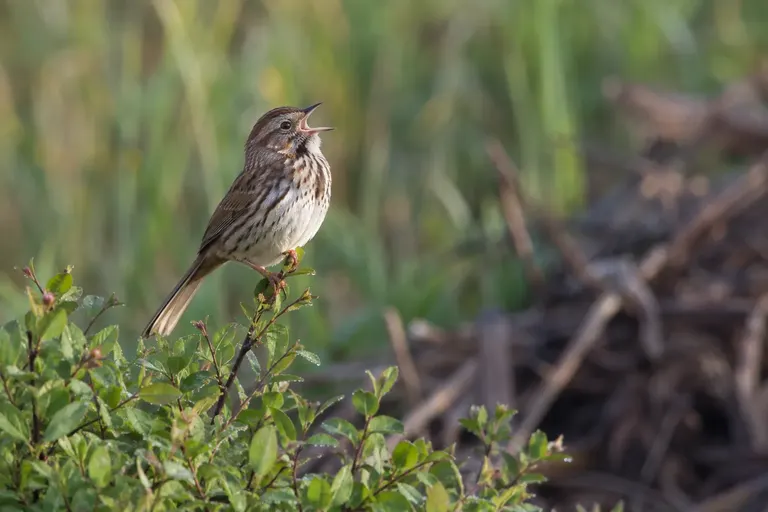
The song sounds like an American Robin’s with extra sweetness. Cornell describes it “as if the bird had operatic training.” The call is a sharp, squeaky chink, often compared to a sneaker squeaking on a gym floor. Learning that call is the easiest way to find grosbeaks hiding in the canopy.
Where and when to see rose-breasted grosbeaks
Breeding range
Rose-breasted grosbeaks breed across eastern North America, especially the northeastern United States, the Great Lakes region, New England and southeastern Canada. Cornell describes breeding habitat as moist deciduous and mixed forests, thickets and semi-open areas: second-growth woods, suburban gardens, orchards and shrubby forest edges, often near water.
Migration
Audubon notes this species migrates relatively late in spring and early in fall, traveling at night. In the northern states, arrivals typically begin from late April into May. Outside the breeding range, across much of the Southeast and southern Plains, you are most likely to see grosbeaks as spring and fall migrants for a few weeks. Cornell notes they may visit feeders during migration even outside their summer range.
Winter
They winter from southern Mexico through Central America into northern South America, where Cornell reports them in forests and highland habitats up to about 11,000 feet.
For exact timing in your county, eBird’s bar charts show when grosbeaks usually arrive and leave. Our guide on how to use eBird checklists, hotspots and alerts explains how to find them.
What do rose-breasted grosbeaks eat?
Natural diet
Audubon describes a diet split roughly evenly between insects and plant food. In the breeding season Cornell lists beetles, bees, ants, butterflies and moths, plus wild fruit such as elderberries and blackberries, and seeds including milkweed. Audubon adds caterpillars, grasshoppers, spiders, elm seeds and tree buds. Grosbeaks glean food from foliage, hover to pick items off leaves and sometimes catch insects in flight.
Best feeder foods for rose-breasted grosbeaks
- Black oil sunflower seed. The top choice. The thin shells crack easily and the kernel is high in fat. Our guide to black oil sunflower seed explains why it attracts so many species.
- Safflower seed. Cornell lists safflower as a grosbeak food. It also discourages many squirrels and blackbirds. See our safflower guide.
- Raw peanuts. Shelled, unsalted peanuts or peanut pieces in a tray or wide-mesh feeder.
- Hulled sunflower chips. Easier to eat and cleaner under feeders, though they spoil faster in wet weather.
- Fruit. Grosbeaks eat berries naturally, and some owners report them sampling fruit put out for orioles.
Avoid mixes heavy in milo, wheat and red millet. Grosbeaks tend to ignore those fillers.
Best feeders for rose-breasted grosbeaks
Grosbeaks are large, stocky birds, weighing 1.4 to 1.7 ounces. Choose feeders with room to land and perch comfortably.
- Hopper feeders: broad ledges suit big birds, and a roof keeps seed dry.
- Platform or tray feeders: the easiest option for sunflower, safflower and peanuts. Choose one with a mesh or drainage floor. Our roundup of platform and tray feeders compares styles.
- Tube feeders with large perches or a seed tray: small-perch tubes built for finches are awkward for grosbeaks.
- Cardinal-style feeders: many feeders designed for cardinals, with ring perches or wide ledges, also suit grosbeaks. See feeders that attract cardinals.
Where to place a grosbeak feeder
Grosbeaks are tree-dwelling birds that feel safest close to leafy cover. Put feeders near deciduous trees or tall shrubs so birds can drop down from the canopy and retreat quickly. Current Cornell Lab guidance no longer relies on a fixed distance from windows; instead, treat nearby glass with external screens, film or closely spaced markings to reduce collision risk.
Plants and habitat that attract rose-breasted grosbeaks
Trees and structure
Rose-breasted grosbeaks nest in saplings and small trees and forage in the leafy canopy. A yard with a mix of mature deciduous trees and younger trees and shrubs underneath offers both. Cornell notes that maturing forests with fewer saplings may be one reason for the species’ slow decline, so a layered planting with young trees is genuinely useful habitat.
In practice, that means resisting the urge to limb up every tree and clear everything beneath it. Let a few volunteer maples, cherries or dogwoods grow along the back edge. Plant a small group of native shrubs under taller trees rather than a single specimen in open lawn. Leave a strip of unmown ground at the woodland edge, where milkweed, blackberry and native wildflowers can grow. Each layer adds foraging space for the caterpillars, beetles and berries grosbeaks eat, and the whole edge becomes more attractive to migrants looking for a place to rest and refuel.
Native plants for rose-breasted grosbeaks by region
Choose trees and shrubs that host insects and produce berries or seeds. Your state extension service or native plant society can confirm what suits your soil.
Northeast and New England
- Red maple and sugar maple (buds, seeds and insects)
- Native serviceberry (early summer fruit)
- Common elderberry (late summer fruit)
- Gray and silky dogwood
- Eastern hemlock and white spruce for nest sites and cover
Great Lakes and Upper Midwest
- Box elder and native maples
- Native elms where disease allows
- Blackberry and raspberry thickets
- Chokecherry and pin cherry
- Common milkweed (seeds are eaten)
Mid-Atlantic and Appalachians
- Native oaks and hickories for insect prey
- Flowering dogwood
- Spicebush
- Pokeweed at the yard edge
Migration stopover yards in the South and Plains
- Mulberry (red mulberry is native)
- Native hackberry
- American beautyberry
- Native elms and oaks
Water for rose-breasted grosbeaks
Grosbeaks drink and bathe, and moving water attracts migrants passing overhead. A bath 1 to 2 inches deep with a dripper, bubbler or solar fountain works well. Keep it near trees and clean it every few days.
Nesting: how to help breeding grosbeaks
Rose-breasted grosbeaks do not use nest boxes. They build loose, open cups of coarse sticks, twigs and grass, often so thin that Cornell notes eggs can be seen through the bottom from below.
Nesting details
| Nesting fact | Cornell data |
|---|---|
| Nest site | Vertical fork of a sapling or small tree such as maple, fir, hemlock or spruce |
| Nest height | Often 5 to 20 ft or more (Audubon) |
| Builders | Both sexes, over about 4 to 9 days |
| Clutch size | 1 to 5 eggs |
| Broods per year | 1 to 2 |
| Incubation | 11 to 14 days |
| Nestling period | 9 to 12 days |
| Egg color | Pale green to blue with reddish-brown speckles |
Both parents share incubation, brooding and feeding. Cornell notes the male incubates for several hours during the day and sometimes sings from the nest, softly or even at full volume.
How to help
- Keep young trees and saplings, not just mature shade trees.
- Delay heavy pruning of small trees until after nesting season.
- Keep cats indoors.
- Watch from a distance. Nest predators include Blue Jays, Common Grackles, squirrels and Cooper’s and Sharp-shinned hawks.
Rose-breasted grosbeak seasonal calendar
| Season | What grosbeaks are doing | What to do |
|---|---|---|
| Early spring (Mar to mid-Apr) | Still on wintering grounds | Clean feeders; stock sunflower and safflower |
| Spring migration (late Apr to May) | Night migration; males often arrive first | Keep feeders full; add moving water |
| Summer (Jun to Aug) | Nesting; feeding insects and fruit to young | Keep sunflower out; protect saplings; no pesticides |
| Fall migration (Aug to Oct) | Leaving relatively early in fall; streaky birds dominate | Berry shrubs and sunflower help refuel migrants |
| Winter (Nov to Feb) | In Central and South America | Plan plantings for next spring |
Rose-breasted or black-headed grosbeak: which will visit your yard?
Geography does most of the sorting. Rose-breasted grosbeaks are eastern birds, breeding from the Great Lakes and New England through southern Canada and down the Appalachians. Black-headed grosbeaks breed across the West, from the Pacific states through the Rockies. The two meet in the Great Plains, where Cornell notes they hybridize, so feeder watchers in states such as Nebraska, the Dakotas and Kansas can see either species or birds with mixed features.
If you live in the zone of overlap:
- Males: a rose-breasted male has a white belly with a red chevron; a black-headed male has a warm cinnamon-orange breast and collar.
- Females: female black-headed grosbeaks tend to be buffier on the breast with finer streaks, while female rose-breasted grosbeaks are whiter below with heavier streaking. Females are harder, and photos help.
- Hybrids: birds showing a mix, such as orange washed with pink, are best reported as hybrids or left unidentified.
The good news is that both species eat the same foods at feeders: black oil sunflower, safflower and peanuts on a sturdy feeder near trees.
How to find grosbeaks in the treetops
Rose-breasted grosbeaks spend much of their time in the leafy canopy, and they can be surprisingly hard to see once trees leaf out. These field habits help:
- Listen for the squeaky chink call. It carries well and gives away birds that are hidden in leaves.
- Learn the song. A robin-like song that sounds smoother and sweeter than a robin’s, coming from high in a deciduous tree in May, is often a grosbeak.
- Watch at feeders early in the day. Many backyard birds are most active in the first hours after sunrise; see our guide to the best time of day to see birds.
- Check fruiting trees in late summer. Grosbeaks gather at elderberry, mulberry and other fruiting shrubs as they fatten for fall migration.
- Look for the flash of pink. In flight, a male’s rosy underwing linings are visible; the female’s are yellowish.
Telling a pair apart at the feeder
A male and female often arrive together in spring. The male’s black and white is obvious; the female stays close and is easy to overlook. If you see a streaky, eyebrowed “sparrow” beside a male grosbeak, cracking sunflower with an oversized bill, it is almost certainly his mate. In late summer, streaky young birds can outnumber adults at feeders, so a sudden rush of brown grosbeaks in August usually means a successful local breeding season.
Common problems and how to fix them
Grosbeaks came for a week, then vanished
That is usually normal migration. Outside the breeding range, grosbeaks stop to refuel and move on. Even in the breeding range, feeder visits often drop in summer once natural insect food is plentiful and pairs are busy nesting.
Grosbeaks never showed up
If no grosbeaks appear, first use eBird to see if your area is in the breeding range or on a regular migration route. Then check the basics: fresh sunflower, a feeder they can perch on, and trees nearby. Our guide on why birds aren’t coming to your feeder covers other causes.
Squirrels and grackles are emptying the feeder
Safflower is less appealing to many squirrels and grackles. A baffle on the pole and a weight-activated feeder can help.
A hawk is hunting at the feeder
Grosbeak-sized birds attract Cooper’s Hawks. Keep feeders near cover, and if a hawk becomes a regular, pause feeding for a week or two. See how to stop hawks from hunting at your feeder.
Common mistakes when trying to attract rose-breasted grosbeaks
- Putting sunflower out too late. Migrants arrive in late April and May. Be ready before them.
- Using only finch tubes. Small perches and small ports do not suit big grosbeaks.
- Cheap filler mixes. Grosbeaks want sunflower, safflower and peanuts, not milo.
- Removing saplings and understory. This is nesting habitat.
- Missing the female. Many “new sparrows” at feeders in May are female grosbeaks. Look at the bill.
Sources
- Rose-breasted Grosbeak overview, All About Birds (Cornell Lab of Ornithology)
- Rose-breasted Grosbeak identification, All About Birds
- Rose-breasted Grosbeak life history, All About Birds
- Rose-breasted Grosbeak, Audubon Guide to North American Birds
- Feeding birds, Project FeederWatch
- Audubon native plants database
Frequently asked questions
What is the best food to attract rose-breasted grosbeaks?
Black oil sunflower seed is the most reliable choice, and the Cornell Lab of Ornithology also lists safflower seed and raw peanuts as grosbeak feeder foods. Offer them in a sturdy hopper, a tray or a tube with large perches, since grosbeaks are big, heavy-billed birds. Native berry shrubs such as elderberry add food in late summer.
When do rose-breasted grosbeaks arrive at feeders?
Rose-breasted grosbeaks migrate at night and tend to arrive relatively late in spring, typically from late April into May in the northern states. They are also seen at feeders during spring and fall migration in areas south of their breeding range. Check recent eBird sightings for your county and have sunflower out a week or two before first arrivals.
What does a female rose-breasted grosbeak look like?
The female looks like a large, heavily streaked brown sparrow with a very big pale bill. She has a bold whitish stripe over the eye, white wingbars and yellowish underwings that show in flight. Many people mistake her for a Purple Finch or an oversized sparrow. Her large triangular bill is the best clue.
Do rose-breasted grosbeaks stay all summer?
In their breeding range, yes. They breed across the northeastern United States, the Great Lakes, New England and southern Canada, raising one or two broods in trees and saplings at forest edges and in suburbs. Outside that range they are usually only migrants, passing through for a few weeks in spring and fall before wintering in Central and South America.
Are rose-breasted grosbeaks rare?
No. Cornell rates them as a species of low conservation concern, with an estimated 4.7 million breeding birds according to Partners in Flight. Populations declined slowly between 1966 and 2019, though. Possible pressures include maturing forests with fewer saplings for nesting and trapping for the cage-bird trade on their wintering grounds.