How to Attract Northern Mockingbirds With Berry Shrubs
How to attract northern mockingbirds: plant native berry shrubs, keep open lawn nearby, add dense nesting cover, offer fruit or suet, and avoid pesticides.
In this article
- Quick answer: what mockingbirds need
- Northern mockingbird at a glance
- How to identify a northern mockingbird
- Where do northern mockingbirds live?
- What do northern mockingbirds eat?
- Best plants to attract mockingbirds
- Water for mockingbirds
- Nesting: how to give mockingbirds a place to raise young
- Northern mockingbird seasonal calendar
- Common problems with mockingbirds and how to fix them
- Will a mockingbird scare other birds away from my yard?
- How to tell a mockingbird has claimed your yard
- Common mistakes when trying to attract mockingbirds
- Watching mockingbirds
- Sources
- Frequently asked questions
Here is how to attract northern mockingbirds: plant berry-producing shrubs and trees, keep some open lawn nearby, and give them a dense shrub or small tree to nest in, usually 3 to 10 feet up. Skip the seed feeder: Cornell Lab of Ornithology notes mockingbirds rarely visit feeders, so fruit, insects and structure do nearly all the work. Once a mockingbird claims your yard, it will likely stay year-round and defend it loudly.
This guide is research-led. It draws on the Cornell Lab’s All About Birds life-history data, Audubon species accounts and Project FeederWatch feeding guidance, plus well-established native plant practice.
Quick answer: what mockingbirds need
- Fruit: native berry shrubs and trees that hold fruit into fall and winter.
- Open ground: a mown lawn or short grass where they run and hop after insects.
- High perches: a treetop, chimney, fence post or wire to sing from.
- Dense nesting cover: thick shrubs or small trees, usually 3 to 10 feet up.
- No pesticides: summer insects feed the nestlings.
- Optional feeding: suet, softened raisins, grapes or chopped apple on a platform in winter.
Northern mockingbird at a glance
| Trait | Details |
|---|---|
| Size | 8.3 to 10.2 in long; 1.6 to 2.0 oz; wingspan 12.2 to 13.8 in |
| Range | Year-round across much of the US, from California to the Northeast and south into Mexico |
| Season in your yard | Mostly all year; strongest presence in the South |
| Natural diet | Insects in summer; berries and wild fruit in fall and winter |
| Feeder foods | Rarely feeds at feeders; may take suet, fruit, raisins |
| Best feeder types | Platform or dish feeder for fruit; suet cage |
| Nesting | Dense shrubs and trees, usually 3 to 10 ft up; 2 to 3 broods |
| Conservation status | Low concern, but declined about 30% from 1966 to 2019 (Cornell Lab) |
How to identify a northern mockingbird
Adults
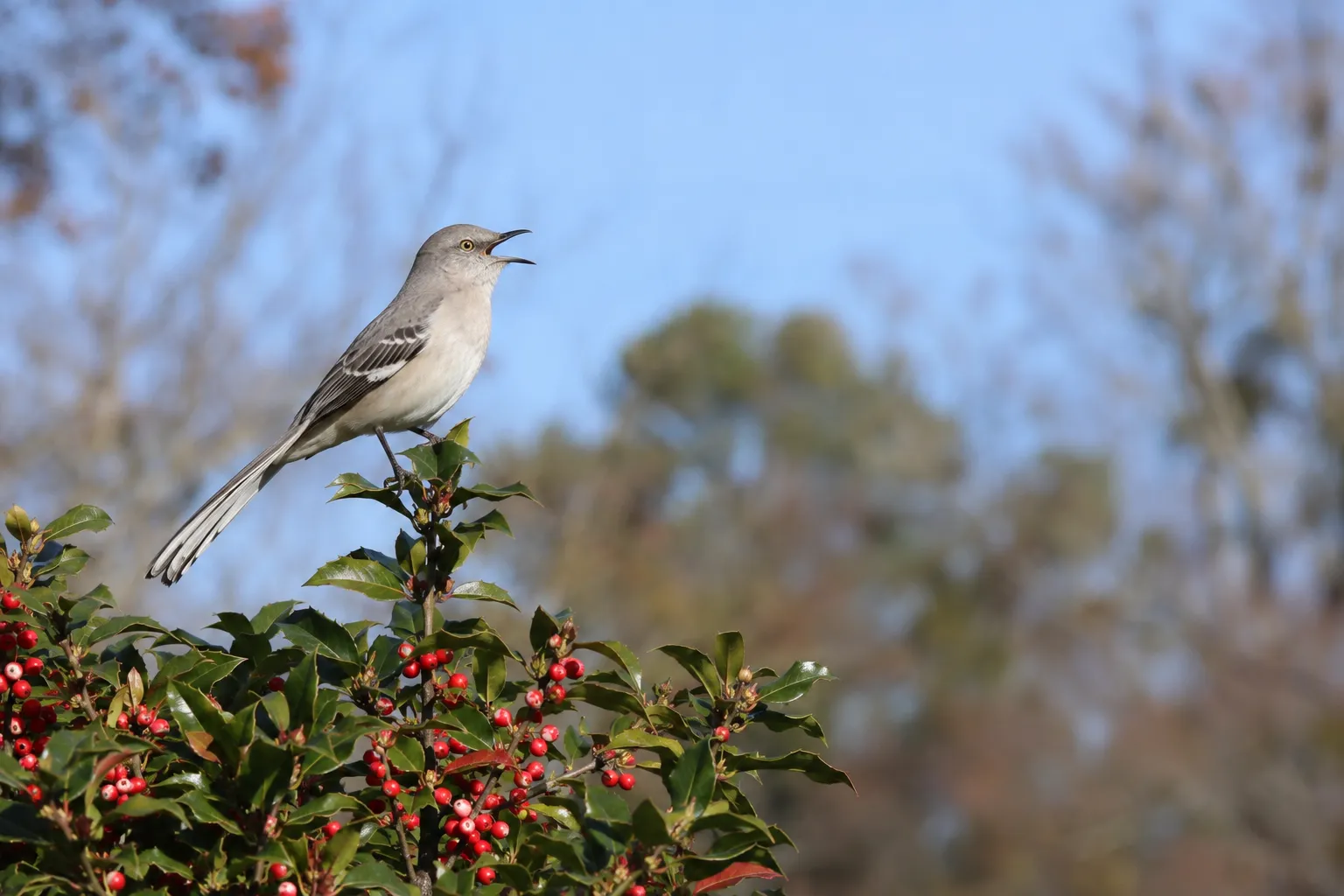
A northern mockingbird is slender and long-tailed, a little larger than a Gray Catbird and similar in length to an American Robin, but much slimmer. Cornell lists it at 8.3 to 10.2 inches long and 1.6 to 2.0 ounces. It is gray-brown above and pale whitish below, with two thin white wingbars. The giveaway comes in flight: large white patches flash in each wing, and the long dark tail shows white outer feathers. The bill is long, thin and slightly downcurved, and the legs are long.
Males and females look alike. Cornell notes females sing too, but more quietly than males.
Juveniles
Young mockingbirds in summer have spotted breasts, which can make them look like a thrush at first glance. The wing patches and long tail still identify them.
Similar species
- Loggerhead shrike: similar gray and white, but with a bold black mask, a thick hooked bill and a big-headed look. Shrikes perch quietly and hunt; mockingbirds sing and run on lawns.
- Gray catbird: darker slate gray all over with a black cap and rusty patch under the tail; no white wing patches.
- Townsend’s solitaire: a western mountain bird with a white eye ring and buffy wing patches.
- Sage thrasher: smaller, with a streaked breast and a shorter tail, in western sagebrush.
The song
The mockingbird is North America’s best-known mimic. Cornell reports a male may learn around 200 songs over his lifetime, repeating phrases several times before switching to the next. Songs include other birds, frogs, insects and mechanical sounds. Males sing from about February through August and again from September to November, often with separate spring and fall repertoires. Our guide to Merlin Sound ID explains why mimics like this one can fool identification apps.
The northern mockingbird is the state bird of Texas, Florida, Arkansas, Mississippi and Tennessee.
Where do northern mockingbirds live?
Mockingbirds live year-round across much of the United States, most commonly in the South and Southwest, and in towns, suburbs, farmland, parks and forest edges at low elevations. Audubon notes the range has expanded north in recent decades, particularly in the Northeast, helped in part by widespread plantings of fruiting shrubs such as multiflora rose (now considered invasive in many states).
Cornell describes their ideal habitat as open ground mixed with shrubby vegetation: hedges, fruiting bushes and thickets next to grass. That combination is exactly what many suburban yards already have, which is why mockingbirds are such familiar neighborhood birds.
What do northern mockingbirds eat?
Seasonal diet
Audubon estimates the annual diet is roughly half insects and half fruit.
- Spring and summer: mostly insects, including beetles, grasshoppers, caterpillars, moths, butterflies, ants, bees, wasps and earthworms, plus the occasional small lizard. Cornell notes they hunt by walking and running across lawns.
- Fall and winter: mostly fruit and berries, including ornamental and wild fruit. Cornell also notes they drink sap from freshly pruned branches.
Mockingbirds sometimes flash their wings open while foraging on the ground. One theory is that the sudden white flash startles insects into moving.
Will mockingbirds use feeders?
Not often. FeederWatch lists mockingbirds among the fruit-eating birds, along with robins, bluebirds, catbirds and waxwings. If you want to try:
- Fruit on a platform. Chopped apple, halved grapes, orange halves or raisins softened in water. Replace daily in warm weather.
- Suet and suet dough. Some mockingbirds take suet in winter, especially during freezes when berries are covered in ice. See our guide to suet cakes and blends.
- Mealworms. Occasionally taken, particularly in the breeding season. Our roundup of dried mealworms covers options.
A low platform or tray feeder is the easiest way to offer fruit. Keep it clean; fruit spoils fast.
How to offer fruit to mockingbirds, step by step
- Start in late fall or winter. Insects are scarce then, and mockingbirds are already eating mostly fruit, so they are more likely to investigate.
- Place the platform near a tall perch and some cover. Mockingbirds like to scan from above before dropping down. A dish a short hop from a shrub or small tree suits them.
- Offer small amounts. A handful of softened raisins, a few halved grapes or a sliced apple is plenty. Large piles attract starlings and spoil.
- Replace daily. In warm weather fruit ferments and draws insects and mold. Remove leftovers each evening.
- Keep it plain. No sugared, dried-with-additives or salted foods. Our guide to what not to feed birds covers the foods to avoid.
- Be patient and consistent. A bird that has never used a feeder may take weeks to notice it. Once one bird claims it, expect it to guard the spot.
Best plants to attract mockingbirds
Fruit-producing native plants are the single most effective way to attract mockingbirds. Aim for a mix that ripens across summer, fall and winter, so there is always something available.
Native plants for mockingbirds by region
Check your state extension service or native plant society for local choices.
Southeast
- American holly, yaupon holly and possumhaw (winter fruit)
- American beautyberry
- Southern wax myrtle
- Red mulberry (early summer fruit)
- Flowering dogwood
Northeast and Midwest
- Winterberry holly (plant a male pollinator nearby for fruit)
- Serviceberry (early summer)
- Gray dogwood and silky dogwood
- Native hawthorns
- Common hackberry
Texas and Southwest
- Yaupon holly and possumhaw
- Texas persimmon
- Agarita
- Desert hackberry and netleaf hackberry
California and the West Coast
- Toyon
- Blue elderberry
- California coffeeberry
- Native hollyleaf cherry
Cornell specifically mentions mulberries, hawthorns and blackberry brambles as good mockingbird plants. Avoid planting invasive fruiting shrubs such as multiflora rose, bush honeysuckles or Chinese privet, even though birds eat the fruit, because birds spread the seeds into natural areas.
Structure matters as much as fruit
- Open ground: mockingbirds hunt insects in short grass. A tidy area of lawn next to shrubs is useful for this species.
- High perches: they sing from the tops of trees, poles, chimneys and wires. Any tall perch in or near the yard helps.
- Dense shrubs and small trees: they nest in thick cover, often thorny or evergreen.
Water for mockingbirds
Mockingbirds drink and bathe regularly, especially in hot, dry regions. A shallow bath 1 to 2 inches deep, placed within a short flight of shrubs, works well. Moving water, such as a dripper or small bubbler, draws attention. In cold northern areas, a heated bath helps in winter when natural water freezes. Clean baths every few days.
Nesting: how to give mockingbirds a place to raise young
Mockingbirds do not use nest boxes. They build open cup nests in dense shrubs and trees.
Nest placement and building
Cornell notes that males usually choose sites and build several partial nests, typically 3 to 10 feet off the ground, though sometimes as high as 60 feet. The female chooses one and finishes it. The male builds the twig foundation and the female adds most of the lining: grasses, rootlets, leaves and sometimes trash such as plastic or foil. Pairs rarely reuse a nest.
Clutch and timing
| Nesting fact | Cornell data |
|---|---|
| Clutch size | 2 to 6 eggs |
| Broods per year | 2 to 3 |
| Incubation | 12 to 13 days |
| Nestling period | 12 to 13 days |
| Egg color | Pale blue or greenish white, splotched with red or brown |
In the South, Audubon notes breeding can begin in late winter.
How to help nesting mockingbirds
- Plant or keep dense shrubs and small trees, especially thorny or evergreen ones.
- Delay heavy pruning of hedges until after the nesting season.
- Keep cats indoors; fledglings spend time on or near the ground.
- Keep your distance from active nests. Mockingbirds defend nests fiercely and will dive at people, pets and even hawks.
Northern mockingbird seasonal calendar
| Season | What mockingbirds are doing | What to offer |
|---|---|---|
| Winter (Dec to Feb) | Defending feeding territories around fruiting shrubs | Winter berries, suet, softened raisins, heated water |
| Early spring (Feb to Apr) | Males sing constantly, build nests; night singing by unmated males | Dense shrubs for nesting; avoid pruning |
| Late spring to summer (Apr to Aug) | 2 to 3 broods; feeding nestlings insects | Open lawn, no pesticides, water |
| Fall (Sep to Nov) | Fall song period; switching to fruit | Native fruiting shrubs; start fruit on platform |
Common problems with mockingbirds and how to fix them
A mockingbird is chasing other birds away
Mockingbirds defend territories year-round. In fall and winter, a single bird may claim a berry bush or feeder and chase robins, cardinals, bluebirds and others. You cannot train this out of a mockingbird, but you can make it harder:
- Spread several fruiting shrubs across the yard instead of planting one large one.
- Put feeders in more than one location, some out of sight of the others.
- Offer seed feeders for other species away from fruit plantings, since mockingbirds care most about fruit.
A mockingbird keeps attacking my window or car mirror
Territorial birds fight their own reflections. Break up the reflection on the outside of the glass with screening, external film, window markers or a temporary cover. Folding car mirrors or covering them works too. The behavior usually fades after the breeding season. Our guide on how to stop birds hitting windows covers the treatments that work.
Mockingbird dive-bombing people or pets
This is nest defense, and it ends when the young fledge, usually within a few weeks. Change your route, wear a hat if needed and keep pets away from the nest shrub for that period. Northern mockingbirds are protected under the Migratory Bird Treaty Act, so active nests must not be disturbed.
A mockingbird singing all night
Cornell notes night singing is mostly by unmated males, and it is more frequent around a full moon. Bright outdoor lights may add to it. Turning off unnecessary lights may help; otherwise it usually stops once the male pairs.
Will a mockingbird scare other birds away from my yard?
This is the most common worry, and the honest answer is: sometimes, but rarely completely. Mockingbirds defend territories against their own species most of all. Cornell notes that females confront other females and males confront males, with boundary disputes that can include hopping back and forth along a line and, occasionally, a physical fight. Other species get chased mainly when they compete for the same food, which in practice means fruit and, less often, suet.
Birds that eat seed, such as chickadees, finches, cardinals and titmice, usually coexist with a resident mockingbird because the mockingbird has little interest in their food. Fruit-eaters such as robins, bluebirds, catbirds and waxwings are more likely to be chased from a berry bush the mockingbird is guarding. A flock of waxwings can sometimes overwhelm a single guard simply by arriving in numbers.
You can reduce conflict by:
- Placing seed feeders on the opposite side of the house from the main fruit plantings.
- Planting fruit in several separate clumps so one bird cannot watch them all.
- Leaving some fruit on the plants rather than concentrating it on a single platform.
The upside of a resident mockingbird is real, too. Its alarm calls and aggressive defense of nests can alert other small birds to cats and hawks, and its insect hunting in summer helps keep garden pests down.
How to tell a mockingbird has claimed your yard
Signs a mockingbird now considers your yard its territory:
- A bird singing from the same high perch day after day, especially your chimney, a TV antenna or the tallest tree.
- Repeated chasing of other mockingbirds along a line such as a fence or driveway.
- Wing flashing on the lawn: the bird half-opens its wings in jerky steps, showing the white patches.
- A single bird that returns to the same fruiting shrub all winter and sits beside it.
Because mockingbirds are long-lived for a songbird (Cornell’s record is at least 14 years, 10 months) and territorial all year, a bird that settles in your yard may be the same individual for several seasons.
Common mistakes when trying to attract mockingbirds
- Relying on seed feeders. Mockingbirds rarely eat seed.
- Planting only one fruit shrub. One bird will defend it and chase everything else away.
- Choosing plants that fruit at the same time. Stagger ripening from summer to winter.
- Removing all dense shrubs. No cover means no nesting.
- Spraying lawns and gardens. Insecticides remove the insects nestlings need.
- Planting invasive fruiting shrubs. Native plants provide fruit without spreading into natural areas.
Watching mockingbirds
Mockingbirds are among the easiest yard birds to watch, since they sing from exposed perches and hunt in the open. Try to see the wing flash as they forage and listen for how many other species you can pick out of one male’s song. For more on building a yard that suits fruit-eaters, insect-eaters and seed-eaters together, see our guide to backyard birding. If you also want robins in the same berry shrubs, see how to attract American robins.
Sources
Frequently asked questions
What is the best way to attract mockingbirds?
Plant fruit, not feeders. Northern mockingbirds rarely use seed feeders, but they come readily to yards with berry-producing shrubs and trees, open lawn for catching insects, and dense shrubs for nesting. Native hollies, hackberry, serviceberry, elderberry, dogwoods and red mulberry are good choices. Skipping insecticides keeps the summer insect supply they need for nestlings.
Do mockingbirds eat birdseed?
Very little. Their diet is roughly half insects and half fruit over the year, with insects dominant in summer and berries in fall and winter. Seed mixes rarely interest them. Some mockingbirds will take suet, suet dough, softened raisins, chopped apples or grapes from a platform, especially during cold snaps when natural fruit runs low.
Why is a mockingbird attacking my window?
Mockingbirds defend territories aggressively, and a bird that sees its reflection in a window or car mirror may treat it as a rival and fight it repeatedly, especially in spring. The fix is to break up the reflection on the outside of the glass with screening, film, or a temporary cover until the behavior stops.
Why do mockingbirds sing at night?
Night singing is most often done by unmated males trying to attract a female, according to the Cornell Lab of Ornithology. It is most common in spring and early summer and can be more frequent around a full moon or near bright artificial lights. It usually stops once the male finds a mate or the breeding season winds down.
Are mockingbirds aggressive to other birds?
They can be. Northern mockingbirds defend territories year-round, and in fall and winter a single bird may guard a fruiting shrub or feeder and chase off robins, cardinals and others. Planting several fruiting shrubs spread around the yard, rather than one large one, makes it harder for one mockingbird to control all the food.