12 Winter Birds Arriving at Your Feeder This Fall, and What Each One Eats
Juncos, White-throated Sparrows, siskins and nine more winter birds reach US feeders in October and November. How to recognize each and what to put out.
If you buy through links on this page we may earn a commission, at no cost to you. It never decides what we recommend. How we earn
In this article
- Quick answer: which winter birds arrive, and where?
- Why do new birds show up at feeders in the fall?
- How do you recognize a Dark-eyed Junco, and what does it eat?
- How do you tell a White-throated Sparrow from a White-crowned Sparrow?
- Which sparrows only reach the northern states or specific regions?
- Why is a Red-breasted Nuthatch suddenly at my feeder?
- How do you identify Pine Siskins, Purple Finches and Evening Grosbeaks?
- What is a Redpoll, and did the Common and Hoary Redpoll become one species?
- Which winter birds eat suet instead of seed?
- What should you put out for winter birds this month?
- What mistakes keep winter birds away from feeders?
- Sources
- Frequently asked questions
The winter birds arriving at your feeder in October and November are mostly northern breeders moving south: Dark-eyed Juncos, White-throated Sparrows, American Tree Sparrows, Pine Siskins and a handful of others. The Cornell Lab of Ornithology calls juncos the “snowbirds” of the middle latitudes, and at 5.5 to 6.3 inches long they are often the first sign that winter feeding season has begun. Most of these newcomers eat on the ground, so a scatter of millet under the feeder matters as much as the feeder itself.
That last point surprises many people. Several of the most common fall arrivals rarely perch on a hanging tube at all. They work the ground below it, scratching in leaves and picking up what other birds drop. If you only offer a tube feeder, you may be missing half the visitors that are already in your yard.
This guide covers 12 species that genuinely arrive at, or increase at, US feeders in fall, where in the country you can expect each one, how to tell them apart, and exactly what to put out.
Quick answer: which winter birds arrive, and where?
| Bird | Length | Where in the US in winter | What to put out |
|---|---|---|---|
| Dark-eyed Junco | 5.5-6.3 in | Most of the lower 48 | Millet, sunflower hearts, on the ground |
| White-throated Sparrow | 6.3-7.1 in | East, South and California | Millet, sunflower, on the ground |
| White-crowned Sparrow | 5.9-6.3 in | West, Southwest, southern and central states | Millet, sunflower hearts, low platform |
| American Tree Sparrow | about 5.5 in | Northern states | Millet, on the ground |
| Fox Sparrow | 5.9-7.5 in | Much of the East, Pacific Coast | Seed scattered near dense cover |
| Red-breasted Nuthatch | about 4.3 in | North and western mountains, farther south in irruption years | Sunflower, suet, peanuts |
| Pine Siskin | 4.3-5.5 in | Anywhere, erratic | Nyjer, sunflower hearts |
| Purple Finch | 4.7-6.3 in | Central and southeastern states, erratic | Black oil sunflower |
| Evening Grosbeak | 6.3-7.1 in | Northern states in irruption years | Black oil sunflower on a platform |
| Redpoll | 4.5-5.5 in | Northern states, occasionally farther south | Nyjer, sunflower hearts |
| Yellow-rumped Warbler | small warbler | Southeast, South, Pacific Coast | Suet, peanut butter mixes |
| Golden-crowned Kinglet | 3.1-4.3 in | Most of the US | Rarely at feeders; conifers and cover |
Sizes are from the Cornell Lab’s All About Birds species pages. Ranges are broad patterns, and local conditions vary.
Why do new birds show up at feeders in the fall?
New birds appear in fall because species that breed in Canada, the far north or high mountains move south or downslope for winter, and many settle into suburban yards with feeders. At the same time, wild seed and fruit start to run down and nights lengthen, so birds need more calories each day.
There are two different patterns behind the arrivals, and it helps to know which is which.
Regular migrants you can count on
Juncos, White-throated Sparrows, White-crowned Sparrows, American Tree Sparrows and Fox Sparrows migrate every year. Where they winter, they come back reliably, often to the same general area. In much of the country these birds start showing up in October and are settled by November. Project FeederWatch, the Cornell Lab’s winter feeder survey, runs from November 1 through April for exactly this reason: that is when the winter community is in place.
Irruptive finches that come only in some years
Pine Siskins, Redpolls, Evening Grosbeaks, Purple Finches and Red-breasted Nuthatches are irruptive. They follow cone and seed crops across the boreal forest. When those crops fail, they flood south, sometimes far beyond their usual winter range. When crops are good, most stay north. The Finch Research Network publishes a winter finch forecast each fall that predicts which species are likely to move, and it is worth reading before you stock up on nyjer.
How do you recognize a Dark-eyed Junco, and what does it eat?
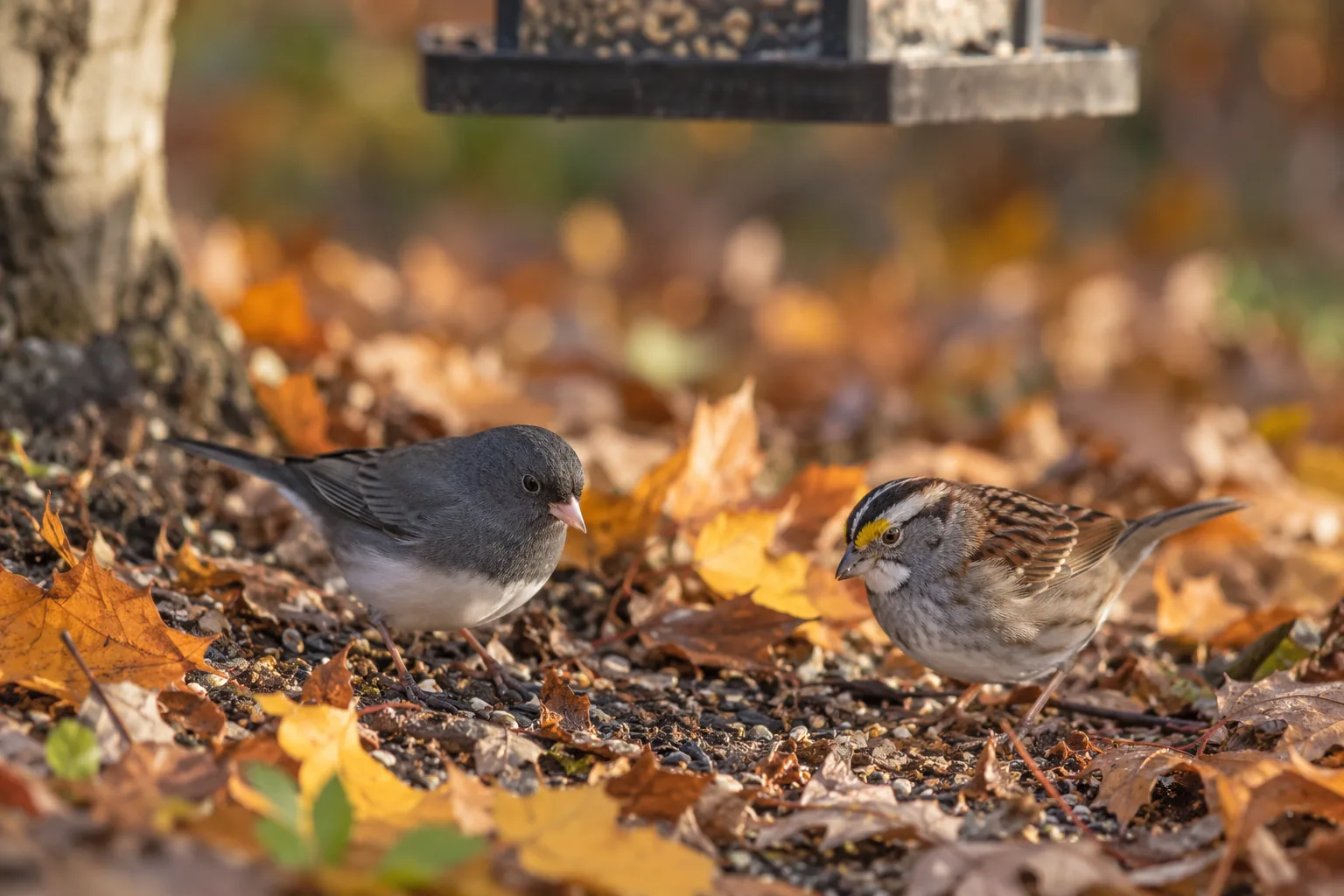
A Dark-eyed Junco is a small, round sparrow, 5.5 to 6.3 inches long and weighing 0.6 to 1.1 oz, with a pale pink bill and white outer tail feathers that flash when it flies. In the East, most are slate gray above with a clean white belly. Western birds come in several color forms, including the “Oregon” junco with a black hood and brown back.
When do juncos arrive?
Juncos breed across Canada, in the western mountains and in the Appalachians, then spread across most of the rest of North America for winter. According to All About Birds, over most of the eastern United States they “appear as winter sets in.” In many northern states that means October, with birds reaching the Southeast later in fall. The Cornell Lab estimates the total population at about 630 million, which is why they are among the most familiar winter visitors anywhere.
What to put out for juncos
Juncos are ground feeders. They hop under shrubs and across lawns picking up small seeds.
- Scatter white proso millet and sunflower hearts on the ground or on a low platform.
- Put food within about 10 feet of shrubs, a hedge or a brush pile so they can reach cover quickly.
- A ground platform feeder with a mesh floor keeps seed off wet soil and drains after rain.
Our species guide on how to attract Dark-eyed Juncos goes deeper into plantings and cover.
How do you tell a White-throated Sparrow from a White-crowned Sparrow?
A White-throated Sparrow has a crisp white throat patch and a yellow spot between the eye and bill; a White-crowned Sparrow has no white throat and no yellow spot, a clean gray breast, and a pink, orange or yellowish bill. Both have bold head stripes, which is why people mix them up.
White-throated Sparrow
White-throated Sparrows are 6.3 to 7.1 inches long and weigh 0.8 to 1.1 oz. They come in two forms. The “white-striped” form has a black-and-white striped crown, while the “tan-striped” form shows buff and brown stripes instead, with lower contrast. The Cornell Lab notes that the two forms almost always pair with a bird of the opposite form, one of the odder facts in North American ornithology.
They breed mainly in Canada and winter across most of eastern and southern North America and in California. Listen for their thin whistled song, often written “Oh sweet Canada,” which they sing even in fall.
What to put out: millet and black oil sunflower on the ground, near cover. White-throated Sparrows scratch under feeders for fallen seed. See our guide to attracting White-throated Sparrows.
White-crowned Sparrow
White-crowned Sparrows are 5.9 to 6.3 inches long and weigh 0.9 to 1.0 oz. Adults have a striking black-and-white striped head. Immatures, which are common in fall, have rusty brown and gray head stripes instead, so a brown-headed bird in October may still be this species.
They winter over much of North America, but they are most common in the West, the Southwest and the southern and central states. In the Northeast and upper Midwest they are more of a migrant than a winter resident. Some western populations stay all year.
What to put out: millet and sunflower hearts on the ground or on a low tray, near brushy cover.
Which sparrows only reach the northern states or specific regions?
The American Tree Sparrow winters mainly in the northern United States and southern Canada, while the Fox Sparrow winters over much of the East and along the Pacific Coast. Neither is a bird most Southern feeders will see.
American Tree Sparrow
This small, round-headed sparrow is about 5.5 inches long. Look for a rusty cap and eyeline on a gray face, a two-toned bill (dark above, yellow below), and a dark spot in the center of an unstreaked breast. Despite its name, it feeds mostly on the ground.
American Tree Sparrows breed on the Arctic tundra and winter in weedy fields, hedgerows and backyards across the northern states. They typically arrive in late fall as the tundra freezes. All About Birds notes they need to take in about 30 percent of their body weight in food and a similar amount of water each day, so a missed day of feeding can be serious for them in hard weather. The species is also listed as a “Common Bird in Steep Decline.”
What to put out: millet and small seeds on the ground, plus unfrozen water. See keeping a bird bath ice-free in winter.
Fox Sparrow
Fox Sparrows are large, chunky sparrows, 5.9 to 7.5 inches long and 0.9 to 1.6 oz. Plumage varies by region. The “Red” form seen in the East is rusty above with heavy reddish spotting below. The “Sooty” form along the Pacific Coast is very dark brown.
The easiest clue is behavior. A Fox Sparrow hops forward and kicks backward with both feet at once, flipping leaves aside to find seeds and insects. They seldom stray far from dense cover.
What to put out: seed scattered right beside thick shrubs or a brush pile, and a layer of leaves left under your hedges. Our piece on why fall cleanup hurts birds explains why leaf litter is a feeding ground in its own right.
Why is a Red-breasted Nuthatch suddenly at my feeder?
A Red-breasted Nuthatch that appears at a feeder where you have never seen one before is usually part of an irruption: in years when conifer seed crops fail in the north, these birds move south in numbers, sometimes by late summer or early fall.
At about 4.3 inches and 0.3 to 0.5 oz, this is a small, barrel-chested bird with a black cap, a white eyebrow, a black line through the eye and rusty-cinnamon underparts. Females have grayer caps and paler bellies. It climbs up, down and sideways on trunks like other nuthatches.
Red-breasted Nuthatches live year-round in northern and mountain conifer forests. In irruption years they turn up well south of that range, often in yards with pines or spruces.
What to put out: black oil sunflower, shelled peanuts and suet. They often grab one seed and fly off to wedge it into bark, so expect lots of quick visits. Our guide to attracting Red-breasted Nuthatches has more on the conifers they prefer.
How do you identify Pine Siskins, Purple Finches and Evening Grosbeaks?
Pine Siskins are small, brown and heavily streaked with yellow edges on the wings and tail; Purple Finches look like cleaner, raspberry-washed House Finches; Evening Grosbeaks are chunky yellow, black and white finches with huge pale bills. All three are irruptive, so they may be abundant one winter and absent the next.
Pine Siskin
Siskins are 4.3 to 5.5 inches long and 0.4 to 0.6 oz, slightly smaller than an American Goldfinch. Look for a slender, sharply pointed bill and flashes of yellow in the wings as they fly. They travel in noisy, wheezy flocks. The Cornell Lab describes them as ranging “widely and erratically” in winter, so they can appear almost anywhere in the lower 48.
What to put out: nyjer and sunflower hearts in a tube or mesh feeder. Siskins are prone to salmonellosis at crowded feeders, so when they arrive, clean feeders more often and spread food across several stations. Our roundup of finch feeders for nyjer covers suitable designs.
Purple Finch
Purple Finches are 4.7 to 6.3 inches long and 0.6 to 1.1 oz. Males are washed in raspberry red over the head, breast and back. Females are brown and white with bold streaks, a whitish eyebrow and a dark line down the side of the throat, which House Finch females lack.
They breed mostly in Canada and the Northeast, and the Cornell Lab describes them as “erratic migrants that follow cone crops,” wintering across the central and southeastern states and returning to a given region roughly every other year.
What to put out: black oil sunflower, in a tube or on a platform.
Evening Grosbeak
Evening Grosbeaks are 6.3 to 7.1 inches long and 1.9 to 2.6 oz, about Northern Cardinal size but thicker set. Males are yellow and black with big white wing patches and a bright yellow eyebrow. Females are mostly gray with a greenish-yellow tinge. Both have a very thick, pale bill in winter.
They make erratic movements into the continental United States in some winters, mostly the northern states, and can then become common at feeders. The species has declined sharply and is now uncommon in much of the East, so a flock at your feeder is a genuine event worth reporting to eBird.
What to put out: black oil sunflower on a sturdy platform. A flock can empty a feeder in a morning.
What is a Redpoll, and did the Common and Hoary Redpoll become one species?
A Redpoll is a small streaky finch, 4.5 to 5.5 inches long and 0.3 to 0.7 oz, with a red cap, a tiny black chin patch and a stubby yellow bill. In 2024 the American Ornithological Society merged Common, Hoary and Lesser Redpoll into a single species now called simply Redpoll, after genetic studies found no meaningful differences between them.
The old “Common” form is brown and white with streaked flanks, and males show a rosy wash on the breast. The old “Hoary” form is paler and frostier, with males that look strikingly white. Both still occur, and noting the form is still interesting, but they are one species.
Redpolls breed in the Arctic. In irruption years they reach the northern states and occasionally the central US, often in busy flocks that hang upside down on seed heads and feeders.
What to put out: nyjer and sunflower hearts. A second nyjer tube helps when a flock of 30 or more arrives.
Which winter birds eat suet instead of seed?
Among fall arrivals, the Yellow-rumped Warbler is the main suet eater, along with the Red-breasted Nuthatch. Most warblers leave the US for winter, but Yellow-rumped Warblers stay farther north than any other warbler.
Yellow-rumped Warbler
The key is diet. All About Birds notes it is the only warbler able to digest the waxes in bayberries and wax myrtles, which lets it winter across the central and southeastern states and along the coasts. In winter it is streaky brown with a yellow patch on the rump and usually small yellow patches on the sides. Its sharp “check” call is a good clue.
What to put out: suet, suet mixes with peanut butter, and sunflower hearts. Native wax myrtle or bayberry shrubs feed them naturally. See our guide to the best suet cakes and blends.
Golden-crowned Kinglet
At 3.1 to 4.3 inches and 0.1 to 0.3 oz, this is smaller than a chickadee. Look for a black-and-white striped face and a yellow crown, with orange in the center on males. Golden-crowned Kinglets breed in the far north and the mountain West and spread across most of North America in winter. The Cornell Lab notes they can survive nights of minus 40 degrees.
Kinglets feed on tiny insects gleaned from conifer needles, and they rarely use feeders. You are more likely to see them flicking through spruces or hedges near your feeding station, sometimes with chickadees. Evergreens, unfrozen water and insect-rich leaf litter are what they need.
What should you put out for winter birds this month?
For October and November, set up three feeding zones: a ground or low platform area for sparrows and juncos, a hanging tube for finches, and a suet feeder for nuthatches and warblers. Then add water and cover.
The October and November checklist
- Clean every feeder before the winter crowd arrives. Scrub, rinse and dry fully.
- Ground station: white proso millet plus sunflower hearts, scattered thinly on a mesh tray or clean ground near shrubs. Refill small amounts often so it stays dry.
- Sunflower tube or hopper: black oil sunflower for nuthatches, Purple Finches and grosbeaks. Our guide to what to feed birds in winter compares the main foods.
- Nyjer or sunflower-heart tube: ready for siskins and Redpolls if the finch forecast suggests an irruption.
- Suet: once nights are regularly cold, for Yellow-rumped Warblers, nuthatches and woodpeckers.
- Water: a shallow bird bath, kept open with a heater or de-icer once it freezes.
- Cover: a brush pile or dense shrub within about 10 feet of the ground station.
- Leaves: leave some under hedges for Fox Sparrows, juncos and kinglets.
A bag of white proso millet is the single most useful addition for most yards in fall, because the ground-feeding sparrows and juncos prefer it.
What mistakes keep winter birds away from feeders?
The most common mistake is offering only a hanging feeder, which leaves ground-feeding juncos and sparrows with nothing but spillage. Others are easy to fix.
- Wet or moldy ground seed. Seed on soil spoils fast in fall rain. Use a mesh tray and put out only what gets eaten in a day or two.
- No cover nearby. Sparrows feed nervously in the open and may avoid a bare lawn. A shrub or brush pile close by makes a big difference.
- Too much open space for hawks. Winter flocks attract Cooper’s and Sharp-shinned Hawks. Cover helps here too.
- Crowded, dirty feeders during a siskin irruption. Salmonellosis spreads where birds pile together. Clean more often and add feeding points.
- Giving up too early. New arrivals need time to find a feeder. In many yards the winter community builds through November and December.
Sources
- Dark-eyed Junco identification and overview, All About Birds (Cornell Lab of Ornithology)
- White-throated Sparrow identification, All About Birds
- American Tree Sparrow overview, All About Birds
- Redpolls United! Highlights from the 2024 AOS Checklist Update, All About Birds
- Juncos Are the Original Snowbirds, Audubon
- Project Overview, Project FeederWatch
- Winter Finch Forecast, Finch Research Network
Each of these guides answers a different question:
- Winter Bird Feeding: What Birds Need When It's ColdWinter bird feeding done right: high-fat foods like suet, sunflower and peanuts, open water, shelter from wind and clean feeders. What birds need in the cold.
- What to Feed Birds in Winter: High-Fat Foods That WorkWhat to feed birds in winter: high-fat black oil sunflower, suet, peanuts and nyjer, millet for ground feeders, fruit for thrushes, plus a source of open water.
- Heated Bird Baths: 6 Best Picks and De-Icers for WinterThe best heated bird bath for most yards is the Allied Precision 970, a 20-inch basin held at 40 to 50°F. 6 picks, a warranty table and a GFCI checklist.
- How to Keep a Bird Bath From Freezing in WinterHow to keep a bird bath from freezing: a thermostatic heater or heated bath on a GFCI outlet works best. Plus no-power methods, safety rules and what to avoid.
- Suet for Birds: Best Suet Cakes, No-Melt Picks and TipsSuet for birds is beef fat that draws woodpeckers, nuthatches and chickadees. Suet cakes compared, raw vs rendered, no-melt suet in heat and when to offer.
- Best Bird Feeder Pole System to Stop Squirrels and RaccoonsThe best bird feeder pole system pairs a rigid steel pole with a proper baffle and smart placement. See our research-based picks for squirrels and raccoons.
- Winter Berry Shrubs for Birds: Best Picks With Lasting FruitWinter berry shrubs for birds: winterberry, native hollies, sumac, chokeberry, viburnum, hawthorn and juniper hold fruit into late winter. What to plant where.
- Gifts for Bird Lovers: Ideas Birders Actually WantGifts for bird lovers, sorted by budget: a binocular harness, a field guide, a squirrel-proof feeder, a heated bird bath, 8x42 binoculars and bird cameras.

Frequently asked questions
What birds come to feeders in October and November?
In much of the US, fall brings Dark-eyed Juncos, White-throated and White-crowned Sparrows, American Tree Sparrows in the north, Fox Sparrows in the East and on the Pacific Coast, Yellow-rumped Warblers in the South and on the coasts, and in some years Red-breasted Nuthatches, Pine Siskins, Purple Finches, Evening Grosbeaks and Redpolls from the north.
What is the best food for juncos and winter sparrows?
Juncos and most winter sparrows feed on the ground. White proso millet, sunflower hearts and a little cracked corn scattered on the ground or offered on a low platform suit them best. Put the food close to shrubs or a brush pile so they can dash to cover, and keep it dry so it does not mold.
Why do some winter finches show up only in certain years?
Pine Siskins, Redpolls, Evening Grosbeaks, Purple Finches and Red-breasted Nuthatches are irruptive. When cone and seed crops fail in the boreal forest of Canada, they move south in large numbers. In years with good northern crops most of them stay north. The Finch Research Network publishes a winter finch forecast each fall.
Are Common Redpoll and Hoary Redpoll still separate species?
No. In its 2024 checklist update, the American Ornithological Society merged Common, Hoary and Lesser Redpoll into one species, now simply called Redpoll. Genetic work found no meaningful differences between them. Pale, frosty birds are still worth noting as the Hoary form, but they count as the same species.
When should I start feeding winter birds?
Fall is a good time to clean feeders and have food out, because many winter visitors settle into a feeding route in October and November. Start with a ground or platform station for sparrows and juncos, a tube of sunflower hearts or nyjer for finches, and suet once nights turn cold.