Bird Behavior: Reading What Birds Are Doing
Bird behavior is readable: posture, calls and movement show whether a bird is feeding, courting, defending a territory or alarmed. Here is how to interpret it.
In this article
- Quick answer: common bird behaviors and what they mean
- Why does reading bird behavior matter?
- How do birds show alarm and fear?
- How do birds defend territories?
- What does courtship behavior look like?
- How can you tell when birds are nesting?
- What do young birds do?
- How do birds feed, and what does it tell you?
- What do comfort behaviors mean?
- How can you tell if a bird is sick?
- How do birds behave in flocks?
- How does behavior change through the year?
- How to practice reading bird behavior
- Common mistakes when interpreting bird behavior
- Quick facts
- Sources
- Frequently asked questions
Reading bird behavior means watching posture, movement and sound to work out what a bird is doing and why: feeding, resting, defending territory, courting, raising young or reacting to danger. Most behavior falls into a handful of categories, and each has telltale signs. A robin running and stopping on a lawn is hunting, a chickadee scolding from a shrub has spotted a predator, and a young bird fluttering its wings with an open mouth is begging for food.
Once you learn to read these signals, birding changes. You stop seeing birds as a list of species and start seeing stories: a pair building a nest, a dominance hierarchy at the feeder, a flock reacting to a hawk before you have seen it. Behavior also helps with identification, because the way a bird moves is often as distinctive as its colors. This guide explains the main types of bird behavior, how to interpret them, and what they mean for backyard birders.
Quick answer: common bird behaviors and what they mean
| What you see | What it usually means |
|---|---|
| Harsh repeated calls, wing and tail flicking | Alarm or mobbing a predator |
| Freezing, then scattering from a feeder | A hawk or other predator nearby |
| Bird singing from a high, exposed perch | Advertising a territory or attracting a mate |
| Two birds of same species chasing in spring | Territorial dispute or courtship |
| Carrying twigs, grass or moss | Nest building |
| Carrying food, especially insects, repeatedly | Feeding young in a nearby nest |
| Young bird fluttering wings, open mouth | Begging for food |
| Feathers fluffed, head tucked | Resting, sleeping or keeping warm |
| Fluffed and lethargic in mild weather | Possible illness |
| Adult feeding another adult | Courtship feeding |
| Dragging a wing near the ground | Distraction display near a nest |
Why does reading bird behavior matter?
There are three good reasons to learn it.
- It helps you find birds. Alarm calls tell you a predator is near. A bird carrying food tells you a nest is close. A flock of chickadees in winter often holds other species.
- It helps you identify birds. A bird creeping down a trunk headfirst is almost certainly a nuthatch. One pumping its tail may be a phoebe. Our guide on how to identify birds explains how behavior fits alongside size, shape, color and sound.
- It helps you avoid disturbing birds. Recognizing signs of stress lets you step back before you cause harm. Our guide to birding etiquette covers the wider principles.
How do birds show alarm and fear?
Alarm behavior is the most useful to learn, because it tells you about predators and about your own impact.
Alarm calls
Many birds have distinct alarm calls, often harsh, repeated and easy to locate. Birds commonly use at least two types:
- Mobbing calls are loud, harsh and easy to locate. They are given when a bird finds a perched predator, such as an owl, cat or snake, and they draw other birds in to harass it.
- Aerial alarm calls are often thin, high-pitched “seet” notes that are hard to locate. They warn of a flying hawk. Birds hearing them usually freeze or dive for cover.
The difference makes sense: a mobbing call should recruit help, so it is easy to find, while an aerial alarm should warn without revealing the caller to a hawk overhead. This pattern has been described in many songbird families on several continents.
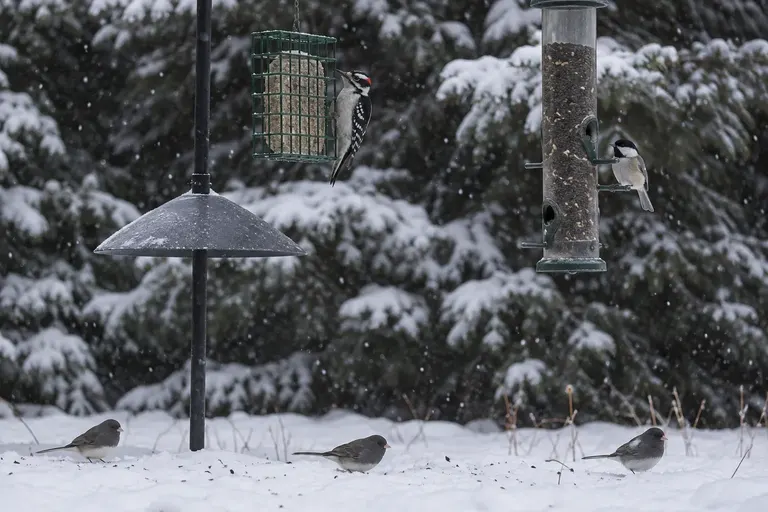
Birds also eavesdrop on other species’ alarms. Research on chickadees has shown that their calls carry information about predator size and threat level, and that nuthatches and other species respond to that information. In backyards, a sudden silence followed by an empty feeder often means a Cooper’s Hawk in North America or a Eurasian Sparrowhawk in Europe is hunting nearby. Our guide on hawks at feeders explains what to do.
Body language of fear
- Sleeking: feathers pressed flat so the bird looks thinner.
- Freezing: motionless, often in cover, sometimes for minutes.
- Crouching: body lowered, ready to spring into flight.
- Wing and tail flicking: a sign of agitation in many small birds.
- Head turning: constant scanning.
- Crest raised: in crested species like titmice, jays and cardinals, a raised crest often signals arousal or alarm, though it is also used in other contexts.
Mobbing
When small birds gather around a predator, scolding and diving, they are mobbing. You can often find roosting owls by following the sound of a mobbing flock. Mobbing is the behavior that pishing imitates; see our guide on pishing for how and when birders use it.
How do birds defend territories?
Many birds defend territories during the breeding season, and some, such as mockingbirds and some hummingbirds, defend food sources year round.
Song
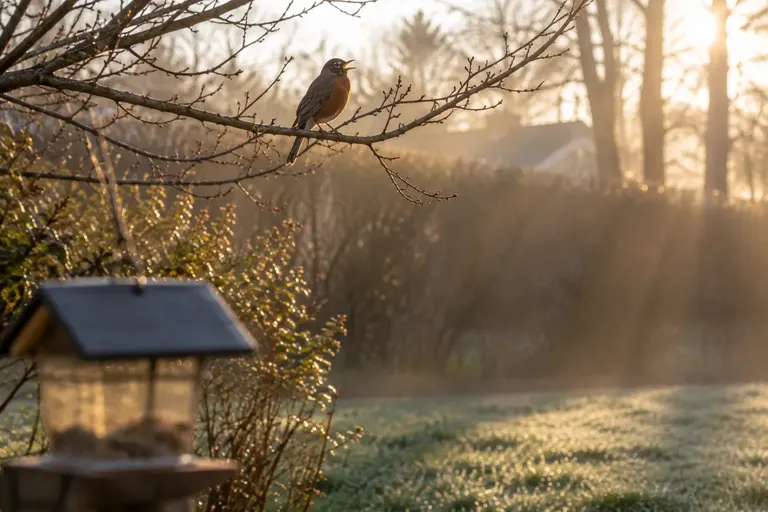
Song is the main territorial signal in songbirds. A male singing from a high, exposed perch is announcing ownership and advertising to females. In most temperate songbirds, singing peaks at dawn in spring. The dawn chorus may be timed for when sound carries well and light is too poor for efficient foraging, though several explanations are still debated. In many tropical species, and in some temperate ones such as Northern Cardinals, females sing too.
Displays and chases
- Countersinging: two males singing back and forth at a territory boundary.
- Posturing: puffing up, spreading the tail, drooping or lifting the wings.
- Chases: often fast and low, ending at a boundary.
- Physical fights: less common, but they happen, especially early in the season.
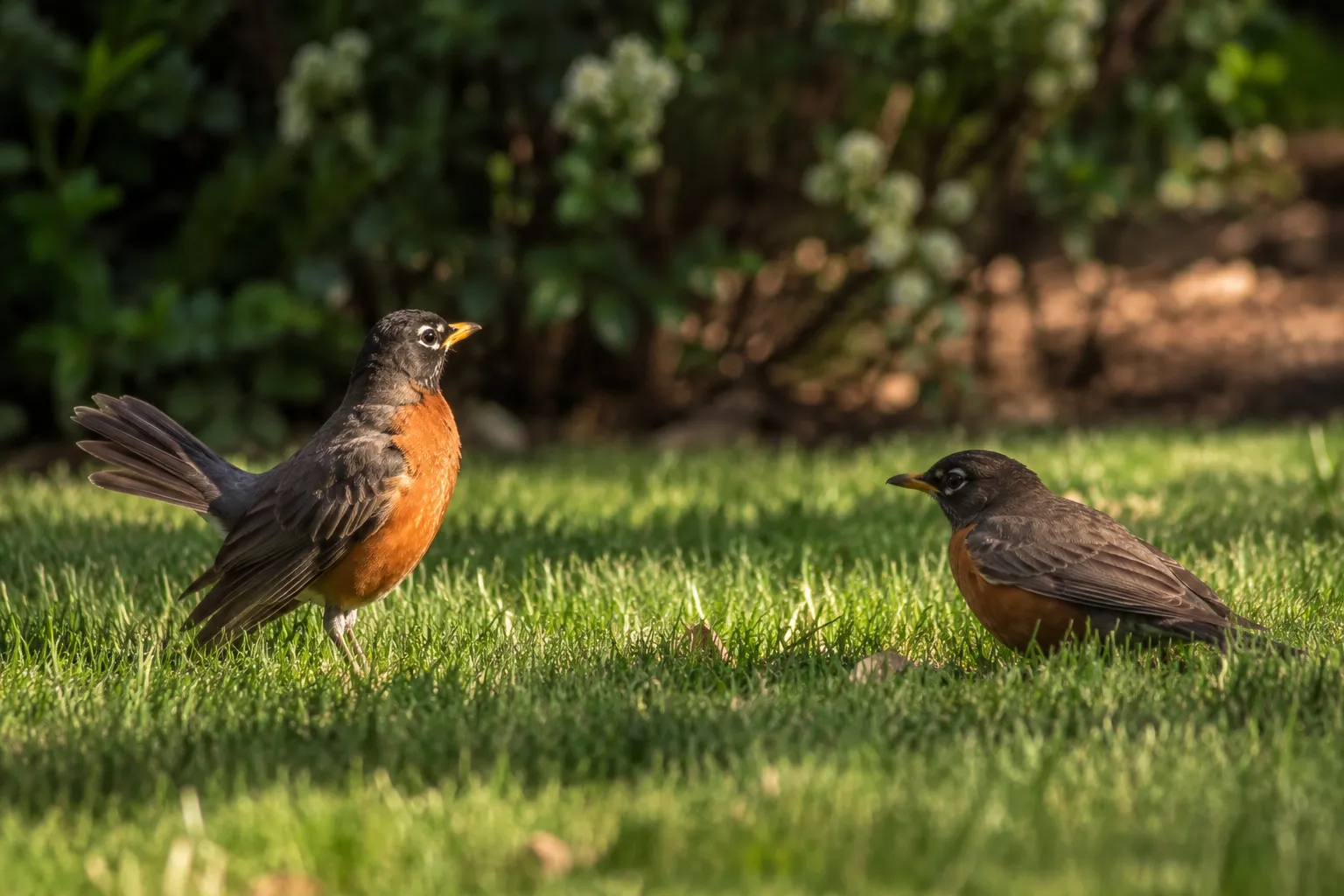
A classic example is the European Robin, a famously territorial bird in which both males and females hold territories in winter and sing to defend them. In North America, Red-winged Blackbirds display loudly from cattails, spreading their red shoulder patches.
Attacking reflections
Birds that repeatedly attack windows or car mirrors are defending territories against their own reflections, which they perceive as rivals. Cardinals and robins are frequent offenders. Covering the outside of the glass or mirror for a few weeks usually ends it, since the behavior fades as the breeding season passes.
What does courtship behavior look like?
Courtship varies more than any other category, from the simple to the spectacular.
Common courtship behaviors
- Courtship feeding: a male feeding a female, common in cardinals, many finches and terns. It may help strengthen the pair bond and show that the male can provide food.
- Displays: puffing, bowing, tail spreading, wing drooping or special flights. Mourning Doves perform display flights with loud wing claps and glides. Many hummingbird males perform dive displays; the male Anna’s Hummingbird makes a loud chirp at the bottom of its dive, produced by its tail feathers.
- Song flights: skylarks in Europe and Asia sing while hovering high overhead. Many grassland birds worldwide use song flights where there are no tall perches.
- Mutual preening: pairs of some species, such as doves, parrots and some finches, preen each other.
- Female solicitation: a female crouching and quivering her wings is often inviting mating.
Courtship can also look like fighting. Chases between a male and female in spring are often courtship pursuits rather than aggression.

How can you tell when birds are nesting?
Nesting behavior is some of the most rewarding to watch, and also the most important to avoid disturbing.
Signs of nesting
- Carrying material: twigs, grass, moss, mud, spider silk or feathers. Birds that make several trips with material in a short period are usually in the middle of construction.
- Repeated trips to the same spot: a bird disappearing into the same shrub, cavity or nest box again and again.
- Carrying food, especially insects: even seed-eating birds feed most nestlings insects. A bird with a beak full of caterpillars is feeding young.
- Carrying fecal sacs: many songbird parents carry small white packets of nestling droppings away from the nest to keep it clean and less obvious.
- Agitation when you approach: alarm calls and anxious behavior may mean you are close to a nest.
Distraction displays
Some birds try to lead predators away from nests. The Killdeer in the Americas is famous for its broken-wing display, dragging one wing and calling as it moves away from its eggs. Plovers in many parts of the world use similar displays. If you see one, you are too close to a nest; move away carefully and watch your step, since the eggs are often on bare ground.
What do young birds do?
Fledglings are some of the most misunderstood birds in the backyard.
- Begging: a young bird fluttering its wings, opening its bill wide and calling repeatedly is asking to be fed. Fledglings keep begging for days or weeks after leaving the nest.
- Clumsy flight and hopping: many songbirds leave the nest before they can fly well. They hop on the ground or in shrubs while parents keep feeding them nearby.
- Following adults: young birds often follow parents around, learning where to find food.
A fledgling on the ground is usually fine and does not need rescue. Our guide to finding a baby bird explains how to tell a healthy fledgling from a nestling in trouble.
How do birds feed, and what does it tell you?
Feeding behavior is excellent for identification because it is linked to a bird’s anatomy and diet.
| Feeding behavior | Example birds |
|---|---|
| Run, stop, look, pull worm from lawn | American Robin, Eurasian Blackbird, Song Thrush |
| Double-footed backward scratch in leaf litter | Towhees, many sparrows |
| Climbing headfirst down trunks | Nuthatches |
| Hitching up trunks, bracing on tail | Woodpeckers, treecreepers |
| Hovering at flowers | Hummingbirds, some sunbirds |
| Sallying out from a perch to catch insects | Flycatchers, phoebes, kingbirds |
| Hanging upside down on twigs or feeders | Chickadees, tits, goldfinches |
| Caching seeds in bark or ground | Chickadees, nuthatches, jays |
Feeder hierarchy
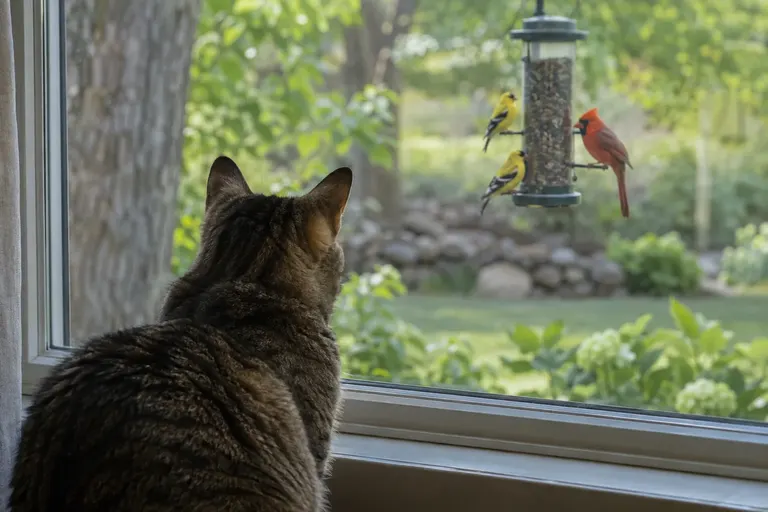
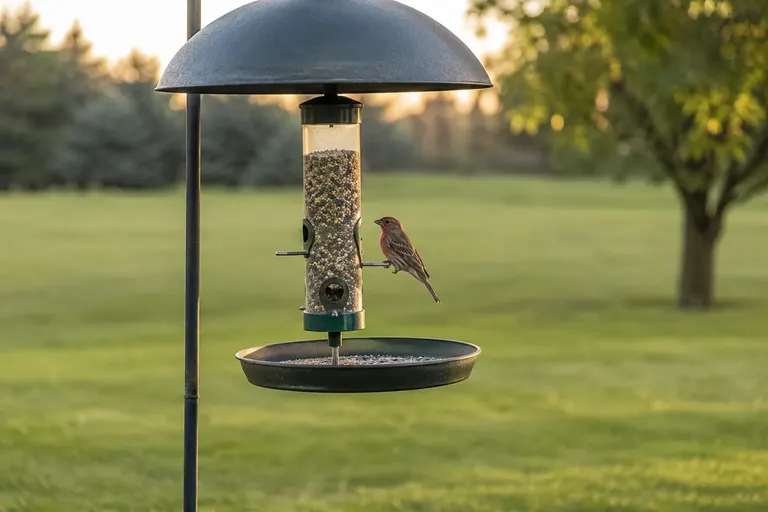
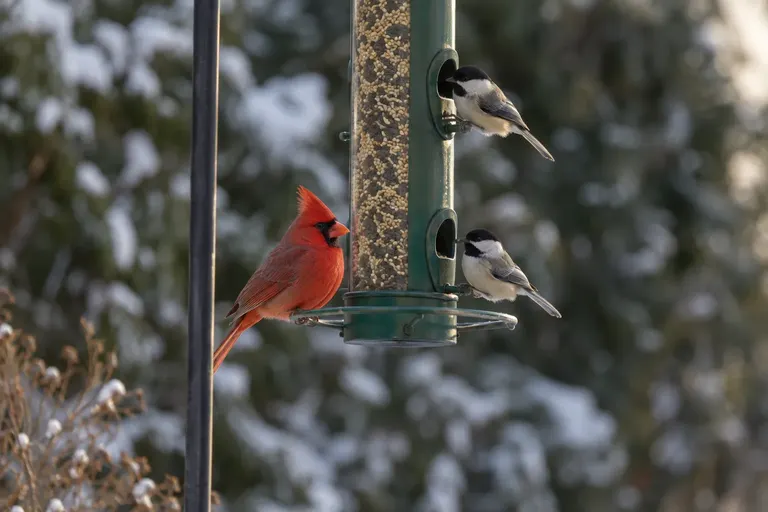
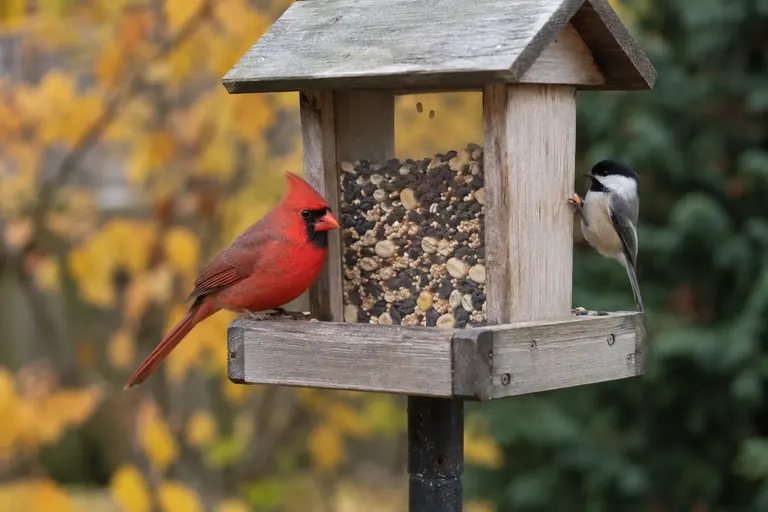
At feeders, watch for a pecking order. Larger birds often displace smaller ones, and within a species, dominant individuals claim the best perches. Blue Jays may scatter smaller birds; House Finches may give way to cardinals. In winter chickadee flocks, rank affects who feeds first and who gets the safest positions.
Hoarding
Some birds store food for later. Chickadees and nuthatches take one seed at a time and hide it in bark or crevices, and jays bury acorns. Food-caching chickadees can relocate many of their hidden items days later, a feat of spatial memory linked to a relatively enlarged hippocampus.
What do comfort behaviors mean?
Many behaviors are about maintaining feathers and body condition.
- Preening: running feathers through the bill to clean and realign them and spread oil from the preen gland near the base of the tail.
- Bathing: splashing in water to clean feathers, usually followed by preening.
- Dust bathing: rolling in dry soil, common in House Sparrows, wrens and gamebirds.
- Sunbathing: lying with wings spread and feathers raised, sometimes looking alarmingly like a sick bird.
- Anting: rubbing ants on feathers or letting ants crawl through them.
- Stretching: a wing and leg stretched on the same side, or both wings raised above the back.
- Fluffing: raising feathers to trap air for warmth.
Our guide on why birds puff up goes deeper into feather fluffing and what it signals.
How can you tell if a bird is sick?
Healthy birds are alert and active. Warning signs include:
- Staying fluffed up and inactive during the day, especially in mild weather.
- Eyes crusty, swollen or closed.
- Allowing very close approach without reacting.
- Difficulty flying, balancing or perching.
- Sitting on the feeder for long periods without eating normally.
House Finch eye disease in North America and trichomonosis in European greenfinches and chaffinches are two diseases spread at feeders. If you see sick birds, clean feeders thoroughly and consider taking them down for a while. See our guide to sick birds at the feeder.
How do birds behave in flocks?
Many birds spend part or all of the year in flocks, and flock behavior has its own logic.
Why join a flock?
Flocking brings two major benefits: more eyes to spot predators, and more chances to find food. A single bird must spend much of its time looking up; a bird in a flock can spend more time feeding because others share the watch. Flocks also dilute risk, because a hawk can only catch one bird at a time.
Mixed-species flocks
In winter in North American woodlands, chickadees and titmice often form the core of mixed flocks joined by nuthatches, kinglets, Downy Woodpeckers and creepers. In European woods, tit flocks play a similar role, often with Goldcrests, treecreepers and Long-tailed Tits. In tropical forests such as the Amazon and the Atlantic Forest of Brazil, mixed flocks can include dozens of species, with certain “sentinel” species giving alarm calls that the rest of the flock relies on.
Flock signals to watch for
- Contact calls: soft, frequent notes that keep a flock together as it moves through cover.
- Synchronized takeoff: a whole flock rising at once usually means one bird spotted danger.
- Spacing: birds on a wire or branch often keep a set distance from neighbors, reflecting individual space and rank.
- Sentinels: in some species, one bird watches from a high perch while others feed.
Large, coordinated flocks such as starling murmurations are another form of the same safety-in-numbers strategy.
How does behavior change through the year?
The annual cycle shapes almost everything birds do. Knowing the calendar helps you predict what you will see.
- Late winter: flocks begin to break up, and the first songs start on mild days.
- Spring: territories, courtship, nest building and the peak of the dawn chorus.
- Early summer: feeding young, then noisy family groups of fledglings.
- Late summer: molt. Many birds become quiet and secretive while they replace feathers.
- Fall: migration, restlessness, flocking and, for many species, food storing.
- Winter: flocks, roosting together, and heavy feeder use in cold weather.
In the Southern Hemisphere, the same cycle runs on the opposite calendar, so a birder in southern Brazil sees nest building around September to December. In the tropics, breeding is often tied to wet and dry seasons rather than temperature.
How to practice reading bird behavior
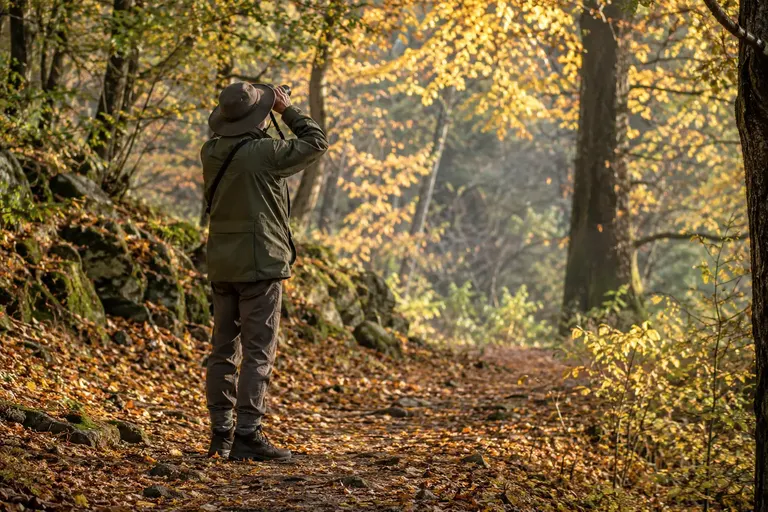
- Watch one bird for five minutes. Resist the urge to move on once you have identified it. Note everything it does.
- Ask “why?” For every action, guess at the reason: feeding, resting, alarm, territory, courtship.
- Watch the reactions of other birds. If one bird’s behavior changes others’, it is probably a signal.
- Listen as well as look. Sounds often explain behavior before you see the cause.
- Keep notes. Behavior patterns only become clear over time. Our guide to keeping a birding journal shows how.
- Watch the same birds through the seasons. Backyard birds show the whole annual cycle, from winter flocks to spring territories to summer families.
Common mistakes when interpreting bird behavior
- Assuming human motives. A bird attacking a window is not angry at you; it is fighting a rival.
- Mistaking sunbathing for injury. Spread wings and a dazed look in the sun are usually normal.
- “Rescuing” healthy fledglings. Most are supervised by parents nearby.
- Ignoring alarm calls. They often signal a predator or tell you that you are too close to a nest.
- Assuming every chase is a fight. Many are courtship.
- Reading one observation as a rule. Individual birds vary. Look for patterns.
Quick facts
- Most bird behavior falls into feeding, resting, comfort, alarm, territory, courtship and parenting.
- Mobbing calls are harsh and easy to locate; aerial hawk alarms are thin and hard to locate.
- Singing from a high perch in spring is usually territorial advertisement.
- Birds carrying insects in spring or summer are usually feeding young nearby.
- Fledglings often beg with fluttering wings and an open mouth for weeks after leaving the nest.
- A bird staying fluffed and sleepy in mild weather may be sick.
- Watching one bird for several minutes teaches more than glancing at many.
Sources
Frequently asked questions
How can you tell if a bird is stressed?
Signs of stress or alarm include repeated harsh calls, rapid tail flicking or wing flicking, a sleek, flattened body with feathers pressed tight, freezing in place, crouching, and constant head turning. A bird that stops feeding to watch you is telling you that you are close enough. Backing away a few steps usually lets it return to normal behavior.
Why do birds flutter their wings while sitting?
In young birds, rapid wing fluttering with an open bill is begging, a signal to parents to deliver food. Adult birds sometimes use similar fluttering in courtship, especially females soliciting food or mating from a mate. Brief wing flicks, in contrast, are usually a sign of mild agitation or alertness. Context and age help you tell them apart.
Why do birds chase each other?
Most chases are about territory, food or mates. In spring, chases between two birds of the same species are often territorial disputes or courtship pursuits. At feeders, short chases are usually competition for food or perches. In late summer and fall, chases between young birds may be part of learning social rank within a flock.
What does it mean when a bird puffs up its feathers?
Fluffing feathers traps air and insulates the body, so it is common in cold weather and during rest. Birds also fluff during preening and some displays. However, a bird that stays fluffed up, inactive and sleepy during the day, especially in mild weather, may be sick. Watch for other signs such as crusty eyes or reluctance to fly.
Do birds show emotions?
Birds show clear behavioral states such as fear, aggression, arousal and relaxation, and their brains share many structures and chemical systems with mammals that are linked to emotion. Whether they experience feelings as humans do cannot be measured directly. Scientists generally describe behavior in terms of motivation and state rather than human emotional labels.