What Attracts Golden-crowned Kinglets to Your Yard?
How to attract Golden-crowned Kinglets: they rarely eat seed, so plant conifers, skip pesticides, add a brush pile and water, and put suet crumbs by cover.
In this article
- Golden-crowned Kinglet at a glance
- What does a Golden-crowned Kinglet look like?
- Golden-crowned or Ruby-crowned Kinglet?
- What do Golden-crowned Kinglets eat?
- Do Golden-crowned Kinglets come to bird feeders?
- How do you make your yard kinglet-friendly?
- How do you find a Golden-crowned Kinglet?
- How do Golden-crowned Kinglets survive winter?
- When will you see them in your yard?
- Do Golden-crowned Kinglets use nest boxes?
- Are Golden-crowned Kinglets declining?
- Is it worth trying to attract them?
- Sources
- Frequently asked questions
To attract Golden-crowned Kinglets, focus on habitat, not seed. They eat tiny insects and spiders, so plant or keep conifers, stop using pesticides, leave leaves and a brush pile, add water, and hang a little suet close to cover. Expect them mostly from late fall to early spring, moving through with other small winter birds.
Be honest with yourself about feeders, though. Kinglets do visit suet now and then, but they spend most of their lives gleaning insects from needles and twigs high in the trees. The yard around your feeder matters far more than the feeder itself.
Golden-crowned Kinglet at a glance
| Feature | Details |
|---|---|
| Length | 3.1 to 4.3 in (8 to 11 cm) |
| Weight | 0.1 to 0.3 oz (4 to 8 g) |
| Wingspan | 5.5 to 7.1 in (14 to 18 cm) |
| Key marks | Black-and-white striped face, yellow crown stripe (orange center on males), thin white wingbar |
| Diet | Mainly small insects, spiders and their eggs; a few seeds in winter |
| Best yard foods | Suet in a small cage, a few mealworms |
| Habitat | Spruce and fir in summer; conifers, mixed woods, parks and suburbs in winter |
| Nest boxes | Not used; builds a hanging cup high in a conifer |
| Conservation | Common Bird in Steep Decline (Cornell Lab) |
Figures from the Cornell Lab’s All About Birds identification and life history pages.
What does a Golden-crowned Kinglet look like?
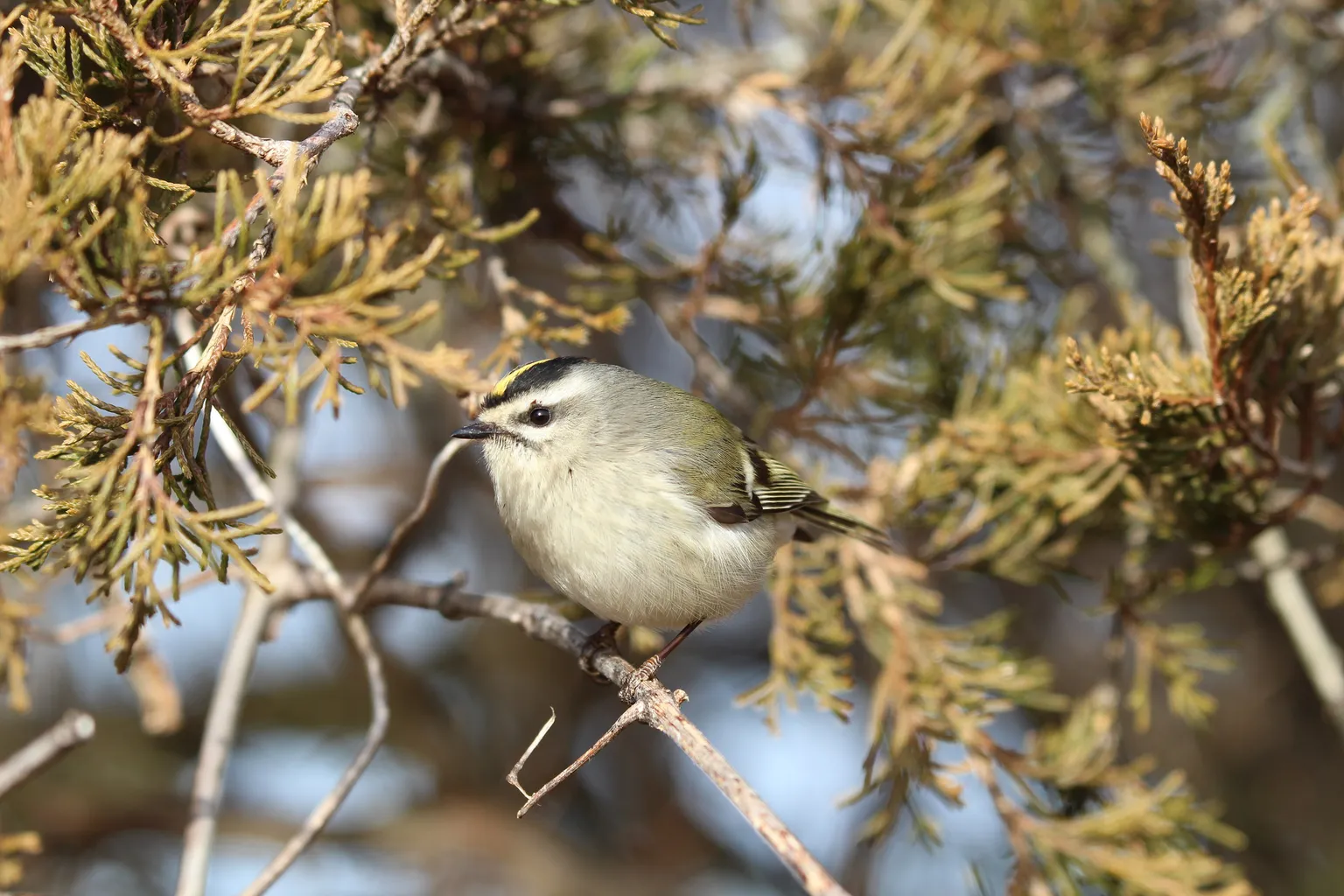
It’s a tiny, round, pale olive bird with a black-and-white striped face and a bright crown patch. The Cornell Lab describes it as barely larger than a hummingbird, pale olive above and gray below, with a short, thin bill made for gleaning small insects.
The crown is the giveaway. Both sexes show a yellow crown stripe bordered with black. Males have orange in the center of the crown, while females have an all-yellow crown patch. Look also for a thin white wingbar and yellow edges on the black flight feathers.
In the field you’ll often see only a small, busy shape hanging from the tip of a spruce twig. Audubon notes that this kinglet often hangs upside down from twig tips and sometimes hovers to pluck insects from foliage or bark.
Golden-crowned or Ruby-crowned Kinglet?
Look at the face. A Golden-crowned Kinglet has bold black-and-white stripes, while a Ruby-crowned Kinglet has a plain face with a white eye ring. The Cornell Lab points to the plain face as the easiest way to separate the Ruby-crowned from its more boldly marked cousin.
| Look at | Golden-crowned Kinglet | Ruby-crowned Kinglet |
|---|---|---|
| Face | Black-and-white stripes | Plain, with a prominent white eye ring |
| Crown | Yellow stripe, usually visible (orange center on males) | Red patch on males, only occasionally visible |
| Behavior | Often high in dense conifers, hangs from twig tips | Restless, flicks wings almost constantly, lower and middle levels |
| Habitat | Conifer forests, especially spruce and fir | More open forests, shrubby habitats in winter |
| Winter | Very cold-hardy, stays far north | Moves to lower elevations and farther south, as far as Mexico |
Behavior and habitat notes from the Cornell Lab and Birds and Blooms.
What do Golden-crowned Kinglets eat?
Mostly insects. The Cornell Lab says they eat small, soft-bodied arthropods and their eggs, gleaned from branch tips, bark and conifer needles, and add only small amounts of seed in winter.
The list of prey is long: springtails, beetles, flies, moths and their caterpillars, lacewings, wasps, spiders and mites all appear in the Cornell Lab’s life history. Audubon adds aphids, scale insects and gnats, and notes that kinglets occasionally take oozing sap.
In winter, the Cornell Lab says, they also forage in brush piles and understory trees. That single fact shapes the whole yard plan below. A kinglet is looking for overwintering insects and insect eggs, and the places that hold them are needles, bark, shrubs and piled branches.
Do Golden-crowned Kinglets come to bird feeders?
Sometimes, but rarely enough that you shouldn’t build your hopes on a feeder. Seed does almost nothing for them. Suet and mealworms are the only feeder foods worth trying.
In Birds and Blooms, ornithologist Ed Pandolfino explains that kinglets are tiny birds with tiny bills and aren’t really going to focus on seeds. He suggests a suet feeder or mealworms on a tray as treats. Here’s how to give those treats the best odds:
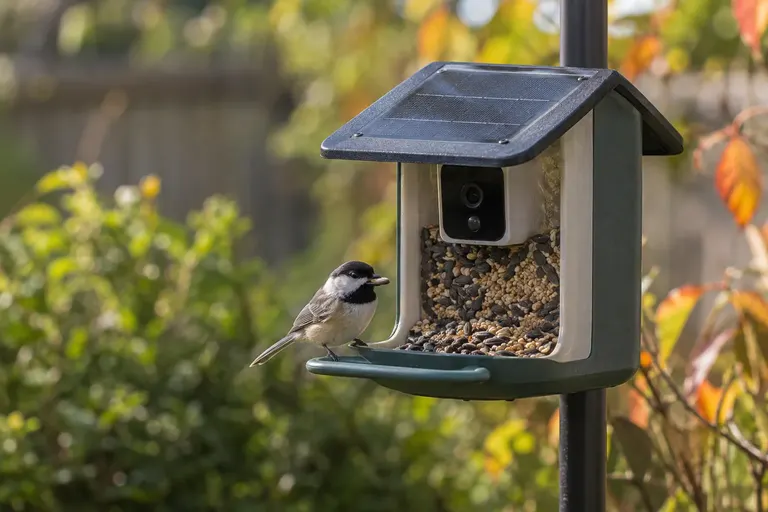
- Suet in a small cage. Hang it close to a conifer or dense shrub, where kinglets already feed. A cage with small openings also keeps jays from emptying it. Our suet feeder guide covers cage sizes, and the suet guide explains which cakes to buy.
- Suet crumbs. Kinglets pick at tiny items. Crumbled suet or suet shavings on a small tray near cover suit their bill better than a hard block.
- A few mealworms. Offer a small handful in a shallow dish near shrubs. Our mealworms guide covers live versus dried.
- Skip seed-only setups. A tube of millet or sunflower won’t bring kinglets in by itself, though it can draw the mixed flocks they travel with.
Keep expectations low and treat any kinglet at the suet as a bonus. The real work happens in the trees.
How do you make your yard kinglet-friendly?
Give them the habitat where their food lives: conifers, pesticide-free plants, leaf litter, brush and water. These steps help kinglets and nearly every other insect-eating bird.
| Step | Why it helps kinglets | Source |
|---|---|---|
| Plant or keep conifers | They forage in conifer needles and nest high in spruce and fir | Cornell Lab |
| Stop spraying pesticides | Tiny insectivores depend on the insects that sprays kill | Birds and Blooms |
| Grow native plants | Native plants support the insects kinglets hunt | Birds and Blooms |
| Build a brush pile | In winter they forage in brush piles and understory | Cornell Lab |
| Provide water | Kinglets favor areas near water | Birds and Blooms |
| Hang suet near cover | Occasional treat that may pull a flock member in | Birds and Blooms |
1. Plant or keep conifers
This is the big one. The Cornell Lab says they breed mainly in boreal and mountain conifer forests and nest in the tops of conifers such as balsam fir, white spruce and black spruce. In winter they widen their range to deciduous woods, swamps, cities and suburbs, but Audubon says to look for them in dense conifers, including pine groves and planted conifers in parks and cemeteries.
If you have room, a group of spruce, fir, pine or hemlock does more than a single tree. Choose species that are native to your area, since those host more of the insects kinglets eat.
2. Stop spraying
Birds and Blooms is direct about this: kinglets depend on insects, so avoid pesticides. Every aphid, scale insect and caterpillar egg on your shrubs is potential kinglet food.
3. Leave the leaves and build a brush pile
Fallen leaves and piled branches hold overwintering insects and give small birds shelter from wind and hawks. See our guides on why you should leave the leaves and how to build a brush pile.
4. Add water
A shallow birdbath helps every insect-eater in winter, when natural water freezes. Our guide to keeping a bird bath ice-free in winter walks through heaters and simpler tricks.
5. Feed the winter flock
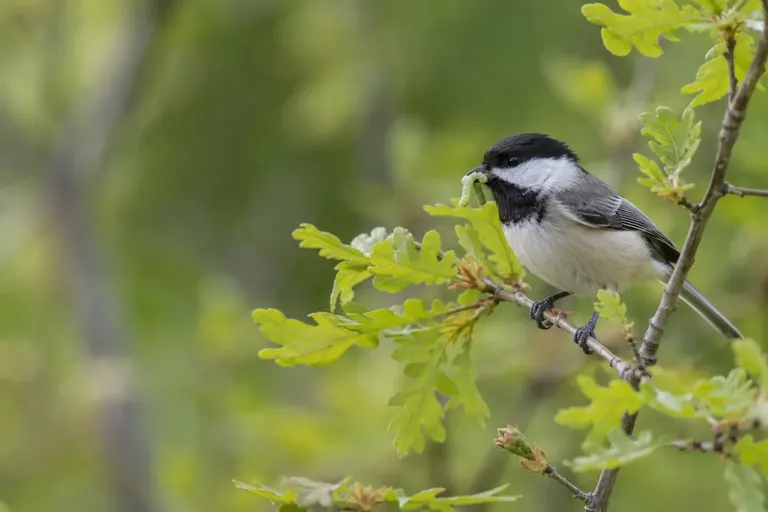
Outside the breeding season, the Cornell Lab says kinglets become more social and flock with other small songbirds, including nuthatches, woodpeckers and warblers. In many yards those mixed flocks form around chickadees. Make your yard work for Black-capped Chickadees with sunflower, suet and nearby trees, and the kinglets traveling with them get a reason to stop.
How do you find a Golden-crowned Kinglet?
Listen first. The Cornell Lab says they usually stay concealed high in dense trees and reveal themselves with thin, very high-pitched calls. The best way to find one is by ear.
The calls are so high that they’re easy to miss, especially over wind or traffic. On a calm winter morning, when a chickadee flock moves through your trees, stop and listen for thin, very high “tsee” notes. A sound ID app helps here; our guide to Merlin Sound ID explains how to get reliable results. Then scan the tips of conifer branches for a tiny bird hanging upside down or hovering.
How do Golden-crowned Kinglets survive winter?
They’re remarkably tough. The Cornell Lab says Golden-crowned Kinglets can survive nights of minus 40 degrees, sometimes huddling together for warmth.
Birds and Blooms notes that some overwinter as far north as Maine despite temperatures that low. To get through long nights on a body weight of a few grams, they need to feed steadily through short winter days, which is why a yard rich in overwintering insects helps more than anything you can put in a feeder. Audubon adds that very cold winters can cause temporary drops in their numbers.
When will you see them in your yard?
For most of the United States, late fall through early spring. The Cornell Lab says they breed in the far north and in the mountains of the West and visit most of North America in winter.
| Season | What kinglets are doing | What helps |
|---|---|---|
| Fall | Migrating late in the season into wintering areas | Conifers, leaf litter left in place |
| Winter | Traveling with mixed flocks, feeding almost constantly | Suet near cover, brush pile, open water |
| Spring | Migrating north early in the season | Pesticide-free shrubs full of insects |
| Summer | Breeding in spruce and fir forests in the North and West | Conifer stands where they nest |
Migration timing from Audubon. Audubon notes that some birds are probably permanent residents on the northern Pacific Coast, so you may see them year-round there.
Do Golden-crowned Kinglets use nest boxes?
No. They build a deep, cup-shaped hanging nest of moss, spiderweb, lichen and bark strips, usually high in a conifer and close to the trunk, according to the Cornell Lab. Nests can be up to about 60 feet off the ground.
| Detail | Golden-crowned Kinglet |
|---|---|
| Nest site | Top of a conifer such as fir or spruce, close to the trunk |
| Clutch size | 3 to 11 eggs |
| Incubation | About 15 days |
| Nestling period | 16 to 19 days |
| Broods per year | 1 to 2 |
The best nesting help is simply mature conifers left standing. Most backyard birders will only host kinglets in winter, since breeding happens mainly in northern and mountain forests.
Are Golden-crowned Kinglets declining?
Yes, overall. The Cornell Lab lists the species as a Common Bird in Steep Decline, with a cumulative drop of about 32 percent between 1966 and 2019, and about 61 percent in the United States alone.
The picture isn’t the same everywhere. The Cornell Lab says eastern populations appear to have slightly increased, possibly because of spruce reforestation, and Audubon notes the breeding range has expanded into areas with planted conifers. Logging, forest fires and other disturbances reduce breeding densities. Partners in Flight still estimates a global breeding population of about 140 million and rates the species 8 out of 20 on its Continental Concern Score, which means low concern.
Is it worth trying to attract them?
Yes, if you have or can plant conifers and shrubs. If your yard is open lawn with no trees, a feeder alone is very unlikely to bring a kinglet in, and time or money is better spent on native evergreens, a brush pile and water first.
The good news is that every step in this guide helps far more birds than kinglets. Chickadees, nuthatches, wrens and warblers all use the same insects, cover and water. Build the habitat, hang a small suet cage near the trees, and listen for those thin high calls on cold mornings.
Sources
- Cornell Lab of Ornithology, All About Birds: Golden-crowned Kinglet Overview
- Cornell Lab of Ornithology, All About Birds: Golden-crowned Kinglet Identification
- Cornell Lab of Ornithology, All About Birds: Golden-crowned Kinglet Life History
- Cornell Lab of Ornithology, All About Birds: Ruby-crowned Kinglet Identification
- Audubon Guide to North American Birds: Golden-crowned Kinglet
- Birds and Blooms: Ruby-crowned and Golden-crowned Kinglets

Frequently asked questions
Do Golden-crowned Kinglets eat bird seed?
Hardly ever. The Cornell Lab of Ornithology says Golden-crowned Kinglets eat mainly small insects, spiders and their eggs, adding only small amounts of seed in winter. Their bills are tiny and thin, built for picking insects out of conifer needles and bark. A seed feeder won't draw them in. Conifers, pesticide-free shrubs, a brush pile and a little suet near cover give you a much better chance.
What feeder is best for Golden-crowned Kinglets?
A small suet cage hung close to a conifer or dense shrub is your best bet, along with a few mealworms in a tray. Birds and Blooms quotes ornithologist Ed Pandolfino recommending exactly those two options, since kinglets aren't built for seeds. Be realistic: kinglets visit feeders only occasionally. Most of the time they feed in the trees around the feeder, not at it.
When can I see Golden-crowned Kinglets in my yard?
In most of the United States, look for them between late fall and early spring. The Cornell Lab says they breed in the far north and in western mountains, then visit most of North America in winter. Audubon notes they migrate late in fall and early in spring. In winter they often turn up in pine groves and planted conifers in parks, cemeteries and suburbs.
How do Golden-crowned Kinglets survive cold winter nights?
They're far tougher than their 4 to 8 gram weight suggests. The Cornell Lab reports that Golden-crowned Kinglets can survive nights of minus 40 degrees, sometimes huddling together for warmth. By day they feed almost constantly on tiny insects and insect eggs hidden in conifer needles and bark. That's why dense evergreens and pesticide-free shrubs matter more to them than any feeder.
How do I tell a Golden-crowned from a Ruby-crowned Kinglet?
Check the face first. The Golden-crowned Kinglet has bold black-and-white stripes on the face and a yellow crown stripe you can usually see. The Ruby-crowned Kinglet has a plain face with a white eye ring, and the male's red crown is only occasionally visible, according to the Cornell Lab. Ruby-crowned Kinglets also flick their wings almost constantly and often forage lower.