How to Attract Song Sparrows: Cover, Seed and Water
How to attract song sparrows: scatter millet and sunflower chips low near dense shrubs, add a brush pile and shallow water, and leave some brushy edges unmowed.
In this article
- Song Sparrow at a glance
- How do you identify a Song Sparrow?
- Where do Song Sparrows live, and do they migrate?
- How to find Song Sparrows in your yard
- What do Song Sparrows eat?
- What kind of feeder do Song Sparrows use?
- What plants attract Song Sparrows?
- Do Song Sparrows nest in backyards?
- Do Song Sparrows use bird baths?
- Seasonal calendar
- Common problems
- Are Song Sparrows declining?
- Common mistakes
- Quick checklist: how to attract Song Sparrows
- Sources
- Frequently asked questions
Here is how to attract Song Sparrows: give them what they look for in the wild: dense, low shrubs and weedy edges for cover, seed scattered on the ground within about 10 feet of that cover, and a shallow source of water. A brush pile and a strip of yard you do not mow will do more than any feeder. Song Sparrows are common, and in most of the US they are one of the easiest sparrows to host year-round once your yard has enough thick cover.
Song Sparrow at a glance
| Trait | Details |
|---|---|
| Size | 4.7 to 6.7 in long, wingspan 7.1 to 9.4 in, 0.4 to 1.9 oz (Cornell Lab; varies widely by region) |
| Look | Streaky brown sparrow with thick streaks on a white chest, often a central breast spot |
| Range | Throughout most of North America, from the Aleutian Islands to the Atlantic, plus an isolated population in Mexico |
| Season in your yard | Year-round in much of the US; winter only in parts of the South; summer only in the northern interior |
| Diet | Insects in the warm months; grass and weed seeds, plus fruit, in winter |
| Feeder type | Ground, low platform or tray; seed spilled beneath hanging feeders |
| Nesting | Open cup on the ground or low in dense vegetation; does not use nest boxes |
| Conservation | Low concern, about 130 million birds, but down roughly 27% since 1966 (Cornell Lab) |
How do you identify a Song Sparrow?
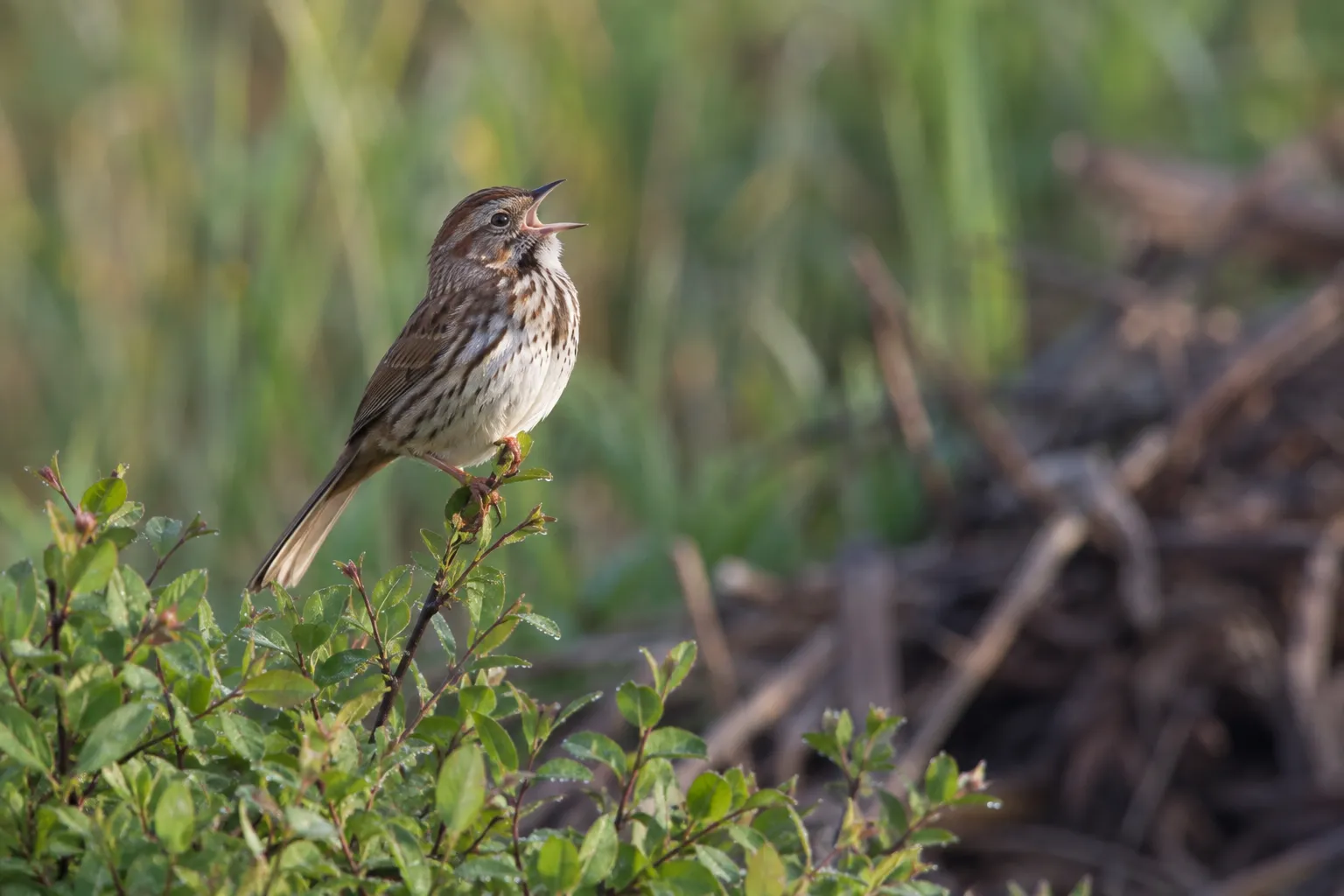
The Cornell Lab describes the Song Sparrow as a russet-and-gray bird with bold streaks down a white chest. It is slightly smaller than a Dark-eyed Junco and slightly larger than a Chipping Sparrow.
Key field marks
- Breast: white with thick brown streaks that often merge into a dark central spot. The spot is a good clue but not unique to Song Sparrows.
- Head: a mix of warm red-brown and slaty gray, with a gray stripe over the eye and a broad dark mustache stripe running down from the bill.
- Tail: fairly long and rounded. In flight the bird pumps its tail down, a habit the Cornell Lab calls distinctive.
- Posture: often perches upright on a low shrub, and leans its head back when singing.
Males and females look alike.
Regional variation
Song Sparrows vary more across their range than almost any other North American bird. The Cornell Lab recognizes 24 subspecies. Birds of the Desert Southwest are pale, birds of the Pacific Northwest are dark and heavily streaked, and birds on Alaska’s Aleutian Islands are darker still and much larger, about one-third longer than eastern birds and twice as heavy. In practice, the Song Sparrow in your yard will match the local pattern in your field guide, so use a regional guide or app.
Juveniles
Young Song Sparrows in summer are, per the Cornell Lab, drabber and buffier than adults, with less distinct head stripes. The streaks on the breast can look finer, which causes confusion with Lincoln’s Sparrow.
Similar species
| Species | How it differs from a Song Sparrow |
|---|---|
| Savannah Sparrow | Shorter, notched tail; finer streaks; often a yellow wash in front of the eye; prefers open grassland |
| Lincoln’s Sparrow | Smaller and neater; fine black streaks on a buffy breast band; shy |
| Fox Sparrow | Larger and chunkier; heavy spotting that forms triangles or chevrons; rusty tail in eastern birds |
| Vesper Sparrow | White outer tail feathers show in flight; white eye ring; open country bird |
| House Finch (female) | Thick, curved finch bill; blurry streaks; no head stripes |
If you are new to separating brown birds, our guide on how to identify birds walks through the size, shape and behavior clues that help most.
Song
The male’s song is a good way to confirm the ID. It usually opens with two to four clear, separated notes, then a buzzy trill, then a jumble of notes. A classic memory phrase is “maids, maids, maids, put on your tea-kettle-ettle-ettle.” The Cornell Lab describes it as stuttering and clattering. Each male has a repertoire of several songs, and the Cornell Lab notes that females prefer males whose songs show better learning. The common call is a sharp, nasal “chimp.”
Where do Song Sparrows live, and do they migrate?
Song Sparrows are found across most of North America. The Cornell Lab describes a continuous range from the Aleutian Islands to the eastern US, with an isolated population on the Mexican plateau roughly 900 miles from the rest.
Their migration pattern depends on where you live:
- Year-round: most of the US from the Pacific Coast across the central states to the Atlantic, especially the northern half of the country, plus coastal regions.
- Summer only: much of Canada and the northern interior. Audubon notes these northern interior birds move south for winter.
- Winter only: the southern tier of the US, including much of Texas, the Gulf Coast and Florida, receives Song Sparrows from the north in the colder months, and some reach northern Mexico.
So a Song Sparrow scratching under your feeder in January may not be the same bird that sang from your fence in June. In year-round areas, the local breeders often stay put, and northern migrants join them for winter. That is one reason winter numbers under feeders can be higher than summer numbers in the middle of the country.
How to find Song Sparrows in your yard
Song Sparrows are often present long before people notice them, because they spend much of their time on the ground under shrubs.
- Listen at dawn in spring. Males sing from exposed perches, often a fence post, the top of a shrub or a low limb about eye level. The song carries, and males repeat the same song type several times before switching.
- Listen for the call. A sharp “chimp” from inside a hedge is a good sign one is there.
- Watch the ground under feeders. Look for a streaky brown bird scratching with both feet, often alongside juncos or White-throated Sparrows in winter.
- Watch how it flies. A low, direct flight into cover with the tail pumping down is classic Song Sparrow.
- Use binoculars. Sparrow ID comes down to streak patterns and face stripes. Close-focusing 8x binoculars make it much easier; see how to choose binoculars for birding.
What do Song Sparrows eat?
Song Sparrows change their diet with the seasons. In the warm months, the Cornell Lab lists beetles, weevils, caterpillars, grasshoppers, dragonflies, midges, crane flies, spiders, snails and earthworms. Year-round plant foods include seeds of buckwheat, ragweed and clover, plus sunflower, wheat and rice, and fruits such as blackberries, blueberries, raspberries, strawberries, mulberries and wild cherries. Audubon adds that coastal birds eat small crustaceans and mollusks.
In winter, weed and grass seeds make up much of the diet, which is when feeders help most.
Best foods to offer
- White proso millet: a favorite of ground-feeding sparrows. Scatter a little on the ground or on a low tray.
- Black oil sunflower seed or sunflower chips: chips (hulled pieces) are easier for sparrows and leave no hulls. See our guide to black oil sunflower seed.
- Cracked corn: cheap and taken readily, but it also draws doves, blackbirds and squirrels, so offer small amounts.
- Mixed seed with millet: many blends that are poor for chickadees are fine for sparrows. Our roundup of the best bird seed explains which mixes avoid filler.
Offer only what the birds clear in a day. Seed that sits on damp ground molds, and moldy seed can make birds sick.
What kind of feeder do Song Sparrows use?
Song Sparrows rarely cling to tube feeders. They forage on the ground, walking and hopping and often scratching the soil with both feet, as both the Cornell Lab and Audubon describe.
- Low platform or tray feeder. A tray a few inches off the ground is ideal. It keeps seed off wet soil and is easy to clean. Our best platform and tray feeders roundup compares styles.
- Ground feeding under a hanging feeder. Song Sparrows will clean up what finches and chickadees drop.
- Near cover. Audubon notes that Song Sparrows visit feeders near protective cover. Put your tray within about 10 feet of a dense shrub or brush pile so they can dash to safety.
If you have cats outdoors, ground feeding is risky. Keep cats indoors, and avoid ground feeding right next to shrubs where a predator could hide at arm’s length. For more on the balance, see where to put a bird feeder.
What plants attract Song Sparrows?
Habitat matters more than food for this species. The Cornell Lab lists an enormous range of habitats, from tidal marshes and desert scrub to forest edges and suburbs. What they share is dense, low vegetation, often near water.
Structure first
- Dense shrubs from knee to head height, especially thorny or tangled ones.
- Unmowed edges of tall grasses and wildflowers, left standing through winter for seed.
- Brush piles made from pruned branches, stacked loosely with large pieces at the bottom.
- Wet spots such as a rain garden, pond edge or low swale.
Native plants by region
| Region | Good Song Sparrow plants |
|---|---|
| Northeast and Great Lakes | Blackberry and raspberry, gray dogwood, arrowwood viburnum, elderberry, New England aster, goldenrods, switchgrass |
| Southeast | Blackberry, American beautyberry, wax myrtle, elderberry, little bluestem, native asters and goldenrods |
| Midwest and Plains | Wild plum thickets, chokecherry, American hazelnut, little bluestem, switchgrass, asters, coneflowers |
| Mountain West | Wild rose, snowberry, chokecherry, willows along water, native bunchgrasses |
| Pacific Coast | California blackberry, snowberry, coyote brush, Nootka rose, native bunchgrasses, willows along streams |
Leave seedheads standing through winter. Asters, goldenrods, coneflowers and native grasses are free sparrow feeders from October to March.
Do Song Sparrows nest in backyards?
Yes, often. The Cornell Lab notes nests in residential flower beds, and Song Sparrows accept close human activity when cover is thick. Males defend small territories, so a well-planted suburban block can hold several pairs.
Nesting facts
According to the Cornell Lab:
- Nest site: chosen by the pair together, hidden in grass or weeds, on the ground or up to about 15 feet high, often near water. Audubon notes most are on the ground or below 4 feet.
- Nest: an open cup of grasses, weeds, bark and rootlets, sometimes lined with animal hair, built by the female in about 4 days.
- Eggs: 1 to 6, blue, blue-green or gray-green with brown, red-brown or lilac spots.
- Incubation: 12 to 15 days.
- Nestling period: 9 to 12 days.
- Broods: 1 to 7 per year. Most pairs raise two or more.
Because nests are on or near the ground, the biggest threats in a yard are cats, mowing and trimming.
How to help nesting Song Sparrows
- Do not trim hedges or clear brush from April through August if you can avoid it.
- Mow around, not through, tall grass and weedy corners.
- Keep cats indoors.
- Song Sparrows are frequent hosts of Brown-headed Cowbirds, which lay eggs in other birds’ nests. Removing feeders that attract cowbirds in spring, such as open trays of millet and cracked corn, may reduce visits, though evidence at the backyard scale is limited.
Do Song Sparrows use bird baths?
Song Sparrows like water and are often found near it. Audubon notes they sometimes forage in shallow water. A bird bath helps, especially in winter and dry summers.
- Use a ground-level or low bath, 1 to 2 inches deep with a textured bottom.
- Place it near shrubs but with a clear view around it.
- Add a dripper to make the water easier to find.
- Clean and refill every few days.
- In freezing climates, a heated bath gives them open water when little else is available.
Seasonal calendar
| Season | What Song Sparrows are doing | What to do |
|---|---|---|
| Late winter (Feb to Mar) | Males start singing and claiming territories | Keep feeding; leave brush and seedheads |
| Spring (Apr to May) | Nest building and first broods | Stop trimming shrubs; keep cats in |
| Summer (Jun to Aug) | Second and later broods; heavy insect feeding | Avoid insecticides; keep water fresh |
| Fall (Sep to Nov) | Northern birds move south; young disperse | Let seedheads stand; build a brush pile |
| Winter (Dec to Jan) | Seed-heavy diet, sometimes in loose flocks with other sparrows | Scatter millet and sunflower chips near cover |
Common problems
Birds not showing up
A yard of lawn and clipped foundation shrubs gives Song Sparrows nowhere to hide. Add cover first, then food. Our guide on why birds aren’t coming to your feeder covers other causes.
Sparrows attacking windows
In spring, male Song Sparrows sometimes attack their reflection in windows or car mirrors, treating it as a rival. This is territorial and usually fades after nesting. Break up the reflection on the outside of the glass with screens, film or a temporary cover.
Hawks
Cooper’s and Sharp-shinned Hawks hunt ground-feeding birds. Dense cover within a short dash of the feeding area is the best defense. See how to stop hawks hunting at your feeder.
Mold and disease on the ground
Seed on bare ground gets wet and moldy. Use a tray with drainage holes, rake up old seed and hulls, and move ground-feeding spots now and then.
Are Song Sparrows declining?
Song Sparrows remain abundant, with an estimated 130 million birds, and the Cornell Lab rates them low conservation concern. Even so, the Cornell Lab reports a decline of roughly 27% since 1966. Some local populations face sharper pressure: the Cornell Lab points to wetland loss around San Francisco Bay, and to island populations lost to fire and introduced hares.
Backyards cannot reverse continental trends alone, but the things that help Song Sparrows at home are simple and cumulative: dense native shrubs, fewer pesticides, indoor cats, less mowing and brush left in place. Each of those also helps wrens, towhees, thrushes and wintering sparrows. Recording what you see on eBird or Project FeederWatch adds your yard to the data scientists use to track these trends.
Common mistakes
Hanging a tube feeder and waiting. Song Sparrows seldom perch on small tube ports. If you only have hanging feeders, let some seed fall or add a low tray.
Clearing every leaf and stem in fall. Fall cleanup removes seedheads, insect shelter and the leaf litter these birds scratch through. Leave beds standing until spring.
Putting the feeding area in the open. A tray in the middle of the lawn feels exposed to a sparrow. Move it closer to cover.
Pruning shrubs into tight shapes. Sheared hedges are dense on the outside and bare inside. Looser, naturally shaped shrubs give better nesting cover.
Quick checklist: how to attract Song Sparrows
- Plant or keep dense shrubs and tangles at the yard’s edge.
- Leave a strip of tall grasses and wildflowers unmowed through winter.
- Build a loose brush pile.
- Offer millet and sunflower chips on a low tray near cover.
- Add a low, shallow bird bath.
- Skip trimming and insecticides during nesting season.
- Keep cats indoors.
Sources
Frequently asked questions
What do Song Sparrows eat at feeders?
Song Sparrows mostly feed on the ground, so they pick up seed below feeders or from low platform trays. White proso millet, black oil sunflower seed, sunflower chips and cracked corn all suit them. In the wild they eat insects through the warm months and switch largely to grass and weed seeds in winter, according to Audubon.
Do Song Sparrows use birdhouses?
No. Song Sparrows build open cup nests on the ground or low in dense shrubs, grasses and weeds, often near water. The Cornell Lab notes nests from ground level up to about 15 feet. To help them nest, keep thick low vegetation, unmowed edges and brush piles rather than putting up a nest box.
How can you tell a Song Sparrow from other sparrows?
Look for thick brown streaks on a white chest that often join into a central spot, a gray and brown striped head, a broad dark mustache stripe, and a long rounded tail that the bird pumps in flight. Savannah Sparrows have a shorter notched tail and often yellow near the eye, and Lincoln's Sparrows have finer streaks on a buffy breast.
Do Song Sparrows stay all winter?
In much of the US, yes. Song Sparrows are year-round residents across a large part of their range. Audubon notes that northern interior populations migrate south for winter, moving into the southern US and northern Mexico, so some areas lose their breeding birds in winter while southern yards gain extra visitors.
When do Song Sparrows sing?
Males sing most in spring and early summer while defending territories, often from an exposed perch at about eye level. Many also sing on mild days in late winter and fall. The song starts with a few clear, separated notes, followed by a buzzy trill and a jumble of notes, and each male knows several song types.