How to Attract Tufted Titmice: Food, Trees and Nest Boxes
How to attract tufted titmice: offer black oil sunflower, peanuts and suet near mature trees, plant native oaks and put up a 1 1/4 inch hole nest box.
In this article
- Tufted titmouse at a glance
- How to identify a tufted titmouse
- Where do tufted titmice live?
- What do tufted titmice eat?
- Best feeders for tufted titmice
- Native plants that attract tufted titmice
- Tufted titmouse nest box specs
- Titmice, chickadees and winter flocks
- How long does it take titmice to find a feeder?
- Do tufted titmice migrate?
- Water for titmice
- Seasonal calendar
- Why aren’t titmice coming to my feeder?
- Common mistakes
- Conservation status
- The short version
- Sources
- Frequently asked questions
Here is how to attract tufted titmice: offer black oil sunflower seed, peanuts and suet, ideally where the feeder sits near mature trees. They live in the same area all year, so a yard with food, tree cover, water and a nest box with a 1 1/4 inch hole can keep a pair around in every season. If you already see chickadees, titmice are usually close behind: the two often travel together.
This guide covers identification, what titmice eat, the best feeders and foods, native trees, nest box specs, a seasonal calendar and common mistakes.
Tufted titmouse at a glance
| Trait | Details |
|---|---|
| Size | 5.5 to 6.3 in long, 0.6 to 0.9 oz, wingspan 7.9 to 10.2 in |
| Range | Year-round in the eastern US and parts of southern Canada |
| Season in yards | All year; feeder use peaks in winter |
| Diet | Insects and spiders in summer; seeds, nuts and berries, especially in fall and winter |
| Best feeder foods | Black oil sunflower, peanuts, suet |
| Feeder type | Hopper, tube, platform, suet and peanut feeders |
| Nesting | Natural cavities, old woodpecker holes and nest boxes |
| Clutch | 3 to 9 speckled eggs, 1 brood a year |
Measurements and nesting data are from the Cornell Lab of Ornithology’s All About Birds.
How to identify a tufted titmouse
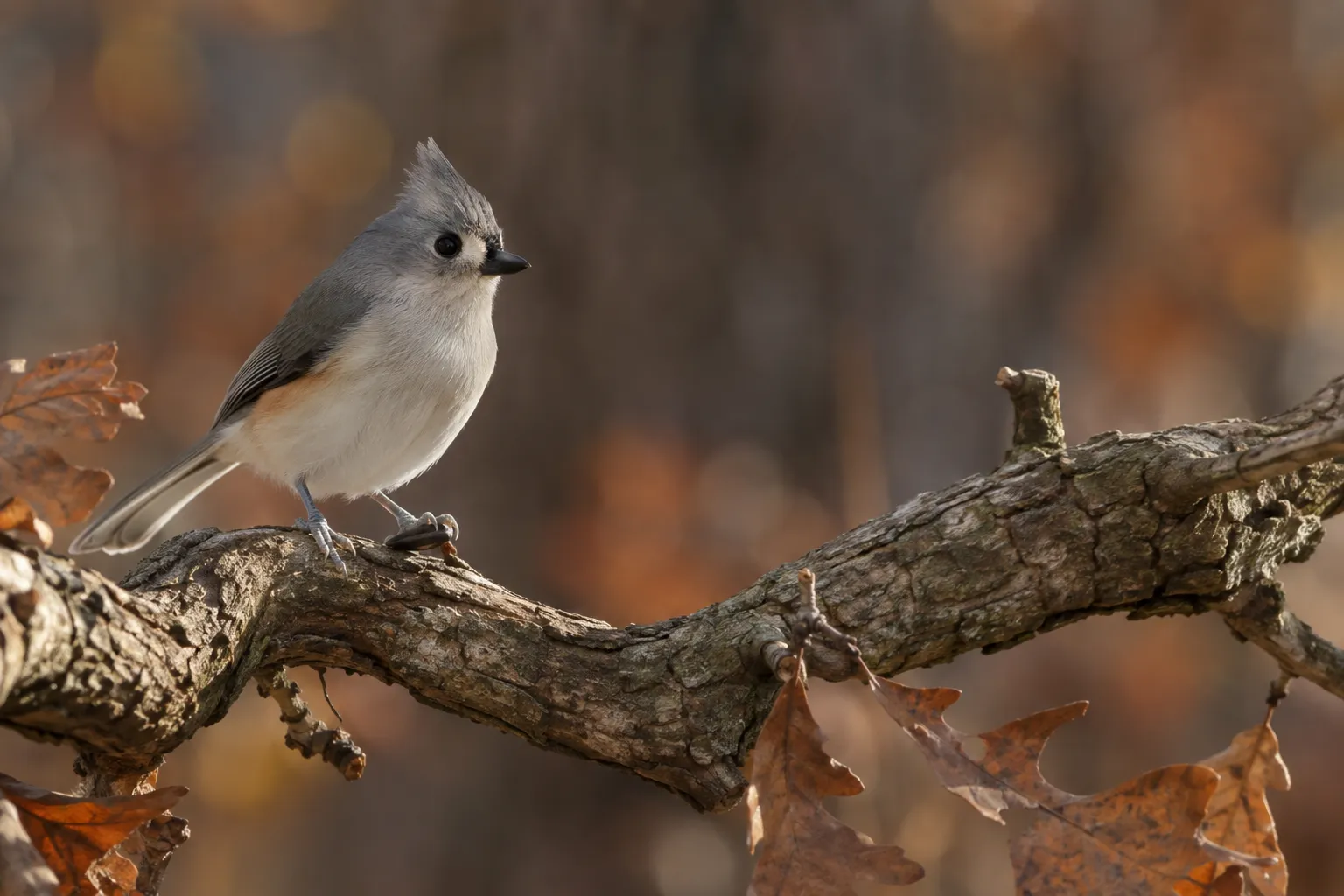
Titmice are small songbirds, noticeably larger than a chickadee but smaller than a cardinal. The Cornell Lab describes soft silvery-gray upperparts, white underparts and peachy-rust flanks. A black patch just above the bill gives them a snub-nosed look, and a pointed gray crest, large dark eyes and a stout bill make them easy to pick out, even in silhouette.
Male, female and juvenile
Males and females look alike. Juveniles resemble adults but tend to look plainer, with a less distinct dark patch above the bill. In some families, young from one year stay with their parents into the next nesting season and help feed the new brood.
Song and calls
- Song: a clear, whistled peter-peter-peter, repeated in bursts. Males sing it most from late winter into summer.
- Calls: harsh, scolding notes that sound like a raspy chickadee call, often while mobbing a predator.
Similar species
- Black-crested Titmouse: found in central and southern Texas and into Mexico, with a black crest instead of gray. The two hybridize where their ranges meet in Texas.
- Oak and Juniper Titmice: plain gray titmice of the West, outside the Tufted range.
- Carolina and Black-capped Chickadees: smaller, with a black cap and bib and no crest.
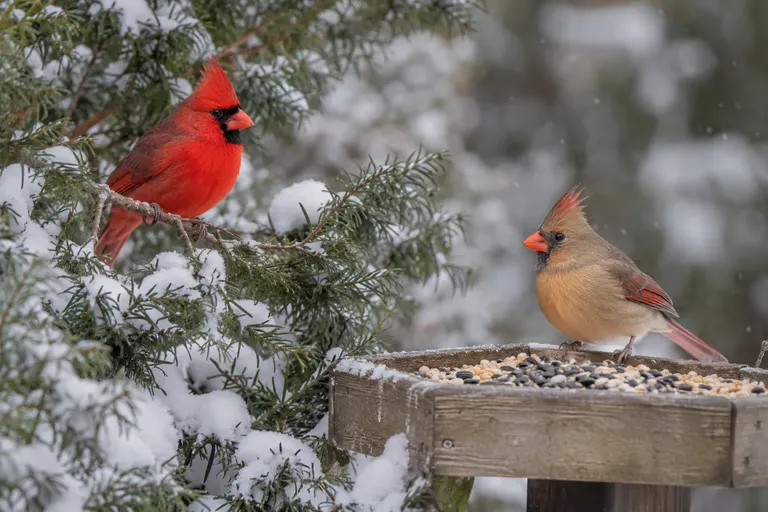
- Northern Cardinal (female): also crested, but much larger, brownish with red accents and a big orange bill.
For more help with confusing birds, see our guide to how to identify birds.
Where do tufted titmice live?
The Cornell Lab describes the Tufted Titmouse as “common in eastern deciduous forests and a frequent visitor to feeders.” It lives year-round from the Atlantic Coast west to the eastern Great Plains and central Texas, and north into New England, the Great Lakes region and parts of southern Ontario. The range has expanded northward over the last 50 years, and bird feeding, maturing suburban trees and milder winters are among the factors often suggested for that spread.
Titmice prefer “deciduous woods or mixed evergreen-deciduous woods, typically in areas with a dense canopy and many tree species,” usually below 2,000 feet, along with orchards, parks and suburbs. Mature shade trees are the single best predictor of whether a yard gets titmice.

What do tufted titmice eat?
The Cornell Lab lists a summer diet built mainly on caterpillars, beetles, ants and wasps, stink bugs and treehoppers, plus spiders and snails. They also eat seeds, nuts and berries, and these become much more important in fall and winter.
Two feeding habits shape how you should feed them:
- They choose big seeds. Research cited by the Cornell Lab found titmice preferentially select the largest seeds available. In-shell black oil sunflower, striped sunflower and peanut pieces all fit.
- They cache food. Titmice hold a seed with their feet, hammer it open, and often hide shelled seeds in bark crevices. The Cornell Lab notes they store seeds within about 130 feet of the feeder, taking one seed per trip and usually shelling it first.
Best feeder foods for titmice
| Food | Why it works | Tips |
|---|---|---|
| Black oil sunflower | Top choice; high fat, easy to open | Offer in hoppers or tubes |
| Striped sunflower | Larger seed that titmice handle well | Also favored by cardinals and jays |
| Peanuts (unsalted) | Fat and protein; large pieces | Shelled in a mesh feeder or chopped on a tray |
| Suet | Winter energy | Use no-melt dough in warm months |
| Sunflower hearts | No shells to clean up | Buy smaller amounts for freshness |
| Mealworms | Protein in spring | Small amounts in a dish |
Our guide to black oil sunflower seed explains why it is the best all-round seed, and our roundup of suet cakes and suet blends compares formulas. Avoid salted or flavored peanuts, which Project FeederWatch advises against.
Best feeders for tufted titmice
Titmice are flexible and use most feeder types, but they like to grab a seed and leave, so feeders near branches work best.
- Hopper feeders: roomy and easy for titmice, cardinals and chickadees. Our roundup of the best bird feeders covers several styles.
- Tube feeders: with ports large enough for in-shell sunflower.
- Platform feeders: titmice readily use trays, which also draw ground birds.
- Suet cages: titmice cling to them like chickadees.
- Peanut feeders: mesh tubes that make birds pull out pieces.
Squirrels love the same foods titmice do. If they are emptying your feeders, see how to keep squirrels off bird feeders.
Where to put a feeder for titmice
Titmice forage in the outer branches of tree canopies and rarely linger in open ground. Place feeders about 10 feet from trees or large shrubs, a widely used compromise that gives birds a short escape flight without handing cover to a lurking cat. Because titmice carry seeds off to cache, trees within about 100 feet help keep them coming back. Our guide to where to put a bird feeder covers height and window safety.
Native plants that attract tufted titmice
Titmice are forest birds, and their summer food is mostly caterpillars and other insects that live on native trees. Planting native trees and shrubs provides food in summer, nuts and berries in fall, and nest cavities as trees mature.
Best trees and shrubs for titmice
- Oaks: the core of titmouse habitat. Oaks host a large number of caterpillar species, and titmice also eat acorn pieces.
- Hickories and American beech: nuts and insect food.
- Native cherries and serviceberries: insects plus summer fruit.
- Maples, tulip trees and sweetgum: insect-rich canopy.
- Pines, red cedar and American holly: year-round cover for winter roosting.
- Bayberry, wax myrtle, viburnums and dogwoods: fall and winter berries.
Native plant ideas by region
| Region | Trees and shrubs to consider |
|---|---|
| Northeast and Great Lakes | White oak, red oak, shagbark hickory, American beech, serviceberry, northern bayberry |
| Mid-Atlantic and Ohio Valley | White oak, tulip tree, black cherry, flowering dogwood, arrowwood viburnum |
| Southeast | Southern red oak, water oak, pignut hickory, American holly, wax myrtle, beautyberry |
| Texas and southern Plains | Post oak, Shumard oak, pecan, Eastern red cedar, possumhaw |
Check with your state native plant society or cooperative extension service for species native to your area.
Keep old trees and dead limbs when safe
Titmice cannot dig their own nest holes. They depend on natural cavities and holes made by woodpeckers. A dead limb or snag that poses no danger to people or buildings is valuable real estate, both for woodpeckers that create cavities and for titmice that later move in.
Tufted titmouse nest box specs
The Cornell Lab notes titmice “nest in tree holes (and nest boxes)” but “cannot excavate their own cavities.” NestWatch recommends:
| Spec | Recommendation |
|---|---|
| Entrance hole | 1 1/4 in diameter |
| Floor | 5 1/2 x 5 1/2 in |
| Interior depth | 8 in |
| Mounting height | 5 to 15 ft |
| Mount | Pole |
| Orientation | Away from prevailing wind |
| Habitat | Near large, mature deciduous trees |
NestWatch advises placing the box “in an area with large, deciduous trees,” such as forests, parks and suburban neighborhoods with mature trees.
Nest box tips
- Put boxes up by late winter, before pairs begin nesting in spring.
- Use a pole and a baffle to stop snakes, raccoons and cats.
- Skip the perch. Titmice do not need one, and it helps predators.
- Watch for House Sparrows. A 1 1/4 inch hole can admit them, so boxes in wooded settings away from buildings and open lawns fare better.
- Clean out old nests after the young fledge.
Titmouse nesting facts
- Nests are cup-shaped, built of damp leaves, moss, grasses and bark strips.
- The lining is hair, fur, wool and cotton. The Cornell Lab notes titmice sometimes pluck hair directly from living mammals.
- Clutches are 3 to 9 eggs, white to creamy white and spotted with chestnut-red, brown, purple or lilac.
- Incubation takes 12 to 14 days, and young fledge after 15 to 16 days.
- Pairs raise one brood a year.
Should you put out nesting material?
Titmice collect hair and fur to line their nests. If you want to help, untreated natural materials are the safest option. Avoid pet hair from animals treated with flea or tick products, dryer lint and long strands of yarn or string, which can tangle birds.
Titmice, chickadees and winter flocks
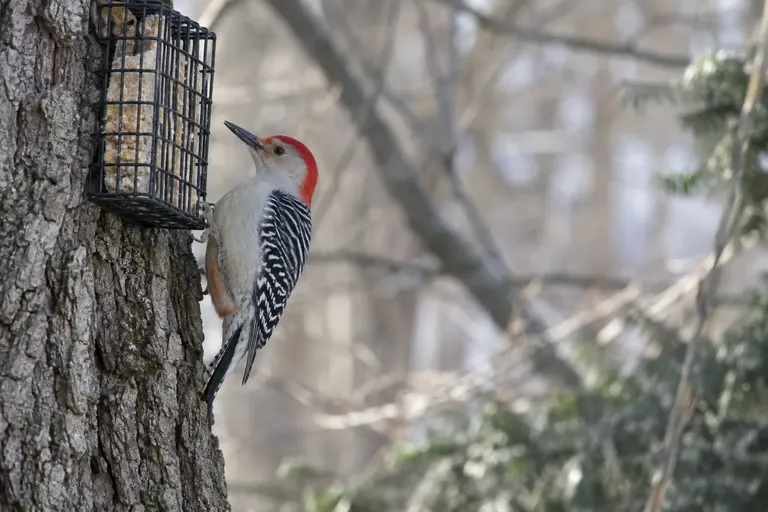
Titmice rarely show up alone in winter. The Cornell Lab notes they often join chickadees, nuthatches and woodpeckers as they move through the woods, and the Cornell Lab’s nuthatch account describes winter foraging flocks “led by chickadees or titmice.” These mixed flocks move through a regular circuit of yards and woodlots each day, so once one flock includes your feeder in its route, you can expect visits at roughly the same times.
Being in a flock helps every member. More eyes spot hawks sooner, and titmice and chickadees give loud, harsh calls when they find a perched owl, hawk or snake. Other birds respond to those calls, sometimes gathering to mob the predator. If you hear a sudden burst of scolding from one shrub, it is worth a look.
Pairs stay on territory
Unlike some songbirds, titmice do not scatter widely in fall. Pairs typically stay near their breeding territory year-round, and young birds sometimes remain with their parents through the winter. That means the titmice at your feeder in January may well be the same birds nesting nearby in May, which is a good reason to put up a nest box close to your feeding area.
How long does it take titmice to find a feeder?
Titmice are curious and bold for their size, and in fall and winter they often find a new feeder within days, especially if chickadees already use it. In spring and summer, when insects are abundant, it can take much longer. A few tips to speed things up:
- Start with black oil sunflower in a hopper or on a tray, where seed is easy to see.
- Hang the feeder along the edge of existing tree cover rather than in the middle of the lawn.
- Add water nearby, which draws birds on its own.
- Keep the feeder filled consistently so a passing flock learns it is reliable.
Can you hand-feed titmice?
Sometimes. Titmice occasionally learn to take peanut pieces or sunflower seeds from a still, open hand at a feeder they know well. Cold mornings and patience help. Individual birds vary a great deal, so treat it as a bonus rather than a goal.
Do tufted titmice migrate?
No. Tufted Titmice are year-round residents throughout their range, with no regular migration. Their northward range expansion has happened gradually as young birds settle in new areas, not through seasonal movements. If titmice disappear from your feeder in summer, they have almost certainly just switched to insect food in the trees and will return as the weather cools.
Water for titmice
Titmice drink and bathe often. A shallow bird bath placed near trees draws them all year, and a heated bath helps in northern winters. Keep water an inch or two deep and change it every few days.
Seasonal calendar
| Season | What titmice are doing | What to offer |
|---|---|---|
| Winter (Dec to Feb) | Mixed flocks with chickadees, nuthatches and woodpeckers; heavy feeder use | Sunflower, peanuts, suet, open water |
| Late winter (Feb to Mar) | Peter-peter songs start; pairs settle territories | Put up and clean nest boxes |
| Spring (Apr to May) | Nest building; lining nests with hair | Mealworms, sunflower; avoid pesticides |
| Summer (Jun to Aug) | Feeding young caterpillars; families roam | Water, modest feeding |
| Fall (Sep to Nov) | Caching seeds; flocks form | Fill feeders fully with sunflower and peanuts |
Why aren’t titmice coming to my feeder?
- No mature trees nearby. Titmice rarely cross wide open areas.
- It’s summer. Insects are plentiful and feeder visits drop.
- The feeder is new. See why birds aren’t coming to your new feeder.
- The seed is a cheap filler mix. Switch to black oil sunflower.
- You are north or west of the range. Check the range map on All About Birds.
Common mistakes
- Hanging feeders in open lawn far from trees.
- Filling feeders with milo-heavy mixes that titmice ignore.
- Removing every dead branch and snag.
- Spraying insecticides on shade trees.
- Using nest boxes without predator guards.
- Letting feeders get dirty. Project FeederWatch recommends cleaning seed feeders every week or two with one part bleach to nine parts water.
Conservation status
Tufted Titmice are common and of low conservation concern. The Cornell Lab reports their numbers increased between 1966 and 2019, with a global breeding population estimated at 12 million. The oldest known wild titmouse was at least 13 years, 3 months old.
The short version
Offer black oil sunflower, peanuts and suet in feeders close to mature trees. Plant native oaks, hickories and berry shrubs, and leave safe snags standing. Put up a 1 1/4 inch nest box on a baffled pole by late winter. Keep water fresh. Tufted titmice are year-round residents, so a yard that works for them in winter usually keeps them all year.
Sources
Frequently asked questions
What is the best food to attract tufted titmice?
Black oil sunflower seed is the favorite, and the Cornell Lab notes titmice also eat suet, peanuts and other seeds, especially in winter. Research cited by the Cornell Lab found titmice tend to choose the largest seeds available, so in-shell sunflower and peanut pieces suit them well. Offer food in a hopper, tube or platform feeder near trees.
Do tufted titmice use birdhouses?
Yes, when natural cavities are scarce. Titmice cannot excavate their own holes, so they rely on old woodpecker holes and nest boxes. NestWatch recommends a box with a 1 1/4 inch entrance hole, a floor about 5 1/2 by 5 1/2 inches and an interior depth of about 8 inches, mounted 5 to 15 feet high on a pole near mature deciduous trees.
Why does a titmouse take one seed and fly away?
Titmice carry a single seed to a branch, hold it with their feet and hammer it open, or they hide it for later. The Cornell Lab notes they usually shell seeds before caching them in bark crevices and store them within about 130 feet of the feeder. That is why one titmouse can make many trips in a few minutes.
Where do tufted titmice live?
Tufted Titmice live year-round across the eastern United States, from the eastern Great Plains to the Atlantic Coast, and into parts of southern Canada. They favor deciduous and mixed woods with a dense canopy, usually below 2,000 feet, plus parks and leafy suburbs. Their range has expanded northward over the past 50 years or so.
What bird sings peter peter peter?
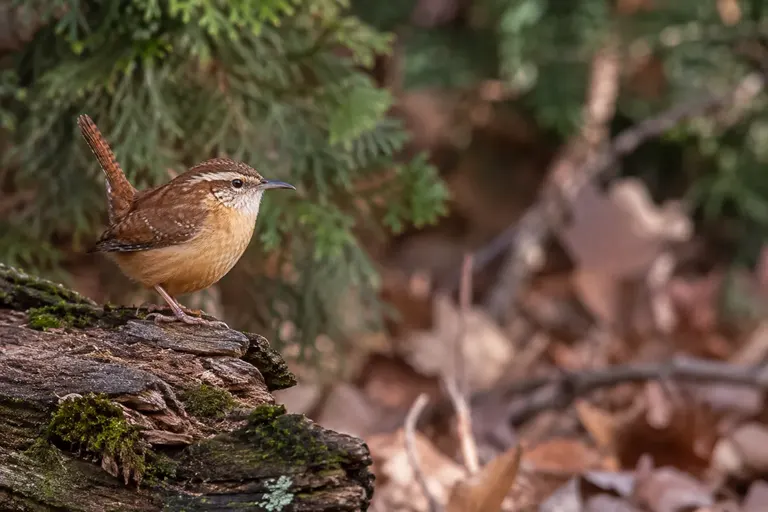
In eastern North America, a clear, whistled peter-peter-peter is most likely a Tufted Titmouse. Males sing it from late winter through the breeding season, and it can be heard throughout the year. Carolina Wrens and Northern Cardinals have somewhat similar repeated whistles, so check with a recording or a sound-ID app if you are unsure.