How to Attract White-throated Sparrows in Winter
How to attract white-throated sparrows: scatter millet and sunflower on the ground near thickets, keep a brush pile and leaf litter, and offer water in winter.
In this article
- White-throated Sparrow at a glance
- How do you identify a White-throated Sparrow?
- Where do White-throated Sparrows live in winter?
- How to find White-throated Sparrows in your yard
- Why are White-throated Sparrows so interesting to scientists?
- Are White-throated Sparrows declining?
- What do White-throated Sparrows eat?
- How to feed White-throated Sparrows
- What plants and habitat attract White-throated Sparrows?
- Do White-throated Sparrows nest in backyards?
- Water for White-throated Sparrows
- Seasonal calendar
- Common problems
- Common mistakes
- Quick checklist: how to attract White-throated Sparrows
- Sources
- Frequently asked questions
Here is how to attract White-throated Sparrows: scatter millet and sunflower seed on the ground or on a low tray right next to dense shrubs, keep a brush pile, and leave fallen leaves under your plantings. These are forest-edge birds that feed by scratching through leaf litter and never stray far from a thicket. Give them cover and ground-level food from October through April and, across much of the eastern US and California, they are among the most reliable winter visitors you can host.
White-throated Sparrow at a glance
| Trait | Details |
|---|---|
| Size | 6.3 to 7.1 in long, wingspan 7.9 to 9.1 in, 0.8 to 1.1 oz (Cornell Lab) |
| Look | Large sparrow with a white throat, striped crown, yellow spot in front of the eye and gray breast |
| Range | Breeds mostly across Canada and the northern US; winters across much of the eastern and southern US and California |
| Season in your yard | Mainly fall through spring; year-round only in parts of the far north |
| Diet | Seeds of grasses and weeds, fruit in fall, insects in summer |
| Feeder type | Ground, low platform or tray; spilled seed below hanging feeders |
| Nesting | Cup on or near the ground under shrubs, grasses or ferns; does not use nest boxes |
| Conservation | Low concern, but down about 33% between 1966 and 2019 (Cornell Lab) |
How do you identify a White-throated Sparrow?
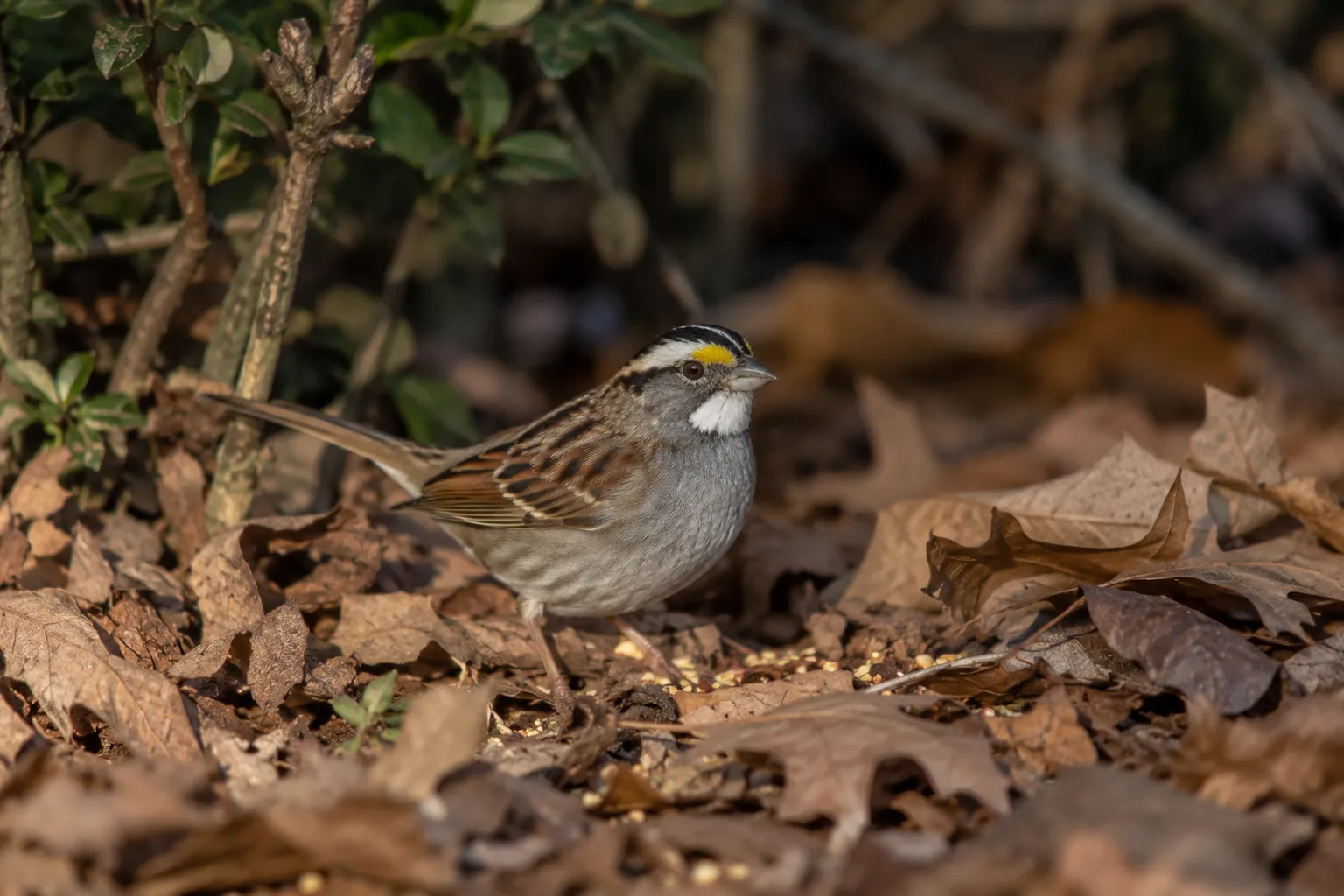
The White-throated Sparrow is a relatively large sparrow, a little bigger than a Song Sparrow, with a plump body and a fairly long tail. The Cornell Lab lists the key marks as a black eyestripe, a white crown and eyebrow, yellow lores (the spot between the eye and bill), and a white throat bordered by a thin black whisker or malar stripe.
White-striped form
This is the bold version: crisp black and white stripes on the crown, a bright white throat and a strong yellow spot in front of the eye. The back is reddish brown with dark streaks, the underparts gray, and the bill gray.
Tan-striped form
The Cornell Lab describes this form as having a buff-on-brown face pattern instead of white-on-black. The throat is still paler than the breast, but less bright, and the yellow is duller. Both forms occur in both sexes.
One of the most studied facts about this species is how these forms pair. The Cornell Lab notes that white-striped birds tend to be more aggressive, and that birds almost always mate with the opposite form. Males of both types prefer white-striped females, while females of both types prefer tan-striped males.
Immatures and juveniles
First-winter birds show brown and black head stripes, less yellow in front of the eye and faint streaks on the breast, according to the Cornell Lab. Juveniles in summer are brownish with heavy breast streaks. In fall, young birds and tan-striped adults can look quite dull, so look for the throat patch, which is still paler and more sharply outlined than the breast.
Similar species
| Species | How it differs |
|---|---|
| White-crowned Sparrow | No white throat patch and no yellow lores; pink, orange or yellowish bill; more upright posture; favors open, brushy areas |
| Golden-crowned Sparrow | Western; yellow forecrown and black cap, no white throat |
| Song Sparrow | Heavily streaked white breast with a central spot; no yellow lores |
| Swamp Sparrow | Smaller, rusty wings, gray face, dull throat; favors wet thickets |
For the reasoning birders use to separate sparrows quickly, see our guide on how to identify birds.
Song and calls
The song is one of the best-known sounds of northern forests: a clear, whistled series, usually written as “Old Sam Peabody, Peabody, Peabody” or “Oh sweet Canada, Canada, Canada”. Audubon notes the two regional versions, fitting since most of these birds breed in Canada. Wintering birds sing too, especially on mild days in late winter and spring, which is often how people first notice them. The calls are a sharp, metallic “pink” and a thin “tseet” in flight or at dusk.
Where do White-throated Sparrows live in winter?
The Cornell Lab describes them as familiar winter birds across most of eastern and southern North America and California. In practice, that means:
- Winter: most of the eastern half of the US from southern New England and the lower Great Lakes south to the Gulf Coast and Florida, west into Texas and the southern Plains, plus California and parts of the Southwest in smaller numbers.
- Breeding: across much of Canada, northern New England, New York’s Adirondacks and the upper Great Lakes, with the range extending west across the boreal forest of western Canada.
- Migration: they pass through the northern states in spring and fall. Audubon notes they migrate mostly at night and relatively late in fall, moving south gradually.
If you live in the Mountain West or Pacific Northwest, they are uncommon, and your winter ground-feeding sparrows are more likely to be White-crowned, Golden-crowned or Fox Sparrows plus Dark-eyed Juncos.
How to find White-throated Sparrows in your yard
Because they stay close to cover, White-throated Sparrows are easy to overlook. A few habits help:
- Listen for rustling. A steady scratching in dry leaves under a hedge is often a White-throat or a towhee.
- Learn the “pink” call. It is one of the most common sounds from winter thickets in the East.
- Try pishing. The Cornell Lab notes they respond well to pishing, the soft “pshh pshh” sound birders make to draw curious birds into view. Use it sparingly and stop once the bird has had a look.
- Check at dawn and dusk. Ground-feeding sparrows are often most active under feeders early and late in the day. Light and temperature shape when birds feed, and the first hour after sunrise is usually busiest.
- Scan the flock. In a mixed group of juncos and sparrows under your feeder, the White-throat is the larger, rusty-backed bird with a bright throat patch.
Why are White-throated Sparrows so interesting to scientists?
The two color forms are not just a curiosity. They are tied to a large chromosomal difference, and the form a bird carries predicts not only its head stripes but also its behavior. White-striped birds tend to sing more and defend territories more aggressively. Tan-striped birds tend to invest more in parental care. Because birds almost always pair with the opposite form, both forms persist in the population in roughly balanced numbers. Researchers have studied this system for decades as a natural example of how genes, behavior and mate choice interact.
The Cornell Lab adds two more notable facts. White-throated Sparrows occasionally hybridize with Dark-eyed Juncos, which is unusual between birds in different genera. And the oldest known White-throated Sparrow was at least 14 years, 11 months old, a long life for a small songbird.
Are White-throated Sparrows declining?
They are still abundant and rated low conservation concern. But the Cornell Lab reports a decline of about 0.74% per year, a cumulative loss of about 33% over most of their range between 1966 and 2019. Collisions with lighted buildings and tall structures during night migration are one documented threat.
At home, you can help by reducing outdoor lighting in spring and fall, treating windows, keeping cats indoors and providing the dense winter cover and seed these birds depend on. Counting them through Project FeederWatch or eBird adds your observations to the long-term data used to track the species.
What do White-throated Sparrows eat?
According to the Cornell Lab, they eat seeds of grasses and weeds, including ragweed and buckwheat, plus fruits of sumac, grape, cranberry, mountain ash, rose, blueberry, blackberry and dogwood. In summer they eat more insects, such as dragonflies, wasps, beetles and caterpillars, and parents feed nestlings almost entirely on animal food. Audubon adds that the winter diet is mostly weed and grass seeds, with berries eaten especially in fall.
Best foods to offer
- White proso millet: a staple for ground-feeding sparrows and juncos. Scatter it thinly on the ground or a low tray.
- Black oil sunflower seed: the Cornell Lab names it alongside millet. Sunflower chips work well and leave no hulls; see our guide to black oil sunflower seed.
- Cracked corn: readily eaten, but it also attracts doves, blackbirds, starlings and squirrels.
- Seed blends with millet: many mixes built around millet suit sparrows well. Our best bird seed roundup separates good blends from filler.
Offer small amounts often. A flock of White-throats plus juncos can clear seed quickly, but leftovers left on wet ground will mold.
How to feed White-throated Sparrows
White-throated Sparrows forage mostly on the ground. The Cornell Lab notes that they hop rather than walk and scratch through leaf litter, often with a quick two-footed backward kick. Audubon adds that they forage near protective thickets.
Where to feed them
- Right at the edge of cover. These birds are more cover-dependent than many feeder species. A feeding spot within a short dash of a thick shrub or brush pile works best.
- On a low platform or the ground. A platform or tray feeder set a few inches off the ground keeps seed dry.
- Below your hanging feeders. They will happily clean up spilled seed.
Balance cover with safety. A feeding spot hidden right against a shrub helps sparrows but also helps a stalking cat. Our guide to where to put a bird feeder explains the trade-offs.
Winter flocks
In fall and winter, White-throated Sparrows form flocks, often mixed with Dark-eyed Juncos, Song Sparrows and cardinals. The Cornell Lab notes that these flocks have a pecking order. Several spread-out feeding spots reduce squabbling and let subordinate birds feed. If you enjoy juncos, the setup is nearly identical; see how to attract Dark-eyed Juncos.
What plants and habitat attract White-throated Sparrows?
In winter the Cornell Lab lists hedgerows, thickets, weedy fields, suburbs, backyards and city parks. The common thread is dense, low cover next to ground where they can scratch for seeds.
Habitat features that work
- Dense shrubs and thickets, especially evergreen or tangled ones that hold snow off the ground beneath.
- A brush pile. The Cornell Lab specifically recommends brush piles for this species.
- Leaf litter. Leave fallen leaves under shrubs and in beds. White-throats scratch through them for seeds and insects.
- Standing seedheads of native grasses and wildflowers through winter.
- Fruiting shrubs that hold berries into fall.
Native plants by region
| Region | Good plants for White-throated Sparrows |
|---|---|
| Northeast and Mid-Atlantic | Arrowwood viburnum, gray dogwood, winterberry, blackberry, staghorn sumac, eastern redcedar, native asters and goldenrods |
| Southeast | American beautyberry, wax myrtle, yaupon holly, blackberry, flowering dogwood, little bluestem |
| Midwest and southern Plains | Roughleaf dogwood, smooth sumac, wild plum, eastern redcedar, switchgrass, asters |
| California | Toyon, coyote brush, California blackberry, California rose, native bunchgrasses |
Do White-throated Sparrows nest in backyards?
Only in their breeding range. There, females build nests on or just above the ground in clearings with dense vegetation, usually under shrubs, grasses or ferns. The Cornell Lab notes they sometimes nest up to 15 feet high in conifers after nests on the ground have been lost to predators.
Nesting facts
According to the Cornell Lab:
- Nest: a cup of moss, grass, twigs and wood chips, lined with fine grasses, rootlets and deer hair, 3 to 5.5 inches across.
- Eggs: 1 to 6, very pale blue or greenish blue, speckled with purple, chestnut and lilac.
- Incubation: 11 to 14 days.
- Nestling period: 7 to 12 days.
- Broods: 1 to 2 per year.
If you live in the breeding range, leave brushy clearings and pond or bog edges unmown, and keep cats indoors.
Water for White-throated Sparrows
Ground-feeding sparrows use low baths readily, especially when natural water is frozen.
- Use a low or ground-level bath about 1 to 2 inches deep.
- Place it near cover, with some open space so birds can see approaching predators.
- In freezing weather, a heated bath is one of the best ways to draw winter birds.
- Scrub and refill every few days.
Seasonal calendar
| Month | What to expect |
|---|---|
| September to October | First migrants arrive in the northern states; birds reach southern yards by October or November |
| November to February | Winter flocks settle; birds visit ground feeding spots daily |
| March to April | Singing increases; some birds begin to leave from southern areas |
| April to May | Most depart for breeding grounds, often singing in yards on the way |
| June to August | Absent from most of the US; nesting in the North |
Common problems
Window collisions during migration
The Cornell Lab notes that these sparrows are killed in large numbers when they collide with tall structures and lighted buildings during their nighttime migration. At home, turn off unneeded outdoor lights during spring and fall migration, and treat windows near feeders. Our guide on how to stop birds hitting windows covers effective options.
Hawks
Ground-feeding flocks attract Cooper’s and Sharp-shinned Hawks. Dense cover close by gives sparrows somewhere to escape. If a hawk begins visiting daily, take seed down for a week or two so the flock disperses and the hawk moves on, then resume. Evergreen shrubs or a thick brush pile within a few feet of the feeding area give the best protection, because sparrows escape by diving into cover rather than outflying a hawk.
Moldy seed on the ground
Rake up old seed and hulls, feed smaller amounts, and use a tray with drainage. Rotate ground spots through the season.
Birds disappear in spring
That is normal. They are heading north to breed. They should return the next fall if the habitat is still there. Banding studies show many wintering songbirds return to the same wintering sites in later years, so a yard that works one winter often hosts the same individuals again. Keep the brush pile, the leaf litter and the feeding spot in place over summer so the habitat is ready when the first birds reappear.
Common mistakes
Feeding only from tube feeders. White-throats rarely use them. Put seed low.
Raking every leaf. Leaf litter is their natural feeding ground. Leave it under shrubs and in beds.
Cutting back perennials in fall. Seedheads are winter food. Wait until spring.
Placing feeders in open lawn. These birds will not venture far from cover.
Quick checklist: how to attract White-throated Sparrows
- Scatter millet and sunflower chips on a low tray near dense shrubs.
- Build a brush pile.
- Leave leaf litter under shrubs.
- Let seedheads stand through winter.
- Add a low, heated bird bath.
- Turn off outdoor lights during migration.
- Keep cats indoors.
For more ideas that help every winter visitor, see our guide to winter bird feeding.
Sources
Frequently asked questions
What do White-throated Sparrows eat at feeders?
The Cornell Lab says White-throated Sparrows readily take millet and sunflower seed at winter feeders. Because they feed on the ground, scatter white proso millet, black oil sunflower seed or sunflower chips beneath feeders or on a low platform, close to dense shrubs. They will also eat cracked corn and seed that falls from hanging feeders.
When do White-throated Sparrows arrive and leave?
They breed mostly in Canada and the far northern US and spend winter across much of the eastern and southern US and California. Audubon notes they migrate relatively late in fall and mostly at night. In many eastern yards they appear in October and stay into April or early May, singing more as spring approaches.
What is the difference between white-striped and tan-striped White-throated Sparrows?
They are two genetic color forms of the same species, not males and females. White-striped birds have a black and white crown and bold face; tan-striped birds have buff and brown stripes and less contrast. The Cornell Lab notes white-striped birds tend to be more aggressive, and birds almost always pair with the opposite form.
What does a White-throated Sparrow sound like?
The song is a clear, whistled series of notes, often remembered as 'Old Sam Peabody, Peabody, Peabody' in the US or 'Oh sweet Canada, Canada, Canada' in Canada. The Cornell Lab describes it as pretty and wavering. In winter listen for a sharp 'pink' call and a thin, slurred 'tseet' from birds in thickets.
Do White-throated Sparrows nest in backyards?
Only within their breeding range, which is mostly Canada, the northeastern US and the upper Great Lakes. There they nest on or near the ground in clearings with dense vegetation, not in nest boxes. Across most of the US they are winter visitors, so the goal is good winter habitat rather than nesting sites.