How Far Do Birds Migrate?
How far do birds migrate? From a few miles up a mountain to more than 40,000 miles a year for Arctic Terns. Distances, nonstop records and how birds do it.

In this article
- Quick facts: how far birds migrate
- What are the main types of migration by distance?
- How far do backyard birds migrate?
- How far do songbirds migrate?
- Which birds migrate the farthest?
- How far do birds migrate in Europe, Asia and South America?
- How far do birds fly in a day or a night?
- How do birds fuel such long journeys?
- How high and how fast do birds migrate?
- Why do some birds migrate so much farther than others?
- How do scientists measure migration distance?
- Myths and facts about migration distance
- What this means for backyard birders
- The bottom line
- Sources
- Frequently asked questions
Birds migrate anywhere from a few miles to more than 40,000 miles a year. Some mountain birds simply move downslope for winter, many backyard songbirds travel a few hundred to a few thousand miles, and a few extreme travelers, like the Arctic Tern, cover distances equal to circling the Earth more than once and a half every year.
The range is so wide because “migration” covers very different strategies. This guide explains the main distance categories, the record holders, how far birds fly in a single push, and how they manage it, with examples from North America, Europe, Africa, Asia and Australasia.
Quick facts: how far birds migrate
- Shortest: altitudinal migrants may move only a few miles up or down a mountain.
- Short distance: many backyard species move a few hundred miles between seasons.
- Medium and long distance: many songbirds travel 1,000 to 5,000 miles each way between temperate breeding grounds and the tropics.
- Farthest annual distance: Arctic Terns average roughly 44,000 miles a year in one major tracking study.
- Longest nonstop flight: a Bar-tailed Godwit tracked in 2022 flew about 8,400 miles from Alaska toward Tasmania without landing.
- Night travel: most North American migrant species fly at night.
- Fuel: long-distance migrants may nearly double their body weight in fat before a major crossing.
What are the main types of migration by distance?
Ornithologists often group migrants into rough categories. They are not rigid, and many species fall between them, but they help make sense of the numbers.
| Type | Typical distance | Examples |
|---|---|---|
| Altitudinal | A few miles, mostly vertical | Some mountain chickadees, juncos and hummingbirds; many Himalayan and Andean birds |
| Short distance | Tens to a few hundred miles | American Robin (some populations), Dark-eyed Junco, Song Sparrow, European Robin in parts of its range |
| Medium distance | Several hundred to about 1,500 miles | White-throated Sparrow, many waterfowl, Chiffchaff in Europe |
| Long distance | 1,500 to 7,000+ miles each way | Most North American warblers, Barn Swallow, Swainson’s Hawk, Northern Wheatear |
| Extreme distance | 10,000 to 50,000+ miles a year | Arctic Tern, Sooty Shearwater, Bar-tailed Godwit |
| Irruptive or nomadic | Irregular, can be hundreds of miles | Crossbills, redpolls, Red-breasted Nuthatch, Bohemian Waxwing |
How far do backyard birds migrate?
Many of the birds you see at feeders migrate less than you might think.
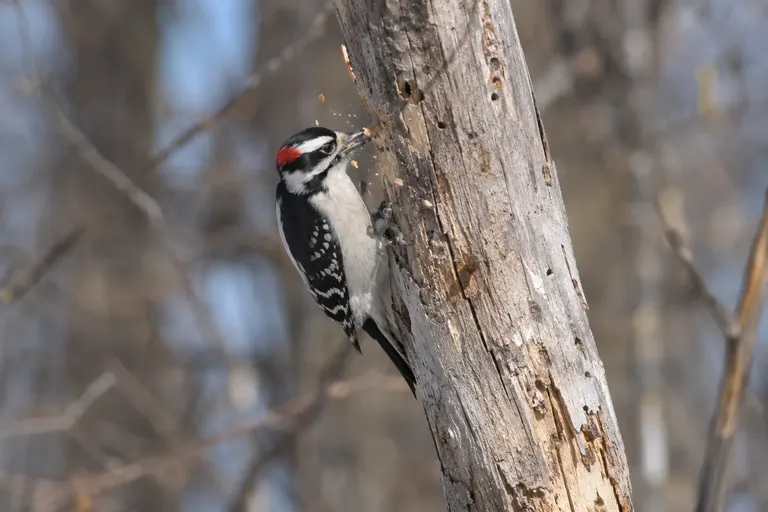
Residents that barely move. Northern Cardinals, chickadees, titmice and most woodpeckers in eastern North America tend to stay near their territories all year. They are the backbone of winter feeder activity.
Short-distance migrants. Dark-eyed Juncos that breed in Canada and the northern forests often move to the United States for winter, sometimes a few hundred miles, sometimes much farther. Some juncos in the Appalachians and western mountains simply move to lower elevations. White-throated Sparrows show up in many eastern yards in fall after leaving breeding grounds in the boreal forest.
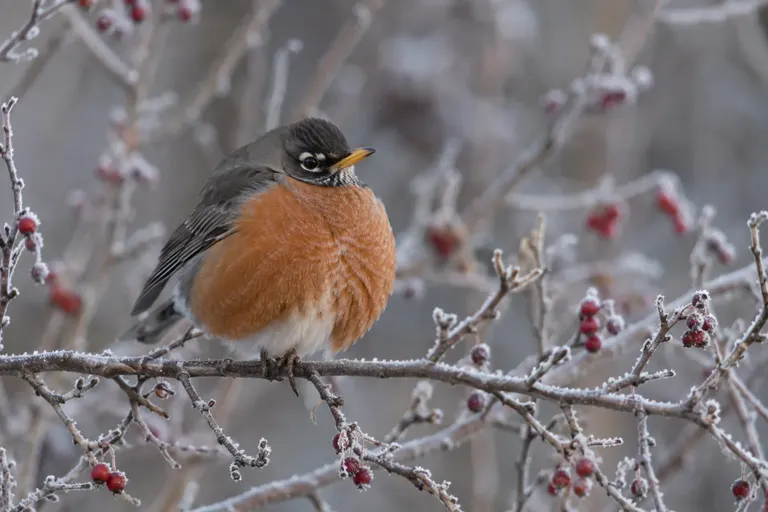
Partial migrants. The American Robin is a good example of how complicated this can be. Robins are found in much of the United States all year, but many northern birds move south, and wintering robins shift around following fruit supplies. The robin you see in January may not be the one that nested in your yard.
True long-distance travelers. The Ruby-throated Hummingbird weighs about as much as a penny, yet many travel from eastern North America to Mexico and Central America each fall. Many are thought to fly nonstop across the Gulf of Mexico, a crossing of roughly 500 miles, while others follow the coastline around it.

How far do songbirds migrate?
Many North American songbirds that breed in the United States and Canada winter in Mexico, the Caribbean, Central America or South America. One-way journeys of 1,500 to 5,000 miles are common.
The Blackpoll Warbler is one of the most remarkable. This small warbler breeds in the boreal forests of Alaska and Canada. In fall, many fly first to the northeastern United States and Atlantic Canada, then set out over the Atlantic Ocean toward the Caribbean and northern South America. A 2015 study using tiny geolocators confirmed that birds made nonstop ocean flights of roughly 1,400 to 1,700 miles, lasting about two to three days. For a bird that weighs around half an ounce, it is an extraordinary effort.
In Europe and Africa, the Barn Swallow travels from breeding grounds across Europe to wintering areas in sub-Saharan Africa, with birds from Britain wintering as far south as South Africa, a trip of several thousand miles. The Northern Wheatear, a small thrush-like bird, has one of the longest songbird migrations known: birds breeding in Alaska winter in East Africa, crossing Asia along the way, while birds from eastern Canada and Greenland cross the North Atlantic to reach West Africa. Tracking has shown Alaskan birds covering roughly 9,000 miles each way.
Which birds migrate the farthest?
The extreme distance club is dominated by seabirds and shorebirds, which can feed at sea or refuel at rich wetlands and can use winds over open ocean. We cover the record holders in depth in our guide to which bird migrates the farthest, but here are the headline numbers.
Arctic Tern
Arctic Terns breed around the Arctic and sub-Arctic and spend the northern winter in the Southern Ocean near Antarctica. In a study published in 2010, researchers tracked terns breeding in Greenland and Iceland with tiny geolocators and found average round trips of about 44,000 miles (about 71,000 km). The birds did not fly straight lines: they followed winding S-shaped routes that appear to take advantage of prevailing winds. A later study of Arctic Terns breeding in the Netherlands recorded even longer annual journeys, around 56,000 miles (about 90,000 km).
Sooty Shearwater
Sooty Shearwaters breed on islands around New Zealand and South America and spend the southern winter in the North Pacific or North Atlantic. A 2006 tracking study of New Zealand birds found that they traveled a huge figure-eight route around the Pacific, covering roughly 40,000 miles (about 64,000 km) in a year.
Bar-tailed Godwit
Bar-tailed Godwits of the subspecies that breeds in Alaska make the longest known nonstop flights of any bird. In fall they fly directly over the Pacific to New Zealand and eastern Australia. In 2022, a young satellite-tagged godwit was tracked flying about 8,400 miles (roughly 13,500 km) from Alaska to Tasmania in around 11 days without stopping. Their spring journey north is longer overall, because it includes a stopover in the Yellow Sea region of East Asia.
How far do birds migrate in Europe, Asia and South America?
Migration is a worldwide phenomenon, organized along broad routes called flyways.
Africa-Eurasia. Billions of birds move between Europe, western Asia and Africa each year. Many must cross the Mediterranean Sea and the Sahara Desert, a combined barrier of well over 1,000 miles for some routes. Soaring birds such as White Storks and many eagles avoid the open sea and funnel across narrow crossings, especially the Strait of Gibraltar in the west and the Bosphorus in Turkey in the east, before continuing south to Africa. The Common Cuckoo has been tracked by researchers in Britain traveling to central Africa for the winter, a journey of several thousand miles each way, with routes differing between individuals.
The Common Swift deserves a special mention. After leaving its breeding grounds in Europe, it spends the nonbreeding season over Africa, and a 2016 study using data loggers found that some swifts stayed airborne for about 10 months at a time, feeding and apparently sleeping on the wing. Over a lifetime, the total distance flown by a swift is enormous, even if its migration route is not the longest.
East Asia-Australasia. Shorebirds breeding in Siberia and Alaska travel to Southeast Asia, Australia and New Zealand, relying heavily on tidal mudflats around the Yellow Sea as refueling stops. Loss of those mudflats is a major conservation concern for species like the Bar-tailed Godwit and Far Eastern Curlew.
The Americas. Many North American breeders winter in South America, and some South American birds migrate within the continent, moving north from Patagonia and the southern cone toward the tropics during the austral winter. Brazil hosts large numbers of wintering shorebirds and swallows from North America, as well as its own internal migrants.
How far do birds fly in a day or a night?
Total migration distance is only part of the picture. How far a bird goes in one push depends on its strategy.
Songbirds typically fly at night, often for several hours, then land at dawn to rest and feed. A night’s flight might cover a couple of hundred miles or more. They then spend one or several days at a stopover refueling before the next flight. Because of those stops, overall progress is much slower than flight speed alone suggests. More than 80 percent of North American migrant species travel at night, according to the BirdCast project, which uses weather radar to forecast migration.
Soaring birds, such as hawks, eagles, storks and vultures, migrate by day. They ride rising columns of warm air called thermals and glide between them, using very little flapping. They often funnel along coastlines and mountain ridges and avoid long water crossings. Swainson’s Hawks, which breed on the Great Plains and in western North America, travel to Argentina for the northern winter, one of the longest migrations of any North American raptor.
Waterfowl often fly in long daytime or nighttime hops, sometimes in the familiar formations explained in our guide to why birds fly in a V.
Nonstop specialists, such as godwits, some shearwaters and the Blackpoll Warbler over the Atlantic, fly continuously for days. Bar-tailed Godwits crossing the Pacific can cover more than 600 miles a day for over a week.

How do birds fuel such long journeys?
Flying thousands of miles takes energy, and birds carry it as fat, the most energy-dense fuel available.
- Hyperphagia. Before migration, many birds enter a phase of intense eating. Some songbirds gain weight rapidly, adding fat under the skin and around organs.
- Doubling body mass. Long-distance nonstop migrants such as the Blackpoll Warbler and Bar-tailed Godwit may nearly double their body weight before departure.
- Shrinking organs. Research on Bar-tailed Godwits found that before their Pacific crossing, their digestive organs shrink, reducing weight they would otherwise carry. The organs regrow after arrival.
- Burning muscle and fat. In flight, birds burn mostly fat, along with some protein.
- Refueling at stopovers. Many migrants rely on high-quality habitat along the way, from coastal wetlands to backyard shrubs and trees full of insects and berries.
Water balance matters too. Birds lose water through breathing, and flying at cooler altitudes helps reduce that loss. Their highly efficient flow-through lungs support sustained flight at high altitude.
How high and how fast do birds migrate?
Altitude. Radar studies show most nocturnal songbird migration takes place at a few thousand feet, generally below about 10,000 feet, with birds choosing heights where winds are most helpful. Some species fly much higher. Bar-headed Geese cross the Himalayas, and tracking of some songbirds crossing the Sahara has recorded flights well above 16,000 feet during the day, apparently to avoid heat and find favorable winds.
Speed. Flight speeds for many small songbirds are often in the range of about 20 to 30 mph in still air, while shorebirds and waterfowl commonly fly faster. Tailwinds can add a lot: migrants often time their departures to ride winds behind weather fronts.
Why do some birds migrate so much farther than others?
Distance reflects a balance of costs and benefits.
- Food. Insect-eaters that breed in northern forests cannot find enough food in winter, so they must go far south. Seed-eaters and birds that can switch diets, like chickadees, can often stay.
- Breeding opportunity. Long summer days and an explosion of insects in the far north offer a rich season for raising chicks.
- Competition. Moving to less crowded breeding grounds can reduce competition for food and nest sites.
- Evolutionary history. Routes often reflect how a species spread in the past. Northern Wheatears breeding in Alaska still return to Africa, following the path of their ancestors’ range expansion rather than wintering in the Americas.
- Leapfrog migration. In some species, the northernmost breeding populations winter farthest south, jumping over populations that stay put in between. The Fox Sparrow in western North America is a frequently cited example.
How do scientists measure migration distance?
Our knowledge has changed dramatically in the past 20 years.
- Bird banding. Placing numbered bands on birds’ legs and recording them again later has been used for more than a century. It shows start and end points but not the route.
- Radar. Weather radar detects large pulses of migrants at night, showing when and where migration happens.
- Geolocators. Tiny light-level loggers record day length and timing, allowing researchers to estimate location. They must be recovered from the bird to download data.
- Satellite and GPS tags. Larger birds can carry tags that transmit location in real time, which is how godwit flights have been followed.
- Automated radio telemetry. Networks like the Motus Wildlife Tracking System use receiving stations to detect tiny radio tags on small birds, bats and insects as they pass.
Many of these studies also reveal how birds navigate, a topic we cover in how birds know where to migrate.
Myths and facts about migration distance
Myth: Birds fly south in one long trip. Fact: Most songbirds migrate in stages, flying at night and stopping for days to refuel.
Myth: Hummingbirds ride on the backs of geese. Fact: There is no evidence for this. Hummingbirds migrate under their own power.
Myth: All birds of one species migrate the same distance. Fact: Distances often vary by population, age and sex. Some individuals of a species migrate while others stay.
Myth: Feeding birds in fall stops them from migrating. Fact: Migration is triggered mainly by day length and internal rhythms, not food availability at a feeder.
What this means for backyard birders
- Keep feeders and water up in fall and spring. Migrants passing through use backyard resources to refuel between flights.
- Plant native shrubs and trees. Insect-rich native plants and fall fruits support stopover birds better than lawns.
- Watch the weather. Big migration nights often follow the passage of cold fronts in fall and warm southerly winds in spring. BirdCast forecasts are a helpful guide.
- Turn off unnecessary outdoor lights. Night migrants can be disoriented by artificial light, especially in cities.
- Report sightings. Submitting checklists to eBird adds to the data scientists use to track migration timing and distance. Our eBird guide shows you how.
The bottom line
Birds migrate from a few miles to more than 40,000 miles a year. Most backyard species travel modest distances, many songbirds make trips of a few thousand miles each way, and a handful of seabirds and shorebirds push the limits of what seems possible, crossing whole oceans without landing. Modern tracking tools keep revealing longer journeys than anyone expected, so today’s records may not stand for long.
Sources
- Cornell Lab of Ornithology, All About Birds: Blackpoll Warbler
- Cornell Lab of Ornithology, All About Birds: Ruby-throated Hummingbird
- Egevang et al. 2010, Tracking of Arctic Terns reveals longest animal migration, PNAS
- Shaffer et al. 2006, Migratory shearwaters integrate oceanic resources across the Pacific Ocean, PNAS
- BirdCast: migration forecasts and live maps



Frequently asked questions
What is the average distance birds migrate?
There is no meaningful single average, because distances range from a few miles to tens of thousands of miles. Many familiar backyard birds are short-distance migrants that move a few hundred miles, while songbirds that winter in Central and South America often travel 2,000 to 5,000 miles each way. Some seabirds and shorebirds cover far more over a year.
Which bird migrates the longest distance?
The Arctic Tern is usually credited with the longest annual migration. Tracking of terns breeding in Greenland and Iceland found average round trips of roughly 44,000 miles (about 71,000 km), and later studies of Dutch birds recorded even longer journeys. The Bar-tailed Godwit holds the record for the longest known nonstop flight, over 8,000 miles.
How far can a bird fly in one day during migration?
It depends on the species. Many small songbirds fly a few hundred miles in a single night and then rest and feed for one or more days, so their average progress is lower. Shorebirds making nonstop ocean crossings can cover more than 600 miles a day for over a week, flying continuously without landing.
How far do hummingbirds migrate?
Many Ruby-throated Hummingbirds travel from eastern North America to Mexico and Central America, and many are thought to cross the Gulf of Mexico in a nonstop flight of roughly 500 miles. The Rufous Hummingbird travels from as far north as Alaska to Mexico, one of the longest migrations for its body size of any bird.
Do all birds migrate?
No. Many birds are year-round residents, such as Northern Cardinals, most chickadees and many woodpeckers in North America. Others are partial migrants, where some populations or individuals move and others stay. Some species, such as crossbills and redpolls, move irregularly in response to food supplies rather than on a fixed annual schedule.
How high do migrating birds fly?
Most migrating songbirds fly at a few thousand feet, often below about 10,000 feet, and choose heights with helpful winds. Some species fly much higher. Bar-headed Geese cross the Himalayas, and tracking studies have recorded some migrants flying above 16,000 feet at times, especially when crossing deserts.