Why Do Birds Sing in the Morning? The Dawn Chorus Explained
Why do birds sing in the morning? Mostly to defend territory and win or guard mates at the hour when song carries well and feeding is hard. Here is the science.
In this article
- Quick facts
- What is the dawn chorus?
- Why do birds sing at all?
- Why do birds sing mostly at dawn? The main hypotheses
- What controls when birds start singing?
- How do birds actually make their songs?
- Is there an evening chorus too?
- Does weather change the dawn chorus?
- Examples from around the world
- Do only male birds sing?
- Why do some birds keep singing all day?
- Myths vs facts about morning birdsong
- What this means for backyard birders
- Sources
- Frequently asked questions
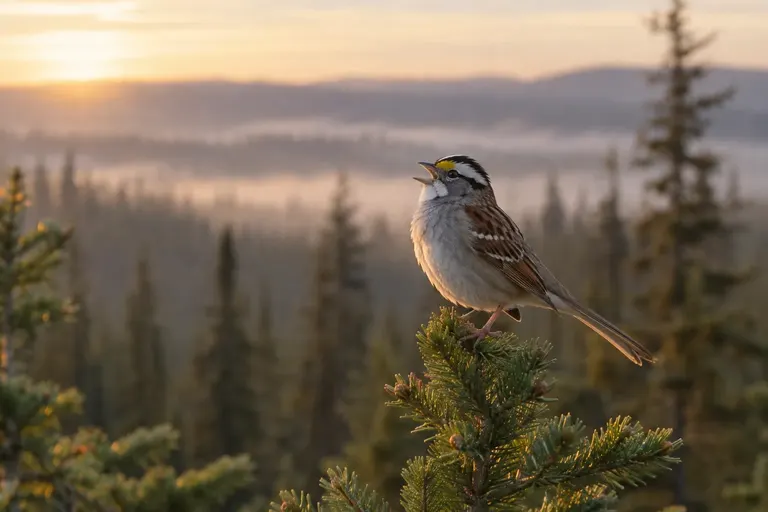
Why do birds sing in the morning? Mainly to defend their territory and to attract or keep a mate, and dawn is the best time to do it. Calm early air carries song farther, dim light makes feeding inefficient so singing costs little, and it is when rivals test territories and females are most likely to be fertile. The result is the dawn chorus, which builds before sunrise, especially in spring; be outside 30 to 45 minutes before sunrise to hear it.
No single reason explains the dawn chorus in every species. Scientists have proposed at least half a dozen hypotheses, and the evidence suggests several work together. Below is what each one says, what the research supports, and how to hear it for yourself.
Quick facts
- The dawn chorus peaks in spring and early summer, during the breeding season.
- In most temperate species, the loudest morning singers are males, though female song is common worldwide.
- The chorus usually starts before sunrise and is loudest around first light.
- Species with relatively large eyes tend to start singing earlier.
- Streetlights and traffic noise can shift singing earlier, or even into the night.
- Song is controlled by hormones and day length, which is why it fades in late summer.
What is the dawn chorus?
The dawn chorus is the period, usually beginning in darkness and lasting into the first hour or so of daylight, when many birds sing at once and at a higher rate than at any other time of day. It is found on every continent where songbirds breed, from temperate woodlands in Europe and North America to tropical forests in Brazil.
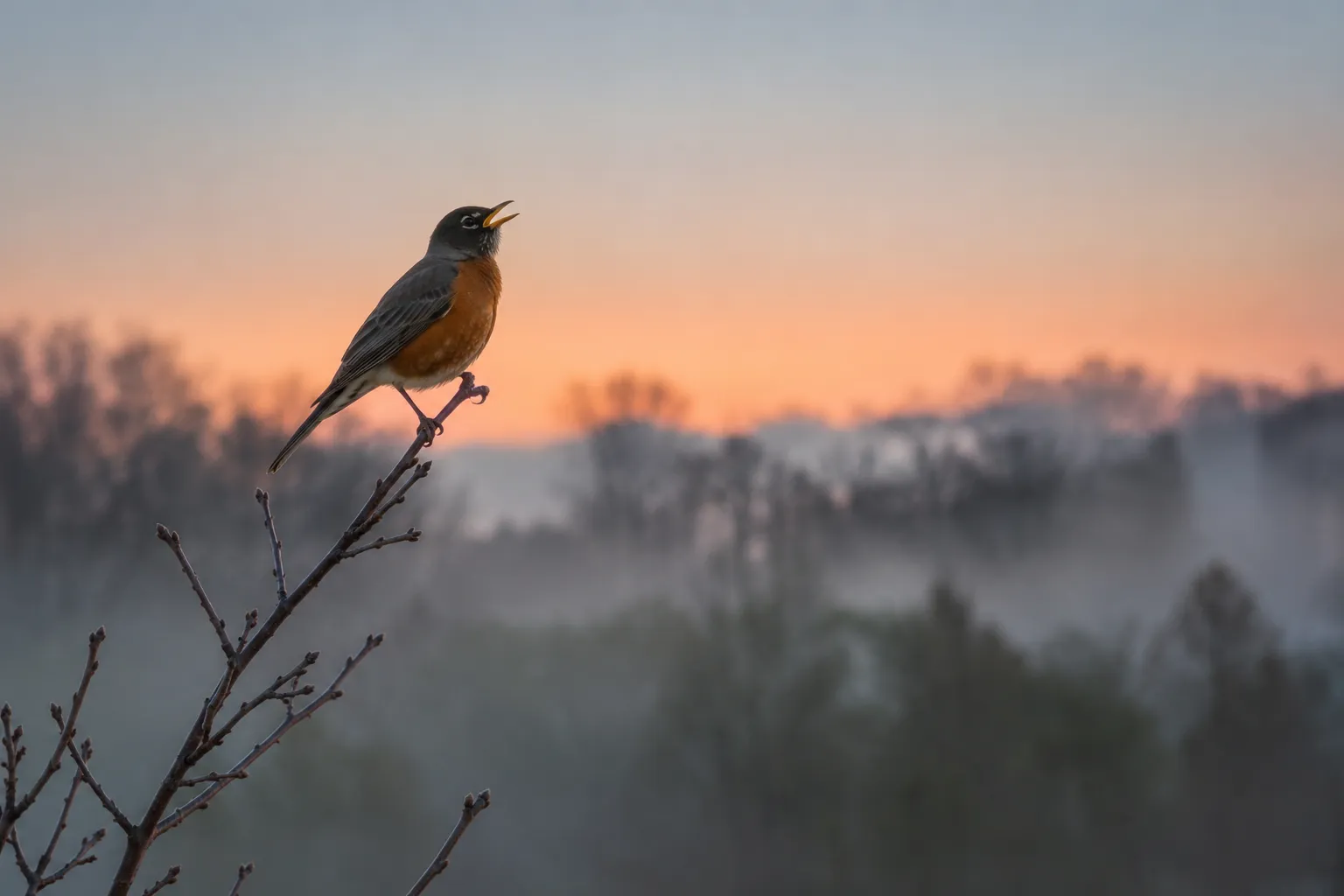
It is not random. In a given place, species tend to join in a fairly consistent order. Across North America, American Robins are often among the first. In Britain and much of Europe, Eurasian Blackbirds, European Robins and Song Thrushes are commonly early, with many finches and sparrows joining later. There is often a smaller, quieter dusk chorus as well.
Why do birds sing at all?
Before asking why birds sing at dawn, it helps to know why they sing. Bird song, as opposed to short calls, has two main jobs:
- Defending territory. A singing bird announces that a patch of habitat is occupied. Experiments in which territory owners were removed, or replaced with loudspeakers playing their song, have shown that song helps keep intruders away.
- Attracting and keeping a mate. Females of many species assess males by their song: its complexity, consistency, repertoire size or stamina. Paired males often keep singing, which may help guard their mate and signal quality.
Song is learned in most songbirds, which is why it varies between regions. We cover this in how birds learn songs and whether birds have regional accents.
Why do birds sing mostly at dawn? The main hypotheses
Does sound travel farther in the morning?
This is the acoustic transmission hypothesis. Early morning often has calmer winds and less turbulence, and temperature layers near the ground can help sound carry. Background noise from insects and people can also be lower. In theory, a song sung at dawn reaches more listeners for the same effort.
The evidence is mixed. Some field measurements find better transmission at dawn, others find the advantage is small or inconsistent. Most researchers now see it as a contributing factor rather than the full explanation.
Is it too dark to feed?
This is the inefficient foraging hypothesis. In the first minutes of the day, light is low and many insects are cold and inactive, so a bird that relies on sight to find food gains little by searching. Singing makes good use of time that would otherwise be wasted.
One of the strongest lines of support comes from eye size. Studies in Europe and elsewhere, including work by Robert Thomas and colleagues published in 2002, found that species with larger eyes relative to body size begin singing earlier in the morning. Larger eyes gather more light, so these birds can see well enough to start their day, and their song, sooner. This fits with the order of the chorus: thrushes and robins, which have fairly large eyes, tend to sing first.
Is dawn song a signal of overnight survival and fitness?
Small birds lose a lot of body weight overnight just keeping warm. A male that can sing vigorously at dawn is showing, in effect, that he survived the night with energy to spare. This idea, sometimes linked to the stochastic energy or reserves hypothesis, predicts that birds sing more at dawn when they have more reserves.
Some experiments support it. In several studies, birds given extra food the evening before sang more at the following dawn. Other studies found weaker effects. The general principle, that dawn song is an honest signal because it is costly, is widely accepted, even if the details vary by species.
Is it about fertile females?
Many female songbirds lay eggs in the early morning, and they are thought to be most fertile shortly after laying. If that is when mating is most likely to succeed, males benefit from being active and conspicuous at dawn, both to attract their own mate and to guard her from rival males.
Research on several species has found that males sing most intensely during their mate’s fertile period, and that dawn singing can fall off once incubation starts. Other studies show a more complex pattern. This mate-guarding and fertility idea is considered one of the more important explanations for temperate songbirds.
Is dawn when territories are tested?
Birds that die overnight leave empty territories. Neighbors and wandering “floaters” without a territory may check at dawn to see which owners are still present. Singing early and loudly tells everyone that the territory is still held. This is sometimes called the social dynamics or territory reestablishment hypothesis.
So which explanation is right?
Probably several at once. A reasonable summary from the research:
| Hypothesis | Core idea | How well supported |
|---|---|---|
| Acoustic transmission | Calm dawn air carries song farther | Mixed, likely a minor factor |
| Inefficient foraging | Too dark to feed, so sing instead | Good support, including eye size studies |
| Energy reserves signal | Singing after a cold night shows quality | Some support from feeding experiments |
| Female fertility and mate guarding | Dawn is when females are fertile | Good support in several species |
| Territory testing | Rivals check for vacant territories at dawn | Plausible, harder to test |
Different species may weight these reasons differently, and conditions such as latitude and habitat shift the balance too.
What controls when birds start singing?
Day length and hormones
In temperate birds, lengthening days in late winter trigger hormonal changes. Rising testosterone in males is closely linked to the growth of song-control areas in the brain and to singing rate. This is why the chorus builds through spring, peaks around the start of breeding, and fades in summer as days shorten and hormone levels fall.
Light levels each morning
Within a day, singing usually starts at a particular light level for each species. Cloudy mornings can delay the start. A full moon can sometimes bring singing slightly earlier.
Artificial light and noise
Human activity is changing the chorus. A widely cited 2010 study by Bart Kempenaers and colleagues found that songbirds near streetlights began their dawn song earlier, and the effect was strongest in species that naturally sing early. Research on European Robins in Sheffield, England, published in 2007, found that robins in noisy urban areas were more likely to sing at night, and that daytime noise predicted this better than light did. Birds appear to shift their singing into quieter hours to be heard.
If you notice a bird singing in the dark near a porch light or busy road, one of these effects is a likely cause. We explain more in why birds chirp at night.
How do birds actually make their songs?
Birds do not sing with a larynx the way we speak. Their sound comes from the syrinx, an organ found where the windpipe splits into the two bronchi leading to the lungs. In songbirds, the syrinx has two sides that can be controlled somewhat independently. That lets some species produce two notes at once or switch rapidly between sides, which is how thrushes create their layered, flute-like phrases.
Song is also governed by a set of connected brain regions often called the song system. In many temperate species these regions grow in spring and shrink after the breeding season, tracking hormone levels. That seasonal brain change is one reason a bird that sings hundreds of songs an hour in May may be almost silent by August.
Is a morning song different from a call?
Yes. Ornithologists separate songs from calls:
- Songs are usually longer, more complex and learned. They are tied mainly to territory and courtship and are most frequent in the breeding season.
- Calls are short, simpler sounds used year round for alarms, contact within a flock, begging or flight. A chickadee’s “chick-a-dee” is a call; its whistled “fee-bee” is its song.
The dawn chorus is mostly song. Calls go on all day, which is why winter mornings still sound busy even when little true singing is happening.
Is there an evening chorus too?
Many birds sing again near dusk, though usually less intensely than at dawn. Thrushes and robins are often among the last birds singing in the evening. The same general forces seem to apply: light is fading, feeding becomes less efficient, and territory owners reinforce their claim before night.
The dawn chorus is typically stronger because of the extra reasons that apply only in the morning: announcing overnight survival, testing for vacant territories after the night, and the timing of female fertility around egg laying.
Does weather change the dawn chorus?
Weather affects both whether birds sing and how far their song carries:
- Rain and strong wind usually reduce singing. Wind masks sound and makes song less effective, and wet, cold birds have less energy to spare.
- Cold mornings can delay the start or reduce singing rates, consistent with the idea that energy reserves matter.
- Overcast skies keep light levels low for longer, which can shift the chorus a little later.
- Mild, still spring mornings tend to produce the fullest chorus.
These patterns are general. Individual species and locations vary, and field studies do not always agree on the size of each effect.
Examples from around the world
- American Robin (North America): a classic early singer, often heard in the dark before sunrise in spring.
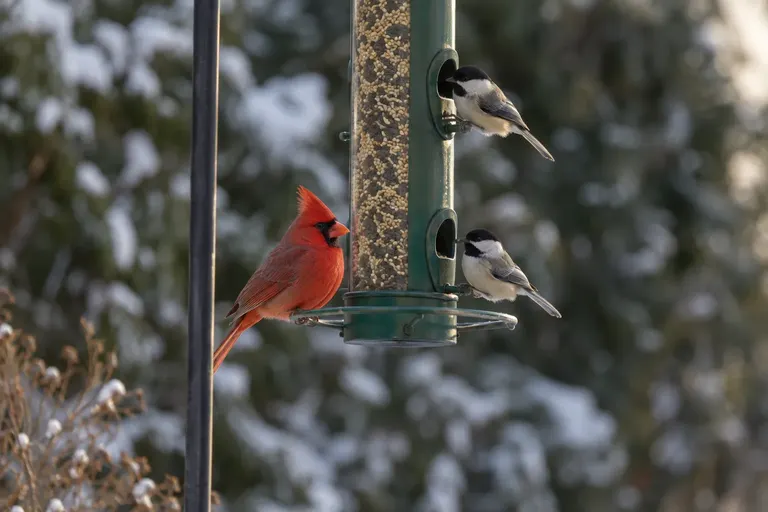
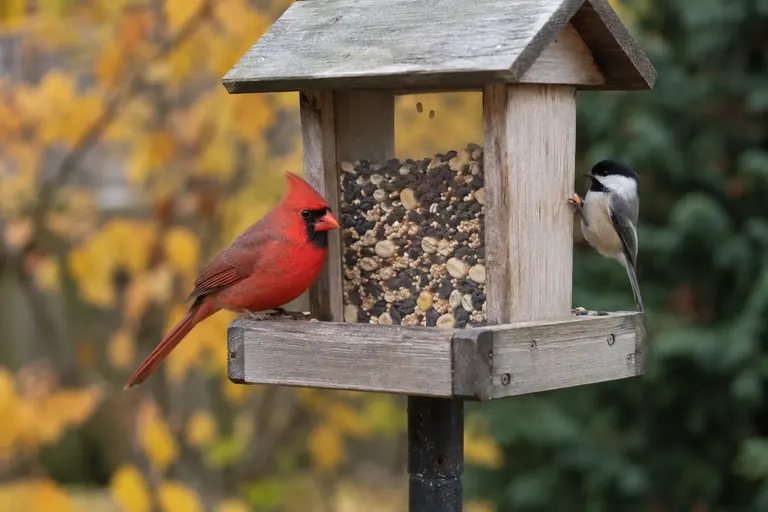
- Northern Cardinal (North America): both males and females sing, and cardinals are often among the early voices in eastern gardens.
- Common Nightingale (Europe and Turkey): famous for singing at night as well as by day. Research in Germany found that unpaired males do much of the nocturnal singing, apparently to attract females migrating overnight, and that paired males largely stop singing at night.
- Eurasian Blackbird and European Robin (Europe): reliable early chorus members. European Robins also sing in fall and winter, since both sexes defend feeding territories then.
- Rufous Hornero (South America): the national bird of Argentina and common in Brazil, where pairs perform loud, coordinated duets.
- Tropical wrens: many species in Central and South America sing tightly coordinated male-female duets that can sound like one bird.
Do only male birds sing?
In many North American and European species, singing is mostly done by males. But that pattern is not universal. A 2014 study in Nature Communications by Karan Odom and colleagues surveyed songbirds worldwide and found that female song is widespread, and that it was likely present in the common ancestor of modern songbirds. In the tropics, where many birds hold territories year round as pairs, female song and duetting are common.
The male-dominated pattern of northern temperate birds may partly reflect migration and short breeding seasons, which favor intense male competition. Researchers are still working out the details.
Why do some birds keep singing all day?
Dawn is the peak, but it is not the only time birds sing. Several groups break the pattern:
- Unpaired males often sing far more than paired ones, and through much of the day, because they still need to attract a mate. In several species, a male that sings on and on into late morning in June may simply not have found a partner yet.
- Mimics such as Northern Mockingbirds can sing for long stretches by day and, when unmated, at night.
- Open-country birds such as skylarks sing in long display flights at many times of day, since there are no perches to sing from and the display itself is part of the signal.
- Tropical residents that hold territories year round may sing in bursts through the day and in more seasons than temperate species.
A quieter midday is also normal. Heat, the need to feed chicks and a drop in the benefits of singing all push birds to spend late morning and afternoon foraging and resting rather than advertising.

Myths vs facts about morning birdsong
Myth: Birds sing in the morning because they are happy. Fact: Song has clear functions: defending territory and attracting or guarding a mate. We cannot measure a bird’s mood, but singing serves survival and breeding.
Myth: All birds sing in the dawn chorus. Fact: Many species take part, but not all. Some sing mainly at other times, and many non-songbirds such as doves, woodpeckers and owls use cooing, drumming or hooting instead.
Myth: Birdsong is only a spring thing. Fact: Spring is the peak, but some birds sing in fall and winter. Resident territorial species such as Carolina Wrens and European Robins sing much of the year.
Myth: Birds sing louder in cities just because they are stressed. Fact: Several studies show urban birds adjust pitch, timing or volume to be heard over noise. That is a practical adjustment to the sound environment, not proof of stress.
What this means for backyard birders
The dawn chorus is one of the best free shows in nature, and a good way to learn birds by sound.
- Get up early in spring. Peak activity in most temperate areas is from April to June. Be outside about 30 to 45 minutes before sunrise to hear the chorus build.
- Listen for the order. Note which species start first. Over a few mornings you will hear a pattern.
- Learn a few songs at a time. Our guide to birding by ear starts with 10 common songs.
- Record what you hear. Jotting down species, start times and weather in a birding journal makes seasonal patterns obvious within a year.
- Use sound ID apps carefully. Apps can be helpful for sorting a busy chorus, but check the results. See our guide to using Merlin Sound ID without getting fooled.
- Plan birding around it. Early morning is also when many birds forage most actively after the chorus, which is why it is often the best time of day to see birds.
- Reduce light at night. Turning off unneeded outdoor lights helps nocturnal migrants and may reduce disrupted singing schedules nearby.
International Dawn Chorus Day, held in early May in many countries, is a good excuse to go out and listen, whether in your garden or a local park.
Sources
- Northern Cardinal overview, Cornell Lab All About Birds
- Robin (European robin), RSPB
- Kempenaers et al. 2010, Artificial night lighting affects dawn song, Current Biology
- Odom et al. 2014, Female song is widespread and ancestral in songbirds, Nature Communications
- Fuller, Warren and Gaston 2007, Daytime noise predicts nocturnal singing in urban robins, Biology Letters
Frequently asked questions
What time does the dawn chorus start?
It usually begins in the dark before sunrise, often 30 to 60 minutes before, and is loudest around first light. The exact timing shifts with latitude, season, weather and the species present. Birds with larger eyes relative to their body size tend to start earlier, and artificial light can push the start even earlier.
Which birds sing first in the morning?
In North America, American Robins are often among the first voices, along with some thrushes and Northern Cardinals. In Europe, Eurasian Blackbirds, European Robins and Song Thrushes are typical early singers, while many small seed-eaters join later. Research links early singing to relatively large eyes, which let birds see in dim light.
Why do birds stop singing in late summer?
Most birds sing to claim territory and attract or keep a mate, so song fades once breeding ends. Shortening days and falling hormone levels, especially testosterone in males, reduce singing. Many birds also molt in late summer, which is energetically costly. Some species, such as European Robins, sing again in fall and winter to defend feeding territories.
Do female birds sing in the dawn chorus?
In many temperate species, the dawn chorus is dominated by males. But female song is widespread worldwide, especially in the tropics, and a 2014 study in Nature Communications concluded that female song was likely present in the common ancestor of songbirds. Female Northern Cardinals sing, and many tropical pairs sing coordinated duets.
Why is a bird singing outside my window at night?
Common reasons are unmated males advertising for a partner, as with Northern Mockingbirds and Common Nightingales, and artificial light from streetlights or porches, which can shift singing earlier. In noisy cities, some birds, such as European Robins, sing at night partly to avoid daytime traffic noise.