What Is Anting in Birds?
What is anting in birds? A bird rubs ants on its feathers or lies on an anthill. Here is what science knows about why birds do it, and what it does not.
In this article
- Quick answer: anting at a glance
- What does anting look like?
- Which birds go anting?
- Which ants do birds use?
- Do birds use things other than ants?
- Why do birds do it? The main hypotheses
- Myths and facts about anting
- When and where are you most likely to see anting?
- What should you do if you see a bird anting?
- Should you worry about ant control in your yard?
- How anting fits into feather care
- What we still don’t know
- Quick facts about anting
- Sources
- Frequently asked questions
What is anting in birds? It is a behavior, recorded in more than 200 bird species, in which a bird deliberately applies ants to its feathers. In active anting, the bird picks up ants in its bill and wipes them along its plumage, usually the underside of the wing tips. In passive anting, it squats or sprawls on an ant nest with its wings spread and lets the ants run through its feathers.
It has been recorded in more than 200 species worldwide, mostly songbirds, and almost always with ants that defend themselves by spraying formic acid. Why birds do it is still debated. The best-supported ideas are that ant chemicals help control feather parasites and microbes, and that rubbing ants removes their acid so they are safe to eat. It may do both, and more.
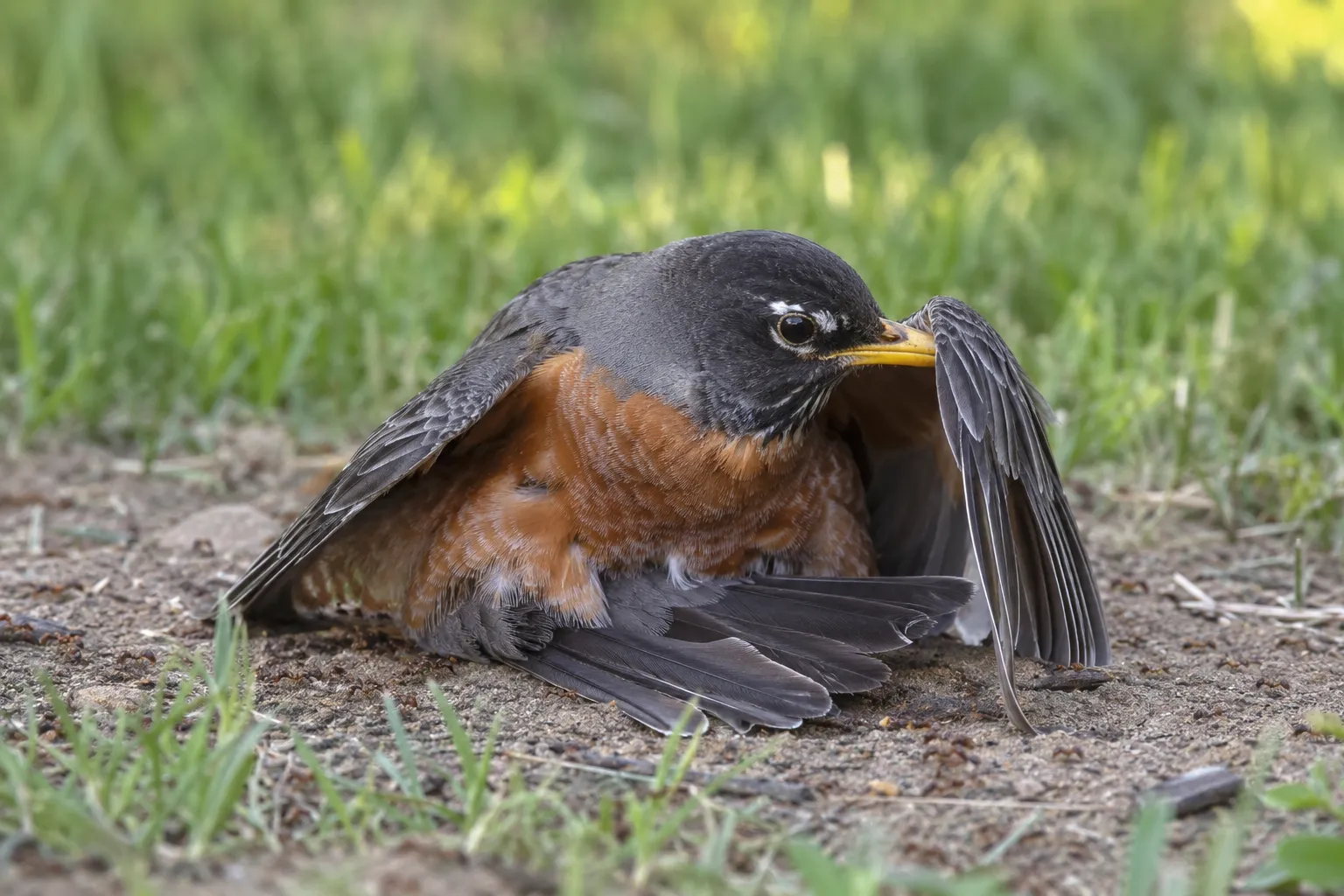
If you have ever seen a robin or a jay sprawled on the lawn looking half dead, wings out and tail twisted forward, there is a good chance you were watching anting. Here is what it is, how it works and what scientists can and cannot say about it.
Quick answer: anting at a glance
| Question | Short answer |
|---|---|
| What is it? | A bird applies ants, or ant secretions, to its feathers |
| Two forms | Active (rubbing ants with the bill) and passive (lying on an ant nest) |
| How widespread? | Recorded in more than 200 species, mostly perching birds |
| Which ants? | Mostly ants that spray formic acid rather than sting |
| Main explanations | Parasite and microbe control, food preparation, skin comfort during molt |
| Is it harmful? | Not known to be, although some substitutes (mothballs, cigarette butts) may be |
| When is it seen? | Mostly warm months, often in summer and late summer |
What does anting look like?
Anting can look alarming the first time you see it. The bird often seems dazed or unbalanced, and some observers assume it is sick, injured or has been hit by a car. In most cases it is none of those things.
Active anting
In active anting, a bird stands or crouches on the ground near ants, picks one or several up in the tip of its bill and wipes them along its feathers with quick, jerky strokes. The most common target is the underside of the flight feathers near the wing tips. To reach them, the bird often droops the wing and brings it forward, and at the same time swings its tail forward and under its body, sometimes so far that it nearly sits on it or tips over.
A bird may repeat the stroke many times with the same ant, drop it, pick up another, or eat the ant at the end. Sessions can last from a few seconds to many minutes.
Passive anting
In passive anting, the bird settles directly on an ant mound or a patch of disturbed ants, spreads its wings flat on the ground, fluffs its body feathers and lets the ants crawl up into the plumage. The posture resembles sunbathing, and the two can be hard to tell apart without seeing the ants. Passive anting is reported less often than active anting, partly because it is harder to recognize.
What anting is not
- Dust bathing uses dry soil, and the bird kicks and shuffles to throw dust through its feathers. See why birds take dust baths.
- Sunbathing uses the same spread-wing posture, but without ants. Our guide to why birds sunbathe covers it.
- Foraging on ants is simply eating them. Flickers and many woodpeckers eat huge numbers of ants but are not necessarily anting when they do.
Which birds go anting?
Anting has been documented in more than 200 bird species, and some reviews put the number higher. The large majority are passerines, the perching birds. The groups that show up most often in the literature include:
- Crows, jays and relatives (corvids). Blue Jays in North America and Eurasian Jays in Europe are among the classic anting birds.
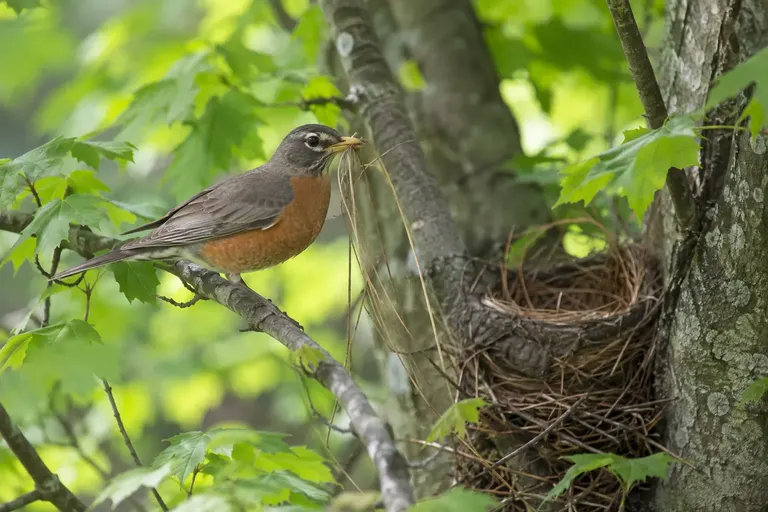
- Thrushes. American Robins, Common Blackbirds and Song Thrushes are frequently reported.
- Starlings. European Starlings, both in their native range and where introduced, ant readily.
- Blackbirds and grackles. Common Grackles are well known for anting, and for using unusual substitutes.
- Sparrows, finches, tanagers, warblers and others. Reports are scattered across many songbird families.
Outside the passerines, records exist but are much rarer, and some older accounts are hard to verify. It is fair to say that anting is a songbird specialty, even though it is not exclusive to them.
Why it is common in some families and apparently absent in others is not known. Part of the answer may be observation bias: bold, ground-feeding birds such as robins, jays and starlings live around people and forage in the open, so they are simply seen more often.
Which ants do birds use?
Birds are not random about ants. Most records involve ants in the subfamily Formicinae, which lack a working sting and instead defend themselves by spraying formic acid from a gland at the tip of the abdomen. Wood ants of the genus Formica are the textbook example in both Europe and North America.
Ants that sting, such as many species in other subfamilies, appear to be used far less often. That pattern is one of the strongest clues about what anting is for: it points toward the chemistry of the ant rather than the ant itself.
Formic acid is a simple, pungent acid that irritates skin and eyes and is toxic to many small arthropods. Some ants also carry other defensive compounds. When a bird squeezes an ant in its bill, the ant sprays, and the bird wipes that spray onto its feathers.
Do birds use things other than ants?
Yes, and this is one of the most intriguing parts of the story. Birds have been reported “anting” with a surprising range of substitutes, including:
- Millipedes, some of which secrete defensive chemicals
- Beetles and other insects with chemical defenses
- Citrus peel and fruit
- Walnut husks
- Marigold flowers and other aromatic plant parts
- Mothballs
- Discarded cigarette butts, and in some reports, smoke from chimneys or fires, a behavior sometimes called smoke bathing
Common Grackles in particular have been reported using mothballs and lime or lemon pieces. Most of these substitutes share one thing: they are pungent, acidic or chemically defended. That supports the idea that birds are after a chemical effect, not the ants as such.
Some substitutes carry real risks. Mothballs contain naphthalene or paradichlorobenzene, and cigarette butts contain nicotine and other toxins. There is no good data on how often birds are harmed this way, but it is one more reason to keep litter and household chemicals out of the yard.
Why do birds do it? The main hypotheses
Scientists have argued about anting for about a century, and there is still no single agreed answer. The main ideas are below, with what supports each one and where the evidence runs thin.
Does anting kill feather lice and mites?
This is the oldest and most popular explanation. Birds carry feather lice, feather mites, fungi and bacteria, all of which can damage plumage. Formic acid is toxic to many small arthropods, and beekeepers use it to treat mites in hives, so the idea is plausible on its face.
What supports it: Birds favor ants with chemical defenses, and they apply the secretions to feathers, not skin. Many substitutes are also pungent or insecticidal. The behavior is concentrated on the flight feathers, which are valuable and slow to replace.
Where it is weak: Direct tests are few and mixed. Laboratory studies of ant secretions against feather microbes and parasites have not consistently shown strong effects at the concentrations a bird would actually apply. Field studies that compare parasite loads in birds that ant and birds that do not are very hard to run, and convincing ones are lacking. So the parasite-control idea remains reasonable but unproven.
Is anting a way to make ants safe to eat?
A second explanation is that anting is food preparation. Formicine ants are well defended: their acid makes them distasteful, and the acid sac itself may be unpleasant or harmful to swallow. By squeezing and wiping an ant, a bird forces it to empty its acid gland onto the feathers, which work like a towel. The ant is then eaten.
What supports it: A 2008 study by Thomas Eisner and Daniel Aneshansley, working with captive Blue Jays, found that jays anted with ants carrying full acid sacs and then ate them, but were much more willing to eat ants directly when the acid sacs had been experimentally removed. That is strong evidence that, at least in Blue Jays, anting helps make ants edible. Many observers also report birds eating the ant at the end of an anting stroke.
Where it is weak: It does not explain passive anting, where the bird eats nothing, or anting with mothballs, citrus or cigarette butts. It also does not explain why the acid goes onto the wing feathers so precisely.
Does anting soothe the skin during molt?
A third idea links anting to molt. Many songbirds molt in summer and late summer, which is also when most anting is reported. Growing feathers may make the skin itchy or sensitive, and some researchers have suggested that ant secretions provide relief or somehow help feather growth.
What supports it: The seasonal overlap is real in many temperate regions.
Where it is weak: Summer is also when ants are most active and when birds are most visible, so the timing may be a coincidence. There is little direct evidence of a soothing effect. For more on the process itself, see why birds molt.
Is it just pleasurable?
Some writers suggest birds ant because it feels good, perhaps from mild skin stimulation, in the same way that some animals seek out certain smells. This is hard to test and says little about why the behavior evolved in the first place. It may be part of the proximate explanation, the immediate reason a bird does it on a given day, rather than the deeper evolutionary reason.
Can more than one explanation be true?
Very likely. Anting may have multiple functions, and the balance may differ between species. A Blue Jay may mostly be preparing a meal, while a starling rubbing a mothball is clearly not. Some biologists also point out that a behavior which first evolved for one reason can later be co-opted for another. The honest summary is that anting is real, widespread and chemically driven, and that its purpose is still an open question.
Myths and facts about anting
| Claim | Reality |
|---|---|
| “A bird anting is injured or dying.” | Usually false. The sprawled, twisted posture is normal for anting and sunbathing. Give it space and it will fly off. |
| “Birds ant to get drunk or high.” | No good evidence. Formic acid is not an intoxicant, and the idea is speculation. |
| “Only a few birds do it.” | False. More than 200 species are on record, and many are common garden birds. |
| “Birds use any ants they find.” | Mostly false. Records are dominated by ants that spray formic acid rather than sting. |
| “Anting has been proven to kill lice.” | Not proven. It is a leading hypothesis with limited direct support. |
| “Anting is just eating ants.” | Partly. In some species, such as Blue Jays, anting clearly precedes eating, but passive anting and anting with non-food objects show it is not only about food. |
When and where are you most likely to see anting?
Most anting is reported during warm weather, especially in summer and early fall in temperate regions, when ants are active and colonies are large. Birds usually ant on open ground: lawns, garden edges, gravel paths, sandy banks and around the base of anthills. Dry, sunny spots are favored, which is also why anting and sunbathing are so often confused.
Anting sessions are brief and easy to miss. The best chance of seeing one is to spend time watching the ground-feeding birds in your yard on warm mornings, particularly robins, jays, starlings and grackles in North America, or blackbirds, jays and starlings in Europe. Our guide to reading what birds are doing covers other behaviors worth watching for at the same time.
What should you do if you see a bird anting?
Very little, and that is the point.
- Stay back. Anting birds are focused but will flush if you approach. Watch from a window or a distance with binoculars; our guide to binoculars for watching from a window covers suitable options.
- Do not intervene. A bird with wings spread on the ground is not necessarily hurt. If it flies off normally afterwards, it was fine.
- Check before assuming injury. A bird that cannot stand, drags a wing while walking, or does not fly when you get close may be hurt. If so, see what to do with an injured bird.
- Keep cats indoors. A bird absorbed in anting on open ground is vulnerable. See cats and birds: keeping your yard safe.
- Note it down. Anting is still poorly documented in many species. Recording the species, date, ant type if you can tell, and any substitute objects in a notebook or eBird checklist comment adds to what is known.
Should you worry about ant control in your yard?
If you enjoy seeing birds, it helps to tolerate some ants. Ants are also a food source for many birds, including flickers, some woodpeckers and many songbirds, and they are important in soil turnover and seed dispersal.
Broad-spectrum insecticides on lawns and borders reduce the insects birds feed on and can expose birds directly. If ants are entering the house, target the problem indoors and at entry points rather than treating the whole yard. Leaving some bare, sunny soil and a less manicured lawn edge gives birds room for anting, dust bathing and sunbathing.
How anting fits into feather care
Feathers are a bird’s flight surface, insulation and display, all in one, and they cannot be repaired once grown. Birds spend a large share of their day on maintenance: preening with the bill, spreading oil from the preen gland, bathing in water, dust bathing, sunbathing and, in some species, anting.
Seen in that context, anting looks like one tool in a larger toolkit. Water bathing loosens dirt. Dust may absorb excess oil and discourage parasites. Sunlight may drive parasites to move where they can be preened out, and may help with vitamin D or feather condition. Anting adds a chemical layer to the same job. You can see how these behaviors connect in our page on why birds puff up.
What we still don’t know
Despite a century of observation, several basic questions remain open:
- How much of the variation is real? Many species have only one or two anting records, and it is unclear whether they ant often or rarely.
- Does it actually reduce parasites in the wild? No large field study has settled this.
- Do young birds learn it or know it? Some observations of hand-raised birds suggest anting can appear without being learned from adults, but data are limited.
- Why the wing tips? The focus on the underside of the primaries is striking and not fully explained.
- How common are harmful substitutes? Reports of mothballs and cigarette butts are anecdotal.
This is one of those areas where careful backyard observers can still add useful records.
Quick facts about anting
- Anting means applying ants or ant chemicals to the feathers.
- Active anting: rubbing ants with the bill. Passive anting: lying on an ant nest.
- Recorded in more than 200 species, mostly songbirds.
- Most anting uses formicine ants, which spray formic acid instead of stinging.
- Birds also use millipedes, citrus, walnut husks, mothballs and cigarette butts.
- A 2008 Blue Jay study showed anting helps make ants safe to eat.
- Parasite control is plausible but not proven.
- Anting is most often seen in warm weather on open ground.
- An anting bird is usually not injured; watch from a distance.
Sources
- Cornell Lab of Ornithology: All About Birds, Blue Jay species account
- Cornell Lab of Ornithology: All About Birds, Common Grackle species account
- Audubon Guide to North American Birds
- RSPB: Jay species information
- Eisner, T. and Aneshansley, D. (2008). Anting in Blue Jays: evidence in support of a food-preparatory function. Chemoecology 18: 197-203.
Frequently asked questions
What is anting in birds?
Anting is a comfort behavior in which a bird either picks up ants and rubs them on its feathers (active anting) or lies on an ant nest with its wings spread and lets ants swarm over its body (passive anting). It has been recorded in more than 200 bird species, most of them songbirds, and usually involves ants that spray formic acid rather than ants that sting.
Why do birds rub ants on their feathers?
Nobody knows for certain, and several explanations may apply. The leading ideas are that ant chemicals help control feather lice, mites, fungi or bacteria, that rubbing makes ants safe to eat by discharging their acid, and that it soothes skin during molt. Evidence for each is partial, and the behavior may serve different purposes in different species.
Is anting harmful to birds?
There is no good evidence that normal anting harms birds. Birds typically ant briefly with ants that spray formic acid, and they appear to choose species rather than using any ant they find. The main risk is from substitutes birds occasionally use, such as mothballs or discarded cigarette butts, which contain chemicals that may be toxic.
What birds are most likely to be seen anting?
In North America, American Robins, Blue Jays, European Starlings, Common Grackles and various thrushes and sparrows are among the birds most often reported anting. In Europe, Eurasian Jays, starlings and thrushes such as the Common Blackbird are frequently mentioned. Most records involve songbirds, especially crows and jays, thrushes and starlings.
What does anting look like?
An anting bird usually crouches on the ground or an ant mound, droops or spreads its wings, and often swings its tail forward under its body. In active anting it grabs an ant in its bill and wipes it along the underside of its wing feathers, especially near the tips. The bird can look dazed, off-balance or even injured, which alarms many first-time observers.
Do birds use things other than ants for anting?
Yes. Birds have been reported rubbing their feathers with millipedes, beetles, citrus peel, walnut husks, marigold flowers, mothballs and even cigarette butts. Many of these substitutes contain pungent or defensive chemicals, which supports the idea that the chemical, not the ant itself, is what matters to the bird.