Why Do Birds Take Dust Baths? How Dust Cleans Feathers
Why do birds take dust baths? Dust soaks up excess preen oil, keeps feathers fluffy and may help control lice and mites. Which birds do it and how to help them.
In this article
- Quick answer: why birds dust bathe
- What is a dust bath?
- Why do birds need to remove oil from their feathers?
- Does dust bathing get rid of mites and lice?
- Which birds take dust baths?
- Is dust bathing a substitute for water bathing?
- Is dust bathing social?
- Why do chickens need dust baths?
- Is it normal for a bird to look dead or injured while dust bathing?
- How do you make a dust bath for wild birds?
- When and how often do birds dust bathe?
- How is dust bathing different from sunbathing and anting?
- Myths vs facts about dust bathing
- What does this mean for backyard birders?
- Quick facts
- Sources
- Frequently asked questions
Why do birds take dust baths? Mainly to keep their feathers in good condition. Fine, dry dust worked into the plumage is thought to soak up excess preen oil and skin lipids, which keeps feathers fluffy, flexible and properly aligned. Dust bathing may also help control feather lice and mites, and for some species, such as chickens and House Sparrows, it has a social side too.
It looks odd, a bird flopping in the dirt and flinging soil over itself, but it is ordinary feather care, as normal as bathing in water. This guide explains how dust bathing works, which birds do it, what the research says about its purpose, and how to give birds a safe dusting spot in your yard.
Quick answer: why birds dust bathe
| Likely purpose | How it helps | Strength of evidence |
|---|---|---|
| Removing excess oil | Dust absorbs preen oil and skin lipids, then shakes out | Good, especially from poultry research |
| Feather structure | Clean, dry feathers fluff and interlock properly | Good |
| Parasite control | Dust may deter or dislodge lice and mites | Mixed; depends on the dust |
| Skin and feather comfort | May relieve itching, especially during molt | Plausible, little direct data |
| Social behavior | Birds dust bathe in groups and copy each other | Documented in chickens and sparrows |
| Cooling or drying in dry habitats | Substitute for water bathing where water is scarce | Plausible for some species |
What is a dust bath?
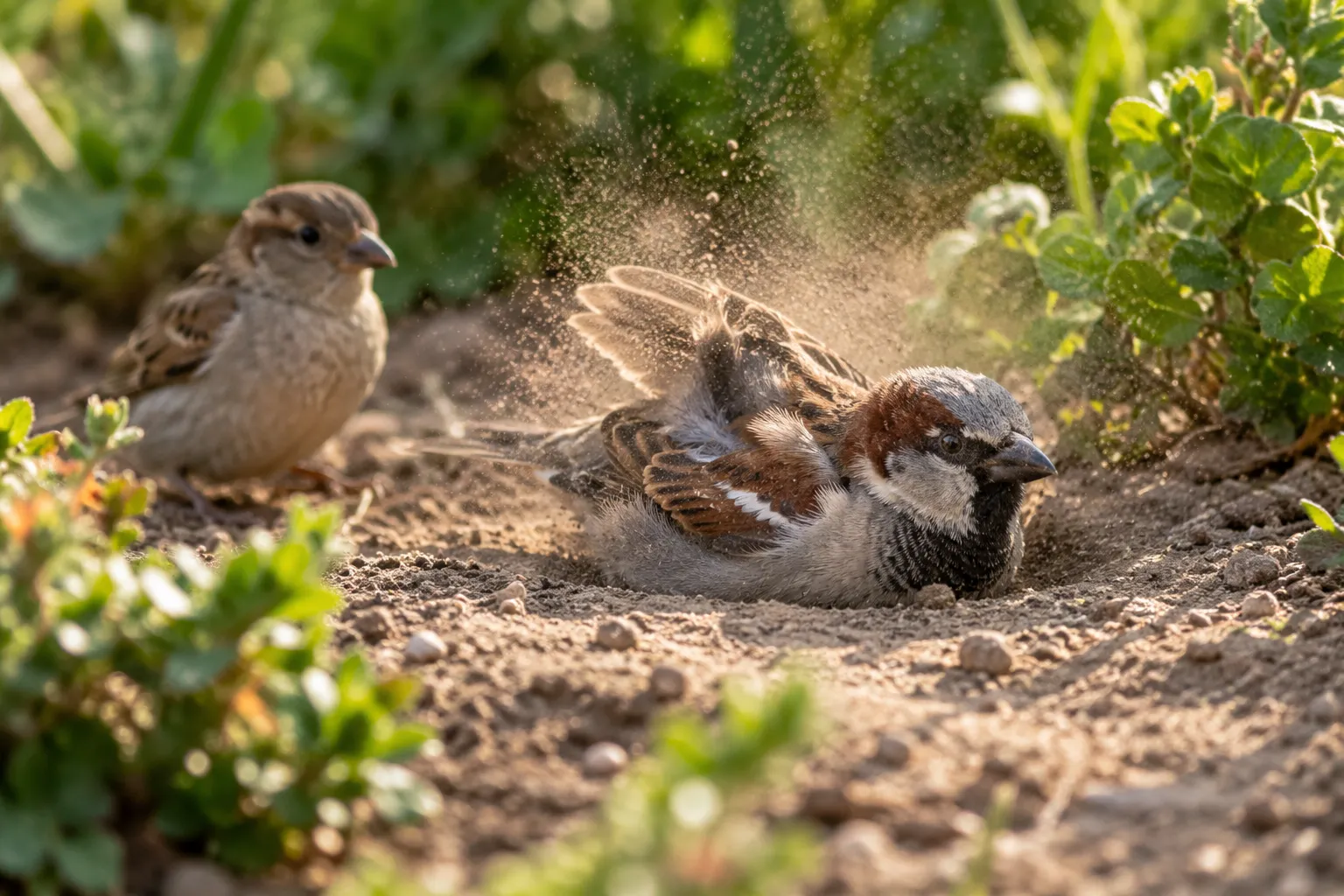
A dust bath is a sequence of movements that works loose soil into the feathers and then removes it. The sequence is fairly consistent across species:
- Scratching a hollow. The bird scratches or pecks at loose soil, often creating a shallow saucer-shaped depression.
- Settling in. It crouches or lies down, fluffing its body feathers so they stand away from the skin.
- Tossing dust. It flicks dust over its back with vigorous wing movements, rubs its head and sides on the ground, and wriggles so the particles reach the feather bases.
- Resting. Some birds lie still for a while, feathers raised, sometimes on their side with a wing extended.
- Shaking off. The bird stands and gives one or more full-body shakes, sending up a cloud of dust. It often preens afterward.
The hollows can persist. In dry gardens and farmyards, you may find a cluster of small, round depressions in fine soil, sometimes called dust wallows, where birds return again and again.
Why do birds need to remove oil from their feathers?
Most birds have a preen gland, or uropygial gland, near the base of the tail. It produces a waxy oil that birds spread over their feathers while preening. The oil helps keep feathers flexible and water-resistant, and in some species it may help protect against bacteria and fungi.
But more is not always better. If oil builds up, feathers can clump and lose their fine structure. The tiny barbs that zip each feather together may not interlock as well, and the fluffy down underneath may not trap air efficiently. A good analogy is hair that has gone too long without washing.
Dust helps solve this. Fine, dry particles absorb oil and other lipids, and when the bird shakes, the oily dust leaves with them. Research on domestic chickens has shown that hens with access to a dust bath have less lipid on their feathers than hens without one, and that the amount of lipid on the feathers seems to influence how much they dust bathe. That makes oil regulation one of the best-supported explanations.
The result is that dust bathing and oiling work together. The bird adds oil through preening and removes the excess through dusting, keeping the plumage in balance.
Does dust bathing get rid of mites and lice?
Parasite control is the explanation most people have heard, and it is plausible. Feather lice chew feathers and skin debris, and mites can live on the skin, in feathers or in nests. Dust could make feathers a less hospitable place, abrade parasites or dislodge them during shaking.
The evidence is more complicated than the popular version suggests. Experiments with domestic hens have found that dust bathing in ordinary soil or litter reduces lice only modestly, while dust baths containing certain minerals or approved treatments reduce them more strongly. So the type of dust seems to matter. Wild birds may choose particular soils, but that has been studied less.
The fairest summary is that dust bathing probably contributes to parasite control in some situations, but it is not a complete defense. Birds also rely on preening, sunbathing, and perhaps anting to manage parasites. See what is anting in birds for that more unusual behavior.
Which birds take dust baths?
Dust bathing is widespread but not universal. It is most typical of birds that live in dry, open country or feed mainly on the ground.
Gamebirds
The gamebird order, which includes chickens, turkeys, quail, grouse, pheasants and partridges, is the group best known for dust bathing. Domestic chickens are the most studied dust bathers of all. In the wild, Wild Turkeys, Northern Bobwhites, California and Gambel’s Quail, Ring-necked Pheasants and Ruffed Grouse all take dust baths, often in regular spots such as dirt roads, field edges and dry banks.
In Europe and Asia, Grey Partridges and Common Quail are frequent dust bathers. In South America, tinamous, an ancient group of ground birds, are also known to dust bathe.
House Sparrows and other songbirds
The House Sparrow is the dust bather most people see. Originally from Europe, the Middle East and Asia and now found across much of the world, including the Americas, it often bathes in groups in dry flower beds, bare patches in lawns and the edges of paths. Sparrows sometimes defend a favorite dust bath from others, so small squabbles are common.
Other songbirds recorded dust bathing include larks, such as the Horned Lark in North America and the Eurasian Skylark and Crested Lark in Europe and Turkey, plus many wrens, some thrushes and pipits. Some birds, including House Sparrows, take both water baths and dust baths, sometimes on the same day.
Other groups
- Hoopoes, found across Europe, Africa and Asia, dust bathe as well as sunbathe.
- Bustards and sandgrouse in dry grasslands and deserts dust bathe regularly.
- Ostriches, rheas and emus roll in dust.
- Some raptors, including kestrels, have been recorded dust bathing, although it is less typical of birds of prey.
- Roadrunners in the arid American Southwest are known to take dust baths.
Many waterbirds, including ducks, gulls and most seabirds, rarely or never dust bathe. They bathe in water and rely on dense, well-oiled plumage.
Is dust bathing a substitute for water bathing?
Partly. In deserts and dry grasslands, where water is scarce or unreliable, dust bathing may be the main way birds clean their plumage. But dust bathing and water bathing are not simply interchangeable. Water baths rinse feathers and help birds realign them, while dust baths remove oils. Many birds that do both seem to use each for its own purpose, and some species hardly ever dust bathe even when dust is plentiful.
For birds that bathe in water, a clean birdbath is valuable year-round. Our guide to where to put a bird bath explains placement.
Is dust bathing social?
In some species, yes. Chickens show strong social facilitation: when one hen starts dust bathing, others nearby often join, and flocks tend to dust bathe at similar times of day. House Sparrows often dust bathe in groups too, and you may see several birds sharing a patch of dry soil in a garden or park.
Group bathing may have practical benefits. More birds mean more eyes watching for predators, which matters because a bird lying in the dust with its feathers raised and wings spread is vulnerable. It may also simply reflect the fact that birds in a flock tend to do the same activity at the same time.
Why do chickens need dust baths?
Anyone who keeps backyard chickens knows they dust bathe with obvious enthusiasm. Animal welfare research treats dust bathing as a strongly motivated behavior in hens. When hens are deprived of suitable material, they may perform the full dust bathing sequence on a bare floor, sometimes called sham or vacuum dust bathing, and they often bathe more intensely once material is provided again. This is one reason welfare standards for laying hens in many countries require access to litter or a dust bathing area.
The research on chickens has also shaped what scientists know about wild birds, although wild species have been studied much less.
Is it normal for a bird to look dead or injured while dust bathing?
It can look alarming. A dust-bathing bird may lie on its side with one wing stretched out, feathers raised and eyes half closed, sometimes for a minute or longer. People occasionally assume it is hurt.
If the bird eventually shakes off, stands normally and flies away when approached, it is fine. The same applies to sunbathing, which often happens in the same sunny spots. Our guide to why birds sunbathe explains those postures. If a bird cannot stand or fly, or stays down for a long time, it may need help; see what to do with an injured bird.
How do you make a dust bath for wild birds?
A simple dusting area can bring House Sparrows, and in some regions quail, towhees or other ground birds, into view. Here is a basic approach.
- Pick a sunny, dry spot. Birds prefer fine, dry soil in full sun or partial sun.
- Keep it open but near cover. Place it in the open, several feet from shrubs, so birds can see approaching predators, with cover close enough to escape to. Cats often ambush birds from dense plants right next to feeding and bathing areas. See cats and birds.
- Loosen the soil. Dig and loosen an area about 2 to 3 feet across and several inches deep.
- Add fine material. Mix in clean play sand or fine, sifted garden soil. Some people add a little fine loam. Remove stones and roots.
- Consider an edge. A ring of stones or a low border helps keep the dust in place.
- Keep it dry. A patch under a roof overhang or in a well-drained spot works best; wet soil is useless for dusting.
- Keep it chemical-free. Do not use pesticides, fertilizers or weed killers on or near the patch.
What not to add
- Insecticidal powders. Products meant for poultry or pets are not intended for wild birds.
- Wood ash or fireplace ash. It can be caustic and may contain unknown residues.
- Diatomaceous earth. Although used by some poultry keepers, the fine dust may irritate the respiratory tract, and its effects on wild birds are not well studied.
- Very fine powders. Materials that hang in the air as a cloud may be inhaled.
When and how often do birds dust bathe?
Timing varies by species and climate, but some patterns are well known.
- Warm, dry weather. Dust bathing is most common when soil is dry and loose, so it peaks in dry spells and in arid regions. After a long rain, birds often wait until the ground dries out.
- Midday and afternoon. Studies of domestic hens show a daily rhythm, with most dust bathing around the middle of the day. Many wild birds seem to follow a similar pattern, dusting in warm, sunny hours after the morning feeding rush.
- Every day or two. Hens with access to good material commonly dust bathe roughly every other day, in bouts that can last many minutes. Wild birds are harder to track, but House Sparrows may return to the same patch repeatedly over a single afternoon.
- During molt. Some observers report more dust bathing while new feathers are growing in, possibly because it helps clear flakes of feather sheath. This is plausible but not well quantified.
How is dust bathing different from sunbathing and anting?
Birds have several ways of caring for their plumage, and they often happen in the same sunny corners of a yard.
| Behavior | What the bird does | Main suspected purpose |
|---|---|---|
| Water bathing | Splashes and dips in shallow water | Cleaning and realigning feathers |
| Dust bathing | Works dry soil into feathers, then shakes it out | Removing excess oil, possibly parasites |
| Sunbathing | Spreads wings and tail, raises feathers in sun | Warming, parasite control, feather care |
| Anting | Rubs ants on feathers or lies on an ant nest | Possibly parasite control or removing ant acids before eating |
| Preening | Uses bill to clean, oil and zip feathers | Daily feather maintenance |
In practice, a bird may do several in sequence: a dust bath, a long shake, a spell of sunbathing and a thorough preen.
Myths vs facts about dust bathing
Myth: Dust bathing birds are dirty. Dust bathing is a cleaning behavior. Birds shake off the dust and preen afterward.
Myth: Dust bathing is only about bugs. Parasite control is one possible benefit, but removing excess oil and maintaining feather structure are better supported.
Myth: Only chickens dust bathe. Many wild birds do, from sparrows and larks to turkeys, hoopoes and even some raptors.
Fact: Birds often have favorite dusting spots. Well-used hollows are reused for weeks or longer, and some birds defend them.
What does this mean for backyard birders?
- Leave some bare ground. A perfectly covered lawn or thick mulch leaves nowhere to dust bathe. A small bare, sunny patch is enough.
- Avoid chemicals. Birds work soil into their plumage, so lawn and garden chemicals can end up on feathers and skin.
- Provide water too. A clean birdbath lets water bathers keep feathers in shape. See how to clean a bird bath.
- Watch the sequence. Dust bathing is a great behavior to observe. Note the species, time of day and weather; you may find birds dust bathe more on warm, dry afternoons.
- Think about the whole garden. Dust baths fit naturally into a yard with native plants, cover and open ground. Our guide to designing a small bird-friendly garden shows how.
Quick facts
- Dust bathing removes excess preen oil and skin lipids from feathers.
- Chickens are the most studied dust bathers; research shows hens are strongly motivated to do it.
- Ordinary dust may reduce lice only modestly; some mineral dusts work better.
- House Sparrows often dust bathe in groups.
- Gamebirds, larks, hoopoes, bustards and ostriches are regular dust bathers.
- Many waterbirds rarely or never dust bathe.
- A dust bath area should be sunny, dry, chemical-free and a few feet from cover.
Sources
- House Sparrow overview, Cornell Lab of Ornithology, All About Birds
- Wild Turkey overview, Cornell Lab of Ornithology, All About Birds
- Northern Bobwhite overview, Cornell Lab of Ornithology, All About Birds
- Horned Lark overview, Cornell Lab of Ornithology, All About Birds
- Royal Society for the Protection of Birds
- National Audubon Society
Frequently asked questions
Why do birds roll in dirt?
Birds roll and flutter in fine, dry soil to work dust through their feathers. The dust is thought to absorb excess preen oil and skin lipids, keeping feathers fluffy and well aligned, and it may help control lice and mites. After the bath, a vigorous shake removes the dust along with oil and debris.
What birds take dust baths?
Dust bathing is common in chickens and other gamebirds, including quail, grouse, pheasants, partridges and Wild Turkeys, and in House Sparrows. Larks, many wrens, some thrushes, Hoopoes, bustards, ostriches and even some raptors such as kestrels have also been recorded dust bathing, especially in dry, open habitats.
Do birds take dust baths to get rid of mites?
Parasite control is one of the leading explanations, and dust may make feathers less comfortable for lice and mites. The evidence is mixed. Studies in domestic chickens suggest ordinary dust bathing reduces lice only modestly, while dust mixed with certain minerals or treatments works better. Oil control is better supported.
Is it normal for a bird to lie flat in the dirt?
Yes, if it is dust bathing or sunbathing. Birds may lie with wings spread, feathers raised and eyes half closed for a minute or more. The bird should shake off, move normally and fly away when approached. A bird that cannot fly or stays down for a long time may need help.
How can I make a dust bath for birds?
Choose a sunny, open spot a few feet from shrubs so birds can see approaching cats. Loosen a patch of soil about 2 to 3 feet across and several inches deep, and mix in fine, clean sand. Keep it dry, free of pesticides and fertilizer, and avoid adding insecticidal powders.