How Many Birds Are There in the World?
How many birds are there in the world? Roughly 50 billion wild birds by the best recent estimate, across about 11,000 species. How scientists count them.
In this article
- Quick answer: the numbers at a glance
- How many birds are there in the world, according to scientists?
- How do you count birds you cannot see?
- Which birds are the most common in the world?
- How many bird species are there, and how many are rare?
- Where do the most birds live?
- Are there more chickens than wild birds?
- Is the number of birds in the world going down?
- Myths and facts about global bird numbers
- What does this mean for backyard birders?
- How will future counts get better?
- Quick facts
- Sources
- Frequently asked questions
How many birds are there in the world? Roughly 50 billion wild birds, according to the most detailed global estimate so far, published in 2021. That works out to about six birds for every person on Earth. Those birds are spread very unevenly across roughly 11,000 species: a handful of species number in the billions, while more than a thousand have populations smaller than a typical town.
That 50 billion figure is an estimate, not a head count, and it comes with real uncertainty. Understanding how scientists arrive at it, and why other estimates differ, tells you a great deal about which birds are thriving, which are rare and what your own feeder counts contribute.
Quick answer: the numbers at a glance
- Wild birds worldwide: roughly 50 billion adults, by the 2021 estimate in the journal PNAS.
- Bird species: about 11,000, depending on which checklist you follow.
- Billion-plus species: only four in that study, led by the House Sparrow at around 1.6 billion.
- Rare species: roughly 12 percent of species were estimated to have fewer than 5,000 individuals.
- Domestic chickens: tens of billions alive at any time, and poultry outweigh all wild birds combined.
- Trend: many regions are losing birds. North America alone has about 3 billion fewer breeding birds than in 1970.
How many birds are there in the world, according to scientists?
The headline number comes from a study by Corey Callaghan, Shinichi Nakagawa and William Cornwell at the University of New South Wales in Australia. They estimated population sizes for about 9,700 species, close to 92 percent of all living birds, and added them up. Their central estimate was roughly 50 billion individual birds.
They were careful to call it a first attempt. The statistical uncertainty was wide, and the method depends heavily on assumptions about how often birds are detected. But it was the first estimate built species by species from real observation data rather than from rough extrapolation.
How did earlier estimates compare?
Before 2021, the most quoted figure came from a 1997 paper by the ecologists Kevin Gaston and Tim Blackburn. They estimated somewhere between 200 and 400 billion birds, using a different approach: they combined estimates of bird density in different habitats with the area of those habitats across the planet.
The gap between 50 billion and several hundred billion is a reminder of how hard this question is. Neither figure is a precise count. The newer estimate uses far more data, but some scientists think it undercounts birds that are hard to see, especially in the tropics, where much of the world’s bird diversity lives and where observer data is thinner.
How do you count birds you cannot see?
No one can count every bird. Instead, scientists combine two kinds of information: careful population estimates for well-studied species, and huge volumes of casual observations from birdwatchers.
Step 1: start with well-studied species
For about 700 species, organizations such as Partners in Flight in North America and BirdLife International had already produced solid population estimates from long-term surveys. These surveys use standardized routes, fixed counting times and trained observers, and they have been repeated for decades.
Step 2: use citizen science to scale up
The 2021 study then used observation data from eBird, the global checklist database run by the Cornell Lab of Ornithology. At the time, eBird held close to a billion records from hundreds of thousands of volunteers. If you submit checklists yourself, your sightings are part of this kind of research. Our guide on how to use eBird explains how checklists are structured.
Step 3: correct for detectability
This is the clever part and also the source of most uncertainty. Some birds are easy to count: a gull on a beach or a sparrow at a feeder. Others are secretive, nocturnal or live high in the forest canopy. The researchers used the well-studied species to learn how the number of birds reported on checklists relates to the true population, then adjusted for traits such as body size, color, flocking behavior and how easy each species is to see.
Step 4: add it all up, with error bars
Each species gets an estimate and a range. Summing thousands of estimates gives the global total. Because every species estimate carries uncertainty, the total does too.
Why the method has critics
Within a year, other researchers published a response arguing that the detectability model produced some implausible numbers for particular species, both too high and too low. That is how science is supposed to work. The broad conclusions, that bird numbers are dominated by a few very common species and that many species are rare, have held up well. The exact totals for individual species should be treated as rough.
Which birds are the most common in the world?
A striking finding is how top-heavy bird populations are. Only four species crossed the billion mark in the 2021 study.
| Species | Rough estimate (2021 study) | Where it lives |
|---|---|---|
| House Sparrow | about 1.6 billion | Native to Eurasia and North Africa, introduced across the Americas, southern Africa and Australasia |
| European Starling | about 1.3 billion | Native to Europe and western Asia, introduced to North America, South Africa, Australia and New Zealand |
| Ring-billed Gull | about 1.2 billion | North America |
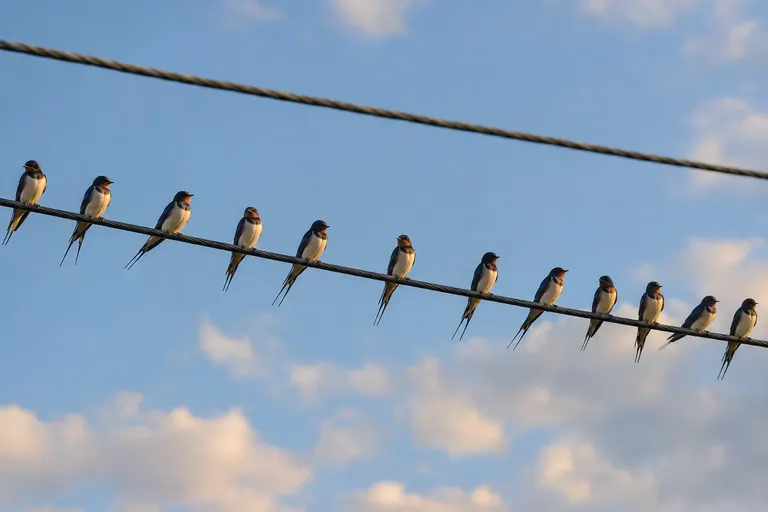
| Barn Swallow | about 1.1 billion | Breeds across the Northern Hemisphere, winters across the Southern Hemisphere |
What about the Red-billed Quelea?
Many books and museums name the Red-billed Quelea, a small finch-like weaver of sub-Saharan Africa, as the most abundant wild bird, often with estimates of around 1.5 billion breeding adults. Quelea flocks can contain millions of birds and take minutes to pass overhead. Its lower ranking in some datasets likely reflects the smaller amount of observation data from much of Africa, not a real shortage of birds. It is fair to say the quelea is one of the most abundant wild birds on Earth, alongside the four in the table.
The Ring-billed Gull surprised many people
The Ring-billed Gull’s estimate raised eyebrows, and it is one of the numbers critics questioned. Gulls are large, pale, noisy and gather in open places such as parking lots, beaches and landfills, so they are reported very often. That makes them a good example of how easy detection can inflate an estimate if the correction is not perfect.
Common birds you probably know
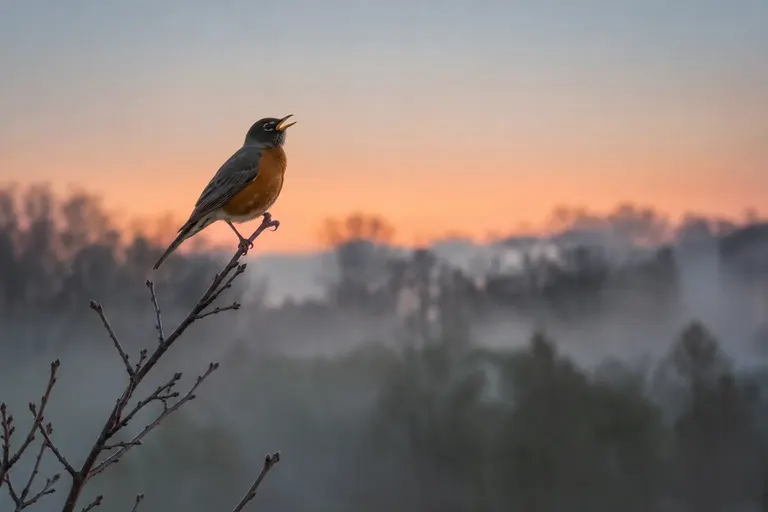
Beyond the billion club, many familiar species number in the hundreds of millions. Species such as the American Robin, Red-winged Blackbird, Mourning Dove, Eurasian Tree Sparrow, Common Chaffinch and Rock Pigeon are all estimated in the hundreds of millions. These are the birds that dominate city parks, farmland and backyards in their regions, and they help explain why a few species account for such a large share of all birds.
How many bird species are there, and how many are rare?
The world’s main checklists recognize about 11,000 living bird species. The International Ornithological Congress (IOC) list and the Clements Checklist, which eBird follows, differ by a few hundred because taxonomists disagree about whether some populations are separate species or subspecies. Genetic studies keep splitting familiar birds into two or more species, so the total creeps upward over time.
The 2021 study found that roughly 1,180 species, about 12 percent, were estimated to have fewer than 5,000 individuals. Many of these live on single islands, isolated mountains or small patches of forest. Examples of birds with very small wild populations include the Kakapo of New Zealand, a flightless parrot that numbered only a few hundred birds after decades of intensive conservation, and the California Condor, which fell to 27 individuals in the 1980s before a captive breeding program began rebuilding it.
Rare does not always mean endangered
Some species are naturally scarce because they live in a tiny range, such as a single volcanic island, yet they may be stable for now. Others are rare because humans made them rare. Conservation status, set by the IUCN Red List, combines population size, trend and range, not just a raw count.
Where do the most birds live?
Numbers and diversity are two different things. The tropics hold the greatest variety of species. Colombia, Peru, Brazil and Ecuador each have more than 1,600 bird species, far more than the United States and Canada combined. But large numbers of individuals often build up in less diverse places with abundant seasonal food.
- Northern forests. The boreal forest across Canada, Alaska, Scandinavia and Russia is sometimes called a bird nursery. Billions of warblers, sparrows, thrushes and flycatchers breed there each summer, then migrate south.
- Farmland and cities. Species that live alongside people, such as House Sparrows, starlings, pigeons and some doves, reach enormous numbers in human landscapes.
- Seas and coasts. Seabird colonies can hold hundreds of thousands to millions of birds on a few rocky islands. Shearwaters and petrels breed in vast numbers on remote islands in every ocean.
- African savannas. Queleas, weavers and other seed-eating birds can gather in flocks of astonishing size where grass seed is abundant.
How migration changes local counts
At any single place, bird numbers swing dramatically through the year. After breeding season, populations are at their peak because the year’s young have joined the adults. Then migration, winter and predators reduce them again before the next spring. Radar studies in the United States have estimated that several billion birds pass over the country during fall migration, far more than in spring, because so many young birds are making their first trip.
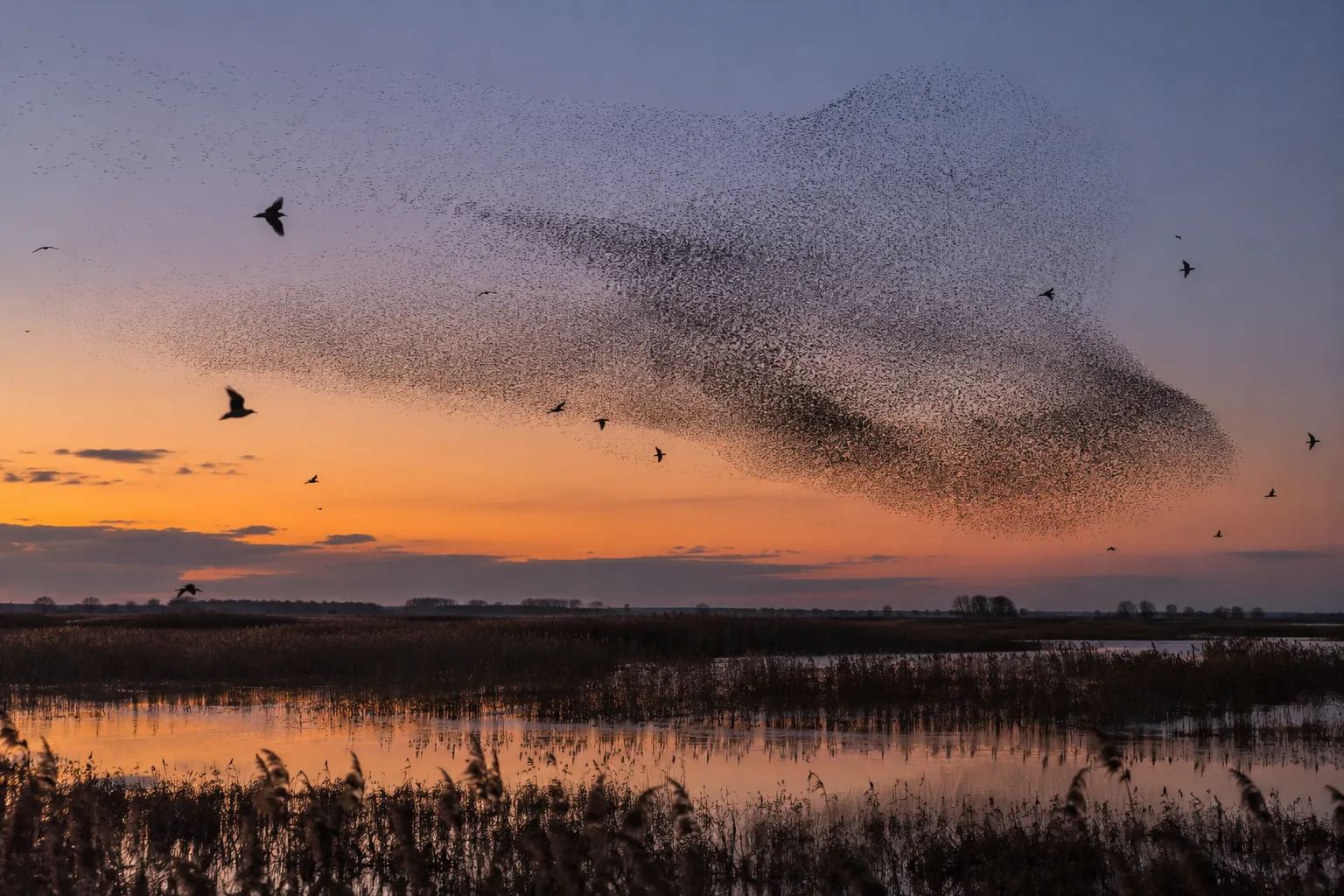
If you have ever watched a starling flock twist over a marsh, you have seen one way birds concentrate in winter. Our explainers on why birds flock together and what a murmuration is cover the science of those gatherings.

Are there more chickens than wild birds?
Domestic chickens are the most numerous bird of all by many measures. Agricultural statistics suggest that tens of billions of chickens are alive at any moment, and many more are raised and slaughtered each year because meat chickens live only a few weeks.
The difference is even clearer by weight. A widely cited 2018 study in PNAS by Yinon Bar-On, Rob Phillips and Ron Milo estimated the total biomass of life on Earth. It found that domestic poultry outweigh all wild birds combined by roughly three to one. In other words, most of the bird flesh on the planet belongs to farmed birds, not wild ones.
This matters because headlines sometimes mix the two. When you read about “how many birds there are,” check whether the figure includes poultry. The 50 billion estimate covers wild birds only.
Is the number of birds in the world going down?
In many regions, yes, and the declines are large enough to be measured with confidence.
- North America. A 2019 study in Science led by Kenneth Rosenberg estimated a net loss of about 3 billion breeding birds since 1970, roughly 29 percent. Most of the loss came from common, widespread species such as sparrows, blackbirds, warblers and finches, not only from rare ones.
- Europe. Long-term monitoring coordinated across many countries shows that farmland birds such as the Eurasian Skylark, Grey Partridge and Eurasian Tree Sparrow have declined steeply since the 1980s.
- Grassland and aerial insect eaters are among the hardest hit on several continents, including swallows, swifts and nightjars.
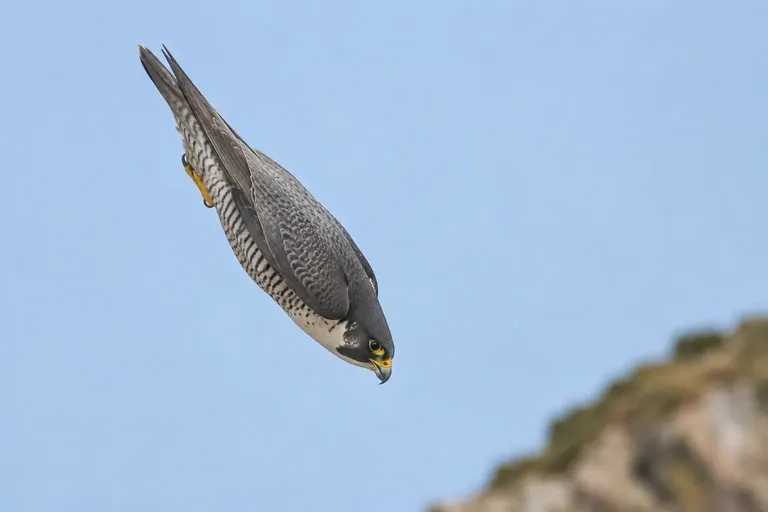
Not every trend is negative. Many ducks and geese in North America increased thanks to wetland protection, and raptors such as the Peregrine Falcon and Bald Eagle recovered after DDT was banned. These successes show that populations can rebound when the causes of decline are addressed.
The main pressures are habitat loss, farming intensification, pesticides and fewer insects, collisions with glass and structures, predation by outdoor cats and climate change. Our article on why bird populations are declining goes through the evidence for each.
Myths and facts about global bird numbers
Myth: “There are hundreds of billions of birds”
Fact: That was the best available estimate in the 1990s, and it is still quoted. The more data-driven 2021 estimate is about 50 billion. The true figure is uncertain, but most current work points to tens of billions rather than hundreds.
Myth: “Common birds are safe”
Fact: Losing a small share of a huge population means losing a lot of birds. Much of North America’s loss since 1970 came from common species. Being common today does not guarantee being common in 50 years.
Myth: “Pigeons are the most common bird”
Fact: Rock Pigeons are abundant in cities worldwide, but global estimates place them well below the House Sparrow and European Starling. They simply concentrate where people notice them.
Myth: “Someone counted them”
Fact: Every global total is a model built on samples. It is closer to estimating a crowd from aerial photos than to counting tickets at the gate.
What does this mean for backyard birders?
The numbers can feel abstract, but they connect directly to your yard.
- Your checklists count, literally. Global estimates depend on volunteer data. Submitting sightings to eBird, Project FeederWatch or national schemes such as the BTO’s Garden BirdWatch in the United Kingdom adds to the dataset that scientists use.
- Common birds deserve attention. Sparrows, starlings and finches may seem ordinary, but they are the bulk of the world’s birds, and declines in them add up to billions.
- Safety fixes have large effects. Collisions with windows and predation by cats each kill very large numbers of birds every year. Treating glass with visible patterns and keeping cats indoors are two of the most effective things a homeowner can do. See our guides to preventing window collisions and keeping cats and birds apart.
- Habitat beats handouts. Feeders help individual birds, but native plants, insects and shelter support whole populations. Our overview of backyard birding covers how to make a yard more useful to birds year-round.
How many birds visit a typical feeder?
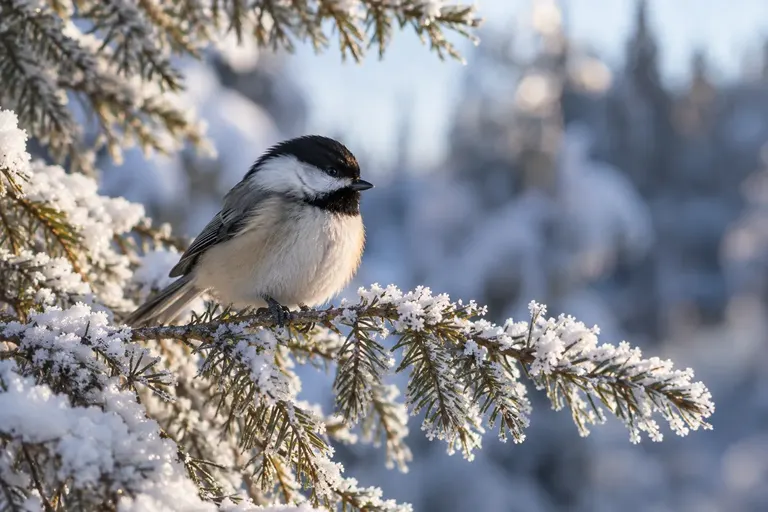
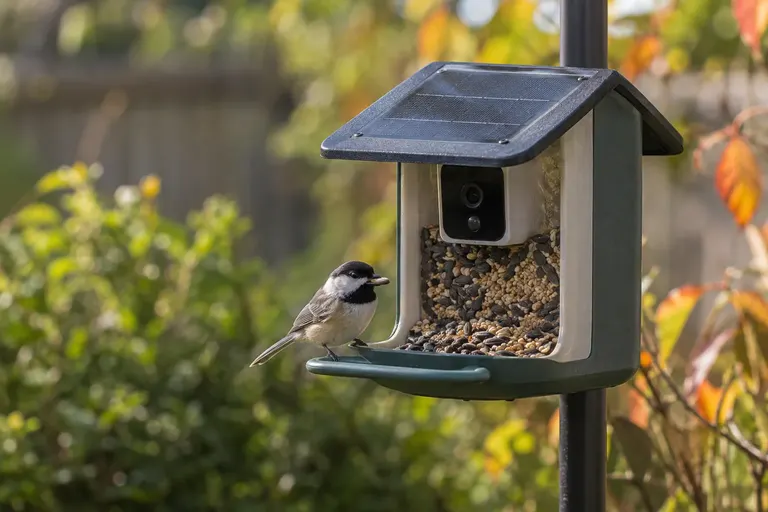
Far more than you might think. Banding studies at busy winter feeders have repeatedly found that the number of individual birds using a feeder over a season is several times higher than the number you see at any one moment. A feeder that seems to host a dozen chickadees may be serving many more, arriving in rotation throughout the day. Most small songbirds also live only a few years, so the individuals turn over quickly, a topic covered in our guide to how long backyard birds live.
How will future counts get better?
Several developments should narrow the uncertainty over the next decade.
- More observers in under-sampled regions. eBird and similar platforms are growing quickly in Africa, Asia and South America, where data gaps are largest.
- Sound recording. Automated recorders and machine-learning tools can detect birds by song across large areas, including shy species that observers rarely see.
- Weather radar. Radar networks in North America and Europe can estimate the mass of migrating birds on a given night, and those estimates can be checked against ground counts.
- Better models. Each round of criticism and response improves the statistics used to correct for detectability.
Scientists will likely keep revising the total, perhaps upward if tropical birds are better counted, perhaps downward if declines continue. The key point for now is not the exact figure but the pattern: a few superabundant species, many scarce ones and clear declines in many regions.
Quick facts
- The best recent estimate is roughly 50 billion wild birds.
- There are about 11,000 living bird species.
- House Sparrow, European Starling, Ring-billed Gull and Barn Swallow each topped a billion in the 2021 estimate.
- The Red-billed Quelea is often cited at around 1.5 billion adults.
- About 12 percent of species may have fewer than 5,000 individuals.
- Domestic poultry outweigh all wild birds combined by roughly three to one.
- North America has lost about 3 billion breeding birds since 1970.
- Your eBird checklists feed directly into estimates like these.
Sources
- Callaghan, C. T., Nakagawa, S., and Cornwell, W. K. (2021). Global abundance estimates for 9,700 bird species. PNAS. https://doi.org/10.1073/pnas.2023170118
- Rosenberg, K. V., et al. (2019). Decline of the North American avifauna. Science. https://doi.org/10.1126/science.aaw1313
- Bar-On, Y. M., Phillips, R., and Milo, R. (2018). The biomass distribution on Earth. PNAS. https://doi.org/10.1073/pnas.1711842115
- Cornell Lab of Ornithology, House Sparrow species account. https://www.allaboutbirds.org/guide/House_Sparrow/overview
- eBird, Cornell Lab of Ornithology. https://ebird.org
Frequently asked questions
How many birds are there in the world right now?
The most widely cited recent estimate, published in 2021 in the journal PNAS, puts the number of wild birds at roughly 50 billion adult individuals. The authors gave a wide uncertainty range, and other scientists have argued that some species were overestimated or underestimated. A fair summary is tens of billions of wild birds, with 50 billion as a reasonable central figure.
What is the most common bird in the world?
Among wild birds, the 2021 global estimate ranked the House Sparrow first, at roughly 1.6 billion individuals, followed by the European Starling, Ring-billed Gull and Barn Swallow, each estimated at over a billion. The Red-billed Quelea of Africa is often cited as the most numerous wild bird, with estimates around 1.5 billion or more. Counting domestic birds, the chicken outnumbers them all.
How many bird species are there?
Roughly 11,000 living bird species are recognized by the major world checklists, such as the IOC World Bird List and the Clements Checklist used by eBird. The exact total differs slightly between lists because taxonomists disagree about where to split one species into two. New species are still described most years, often from tropical forests or through genetic studies.
Are there more chickens than wild birds?
Not in raw numbers, but it is closer than most people expect. Tens of billions of chickens are alive at any time, compared with roughly 50 billion wild birds. By weight, domestic poultry clearly win: a 2018 study of global biomass estimated that poultry outweigh all wild birds combined by roughly three to one.
Is the number of birds going down?
In many regions, yes. A 2019 study in Science estimated that North America has about 3 billion fewer breeding birds than in 1970, a drop of roughly 29 percent. Long-term monitoring in Europe also shows steep declines in farmland birds. Some groups, such as many waterfowl and raptors, have increased thanks to conservation.